

DeepRails
DeepRails delivers precise AI guardrails to detect and rectify LLM hallucinations in real-time, ensuring quality output.
tool Details
About DeepRails
DeepRails is an innovative AI reliability and guardrails platform designed specifically for development teams focused on deploying trustworthy, production-grade AI systems. As large language models (LLMs) integrate more deeply into real-world applications, the risk of hallucinations and erroneous outputs has emerged as a critical barrier to widespread adoption. DeepRails tackles this challenge head-on by providing a comprehensive suite that not only detects these issues but also offers substantial remediation solutions. Serving as a crucial quality control layer, the platform evaluates AI outputs on various dimensions, including factual accuracy, grounding in source material, and reasoning consistency. This enables engineering teams to differentiate between critical factual errors and acceptable model variance with remarkable precision. DeepRails is model-agnostic and ready for production, seamlessly integrating with leading LLM providers and contemporary development pipelines. Its primary value proposition lies in moving beyond basic monitoring to offer automated remediation workflows, customizable evaluation metrics aligned with specific business goals, and human-in-the-loop feedback systems that support continuous model improvement. The platform is specifically tailored for AI engineers and developers who need granular control, robust auditing capabilities, and the assurance to scale AI features without sacrificing reliability or accuracy.
Features
Ultra-Accurate Hallucination Detection
DeepRails employs advanced algorithms to identify hallucinations within LLM outputs, ensuring that erroneous information does not reach end-users. This feature is integral for maintaining the integrity of AI-driven applications, particularly in sensitive domains like healthcare and finance.
Automated Remediation Workflows
With built-in automated remediation capabilities, DeepRails allows developers to address quality issues dynamically. Utilizing features like FixIt and ReGen, the platform can correct errors in real-time before they impact customers, significantly enhancing the reliability of AI outputs.
Comprehensive Analytics Console
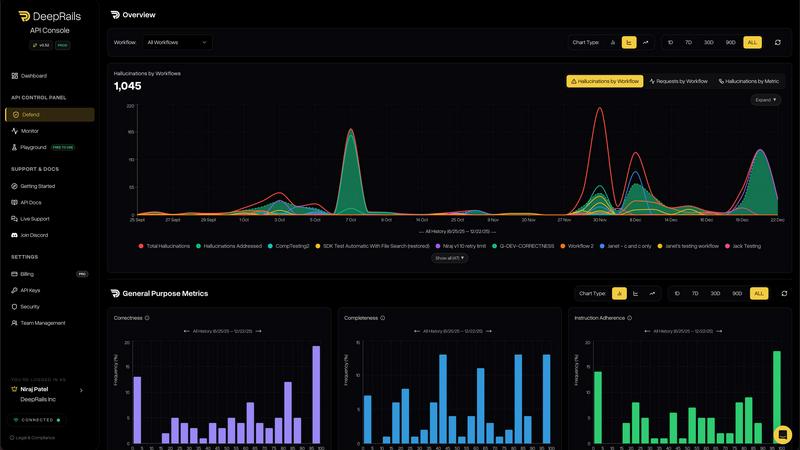
The DeepRails Console provides a user-friendly interface for tracking performance metrics, improvement chains, and detailed audit logs. This analytics feature enables teams to drill down into every interaction, providing transparency and insights into the effectiveness of AI deployments.
Expansive Library of Guardrail Metrics
DeepRails offers an extensive library of customizable guardrail metrics to evaluate AI outputs. Teams can select from general-purpose metrics or design custom metrics tailored to their specific domains, allowing for precise detection of hallucinations and other quality concerns with granular scoring.
Use Cases
Legal Document Verification
Legal professionals can utilize DeepRails to ensure the accuracy of citations and claims in AI-generated documents. By verifying outputs against established legal standards, DeepRails helps mitigate the risks associated with misinformation in legal contexts.
Financial Advisory Services
In the finance sector, DeepRails assists institutions in evaluating the accuracy of AI-generated financial advice. By ensuring that recommendations are factually correct and grounded in reliable data, organizations can maintain trust with their clients.
Healthcare Decision Support
Healthcare applications powered by AI can leverage DeepRails to enhance the reliability of clinical decision support systems. By verifying drug interactions and treatment recommendations, DeepRails plays a crucial role in safeguarding patient welfare.
Educational Tools
Educational platforms using AI can benefit from DeepRails by ensuring that generated content adheres to factual accuracy and instructional guidelines. This is essential for maintaining the quality of educational resources provided to learners.
Frequently Asked Questions
What types of AI systems can DeepRails integrate with?
DeepRails is designed to be model-agnostic, meaning it can seamlessly integrate with a wide range of AI systems and leading LLM providers. This flexibility allows teams to deploy DeepRails across various applications without being limited to a specific model.
How does DeepRails ensure continuous improvement of AI models?
DeepRails incorporates human-in-the-loop feedback systems, which facilitate ongoing model refinement. This feature allows developers and AI engineers to provide direct feedback on outputs, driving continuous learning and adaptation of AI models.
Can I customize the guardrail metrics?
Yes, DeepRails offers an expansive library of guardrail metrics that can be tailored to specific business needs. Users can select from existing metrics or create custom ones to meet the unique requirements of their domain.
What kind of analytics does the DeepRails Console provide?
The DeepRails Console delivers comprehensive analytics, including performance metrics, improvement chains, and detailed audit logs. This enables teams to monitor their AI outputs effectively, ensuring transparency and accountability in the deployment process.