

ninthsystemsagents
Ninth Systems Agents creates custom AI agents that automate business tasks with governance, enhancing efficiency and.

About ninthsystemsagents
Ninth Systems Agents is a pioneering provider of autonomous AI agents specifically designed for real-world business automation. Unlike traditional chatbots that merely respond to user inquiries, Ninth Systems Agents create intelligent systems capable of comprehending context, making informed decisions, and executing complex, multi-step tasks within a company’s existing infrastructure. This solution is ideal for businesses aiming to enhance their operational efficiency, minimize labor costs, and streamline hiring processes through the automation of intricate workflows. The company offers a comprehensive service that includes initial workflow analysis, the selection of appropriate models and tools, development with robust enterprise guardrails, and ongoing performance tuning against key business metrics such as cost per ticket, average handle time (AHT), and customer satisfaction (CSAT). By leveraging advanced architectures like MCP, A2A, RAG, and CAG, Ninth Systems Agents enables autonomous operation, teamwork, and continuous learning from specific organizational data, thus functioning as scalable digital employees integrated with a business’s CRM, help desk, documentation, and internal APIs.
Features
Custom AI Agent Development
Ninth Systems Agents specializes in creating tailored AI agents for business operations, converting runbooks into governed workflows that execute seamlessly across various systems, ensuring compliance and traceability.
Integrated Approval Mechanism
The platform incorporates a built-in approval system that allows critical actions to be validated by human operators before execution, thus maintaining governance and compliance throughout all automated processes.
Real-Time Audit Logging
Each action performed by the AI agents is captured in an audit log, providing full visibility and traceability for governance teams. This feature ensures that all workflows are compliant and can be reviewed at any time.
Multi-Channel Workflow Execution
Ninth Systems Agents can manage workflows across multiple business applications, including CRM, support systems, and analytics platforms, providing businesses with a unified automation experience that enhances operational efficiency.
Use Cases
Operations Management
Ninth Systems Agents automate routine operational tasks, streamlining processes and reducing bottlenecks. By standardizing runbooks, businesses can achieve faster task completion and lower operational costs.
Customer Support Automation
Customer support teams can leverage AI agents to automate triage, escalation, and follow-ups, significantly improving response times and customer satisfaction while maintaining necessary approval and quality checks.
Revenue Operations Enhancement
RevOps and data teams benefit from ongoing AI-driven maintenance of CRM and analytics systems, ensuring data integrity, accuracy, and actionable insights while minimizing manual data corrections.
Compliance and Governance Assurance
With built-in audit logs and human approval mechanisms, Ninth Systems Agents ensure that all automated actions adhere to company policies and compliance requirements, thus safeguarding organizational governance.
Frequently Asked Questions
How do Ninth Systems Agents differ from traditional chatbots?
Ninth Systems Agents go beyond simple question-answering capabilities by executing complex workflows, making decisions, and coordinating tasks across multiple systems, thereby offering a more comprehensive automation solution.
What types of businesses can benefit from Ninth Systems Agents?
Any organization looking to improve operational efficiency, reduce costs, and automate complex workflows can benefit from Ninth Systems Agents, particularly those in customer support, operations, and revenue operations.
What measures are in place to ensure compliance and governance?
Ninth Systems Agents incorporate a robust approval mechanism and real-time audit logging for every action taken, ensuring that all automated processes comply with organizational policies and can be easily audited.
How does the AI learning process work?
Ninth Systems Agents utilize advanced learning architectures that enable the AI to continuously learn from company-specific data, improving decision-making and operational efficiency over time as it adapts to evolving business needs.
Similar to ninthsystemsagents
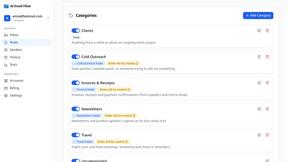
AI Email Filter
AI Email Filter sorts incoming mail into folders using plain-language prompts you write. Works with any IMAP mailbox; bring your own LLM if you want.
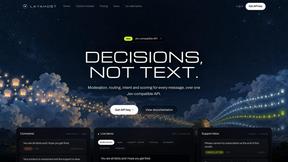
layahost
Moderation, routing, intent and scoring for any text over one Jev-compatible API, hosted in the EU.


MetaMuse
MetaMuse video generator and image generator for real creative workflows

Hailuo AI
Create Hailuo AI videos from text or images with guided prompts, motion and camera controls, flexible settings, and downloadable results.
