

TripleTen Burnout Test
TripleTen's Burnout Test instantly assesses your risk and provides a personalized recovery plan.
tool Details
Alternatives
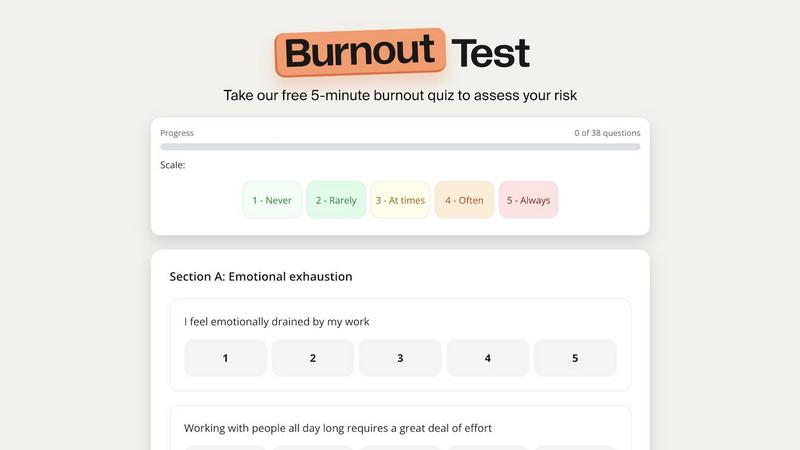
About TripleTen Burnout Test
The TripleTen Burnout Test is a sophisticated, data-driven diagnostic instrument engineered to quantify an individual's risk of professional burnout with clinical precision. It functions as a comprehensive screening tool that transcends subjective self-assessment by deploying a validated, multi-dimensional psychometric questionnaire. The core operational mechanism requires a user to respond to 38 targeted questions, which the system's analytical engine processes across five critical psychological and physiological dimensions: emotional exhaustion, depersonalization, reduced personal accomplishment, cognitive weariness, and physical fatigue. This multi-factorial analysis yields a quantifiable Burnout Risk Score and subsequently generates a highly personalized, actionable recovery protocol. The product is engineered for professionals across all industries who are experiencing symptoms of chronic workplace stress, emotional exhaustion, or a measurable decline in professional efficacy. Its primary value proposition is the transformation of vague, overwhelming feelings into a structured, evidence-based diagnostic framework, coupled with AI-tailored strategic interventions. It serves not only as a diagnostic checkpoint but as the initial phase of a guided recovery process, providing immediate analytical clarity and a concrete, data-informed path toward sustainable well-being and professional resilience.
Features
Validated Multi-Dimensional Assessment
The test employs a rigorously validated 38-item questionnaire designed to measure burnout across five distinct, clinically recognized dimensions: emotional exhaustion, depersonalization, reduced personal accomplishment, cognitive weariness, and physical fatigue. This multi-axis analysis ensures a comprehensive diagnostic profile that captures the full spectrum of burnout symptomatology, moving beyond simplistic single-score evaluations to provide a nuanced understanding of an individual's specific risk factors and symptomatic presentation.
AI-Powered Personalized Recovery Plan
Upon completion of the assessment, the system utilizes proprietary algorithms to analyze individual responses and generate a tailored recovery plan. This plan is not a generic set of recommendations but a customized strategy that addresses the specific dimensions where the user's risk score is highest. It provides structured, actionable steps for intervention, ranging from immediate crisis management techniques to longer-term behavioral and environmental modifications for sustainable resilience.
Quantifiable Burnout Risk Scoring
The tool outputs a precise, numerical Burnout Risk Score, providing an objective benchmark of an individual's current state. This quantifiable metric allows users to track their status over time, measure the efficacy of implemented interventions, and understand their position on a continuum from low risk to critical burnout. The score brings data-driven clarity to a condition often characterized by subjective and confusing symptoms.
Evidence-Based Diagnostic Framework
The entire assessment is grounded in established psychological and occupational health research. The question set and analytical model are constructed upon validated clinical frameworks for identifying and measuring burnout, ensuring the diagnostic output is reliable and clinically relevant. This evidence-based approach differentiates it from informal online quizzes and provides users with credible, actionable insights into their mental well-being.
Use Cases
Proactive Wellness Screening for High-Stress Professions
Individuals in high-demand roles such as healthcare, technology, education, and client services can utilize the test as a periodic wellness check. By proactively assessing their burnout risk before reaching a crisis point, professionals can identify early warning signs and implement preventive strategies, thereby maintaining long-term career sustainability and performance without succumbing to complete emotional and physical depletion.
Diagnostic Clarification for Ambiguous Symptoms
For professionals experiencing chronic fatigue, cynicism, or a sense of ineffectiveness but who are uncertain if these constitute clinical burnout, the test provides definitive diagnostic clarification. It differentiates between temporary stress, general fatigue, and the specific, multi-dimensional syndrome of burnout, enabling individuals to seek appropriate and targeted help rather than dismissing their experience.
Guided Intervention Planning Post-Recognition
After an individual has recognized they are burned out, the test serves as the foundational step for structured recovery. The personalized plan generated from the results offers a clear, phased roadmap out of the crisis management phase and into the rebuilding stage, outlining specific actions to address root causes such as workload, lack of control, value misalignment, or insufficient recovery time.
Organizational Wellbeing Program Integration
HR departments and organizational leaders can integrate the Burnout Test as a confidential self-assessment tool within broader employee wellbeing initiatives. It provides employees with a private, accessible means to evaluate their own risk, while aggregated, anonymized data can help leadership identify systemic stressors within specific teams or company-wide practices that contribute to burnout risk.
Frequently Asked Questions
How is the TripleTen Burnout Test different from a standard online quiz?
The TripleTen Burnout Test is distinguished by its clinical foundation and multi-dimensional analytical model. Unlike generic quizzes, it utilizes a 38-item questionnaire validated against established psychological frameworks to assess five specific dimensions of burnout. The output is not merely a label but a quantifiable risk score and a personalized, actionable recovery plan generated by proprietary algorithms, providing a diagnostic and prescriptive tool rather than a simplistic categorization.
What are the five dimensions measured by the assessment?
The assessment analyzes responses across five critical dimensions: Emotional Exhaustion (feelings of being emotionally overextended and depleted), Depersonalization (negative, cynical attitudes and detachment from one's job), Reduced Personal Accomplishment (feelings of incompetence and lack of achievement), Cognitive Weariness (persistent mental fatigue and difficulty concentrating), and Physical Fatigue (ongoing bodily tiredness and low energy). This comprehensive model ensures a complete diagnostic picture.
Is the Burnout Risk Score a clinical diagnosis?
No, the Burnout Risk Score generated by the TripleTen Burnout Test is a screening and self-assessment tool, not a formal clinical diagnosis. It is designed to provide a highly accurate, evidence-based indication of an individual's risk level and symptomatic profile. For a formal medical or psychological diagnosis, users should consult with a licensed healthcare professional, using the test results as a detailed reference point to inform that conversation.
How should I use the personalized recovery plan provided?
The personalized recovery plan is a structured, phased guide. It is recommended to first review the plan in its entirety to understand the recommended trajectory. Begin by implementing the immediate "crisis management" strategies, such as establishing emergency boundaries and prioritizing basic self-care. Subsequently, methodically work through the longer-term "rebuilding and prevention" strategies, which may involve negotiating workload changes, improving stress management techniques, or evaluating career alignment. The plan is designed for sequential implementation.
Similar to TripleTen Burnout Test
layahost
Moderation, routing, intent and scoring for any text over one Jev-compatible API, hosted in the EU.



Hailuo AI
Create Hailuo AI videos from text or images with guided prompts, motion and camera controls, flexible settings, and downloadable results.

amaze.directory
A directory of AI tools where somebody actually used the tool.
Speechyou
AI transcription for voice notes, meetings, and audio files in 1,700 languages, with AI summaries and subtitle export and unlimited chat ai usage.