
Agent to Agent Testing Platform vs AI Photo Assistant
Side-by-side comparison to help you choose the right tool.

Agent to Agent Testing Platform
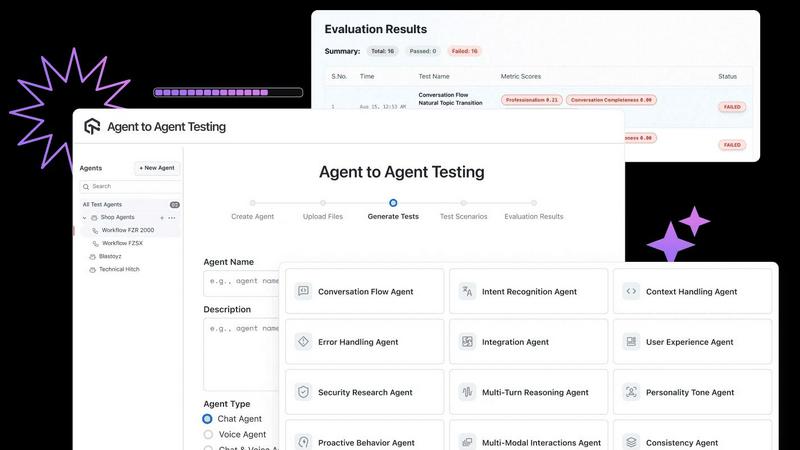
The Agent to Agent Testing Platform validates AI agent behavior across chat, voice, and multimodal systems for security.
Last updated: February 26, 2026

AI Photo Assistant
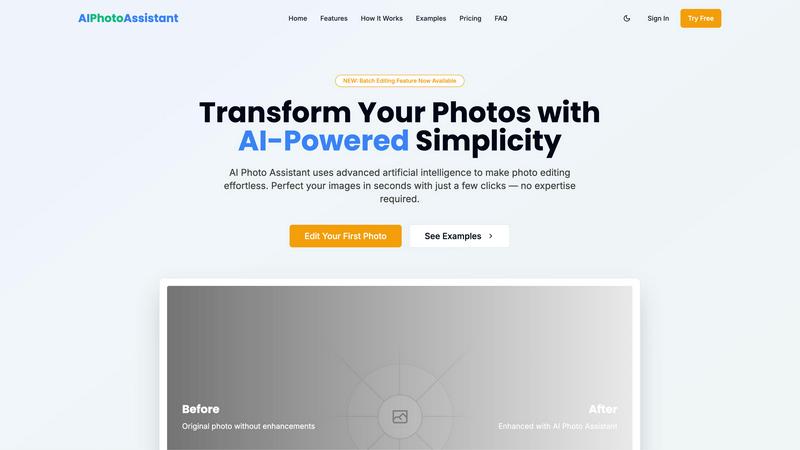
AI Photo Assistant uses advanced AI to automatically enhance photos into professional images instantly.
Last updated: March 1, 2026
Visual Comparison
Agent to Agent Testing Platform
AI Photo Assistant
Feature Comparison
Agent to Agent Testing Platform
Automated Scenario Generation
This feature allows for the automated creation of diverse test cases that simulate real-world interactions for AI agents. By generating scenarios for chat, voice, and hybrid modalities, the platform ensures comprehensive coverage of various interaction possibilities.
True Multi-Modal Understanding
The platform enables users to define detailed requirements or upload Product Requirement Documents (PRDs) that include diverse inputs such as images, audio, and video. This capability allows for a more accurate assessment of how agents respond to a wide range of stimuli reflective of real-world scenarios.
Autonomous Test Scenario Generation
Users can access an extensive library of hundreds of pre-defined scenarios or create custom test scenarios. This flexibility allows organizations to evaluate AI agents based on specific attributes such as personality tone, data privacy compliance, and intent recognition.
Diverse Persona Testing
By leveraging multiple personas, the platform simulates varied end-user behaviors and interactions. This ensures that AI agents are tested for effectiveness across different user types, such as International Callers or Digital Novices, thus facilitating a more comprehensive evaluation.
AI Photo Assistant
Smart Auto-Enhancement
This is the core AI-driven engine that performs a holistic image analysis. Utilizing convolutional neural networks (CNNs), it evaluates compositional elements, lighting conditions, and color data to apply a calibrated set of enhancements. These include dynamic tone mapping for optimal luminance, adaptive contrast adjustment, perceptual saturation boosting, and automatic white balance correction. The adjustments are non-destructive and applied contextually, meaning a portrait receives different optimization than a landscape or product shot, ensuring technically correct and aesthetically pleasing results automatically.
Batch Processing
A functionality designed for operational efficiency, allowing users to upload and process multiple images simultaneously. The system applies a consistent enhancement profile or individually analyzes each photo in the queue using the same AI models as single-file processing. This feature is critical for workflows involving product photo catalogs, event photography, or social media content batches, enabling the enhancement of dozens or hundreds of images with a single command, significantly reducing manual effort and turnaround time.
Portrait-Specific Optimization
A specialized feature set that activates when the AI detects human subjects. It employs facial recognition and segmentation models to apply targeted enhancements. These include subtle skin tone smoothing, selective exposure adjustment on faces, intelligent teeth whitening, and eye sharpening and brightening. The algorithms are trained to avoid an artificial "over-edited" look, preserving natural textures and details while correcting common photographic flaws typical in portrait and selfie photography.
Advanced Export & Resolution Options
The platform provides tiered output control based on user subscription. Exports can be rendered in Standard Definition (SD), High Definition (HD), or maximum available resolution, preserving all enhanced details. The processing pipeline includes optimized compression algorithms to maintain visual fidelity. Furthermore, integrated sharing capabilities allow for direct export to cloud storage links or social media platforms, streamlining the final step of the editing workflow.
Use Cases
Agent to Agent Testing Platform
Quality Assurance for Enterprises
Enterprises deploying AI agents can utilize the platform to ensure that their agents perform reliably and meet business standards before rollout. This is crucial for maintaining customer satisfaction and safeguarding brand reputation.
Enhancing User Experience
The platform allows organizations to assess how AI agents interact with users across different modalities. By testing under various scenarios, businesses can refine agent responses, leading to improved user interaction and satisfaction.
Compliance and Risk Management
With built-in validation for policy violations and escalation logic, the platform helps organizations ensure their AI agents comply with regulatory standards. This is particularly vital for industries with stringent compliance requirements, such as finance and healthcare.
Performance Optimization
The platform enables regression testing, providing insights into potential areas of concern. This helps organizations prioritize critical issues and optimize their testing efforts, ensuring that AI agents continuously improve in their performance.
AI Photo Assistant
E-commerce Product Catalog Management
Small to medium-sized business owners can utilize the batch processing and auto-enhancement features to standardize their product imagery. The AI consistently applies optimal lighting, color accuracy, and sharpness across hundreds of product photos, creating a professional and cohesive online storefront without the cost of a professional photographer or editor for every shoot. This ensures products are presented in the best light, potentially increasing conversion rates.
Social Media Content Creation
Content creators, influencers, and digital marketers operating on tight schedules can leverage the one-click enhancement to rapidly prepare photos for publication. The AI's ability to perfect images in seconds allows for maintaining a consistent, high-quality aesthetic across Instagram, Facebook, and other visual platforms. This enables a faster content turnaround, allowing creators to focus on strategy and engagement rather than manual editing tasks.
Personal Photography Enhancement
General consumers with archives of personal photos from events, vacations, or daily life can use the platform to salvage underexposed, poorly colored, or compositionally weak images. The AI automatically corrects these issues, transforming casual snapshots into share-worthy photographs. This use case eliminates the need to learn complex software, making professional-grade correction accessible for personal memories and family albums.
Marketing & Advertising Asset Preparation
Marketing professionals and agencies handling large volumes of visual assets for campaigns can implement AI Photo Assistant for initial optimization and standardization. Before final manual tweaks or branding application, the AI can ensure all raw photos have a consistent baseline of color grading, exposure, and clarity, streamlining the pre-production phase and reducing the workload on graphic design teams.
Overview
About Agent to Agent Testing Platform
Agent to Agent Testing Platform is an innovative AI-native quality and assurance framework that revolutionizes how AI agents are validated in real-world scenarios. As artificial intelligence systems evolve into more autonomous entities, traditional quality assurance (QA) models that are designed for static software become inadequate. This platform is uniquely designed to engage in comprehensive testing, evaluating full multi-turn conversations across various modalities including chat, voice, and phone interactions. Targeted at enterprises deploying AI agents, this platform ensures that the behavior and performance of these agents are thoroughly vetted before they are rolled out into production environments. By introducing advanced multi-agent test generation using over 17 specialized AI agents, it identifies long-tail failures and edge cases that manual testing often overlooks, providing organizations with the confidence that their AI agents will operate reliably and effectively.
About AI Photo Assistant
AI Photo Assistant is a cloud-based, automated photo editing platform engineered to deliver professional-grade image enhancement through sophisticated artificial intelligence. The system operates on a proprietary technology stack that integrates multiple neural network architectures, machine learning algorithms, and high-performance image processing engines. Its core function is to perform a comprehensive, context-aware analysis of digital photographs and autonomously apply precise adjustments to critical parameters including luminance distribution, contrast ratios, color saturation and balance, white point calibration, and compositional framing. This process requires zero manual input, automating tasks that traditionally demand significant technical skill in software like Adobe Photoshop.
The platform is architected for a broad user base that requires high-quality visual outputs but lacks the time, financial resources, or technical expertise for complex manual editing. This includes social media content creators needing rapid batch processing, e-commerce entrepreneurs and small business owners requiring polished product catalogs, marketing professionals managing large volumes of digital assets, and general consumers seeking to optimize personal photography. The principal value proposition is the democratization of professional photo editing: it delivers consistent, studio-quality results through an intuitive, one-click interface, thereby eliminating the traditional barriers of skill acquisition and time-intensive manual labor. The system's cloud infrastructure ensures scalability and access to continuous AI model improvements without user-side software updates.
Frequently Asked Questions
Agent to Agent Testing Platform FAQ
What types of AI agents can be tested using this platform?
The Agent to Agent Testing Platform supports a variety of AI agents, including chatbots, voice assistants, and phone caller agents, providing a comprehensive testing solution across different modalities.
How does the platform ensure the accuracy of AI agent behavior?
The platform utilizes advanced multi-agent test generation and autonomous synthetic user testing to simulate thousands of production-like interactions, ensuring that AI agent behavior is accurately evaluated under varied real-world conditions.
Can organizations create custom test scenarios?
Yes, organizations can create custom scenarios to evaluate their AI agents based on specific needs or requirements, in addition to accessing a library of hundreds of pre-defined scenarios.
What metrics can be evaluated with this platform?
The platform provides insights on several key metrics, including bias, toxicity, hallucination, effectiveness, empathy, and professionalism, enabling organizations to comprehensively assess their AI agents.
AI Photo Assistant FAQ
What image formats does AI Photo Assistant support?
The platform supports all major raster image formats for input, including JPEG, PNG, WebP, and TIFF. Output formats are typically JPEG and PNG, with the specific options and maximum resolution available dependent on the user's selected subscription plan (Free, Pro, or Unlimited). The system's cloud processors handle format conversion seamlessly during the enhancement pipeline.
How does the AI ensure my photos are not over-processed or look artificial?
The underlying neural networks are trained on vast datasets of professionally edited and aesthetically rated photographs. The models learn to apply enhancements within perceptual boundaries that are considered "natural" by human standards. Furthermore, the adjustments are context-aware; for instance, it applies more aggressive dynamic range correction to a landscape than a portrait, where subtler skin tone preservation is prioritized. The system avoids uniform filters in favor of intelligent, pixel-specific adjustments.
Is there a limit to how many photos I can edit?
Yes, processing limits are defined by your subscription tier. The Free plan allows for the enhancement of up to 5 images per month. The Pro plan increases this limit to 100 photos per month, while the Unlimited plan provides unrestricted processing. All plans utilize the same core AI technology, with differences primarily in volume limits, output resolution, and access to advanced features like batch processing.
How does the Batch Processing feature work?
Users can select multiple image files from their device or connected cloud storage and upload them simultaneously to a processing queue. The AI then analyzes and enhances each photo individually, applying the same intelligent, context-aware adjustments used in single-photo mode. Users can monitor the queue's progress and download the entire enhanced set as a ZIP archive or individually, making it ideal for processing event photos, product shots, or content batches efficiently.
Alternatives
Agent to Agent Testing Platform Alternatives
Agent to Agent Testing Platform is an innovative AI-native quality assurance framework designed specifically for validating the behavior of AI agents across various communication modalities, including chat, voice, and phone systems. Its primary purpose is to detect security and compliance risks that may arise in real-world interactions, particularly as AI systems become more autonomous and complex. Users typically seek alternatives to this platform for reasons such as pricing considerations, specific feature requirements, or compatibility with their existing technology stacks. When choosing an alternative to the Agent to Agent Testing Platform, it's essential to evaluate several key factors. Look for platforms that offer comprehensive multi-turn conversation testing capabilities, robust support for autonomous synthetic user testing, and effective mechanisms for validating AI behavior in real-world scenarios. Additionally, ensure that the alternative can meet your organization's specific needs regarding scalability, traceability, and compliance validation.
AI Photo Assistant Alternatives
AI Photo Assistant is a cloud-based AI photo editing platform within the AI Assistants category. It utilizes neural networks and machine learning to automate professional-grade image enhancement, applying context-aware adjustments to luminance, contrast, color, and composition through a one-click interface. Users may seek alternatives for various reasons, including specific budgetary constraints, the need for different feature sets like advanced manual controls or batch processing capabilities, or platform compatibility requirements such as dedicated desktop software versus mobile-first applications. The search often stems from a need to match a tool's technical specifications more closely to individual or professional workflow demands. When evaluating alternatives, key considerations include the underlying AI model's sophistication for different image types, the granularity of automated versus manual control, output resolution and format support, processing speed, data privacy policies, and integration capabilities with existing creative or asset management ecosystems. The optimal solution balances automated intelligence with the necessary level of user oversight for the intended use case.