Agent to Agent Testing Platform vs DigitalMagicWand
Side-by-side comparison to help you choose the right tool.

Agent to Agent Testing Platform
The Agent to Agent Testing Platform validates AI agent behavior across chat, voice, and multimodal systems for security.
Last updated: February 26, 2026

DigitalMagicWand
DigitalMagicWand is a comprehensive AI suite for generating and manipulating visuals, audio, video, and text with advanced technical precision.
Last updated: March 18, 2026
Visual Comparison
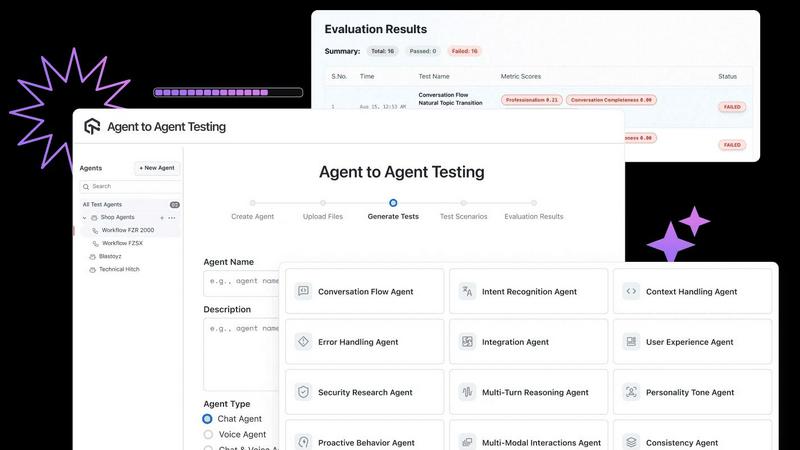
Agent to Agent Testing Platform
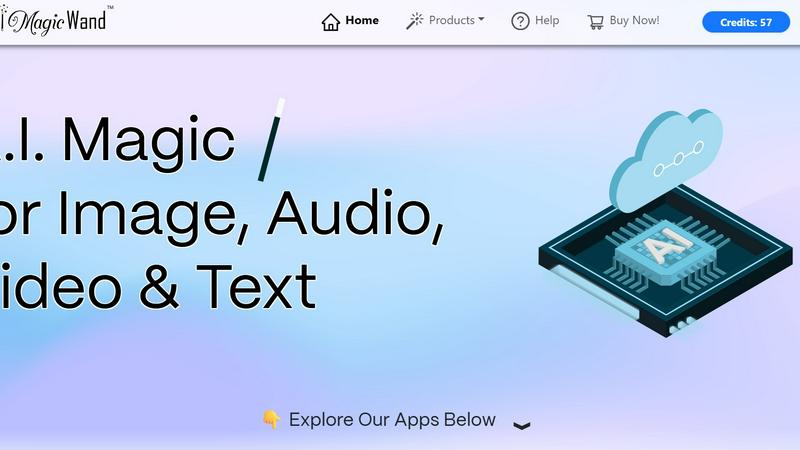
DigitalMagicWand
Feature Comparison
Agent to Agent Testing Platform
Automated Scenario Generation
This feature allows for the automated creation of diverse test cases that simulate real-world interactions for AI agents. By generating scenarios for chat, voice, and hybrid modalities, the platform ensures comprehensive coverage of various interaction possibilities.
True Multi-Modal Understanding
The platform enables users to define detailed requirements or upload Product Requirement Documents (PRDs) that include diverse inputs such as images, audio, and video. This capability allows for a more accurate assessment of how agents respond to a wide range of stimuli reflective of real-world scenarios.
Autonomous Test Scenario Generation
Users can access an extensive library of hundreds of pre-defined scenarios or create custom test scenarios. This flexibility allows organizations to evaluate AI agents based on specific attributes such as personality tone, data privacy compliance, and intent recognition.
Diverse Persona Testing
By leveraging multiple personas, the platform simulates varied end-user behaviors and interactions. This ensures that AI agents are tested for effectiveness across different user types, such as International Callers or Digital Novices, thus facilitating a more comprehensive evaluation.
DigitalMagicWand
Multi-Modal AI Processing Suite
The platform integrates distinct, specialized AI engines for text, audio, and image processing within a single interface. This includes a statistical pattern analysis engine for text humanization, a spectral analysis and machine learning model for audio stem separation and MIDI conversion, and a diffusion-based model for text-to-image and vector graphic generation. This architectural approach allows for optimized performance per task while maintaining a consistent user experience and centralized asset management across different content creation workflows.
Proprietary AI Detection and Humanization
DigitalMagicWand features a dual-system for text analysis. Its AI Detector utilizes a deep learning model trained on vast datasets of human and machine-generated text (including outputs from GPT, Claude, and Gemini) to provide a quantifiable confidence score for AI authorship. Complementing this, the Undetectable AI Humanizer employs proprietary linguistic algorithms that deconstruct AI-generated text, identifying and restructuring statistical patterns, syntactic predictability, and lexical choices to replicate the nuanced irregularities of authentic human writing without altering the core semantic message.
Studio-Grade Audio Stem Separation
The UnMixIt™ Pro tool provides advanced source separation capabilities using state-of-the-art neural networks. It can deconstruct a mastered stereo audio file into discrete, high-quality stems such as vocals, drums, bass, and other instruments with minimal artifacts. This process utilizes a complex model trained on extensive multi-track recordings to isolate frequency and temporal components, offering musicians and producers clean stems for remixing, sampling, and audio restoration with professional-grade precision.
Context-Aware Generative Image Editing
The AI Image Editor goes beyond simple filters, implementing an inpainting and outpainting diffusion model that understands user intent via text prompts. Users can perform complex, context-aware edits such as object removal, background replacement, or element addition by describing the change. The system analyzes the image's spatial and semantic context to generate new pixels that are photorealistic and coherent with the existing scene's lighting, texture, and perspective, enabling non-destructive, instruction-based manipulation.
Use Cases
Agent to Agent Testing Platform
Quality Assurance for Enterprises
Enterprises deploying AI agents can utilize the platform to ensure that their agents perform reliably and meet business standards before rollout. This is crucial for maintaining customer satisfaction and safeguarding brand reputation.
Enhancing User Experience
The platform allows organizations to assess how AI agents interact with users across different modalities. By testing under various scenarios, businesses can refine agent responses, leading to improved user interaction and satisfaction.
Compliance and Risk Management
With built-in validation for policy violations and escalation logic, the platform helps organizations ensure their AI agents comply with regulatory standards. This is particularly vital for industries with stringent compliance requirements, such as finance and healthcare.
Performance Optimization
The platform enables regression testing, providing insights into potential areas of concern. This helps organizations prioritize critical issues and optimize their testing efforts, ensuring that AI agents continuously improve in their performance.
DigitalMagicWand
Academic Integrity and Content Verification
Educators, publishers, and hiring managers can utilize the Accurate AI Detector to screen submitted documents, research papers, and application materials for machine-generated content. The clear confidence scoring system provides an auditable metric to support decisions regarding content originality, facilitating the maintenance of academic and professional integrity standards without relying on subjective manual review.
Music Production and Audio Post-Production
Musicians and audio engineers can leverage Digital Ear™ Piano to transcribe complex piano recordings into editable MIDI data for scoring, rearrangement, or sound module triggering. Simultaneously, DJs and producers can use UnMixIt™ Pro to isolate acapella vocals or drum tracks from commercial songs to create legal, high-quality samples and remixes, streamlining the creative process in music production and live performance preparation.
Marketing and E-commerce Asset Creation
Marketing teams and online retailers can rapidly generate product visuals and promotional graphics. Using the text-to-image and vector art generators, they can create unique illustrations and logos from descriptive prompts. The AI Image Editor and Background Removal tool allow for the quick creation of clean, consistent product shots on white backgrounds or in custom settings, eliminating the need for costly photoshoots and extensive manual Photoshop work.
Digital Content Restoration and Enhancement
Archivists, photographers, and individuals can restore and enhance legacy media. The platform can be used to colorize black-and-white photos, remove scratches and noise from old scans, upscale low-resolution images, and even separate dialogue from background noise in old audio recordings using the audio isolation tools. This provides a powerful, accessible solution for preserving and improving the quality of historical digital assets.
Overview
About Agent to Agent Testing Platform
Agent to Agent Testing Platform is an innovative AI-native quality and assurance framework that revolutionizes how AI agents are validated in real-world scenarios. As artificial intelligence systems evolve into more autonomous entities, traditional quality assurance (QA) models that are designed for static software become inadequate. This platform is uniquely designed to engage in comprehensive testing, evaluating full multi-turn conversations across various modalities including chat, voice, and phone interactions. Targeted at enterprises deploying AI agents, this platform ensures that the behavior and performance of these agents are thoroughly vetted before they are rolled out into production environments. By introducing advanced multi-agent test generation using over 17 specialized AI agents, it identifies long-tail failures and edge cases that manual testing often overlooks, providing organizations with the confidence that their AI agents will operate reliably and effectively.
About DigitalMagicWand
DigitalMagicWand is a comprehensive, cloud-based platform that provides a unified suite of professional-grade AI tools for processing and creating digital media across four core modalities: text, audio, image, and video. The platform is engineered to serve a diverse user base, including content creators, digital marketers, musicians, audio engineers, graphic designers, educators, and business professionals who require efficient, high-fidelity manipulation of digital assets. Its core value proposition lies in democratizing access to advanced artificial intelligence technology, eliminating the need for deep technical expertise or expensive, specialized software. By integrating multiple AI-powered applications into a single ecosystem, DigitalMagicWand streamlines complex workflows—from detecting AI-generated text and converting audio to MIDI, to generating vector art and performing non-destructive image editing—all through an intuitive, task-oriented interface. The platform leverages proprietary algorithms and cutting-edge models to ensure output quality that meets professional standards, enabling users to enhance, transform, and generate content with unprecedented speed and precision.
Frequently Asked Questions
Agent to Agent Testing Platform FAQ
What types of AI agents can be tested using this platform?
The Agent to Agent Testing Platform supports a variety of AI agents, including chatbots, voice assistants, and phone caller agents, providing a comprehensive testing solution across different modalities.
How does the platform ensure the accuracy of AI agent behavior?
The platform utilizes advanced multi-agent test generation and autonomous synthetic user testing to simulate thousands of production-like interactions, ensuring that AI agent behavior is accurately evaluated under varied real-world conditions.
Can organizations create custom test scenarios?
Yes, organizations can create custom scenarios to evaluate their AI agents based on specific needs or requirements, in addition to accessing a library of hundreds of pre-defined scenarios.
What metrics can be evaluated with this platform?
The platform provides insights on several key metrics, including bias, toxicity, hallucination, effectiveness, empathy, and professionalism, enabling organizations to comprehensively assess their AI agents.
DigitalMagicWand FAQ
How accurate is the AI Detector for Text?
The AI Detector is built on a continuously updated model trained on a vast corpus of text from both human authors and multiple AI models. It provides a percentage-based confidence score indicating the likelihood of AI authorship. Accuracy is statistically high, especially for longer texts, but it should be used as a supportive tool rather than a sole determinant, as no detector can claim 100% infallibility due to the evolving nature of AI writing and human mimicry.
What audio formats are supported for MIDI conversion and stem separation?
The platform supports common lossless and lossy audio formats for input, including WAV, AIFF, MP3, and AAC. For MIDI conversion via Digital Ear™, the output is a standard MIDI file (.mid) compatible with all Digital Audio Workstations (DAWs). For stem separation with UnMixIt™ Pro, outputs are typically delivered as high-quality WAV or MP3 files, providing flexibility for use in professional mixing environments or casual playback.
Can the AI Image Editor handle complex edits like changing a person's pose or clothing?
The AI Image Editor is optimized for context-aware generation and removal based on text prompts and user-defined masks. While it can effectively add, remove, or replace objects and backgrounds, highly specific edits that require altering the fundamental structure of a subject (like a precise change in human pose or intricate clothing redesign) may be beyond its current deterministic capabilities. It excels at semantic edits where the new content can be plausibly inferred from the existing scene context.
Is the humanized text from the AI Humanizer guaranteed to pass all detectors?
While the Undetectable AI Humanizer is engineered using proprietary algorithms to eliminate statistical patterns common to AI generation, no tool can offer an absolute guarantee against all detectors. The landscape of AI detection software is diverse and constantly evolving. The humanizer is designed to significantly reduce detection scores, often to levels indistinguishable from human writing, but its effectiveness should be verified against the specific detector platform of concern by the user.
Alternatives
Agent to Agent Testing Platform Alternatives
Agent to Agent Testing Platform is an innovative AI-native quality assurance framework designed specifically for validating the behavior of AI agents across various communication modalities, including chat, voice, and phone systems. Its primary purpose is to detect security and compliance risks that may arise in real-world interactions, particularly as AI systems become more autonomous and complex. Users typically seek alternatives to this platform for reasons such as pricing considerations, specific feature requirements, or compatibility with their existing technology stacks. When choosing an alternative to the Agent to Agent Testing Platform, it's essential to evaluate several key factors. Look for platforms that offer comprehensive multi-turn conversation testing capabilities, robust support for autonomous synthetic user testing, and effective mechanisms for validating AI behavior in real-world scenarios. Additionally, ensure that the alternative can meet your organization's specific needs regarding scalability, traceability, and compliance validation.
DigitalMagicWand Alternatives
DigitalMagicWand is a comprehensive AI assistant platform specializing in multimodal content processing. It operates within the AI Assistants category, providing a unified suite of tools for generating and manipulating visual, audio, video, and text-based assets through artificial intelligence. Users may seek alternatives for various technical and operational reasons. Common drivers include specific budgetary constraints, the need for different pricing models, or requirements for specialized features not covered in the core suite. Platform compatibility, such as the necessity for dedicated desktop applications versus cloud-based APIs, and particular workflow integrations also influence the search for other solutions. When evaluating alternatives, key technical considerations include the scope of supported media modalities, the underlying AI model specifications for each task, and output quality benchmarks. Additionally, assess the platform's architecture for scalability, available API endpoints for developers, data privacy protocols, and the granularity of control offered over the AI's processing parameters.