APIMCP.dev vs Caller
Side-by-side comparison to help you choose the right tool.

APIMCP.dev
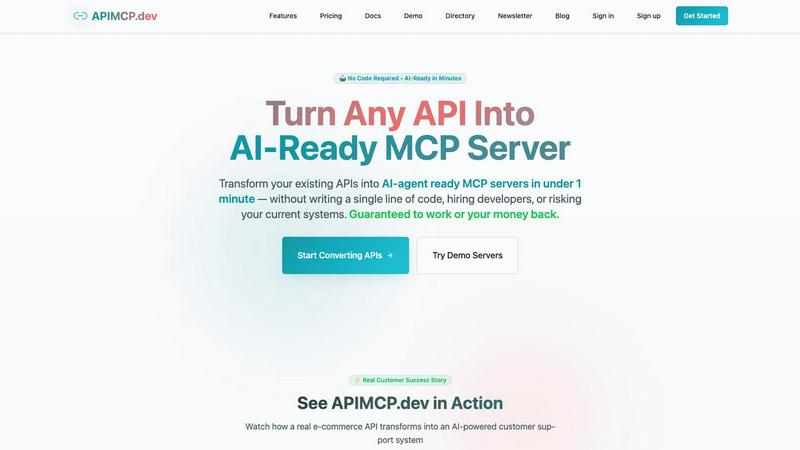
APIMCP.dev instantly transforms any REST API into a production-ready MCP server for AI agents.
Last updated: March 1, 2026

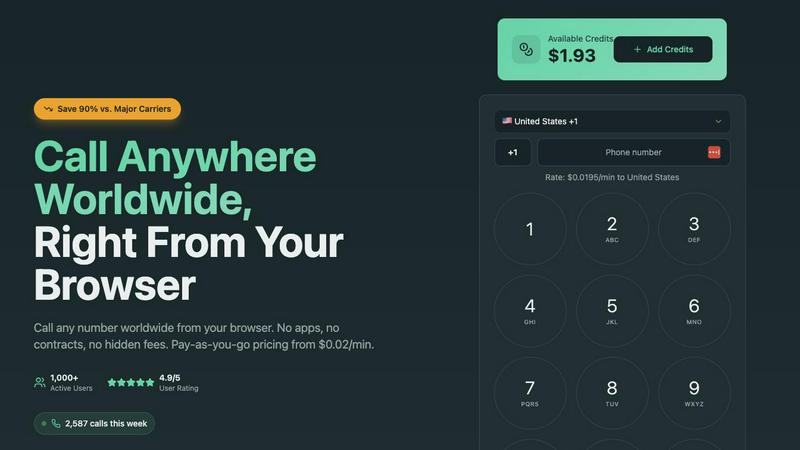
Caller enables secure, pay-as-you-go international calls from any browser at rates from $0.02/min.
Last updated: March 1, 2026
Visual Comparison
APIMCP.dev
Caller
Feature Comparison
APIMCP.dev
Automated OpenAPI to MCP Conversion
The platform's core engine automatically parses a provided OpenAPI specification (Swagger) and intelligently maps REST endpoints, parameters, request bodies, and response schemas into fully compliant MCP tools. It generates accurate tool names, descriptions, and input parameter definitions required for AI agents to understand and correctly invoke the API. This conversion happens in under one minute, transforming weeks of manual development into an instantaneous, code-free process.
Enterprise-Grade Security & Authentication Handling
APIMCP.dev provides built-in, secure handling for various API authentication methods, including API keys, OAuth 2.0, and HTTP Basic Auth. The generated MCP server acts as a secure bridge, meaning sensitive credentials are managed by the platform and are not exposed to the end-user AI agent. This architecture ensures your existing systems remain untouched and secure, maintaining all original access controls and audit trails.
Real-Time Analytics and Performance Monitoring
The platform includes a dashboard for monitoring the usage and performance of your generated MCP servers in real-time. You can track metrics such as the volume of AI agent interactions, endpoint call frequency, system response times, and error rates. This provides operational visibility into how AI agents are utilizing your APIs, enabling performance optimization and informed decision-making.
Guaranteed Uptime and Priority Support
APIMCP.dev guarantees 99.9% uptime for all hosted MCP servers, ensuring reliable availability for AI agent integrations. Subscribers to the Professional Plan receive priority email support for technical assistance. The service is backed by a 30-day money-back guarantee and a specific 60-minute setup guarantee, promising a functional integration or a full refund.
Caller
Browser-Based WebRTC Telephony
Caller operates entirely within a modern web browser using Web Real-Time Communication (WebRTC) protocols, requiring no downloads, plugins, or external software. This architecture enables instant call initiation from any device—desktop, laptop, tablet, or smartphone—with a compatible browser and internet connection. The platform handles all signaling and media processing server-side, abstracting the technical complexity of VoIP configuration from the end-user. This feature ensures maximum accessibility and eliminates platform-specific dependencies, providing a uniform experience across operating systems.
Transparent Pay-As-You-Go Billing
The platform employs a straightforward, consumption-based billing model where users only pay for completed call minutes. Credits are purchased upfront and never expire, with no monthly subscriptions, minimum commitments, or hidden fees. Rates start from $0.01 to $0.02 per minute to numerous destinations, offering cost savings of up to 90% compared to traditional carriers. Real-time usage tracking within the user dashboard provides complete visibility into credit consumption and call history, ensuring financial predictability and control.
Global Direct Dial Coverage
Caller provides direct-dial access to telephone numbers in over 200 countries and territories worldwide, encompassing all major and numerous regional destinations. The platform connects seamlessly to both landline and mobile networks without requiring intermediary access numbers or PIN codes. This feature is powered by a globally distributed network of carrier partnerships and SIP trunks, engineered for low-latency routing to ensure call quality and connection reliability irrespective of the destination.
Dedicated Virtual Phone Numbers
For professional use, Caller offers the capability to purchase dedicated virtual phone numbers for use as outbound caller ID or for receiving calls. Numbers are available in various formats, including local, toll-free, and mobile, from countries such as the United States, United Kingdom, and Canada. These numbers are activated instantly upon purchase and can be managed directly from the web interface, enhancing professional presence and enabling localized business communications without physical presence.
Use Cases
APIMCP.dev
AI-Powered Customer Support Automation
Transform e-commerce or CRM APIs (e.g., Shopify, WooCommerce, Salesforce) into an AI-ready knowledge and action system. Customer support agents or end-users can ask questions like "What's the status of order #12345?" or "Refund the latest purchase for [email protected]." The AI agent, via the MCP server, automatically calls the appropriate GET /api/orders/{id} or POST /api/refunds endpoints, retrieving or executing actions with precise, real-time data without human intervention.
Intelligent Internal Data Querying and Reporting
Enable non-technical team members in finance, marketing, or operations to query complex internal databases and business intelligence systems through natural language. By connecting an internal reporting API, users can ask, "What were Q3 sales figures for the EMEA region?" The AI agent translates this into the correct API call, returning formatted data instantly, democratizing data access and eliminating backlogged requests for custom reports.
Automated Content and Digital Asset Management
Integrate CMS (e.g., WordPress, Contentful) or Digital Asset Management (DAM) system APIs. Content teams can instruct an AI agent to "Find all unpublished blog posts from last month and schedule them for publishing next Tuesday" or "Resize the product images in the 'Summer Collection' folder." The AI executes these multi-step procedures via the MCP server, automating routine content operations.
Streamlined DevOps and Infrastructure Management
Connect DevOps toolchain APIs from providers like AWS, GitHub, or Datadog. Developers and engineers can manage infrastructure using natural language commands within their IDE (like Cursor) or chat interface: "Spin up a new staging environment," "Check the error rate for service X," or "Roll back the last deployment." The MCP server executes these commands safely and accurately, accelerating development workflows.
Caller
International Business Development and Sales
Sales professionals and business developers conducting outbound calls to international prospects can leverage Caller for its cost-effective global rates and professional caller ID options. The ability to present a local or toll-free number increases answer rates, while the pay-as-you-go model aligns costs directly with sales activity. The platform's HD audio quality ensures clear communication during critical negotiations, and its browser-based nature allows for immediate use from any workstation or while traveling.
Remote Team and Distributed Workforce Communication
Companies with remote employees, freelancers, or contractors spread across different countries can utilize Caller for internal and external communication without incurring prohibitive long-distance charges. Team members can call each other or contact local vendors and services in their respective regions directly from their browsers. This eliminates the need for expensed personal mobile plans or complex corporate VoIP setups, streamlining operational overhead.
Personal and Family International Calling
Individuals with family, friends, or contacts abroad can use Caller for affordable personal communication. The service is ideal for frequent, long-duration calls to international mobile and landline numbers, offering significant savings compared to standard mobile carrier international plans. The simple interface and lack of contracts make it accessible for non-technical users, requiring only an internet connection to maintain global personal connections.
Customer Support and Service Outreach
Small to medium-sized businesses providing customer support to an international clientele can deploy Caller for outbound service calls, follow-ups, and technical support. The transparent pricing allows for precise cost allocation per client or department. Support agents can operate the system from any browser, facilitating flexible and remote work arrangements. The option to use a dedicated business number reinforces brand professionalism.
Pricing Comparison
APIMCP.dev
APIMCP.dev offers a simple, transparent pricing model centered on a Professional Plan. Users can start with a full-featured 14-day free trial without requiring a credit card. After the trial, the Professional Plan is available for a one-time payment of $29.90. This plan includes unlimited API conversions, unlimited active MCP servers, guaranteed 99.9% server uptime, enterprise-grade security features, priority email support, and a 30-day money-back guarantee. The service is backed by a specific 60-minute setup guarantee, promising a working integration or your money back.
Caller
Caller operates on a transparent, credit-based pay-as-you-go model. There are no monthly subscriptions, contracts, or minimum spend requirements. Users purchase account credits that never expire and are charged only for completed call minutes. Outbound calling rates start as low as $0.01 to $0.02 per minute to numerous destinations, such as the United States. Dedicated virtual phone numbers for caller ID or inbound purposes are available as a separate add-on, with monthly fees starting from $1.99 for a US local number, $2.50 for a UK toll-free number, and $3.00 for a Canadian mobile number. All pricing is listed transparently on the platform, and users can track their credit usage in real-time.
Overview
About APIMCP.dev
APIMCP.dev is a specialized software platform engineered to bridge the critical gap between existing RESTful API infrastructure and modern AI agent ecosystems. It functions as an automated, high-speed conversion engine that transforms standard OpenAPI specifications into fully operational Model Context Protocol (MCP) servers. This process, which traditionally demands 40 to 80 hours of specialized development work involving protocol understanding, tool definition, and server implementation, is executed by APIMCP.dev in under 60 seconds without requiring any manual coding. The core technical value proposition is enabling seamless, secure, and instantaneous integration of proprietary or third-party APIs with leading AI tools like Anthropic's Claude, OpenAI's ChatGPT, Cursor IDE, and other MCP-compatible agents. The platform is architected for developers, product teams, and enterprises seeking to rapidly augment their operations with AI capabilities without disrupting or modifying their existing backend systems. By completely eliminating the MCP development bottleneck, APIMCP.dev democratizes access to AI-agent functionality, allowing organizations to leverage their substantial existing API investments for intelligent automation, complex data querying, and procedural task execution directly through natural language interfaces.
About Caller
Caller is a sophisticated, browser-based Voice over Internet Protocol (VoIP) telephony platform engineered to facilitate high-quality, cost-effective international voice communications. It functions as a pure web application, eliminating the need for traditional hardware, software installations, SIM cards, or complex carrier contracts. The platform establishes direct, encrypted audio connections between a user's web browser and any global telephone number, including landlines and mobile devices, leveraging enterprise-grade infrastructure for reliability. Its core architectural principle is the elimination of infrastructural complexity, providing instant access to a global telephony network through a simple, intuitive web interface. Caller is architected for a broad user base, including individual consumers, freelancers, digital nomads, remote workers, and businesses of all sizes seeking a streamlined, software-defined communication solution. The value proposition is anchored in a transparent, consumption-based pricing model that operates strictly on a pay-as-you-go basis, with per-minute rates demonstrably lower—up to 90% cheaper—than those of conventional mobile and landline carriers. This combination of technical simplicity, global reach, and economic efficiency positions Caller as a modern alternative to legacy telephony systems.
Frequently Asked Questions
APIMCP.dev FAQ
What is the Model Context Protocol (MCP)?
The Model Context Protocol (MCP) is an open standard that enables AI applications and agents to connect securely to external data sources and tools. It provides a standardized way for AI models to discover, describe, and invoke capabilities provided by servers. APIMCP.dev automates the creation of these standardized servers from your existing OpenAPI specs, making your APIs natively accessible to any MCP-compatible AI agent.
How does authentication work with my existing APIs?
You provide your API authentication details (e.g., API key, OAuth credentials) securely to APIMCP.dev during the setup process. The generated MCP server manages these credentials and automatically includes the necessary authentication headers or tokens in every request it forwards to your backend API. The end-user or AI agent never sees or handles your raw credentials, maintaining security.
Do I need to host the generated MCP server myself?
No. APIMCP.dev provides fully hosted and managed MCP servers as part of its service. You receive a dedicated, secure endpoint URL (e.g., https://mcp.apimcp.dev/userId/your-api) that is always online. This eliminates the need for you to manage server infrastructure, scaling, or MCP protocol updates, ensuring maximum reliability and ease of use.
What happens if my OpenAPI specification changes?
You can easily update your MCP server by re-running the conversion process in the APIMCP.dev dashboard with your updated OpenAPI specification. The platform will regenerate the MCP tools to reflect new endpoints, modified parameters, or changed schemas. This ensures your AI agent integrations remain synchronized with your API's current capabilities without manual code updates.
Caller FAQ
How does Caller achieve such low international calling rates?
Caller leverages Voice over Internet Protocol (VoIP) technology and direct peering agreements with tier-1 telecommunications carriers and local providers globally. By routing calls over the internet to the nearest point of entry to the destination's public switched telephone network (PSTN), the platform bypasses the traditional, costly international long-distance circuits used by mobile operators. This software-defined network architecture, combined with a high-volume operational model, allows for drastically reduced per-minute costs which are passed directly to the user.
What are the technical requirements to use Caller?
The primary requirement is a stable broadband internet connection. For the application itself, you need a modern web browser (e.g., Chrome, Firefox, Safari, Edge) that supports WebRTC standards, which includes most browsers released within the last 5 years. You will also need a functional microphone and speakers or a headset. No specific hardware, SIM card, or landline is required. The service is accessible from desktop computers, laptops, tablets, and smartphones.
Is call quality reliable and secure?
Yes, Caller utilizes enterprise-grade global infrastructure with multiple points of presence to ensure reliable, low-latency connections. Calls are encoded in high-definition (HD) voice codecs for crystal-clear audio. All call signaling and media streams are secured with bank-level SSL/TLS encryption, ensuring that your conversations are private and protected from interception. Payment transactions are also processed through PCI-compliant systems.
Can I receive calls on a Caller virtual number?
The provided context primarily details Caller's outbound calling functionality from the browser. While the platform offers dedicated virtual phone numbers, the current documentation emphasizes their use for outbound caller ID to enhance professional presence. For definitive information on inbound call capabilities to these numbers, users should consult the official "Buy Numbers" section or contact support, as features may be expanded or configured differently for inbound services.
Alternatives
APIMCP.dev Alternatives
APIMCP.dev is a specialized productivity and management platform that instantly converts REST APIs into AI-ready Model Context Protocol (MCP) servers without manual coding. It automates a complex development process, enabling seamless integration between existing API infrastructure and modern AI agent ecosystems like Claude and ChatGPT. Users may explore alternatives for various reasons, including specific budget constraints, the need for different feature sets like custom server hosting or advanced security models, or platform requirements such as on-premises deployment. The search for a different solution is a normal part of evaluating the right tool for a project's technical and operational needs. When assessing alternatives, key criteria include the solution's conversion automation capabilities, support for the full MCP specification, security and authentication handling, deployment flexibility, and the total cost of ownership. The core evaluation should focus on how effectively a platform bridges the gap between a proprietary API and AI agents while meeting specific development and compliance requirements.
Caller Alternatives
Caller is a browser-based telephony platform within the productivity and management software category. It facilitates international voice calls directly from a web browser using VoIP technology, operating on a transparent pay-as-you-go pricing model without requiring hardware or long-term contracts. Users may seek alternatives for various technical and operational reasons. Common drivers include the need for different pricing structures such as monthly subscriptions or bundled minutes, requirements for specific features like call recording or advanced team management, and preferences for native desktop or mobile applications over a purely browser-based interface. Platform compatibility and integration needs with existing business software stacks are also significant factors. When evaluating an alternative platform, key technical criteria include the core architecture (WebRTC, SIP, or proprietary app), supported audio codecs and network protocols for call quality, and the granularity of the billing model. Operational considerations should encompass the availability of essential telephony features, the depth of administrative controls for business deployments, and the robustness of security measures such as end-to-end encryption for sensitive communications.