APIMCP.dev vs Quitlo
Side-by-side comparison to help you choose the right tool.

APIMCP.dev
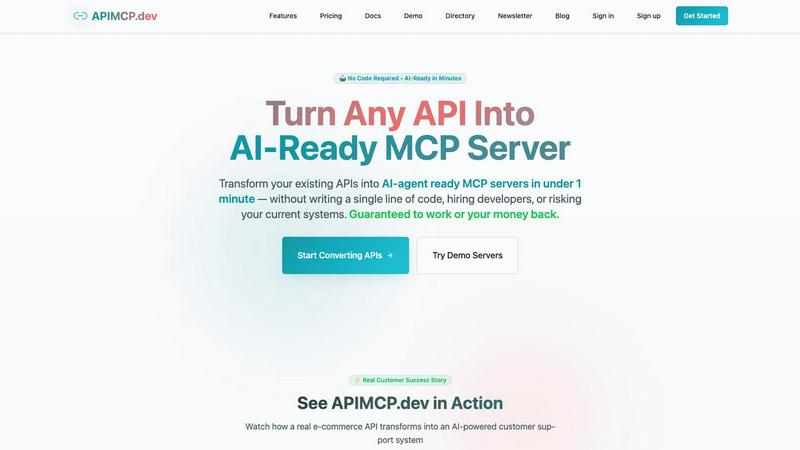
APIMCP.dev instantly transforms any REST API into a production-ready MCP server for AI agents.
Last updated: March 1, 2026

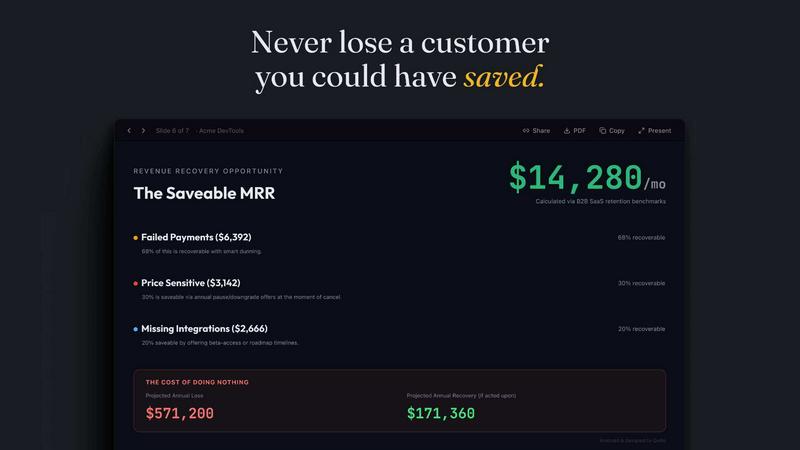
Quitlo leverages AI voice calls to uncover customer churn reasons and delivers actionable insights directly to your.
Last updated: March 4, 2026
Visual Comparison
APIMCP.dev
Quitlo
Feature Comparison
APIMCP.dev
Automated OpenAPI to MCP Conversion
The platform's core engine automatically parses a provided OpenAPI specification (Swagger) and intelligently maps REST endpoints, parameters, request bodies, and response schemas into fully compliant MCP tools. It generates accurate tool names, descriptions, and input parameter definitions required for AI agents to understand and correctly invoke the API. This conversion happens in under one minute, transforming weeks of manual development into an instantaneous, code-free process.
Enterprise-Grade Security & Authentication Handling
APIMCP.dev provides built-in, secure handling for various API authentication methods, including API keys, OAuth 2.0, and HTTP Basic Auth. The generated MCP server acts as a secure bridge, meaning sensitive credentials are managed by the platform and are not exposed to the end-user AI agent. This architecture ensures your existing systems remain untouched and secure, maintaining all original access controls and audit trails.
Real-Time Analytics and Performance Monitoring
The platform includes a dashboard for monitoring the usage and performance of your generated MCP servers in real-time. You can track metrics such as the volume of AI agent interactions, endpoint call frequency, system response times, and error rates. This provides operational visibility into how AI agents are utilizing your APIs, enabling performance optimization and informed decision-making.
Guaranteed Uptime and Priority Support
APIMCP.dev guarantees 99.9% uptime for all hosted MCP servers, ensuring reliable availability for AI agent integrations. Subscribers to the Professional Plan receive priority email support for technical assistance. The service is backed by a 30-day money-back guarantee and a specific 60-minute setup guarantee, promising a functional integration or a full refund.
Quitlo
Adaptive AI Conversations
Quitlo replaces static forms with engaging AI conversations that adapt to the customer's responses. This feature allows for a natural dialogue, enabling the platform to gather deep insights into customer sentiments and churn reasons.
Real-Time Signal Detection
The platform continuously monitors customer behavior for various signals, such as cancellations or low satisfaction scores. This proactive detection ensures that Quitlo can engage customers at critical moments, preventing potential churn before it happens.
Instant Actionable Insights
After a conversation, Quitlo delivers a structured summary of the findings directly into collaboration tools like Slack or Jira. This summary includes churn reasons, customer sentiment, competitor mentions, and recommended actions, facilitating immediate follow-up by the team.
Comprehensive Coverage of Churn Scenarios
Quitlo encompasses multiple entry points for customer engagement, including cancellation flows, surveys, payment recovery, win-back campaigns, and onboarding check-ins. This ensures that every potential churn moment is addressed effectively.
Use Cases
APIMCP.dev
AI-Powered Customer Support Automation
Transform e-commerce or CRM APIs (e.g., Shopify, WooCommerce, Salesforce) into an AI-ready knowledge and action system. Customer support agents or end-users can ask questions like "What's the status of order #12345?" or "Refund the latest purchase for [email protected]." The AI agent, via the MCP server, automatically calls the appropriate GET /api/orders/{id} or POST /api/refunds endpoints, retrieving or executing actions with precise, real-time data without human intervention.
Intelligent Internal Data Querying and Reporting
Enable non-technical team members in finance, marketing, or operations to query complex internal databases and business intelligence systems through natural language. By connecting an internal reporting API, users can ask, "What were Q3 sales figures for the EMEA region?" The AI agent translates this into the correct API call, returning formatted data instantly, democratizing data access and eliminating backlogged requests for custom reports.
Automated Content and Digital Asset Management
Integrate CMS (e.g., WordPress, Contentful) or Digital Asset Management (DAM) system APIs. Content teams can instruct an AI agent to "Find all unpublished blog posts from last month and schedule them for publishing next Tuesday" or "Resize the product images in the 'Summer Collection' folder." The AI executes these multi-step procedures via the MCP server, automating routine content operations.
Streamlined DevOps and Infrastructure Management
Connect DevOps toolchain APIs from providers like AWS, GitHub, or Datadog. Developers and engineers can manage infrastructure using natural language commands within their IDE (like Cursor) or chat interface: "Spin up a new staging environment," "Check the error rate for service X," or "Roll back the last deployment." The MCP server executes these commands safely and accurately, accelerating development workflows.
Quitlo
Enhancing Customer Retention
SaaS companies can utilize Quitlo to engage customers who show signs of leaving. By understanding the specific reasons behind their dissatisfaction, businesses can implement targeted retention strategies.
Improving Product Development
Insights gathered from Quitlo can inform product teams about common customer pain points. This feedback loop helps prioritize feature development and enhancements based on real customer needs.
Optimizing Pricing Strategies
By uncovering detailed feedback related to pricing concerns, Quitlo enables companies to adjust their pricing models or introduce new options, such as team pricing, to better meet market demands.
Strengthening Competitive Positioning
With insights into competitor mentions during conversations, businesses can analyze how they stack up against rivals. This information allows for strategic adjustments in marketing and product offerings to improve competitive advantage.
Overview
About APIMCP.dev
APIMCP.dev is a specialized software platform engineered to bridge the critical gap between existing RESTful API infrastructure and modern AI agent ecosystems. It functions as an automated, high-speed conversion engine that transforms standard OpenAPI specifications into fully operational Model Context Protocol (MCP) servers. This process, which traditionally demands 40 to 80 hours of specialized development work involving protocol understanding, tool definition, and server implementation, is executed by APIMCP.dev in under 60 seconds without requiring any manual coding. The core technical value proposition is enabling seamless, secure, and instantaneous integration of proprietary or third-party APIs with leading AI tools like Anthropic's Claude, OpenAI's ChatGPT, Cursor IDE, and other MCP-compatible agents. The platform is architected for developers, product teams, and enterprises seeking to rapidly augment their operations with AI capabilities without disrupting or modifying their existing backend systems. By completely eliminating the MCP development bottleneck, APIMCP.dev democratizes access to AI-agent functionality, allowing organizations to leverage their substantial existing API investments for intelligent automation, complex data querying, and procedural task execution directly through natural language interfaces.
About Quitlo
Quitlo is an innovative Churn Intelligence Platform designed specifically for B2B SaaS companies. It addresses a critical pain point in customer retention by moving beyond traditional cancellation surveys and forms, which often yield low response rates and vague feedback. With Quitlo, businesses can engage customers through empathetic AI conversations, utilizing both voice and text to gather in-depth insights. The platform automatically detects signals such as cancellations, low Net Promoter Scores (NPS), or failed payments, initiating a real-time two-minute dialogue with the customer. This interaction uncovers the reasons behind churn in a structured manner, providing actionable summaries that are delivered seamlessly to tools like Slack or Jira. Quitlo empowers teams to transform ambiguous data points into informed retention strategies, ultimately helping to save revenue and understand the true motivations behind customer decisions. As a comprehensive solution for understanding customer churn, Quitlo represents a shift towards more dynamic and effective customer engagement.
Frequently Asked Questions
APIMCP.dev FAQ
What is the Model Context Protocol (MCP)?
The Model Context Protocol (MCP) is an open standard that enables AI applications and agents to connect securely to external data sources and tools. It provides a standardized way for AI models to discover, describe, and invoke capabilities provided by servers. APIMCP.dev automates the creation of these standardized servers from your existing OpenAPI specs, making your APIs natively accessible to any MCP-compatible AI agent.
How does authentication work with my existing APIs?
You provide your API authentication details (e.g., API key, OAuth credentials) securely to APIMCP.dev during the setup process. The generated MCP server manages these credentials and automatically includes the necessary authentication headers or tokens in every request it forwards to your backend API. The end-user or AI agent never sees or handles your raw credentials, maintaining security.
Do I need to host the generated MCP server myself?
No. APIMCP.dev provides fully hosted and managed MCP servers as part of its service. You receive a dedicated, secure endpoint URL (e.g., https://mcp.apimcp.dev/userId/your-api) that is always online. This eliminates the need for you to manage server infrastructure, scaling, or MCP protocol updates, ensuring maximum reliability and ease of use.
What happens if my OpenAPI specification changes?
You can easily update your MCP server by re-running the conversion process in the APIMCP.dev dashboard with your updated OpenAPI specification. The platform will regenerate the MCP tools to reflect new endpoints, modified parameters, or changed schemas. This ensures your AI agent integrations remain synchronized with your API's current capabilities without manual code updates.
Quitlo FAQ
How does Quitlo engage with customers to understand churn?
Quitlo uses AI-driven conversations that adapt to customer responses, allowing for a two-minute dialogue that captures detailed feedback rather than relying on static forms.
What types of signals can Quitlo detect?
Quitlo can automatically detect various signals such as customer cancellations, low NPS scores, failed payments, and even reduced engagement after onboarding, prompting timely interventions.
In what formats does Quitlo deliver insights?
The platform delivers structured summaries of customer conversations directly to collaboration tools like Slack or Jira, ensuring that teams can act on insights quickly and efficiently.
How does Quitlo differ from traditional exit surveys?
Unlike traditional exit surveys that often provide one-word answers with little context, Quitlo facilitates real conversations that yield comprehensive insights into customer sentiments and motivations for leaving.
Alternatives
APIMCP.dev Alternatives
APIMCP.dev is a specialized productivity and management platform that instantly converts REST APIs into AI-ready Model Context Protocol (MCP) servers without manual coding. It automates a complex development process, enabling seamless integration between existing API infrastructure and modern AI agent ecosystems like Claude and ChatGPT. Users may explore alternatives for various reasons, including specific budget constraints, the need for different feature sets like custom server hosting or advanced security models, or platform requirements such as on-premises deployment. The search for a different solution is a normal part of evaluating the right tool for a project's technical and operational needs. When assessing alternatives, key criteria include the solution's conversion automation capabilities, support for the full MCP specification, security and authentication handling, deployment flexibility, and the total cost of ownership. The core evaluation should focus on how effectively a platform bridges the gap between a proprietary API and AI agents while meeting specific development and compliance requirements.
Quitlo Alternatives
Quitlo is an innovative Churn Intelligence Platform designed specifically for B2B SaaS companies, utilizing AI-driven voice calls to understand customer attrition. It addresses a critical gap in traditional feedback mechanisms, which often yield low response rates and minimal insight. Users frequently seek alternatives to Quitlo due to factors such as pricing, feature sets, or specific platform integrations that better align with their operational needs. When evaluating alternative solutions, it is essential to consider their ability to provide actionable insights, engagement methods, and the overall adaptability of the technology to fit within existing workflows. --- [{"question": "What is Quitlo?", "answer": "Quitlo is the first Churn Intelligence Platform tailored for B2B SaaS companies, using AI voice calls to gather insights about customer churn."},{"question": "Who is Quitlo for?", "answer": "Quitlo is designed for B2B SaaS companies looking to understand customer retention and churn dynamics more effectively."},{"question": "Is Quitlo free?", "answer": "Quitlo is a subscription-based service, and pricing details can vary based on the features and scale required."},{"question": "What are the main features of Quitlo?", "answer": "Quitlo features AI-driven conversations to engage customers, automated signal detection for churn indicators, and actionable summaries delivered to tools like Slack or Jira."}]