AskFormulas vs ScopeSnap
Side-by-side comparison to help you choose the right tool.

AskFormulas
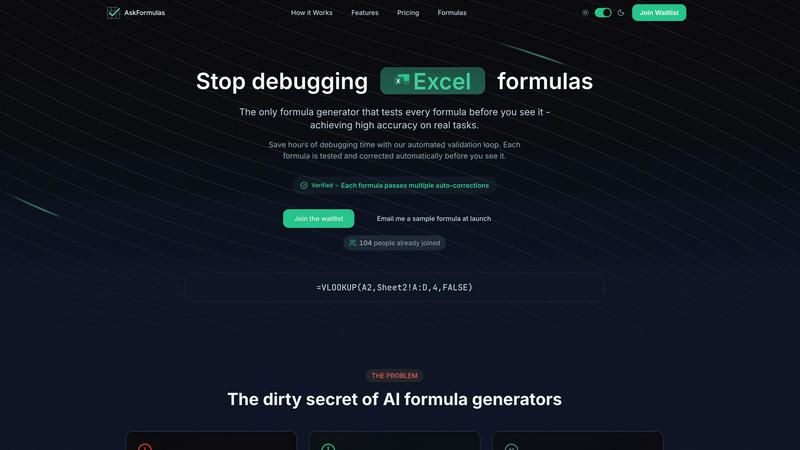
AskFormulas generates and automatically validates Excel and Google Sheets formulas for guaranteed accuracy.
Last updated: February 28, 2026

ScopeSnap
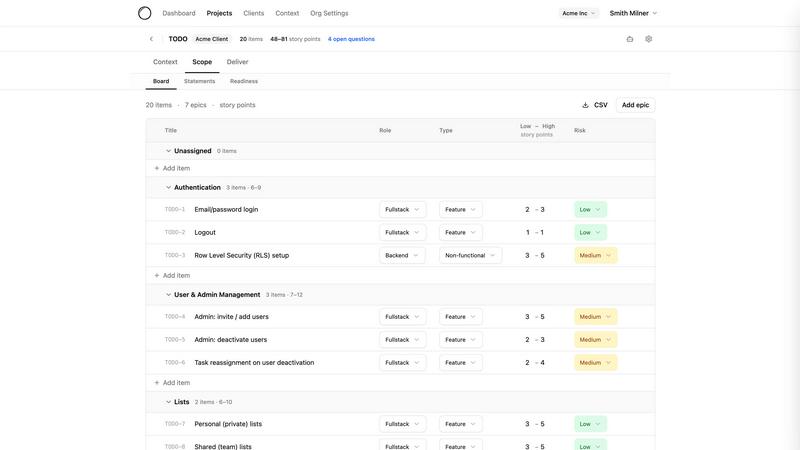
ScopeSnap uses AI to transform discovery notes into structured project scopes and client-ready proposals.
Last updated: March 18, 2026
Visual Comparison
AskFormulas
ScopeSnap
Feature Comparison
AskFormulas
Proprietary Validation Loop
The core technological innovation of AskFormulas is its automated, three-step validation process. Every user request is first analyzed to convert natural language into formula intent. The generated formula then undergoes automated testing in a secure sandbox environment using synthetic test data. If errors like #REF! or #VALUE! are detected, the system initiates iterative auto-corrections until the formula passes all validation checks. This loop ensures each output is verified as functional before the user ever sees it, guaranteeing high accuracy.
Cross-Platform Syntax Toggle
AskFormulas provides full support for both Microsoft Excel and Google Sheets formula syntax through a simple, one-click toggle. The system automatically adjusts the generated formula's structure and function names to be natively compatible with the selected platform. This eliminates the need for manual translation between applications like VLOOKUP and ARRAYFORMULA, enabling seamless workflow integration for users who operate across different spreadsheet ecosystems.
Smart Error Detection and Correction
Beyond initial generation, the platform features intelligent error detection that identifies common formula mistakes. When an issue is found during the validation phase, such as an incorrect range reference or syntax error, the system does not simply return the broken formula. Instead, it automatically diagnoses the problem and applies corrections through multiple iterations until a working, validated formula is produced, effectively removing the debugging burden from the user.
Formula History and Management
AskFormulas includes a personal formula library that automatically saves a user's recently generated formulas. This history feature ensures that no previously created formula is ever lost, allowing for quick retrieval and reuse. It acts as a knowledge base, enabling users to build upon past work without needing to regenerate complex requests from scratch, thereby enhancing productivity and consistency.
ScopeSnap
AI-Powered Scope Decomposition
This core feature processes unstructured discovery artifacts like call transcripts and notes to automatically generate a structured project backlog. The AI identifies key themes and user stories, grouping them into logical epics. It critically analyzes the input to flag ambiguous requirements, underlying assumptions, and open questions that require client clarification, ensuring the foundational scope is comprehensive and well-understood before estimation begins.
Interactive Scope Refinement & Estimation Board
The generated scope is presented within an interactive, kanban-style board where users can review, edit, and organize all scope items. This interface allows for the assignment of roles (e.g., front-end, back-end), the application of story points or hourly estimates to each task, and the direct resolution of AI-identified questions. This feature facilitates collaborative and iterative refinement, turning the initial AI output into a precise, agreed-upon project specification.
Automated Proposal & SOW Generation
Upon finalizing the scope and estimates, ScopeSnap automatically compiles all structured data into a professionally formatted client proposal or Statement of Work. This document includes a detailed breakdown of features, timelines, cost estimates, payment terms, and project assumptions. The automation ensures consistency, eliminates manual copy-pasting errors, and saves hours of document preparation time, delivering a polished deliverable instantly.
Centralized Project Context Repository
ScopeSnap acts as a single source of truth for pre-project discovery. Users can upload and store all relevant context—meeting recordings, transcripts, email chains, and briefs—directly linked to the project scope. This centralized repository ensures that all decisions and scope items are traceable back to original client conversations, providing crucial auditability and reference during both the sales process and subsequent project execution.
Use Cases
AskFormulas
Complex Financial Modeling
Financial analysts and revenue managers can utilize AskFormulas to rapidly construct and debug intricate financial models, forecasts, and automated reports. By describing logic in plain English, such as "calculate quarterly CAGR from this revenue table," they receive validated, complex formulas like XLOOKUP or SUMIFS arrays, saving hours otherwise spent on manual formula writing and error-checking, thus accelerating model deployment.
Automated Business Reporting
Small business owners and operations managers can automate repetitive reporting tasks. Instead of manually aggregating sales data or filtering customer lists, they can input requests like "sum all values in column B where column A contains 'Sales'" to instantly get a working =SUMIF formula. This enables the creation of dynamic dashboards and reports without requiring deep technical expertise in spreadsheet functions.
Data Cleaning and Transformation
Professionals dealing with messy datasets can use AskFormulas to generate formulas for standardizing and cleaning data. Requests such as "extract the domain from email addresses in column C" or "combine first and last name with a space" yield validated TEXTSPLIT or CONCATENATE formulas. This streamlines data preparation, ensuring accuracy and consistency for analysis or migration projects.
Educational and Training Purposes
Individuals learning spreadsheet software or teams undergoing training can use AskFormulas as an interactive learning aid. By experimenting with natural language descriptions and studying the validated, correct formulas returned, users can better understand proper syntax, function application, and logical construction, bridging the gap between conceptual understanding and practical implementation.
ScopeSnap
For Freelance Developers Scoping Solo Projects
Independent developers can use ScopeSnap to efficiently manage client discovery. After a discovery call, they paste their notes or transcript into the platform. The AI creates a first-draft scope, helping the freelancer ensure no critical feature is overlooked. They then refine estimates and quickly generate a professional proposal, allowing them to compete with larger agencies on professionalism while saving valuable time otherwise spent on administrative tasks.
For Software Agencies Standardizing Sales Processes
Development agencies can implement ScopeSnap to create a consistent, scalable workflow for their sales and pre-sales teams. It ensures every project estimate follows the same rigorous decomposition process, improving accuracy and reducing risk. The automated SOW generation enforces brand consistency and legal compliance across all client proposals, making the sales pipeline more efficient and reliable.
For Technical Consultants Defining Project Requirements
Consultants hired to define project specifications for a client's internal team or for another agency can utilize ScopeSnap to structure their findings. The tool helps systematically break down complex business needs into technical requirements, user stories, and acceptance criteria. The final output is a clear, actionable specification document or RFP supplement that accurately communicates project scope.
For Refining and Re-scoping Existing Project Ideas
When a client returns with an existing, vague project idea or a failed previous estimate, ScopeSnap provides a structured method for re-analysis. By inputting the available information, the AI can help deconstruct the problem anew, identify gaps in the previous scope, and build a more solid, estimatable foundation, facilitating a more successful project restart or rescue.
Overview
About AskFormulas
AskFormulas is an advanced AI-powered formula generator engineered to eliminate the inefficiency and frustration associated with broken spreadsheet formulas. The platform directly addresses the critical flaw in conventional AI formula tools, which have documented error rates of 40-60%, by implementing a proprietary, automated validation loop. This system ensures that every single formula is rigorously tested and corrected against real or synthetic data before being presented to the user. The core value proposition is delivering guaranteed, working formulas with a verified accuracy rate exceeding 95%, thereby saving professionals hours of manual debugging time each week. It supports both Microsoft Excel and Google Sheets syntax, allowing users to seamlessly switch between platforms with a single toggle. The tool is designed for a wide range of users, from financial analysts and revenue managers constructing complex models and automated reports, to small business owners and individuals who lack deep expertise in spreadsheet syntax but need reliable, powerful formulas to drive their work.
About ScopeSnap
ScopeSnap is an AI-powered platform engineered to transform the initial, often chaotic phase of software project discovery into a structured, actionable, and client-ready deliverable. It is specifically designed for freelance developers, technical consultants, and software development agencies who engage in scoping and estimating custom software projects. The core value proposition of ScopeSnap lies in its systematic elimination of manual, error-prone processes associated with project definition. By ingesting raw inputs such as meeting transcripts, email threads, and handwritten notes, its AI engine performs an intelligent breakdown of high-level ideas into discrete, estimatable tasks organized into epics and a clear backlog. This structured approach forces clarity, surfaces implicit assumptions, and identifies open questions early in the cycle. Users can then iteratively refine this scope, assign roles, and attach time or cost estimates with confidence. Finally, the platform automates the generation of professional proposals or Statements of Work (SOW), compiling the refined scope, estimates, and project terms into a polished document ready for client presentation. ScopeSnap directly addresses the critical pain points of missed requirements, scope vagueness, and the extensive time investment required for proposal creation, thereby reducing commercial risk and accelerating the sales cycle for service providers.
Frequently Asked Questions
AskFormulas FAQ
How accurate are the generated formulas?
AskFormulas achieves a verified accuracy rate exceeding 95% for real-world tasks. This high reliability is a direct result of the proprietary validation loop, which automatically tests and corrects every formula against synthetic data before presentation. This process stands in contrast to conventional AI tools that have documented error rates of 40-60% because they lack such rigorous, automated testing protocols.
Does it work with both Excel and Google Sheets?
Yes, AskFormulas provides full, native support for both Microsoft Excel and Google Sheets. A dedicated one-click toggle allows users to switch between platforms instantly. The system automatically adjusts the generated formula's syntax and function names to be fully compatible with the selected application, handling platform-specific differences like function variations and array formula structures seamlessly.
How many formulas can I generate per month?
Formula generation limits are defined by your subscription plan. The Starter plan includes 500 formulas per month, the Pro plan offers 2,000 formulas per month, and the Team plan provides 6,000 formulas per month shared among up to 5 team members. This tiered structure is designed to accommodate the needs of individual users, power users, and small teams respectively.
What happens if my formula has an error?
If a potential error is detected during the automated validation phase, the system does not deliver a broken formula. Instead, its smart error detection identifies issues like incorrect range references or syntax problems. The validation loop then engages in iterative auto-corrections, running the formula through multiple tests and fixes until it produces a fully functional, validated output that is guaranteed to work.
ScopeSnap FAQ
What types of input does ScopeSnap accept for analysis?
ScopeSnap is designed to process textual input from a variety of discovery sources. This includes direct text entry, pasted content from meeting transcripts (e.g., from Otter.ai or Rev), email correspondence, notes from tools like Notion or Google Docs, and bullet-point lists of client requirements. The system extracts key concepts and requirements from this unstructured data to build the initial scope structure.
How accurate are the AI-generated estimates and scope items?
The AI-generated scope and tasks are a starting point for human refinement, not a final estimate. Accuracy is highly dependent on the quality and detail of the input context provided. The AI's primary role is to ensure comprehensiveness and structure, surfacing potential tasks and questions a human might miss. The final, responsible estimation must be performed by the user within the refinement board, applying their own expertise to adjust story points, hours, and resource assignments.
Can I customize the generated proposal documents?
Yes, the automated Proposal and Statement of Work generation feature is built with customization in mind. Users can typically define company details, standard terms and conditions, payment schedules, and branding elements (like logos and colors) in settings or templates. The content pulled from the refined scope board (features, estimates, assumptions) populates these templates to create a client-ready document that aligns with your professional standards.
Is ScopeSnap suitable for very large or complex enterprise projects?
ScopeSnap is optimized for the workflow of freelancers, small to mid-sized agencies, and consultants. While it can handle substantial projects by breaking them into phases or multiple epics, extremely large enterprise projects with deeply interdependent systems may require more specialized enterprise architecture tools. However, for defining clear scope and deliverables for a specific module, MVP, or well-bounded project within a larger program, ScopeSnap remains highly effective.
Alternatives
AskFormulas Alternatives
AskFormulas is an advanced AI-powered productivity tool designed to generate and automatically validate spreadsheet formulas for Microsoft Excel and Google Sheets. It operates within the specialized category of formula generation and debugging software, targeting professionals who rely on accurate, complex spreadsheet models. Users may seek alternatives for various reasons, including budget constraints, specific feature requirements not met by a single platform, or a need for integration with other software ecosystems. Some may prioritize different aspects of the user experience or require support for less common spreadsheet applications. When evaluating alternatives, key criteria should include the tool's core accuracy rate and validation methodology, the range of supported spreadsheet platforms and functions, the depth of integration with existing workflows, and the overall cost relative to the value of time saved and error reduction. The fundamental differentiator in this category is the mechanism for ensuring formula correctness before delivery.
ScopeSnap Alternatives
ScopeSnap is a project scoping and proposal generation tool within the productivity and management software category. It leverages artificial intelligence to help freelance developers and software agencies transform unstructured discovery notes into detailed project scopes, accurate estimates, and professional client proposals. Users may explore alternatives to ScopeSnap for various reasons, including budget constraints, specific feature requirements not met by the platform, or integration needs with their existing tech stack. The search for a different solution often stems from a need for more granular control, different pricing models, or platform compatibility issues. When evaluating an alternative, key considerations should include the tool's core methodology for scope decomposition and estimation, the quality and customizability of its output documents, and the overall efficiency it brings to the pre-sales workflow. The ideal solution should demonstrably reduce the time and risk associated with defining software project requirements and communicating them to clients.