CCAPI vs Seedance 2 AI Video Generator
Side-by-side comparison to help you choose the right tool.

CCAPI
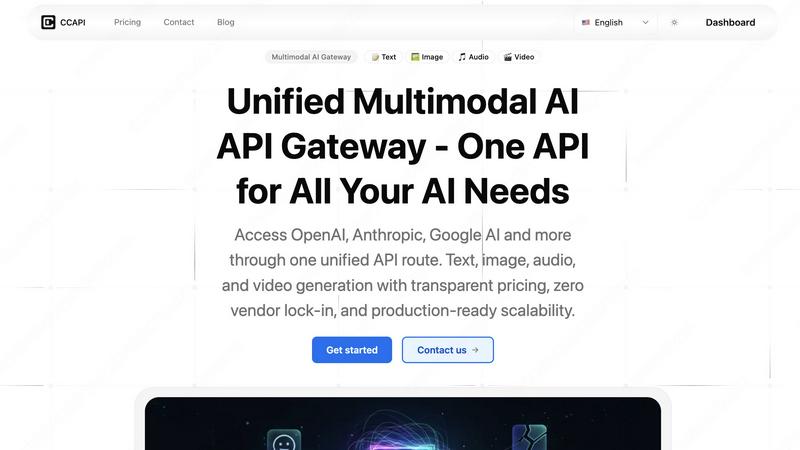
CCAPI is a unified API gateway that seamlessly integrates multiple AI providers for text, image, audio, and video.
Last updated: February 26, 2026

Seedance 2 AI Video Generator
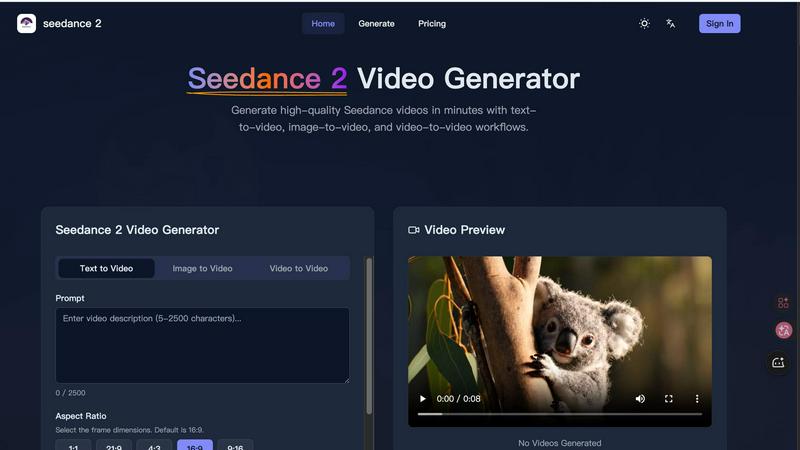
Seedance 2.0 transforms text, images, or clips into high-quality cinematic videos with precise control and consistent.
Last updated: March 1, 2026
Visual Comparison
CCAPI
Seedance 2 AI Video Generator
Feature Comparison
CCAPI
Unified API Access
CCAPI offers a single endpoint for accessing a multitude of AI providers, including OpenAI, Anthropic, Google AI, and others. This unified access simplifies the integration process for developers, allowing them to make a single call to generate text, images, audio, or video without needing to handle different APIs for each provider.
Smart Routing
With CCAPI's smart routing technology, developers can rest assured that their requests will not fail due to provider downtime. In the event of a failure, the system automatically redirects requests to other available providers, maintaining an impressive 99.9% uptime and ensuring that applications remain operational even under unforeseen circumstances.
Developer-Friendly Integration
CCAPI is designed with developers in mind, featuring OpenAI-compatible endpoints that allow for easy migration from existing implementations. By simply changing the base URL in the API calls, developers can access all models available through CCAPI without rewriting significant portions of their code.
Comprehensive Monitoring Dashboard
CCAPI provides a real-time dashboard where developers can monitor their usage, including costs, latency metrics, and success rates. This feature allows developers to track their expenses effectively and optimize their applications based on performance insights, ensuring efficient resource allocation.
Seedance 2 AI Video Generator
Multimodal Input Generation
Seedance 2.0 supports three distinct generation modes: Text-to-Video, Image-to-Video, and Video-to-Video. This multimodal flexibility allows users to initiate creation from a written concept, a visual reference image to maintain style consistency, or existing source footage for controllable restyling and motion transfer. Each mode is optimized for specific workflows, providing maximum creative flexibility whether you are concepting from scratch or iterating on established visual material.
Reference-First Workflow for Consistency
A key technical differentiator is its reference-first generation approach. By using an image or video clip as a reference input, the model anchors the output's character design, artistic style, color palette, and camera perspective. This significantly reduces the guesswork and iterative prompting often required in AI video generation, leading to more predictable, coherent, and brand-consistent results essential for professional projects and serialized content.
Joint Audio-Video Synthesis
The platform features advanced joint audio-video synthesis in a single generation pass. This includes synchronized audio generation encompassing sound effects (SFX), background music scoring, and voice dialogue. Critically, it supports accurate lip-sync for over ten languages, including English, Chinese, Japanese, and Korean. This integrated feature streamlines post-production by delivering a complete audiovisual package, eliminating the need for separate audio editing and syncing steps.
High-Fidelity Output Specifications
Seedance 2.0 delivers professional-grade output specifications. It generates videos up to 1080p resolution at a cinema-standard frame rate of up to 24fps for smooth playback. Videos can be created in durations of 5 to 10 seconds per generation, with extension capabilities, and in aspect ratios of 16:9, 9:16, and 1:1 for optimal display across social platforms, widescreen formats, and mobile screens. All output is delivered in the universally compatible MP4 (H.264) format.
Use Cases
CCAPI
Chatbot Development
Developers can leverage CCAPI to build intelligent chatbots that utilize the latest language models for natural language understanding. By accessing multiple AI providers through a single endpoint, developers can enhance their chatbots with advanced conversational capabilities, improving user experience significantly.
Content Creation
Content creators can use CCAPI to generate high-quality text, images, and videos for blogs, social media, or marketing campaigns. The ability to switch between different AI models ensures that creators can always access the best tools available for their specific content needs.
Multimedia Applications
CCAPI's support for audio and video generation makes it an ideal choice for developers of multimedia applications. Whether creating promotional videos, podcasts, or interactive content, developers can utilize CCAPI to seamlessly integrate AI-generated media into their projects.
Data Analysis and Reporting
Businesses can integrate CCAPI into their data analysis processes, using AI-generated insights to enhance reports and presentations. By accessing models that specialize in reasoning and summarization, organizations can generate detailed analyses that inform decision-making.
Seedance 2 AI Video Generator
Rapid Social Media Content Creation
Marketing teams and social media managers can leverage Seedance 2.0 to rapidly produce a high volume of platform-specific video content. By quickly generating multiple versions of promotional clips, animated explainers, or engaging short-form videos in various aspect ratios (9:16 for Reels/TikTok, 1:1 for Instagram), teams can maintain a consistent posting schedule and A/B test content without extensive production timelines or resource allocation.
Concept Visualization and Storyboarding
Filmmakers, ad agencies, and creative directors can use the Text-to-Video and Image-to-Video modes to visualize concepts and create dynamic storyboards. This allows for the fast iteration of visual ideas, camera movements, and scene compositions during pre-production. Teams can evaluate creative directions and present tangible visual concepts to clients or stakeholders before committing to full-scale filming.
Product Demonstration and Explainer Videos
Businesses can create polished product demo and explainer videos directly from reference images of their products or UI screenshots. The Image-to-Video mode can animate the product, showcase features, or simulate user interactions. The integrated audio generation can add voiceover and sound effects, resulting in a professional, engaging video asset suitable for websites, sales pitches, and customer education.
Brand-Consistent Advertising Campaigns
For brands running multi-channel advertising campaigns, Seedance 2.0's reference-first workflow ensures visual consistency across all assets. A core brand image or style guide can be used as a reference to generate a series of video ads, ensuring uniform character appearance, color grading, and aesthetic tone. This maintains brand integrity while enabling the scalable production of video ads tailored for different platforms and messaging angles.
Overview
About CCAPI
CCAPI is a comprehensive and unified API solution designed for developers seeking seamless access to multiple AI providers, including OpenAI, Anthropic, Google AI, and many more. By aggregating various AI models under one roof, CCAPI streamlines the process of text, image, audio, and video generation, allowing developers to focus on building innovative applications without the complexity of managing multiple API endpoints. With a remarkable 99.9% success rate and 24/7 monitoring, CCAPI ensures high availability and reliability for mission-critical tasks. The platform's smart routing feature automatically switches between providers in case of failure, ensuring uninterrupted service. Whether you are developing chatbots, content generation tools, or multimedia applications, CCAPI provides the flexibility and capability to meet diverse AI needs while simplifying the integration process for developers.
About Seedance 2 AI Video Generator
Seedance 2.0 is a state-of-the-art AI video generation platform engineered to transform text prompts, reference images, or existing source footage into high-quality, cinematic video clips. It represents a significant advancement in controllable AI video synthesis, prioritizing a fast, all-in-one workflow that minimizes traditional editing overhead. The platform is built upon the proprietary Seedance 2.0 model, which delivers enhanced motion smoothness, superior temporal consistency, and robust reference-driven generation. This allows users to anchor creative outputs to specific visual styles, characters, or camera feels with greater precision than prompt wording alone. Designed for professional creators, marketing teams, and agencies, Seedance 2.0 accelerates video production for advertising, social media content, product demos, and more. Its core value proposition lies in combining best-in-class motion synthesis and character consistency with practical features like integrated multilingual lip-sync and joint audio-video generation, enabling the rapid creation of polished, production-ready video assets directly from conceptual inputs.
Frequently Asked Questions
CCAPI FAQ
What types of AI models does CCAPI support?
CCAPI supports a wide range of AI models across multiple modalities, including text, image, audio, and video generation. This includes popular providers like OpenAI, Anthropic, Google AI, and others.
How does smart routing work in CCAPI?
Smart routing automatically detects when a provider is unavailable and reroutes requests to other active providers. This ensures that applications using CCAPI maintain functionality and performance, even during outages.
Is CCAPI suitable for small-scale projects?
Yes, CCAPI is designed to cater to developers of all sizes, from small startups to large enterprises. Its pay-as-you-go pricing model and easy integration make it an excellent choice for any scale of project.
Can I use my own API keys with CCAPI?
Absolutely. CCAPI allows developers to bring their own API keys and endpoints, enabling customization and flexibility in integrating any OpenAI-compatible provider into their applications.
Seedance 2 AI Video Generator FAQ
What are the main technical specifications for video output?
Seedance 2.0 generates videos with a maximum resolution of 1080p, a frame rate of up to 24fps, and durations between 5 to 10 seconds per generation (extendable). Supported aspect ratios are 16:9 (widescreen), 9:16 (vertical), and 1:1 (square). All videos are output in the standard MP4 (H.264) format for universal compatibility with editing software and digital platforms.
How does the reference-first workflow improve video quality?
The reference-first workflow uses an uploaded image or video clip as a visual anchor for the generation process. This direct input provides the AI model with concrete data on style, composition, color, and character details, leading to outputs with significantly higher consistency and fidelity to the intended vision. It reduces reliance on ambiguous text prompts, resulting in less guesswork, fewer failed generations, and more controllable, production-ready results.
Which languages are supported for lip-sync in audio generation?
The joint audio-video synthesis feature includes accurate lip-sync support for over ten languages. Confirmed languages include English, Chinese, Japanese, and Korean. This multilingual capability allows for the creation of localized video content with synchronized spoken dialogue, making the tool effective for global marketing campaigns and content aimed at diverse linguistic audiences.
How does Seedance 2.0 compare to other AI video models like Sora or Runway?
Based on provided comparisons, Seedance 2.0 competes strongly in areas of cinematic quality, motion realism, and character consistency. Its distinct advantages include integrated audio generation with multilingual lip-sync (a feature absent in several competitors) and a reference-first workflow designed for precise control. It is engineered for rapid iteration and production-readiness, positioning it as a practical tool for professional workflows requiring both high quality and efficient output speed.
Alternatives
CCAPI Alternatives
CCAPI, or Unified Multimodal AI API Gateway, is a sophisticated platform designed for seamless integration and access to a multitude of AI services, including those from OpenAI, Anthropic, and Google AI. As a developer-centric solution, it provides a single API endpoint for diverse AI functionalities, covering text, image, audio, and video generation. This versatility makes CCAPI a valuable tool in the development landscape, catering to various AI needs within a unified framework. However, users often find themselves seeking alternatives to CCAPI for several reasons. These may include pricing structures that better fit their budget, specific feature sets that align more closely with their project requirements, or platform compatibility concerns. When evaluating alternatives, it is crucial to consider factors such as API performance, ease of integration, support for multimodal capabilities, and the breadth of services offered to ensure that the chosen solution meets their development goals effectively.
Seedance 2 AI Video Generator Alternatives
Seedance 2 AI Video Generator is a specialized tool within the AI video synthesis category, designed to transform text prompts, reference images, and source clips into cinematic-quality videos. Its core value proposition lies in a streamlined, all-in-one workflow that emphasizes consistent character and scene generation, smooth video extensions, and precise prompt control for rapid content creation. Users often explore alternatives to Seedance 2 for various practical reasons. These can include budget constraints and specific pricing model requirements, the need for different feature sets or output styles, and compatibility with particular operating systems or hardware. The search may also be driven by workflow integration needs, such as compatibility with existing editing software or cloud storage platforms. When evaluating an alternative AI video generator, key technical considerations should guide the decision. Assess the model's core capabilities in text-to-video, image-to-video, and video-to-video generation, along with its output resolution, frame rate consistency, and control over motion dynamics. Equally important are the platform's user interface complexity, rendering speed, available export formats, and the transparency of its usage policies and data security measures.