Clinic Comply vs Quickfix AI
Side-by-side comparison to help you choose the right tool.

Clinic Comply
ClinicComply is an all-in-one platform that centralizes RACGP accreditation and vendor management for Australian healthcare practices.
Last updated: March 19, 2026

Quickfix AI
Quickfix AI instantly diagnoses and explains your system's performance and health in plain English.
Last updated: February 28, 2026
Visual Comparison
Clinic Comply
Quickfix AI
Feature Comparison
Clinic Comply
RACGP Accreditation Module
This feature provides a fully mapped digital checklist for the RACGP 5th Edition Standards. Each criterion is broken down into actionable items with clear guidance. Users can upload evidentiary documents—such as policies, registers, and meeting minutes—and link them directly to the specific checklist criteria they satisfy. The module dynamically calculates a live compliance score and enables the one-click generation of a structured, assessor-ready evidence pack, eliminating last-minute scrambling before an accreditation visit.
Integrated IT Vendor Portal
Clinic Comply includes a secure portal functionality to streamline compliance documentation collection from third-party IT vendors and Managed Service Providers (MSPs). Instead of protracted email exchanges, users can generate and send a secure upload link directly to their vendor. Documents, such as Data Processing Agreements or Security Policies, are uploaded by the vendor directly into the platform, where they are automatically catalogued in the practice's evidence library and linked to the relevant compliance criteria.
Multi-Framework Compliance Dashboard
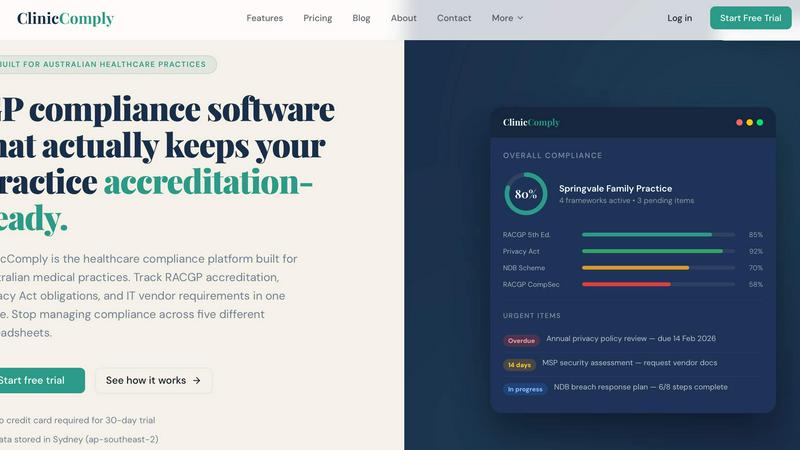
The platform offers a unified dashboard that aggregates compliance status across all active frameworks relevant to an Australian practice. This includes RACGP Standards, Privacy Act, NDB Scheme, state-based health records acts, and more. The dashboard presents an overall compliance percentage, highlights pending or overdue action items, and provides framework-specific progress tracking. This gives practice managers a real-time, holistic view of their compliance posture at a glance.
Automated Deadline and Task Management
Clinic Comply transforms static compliance requirements into an active workflow. The system automatically identifies and surfaces upcoming deadlines for recurring tasks, such as annual policy reviews or staff training. It allows for the assignment of tasks to specific team members, tracks completion status, and sends reminders for overdue items. This proactive feature ensures continuous compliance maintenance and prevents critical items from being overlooked.
Quickfix AI
Comprehensive One-Click System Scan
The agent performs a holistic scan of your entire system in under one minute. It audits key performance indicators across all major subsystems: CPU (usage per core, temperature, clock speed), RAM (utilization, pressure, available capacity), GPU (load, temperature), storage drives (health via S.M.A.R.T. data, used/free space, read/write speeds), network adapters (upload/download bandwidth, latency), battery health (maximum capacity, cycle count), and core security settings (firewall status, FileVault/Gatekeeper on macOS). This provides a unified, real-time snapshot of system status without requiring multiple disparate tools.
AI-Powered Analysis and Plain-English Reporting
Beyond data collection, Quickfix AI's proprietary AI engine analyzes the diagnostic report to identify anomalies, bottlenecks, and potential issues. It then generates an intelligible summary, explaining technical concepts in accessible language. For example, instead of merely stating "CPU at 89%," it identifies the specific processes responsible (e.g., "Chrome at 45%") and provides clear, actionable guidance such as recommending the closure of unnecessary browser tabs to alleviate immediate memory and CPU strain.
Secure Remote Diagnostics via Sharing Codes
This feature is engineered for IT support and helpdesk scenarios. A user can generate a unique, time-limited sharing code after a scan. This code can be securely provided to a technician, who can then view the full diagnostic report remotely without needing direct access to the physical machine. This facilitates rapid, accurate troubleshooting for distributed teams and remote employees, streamlining the support process and reducing resolution time significantly.
Interactive AI Chat for Detailed Inquiries
Users can engage directly with the AI using a conversational chat interface. By asking natural language questions about their system report—such as "Why is my Mac running slow?" or "Is my disk failing?"—the AI provides contextual, detailed answers drawn from the specific scan data. This interactive dialogue allows for deeper investigation and personalized recommendations, effectively acting as an on-demand system administrator for non-technical users.
Use Cases
Clinic Comply
Preparing for RACGP Accreditation Assessment
A general practice utilizes Clinic Comply to manage its triennial RACGP 5th Edition accreditation cycle. The team works through the pre-built checklist, uploading and linking evidence as they progress. As the assessment date approaches, the practice manager uses the platform to identify any gaps, assign final tasks, and ultimately download a complete, organized digital evidence pack to present to the surveyor, ensuring a smooth and confident assessment process.
Managing Privacy Act and Data Breach Obligations
A medical clinic employs Clinic Comply to maintain adherence to the Privacy Act 1988 and the Notifiable Data Breaches (NDB) Scheme. The platform guides them in maintaining and reviewing their privacy policy, data breach response plan, and staff training records. It provides a clear framework for documenting any data incidents and tracking the mandatory response steps, thereby ensuring legal obligations are met systematically and reducing regulatory risk.
Coordinating Compliance Evidence from IT Vendors
A practice needs to collect security documentation from its external IT provider to satisfy RACGP CompSec and privacy requirements. Instead of manual follow-ups, the practice manager sends a secure upload request via Clinic Comply's Vendor Portal. The MSP uploads the required documents directly, which are then automatically filed against the correct compliance criteria within the practice's evidence library, saving weeks of coordination effort.
Centralizing Compliance for Multi-Location Practices
A healthcare organization operating several clinics uses Clinic Comply to standardize and oversee compliance across all its locations. Each site manages its own evidence and progress within the platform, while head office administrators can use the dashboard to monitor the overall compliance status, identify common issues, and ensure consistent application of policies and procedures group-wide.
Quickfix AI
Proactive System Health and Performance Monitoring
Tech enthusiasts, developers, and power users employ Quickfix AI to continuously monitor their system's vitals. This is crucial for maintaining optimal performance during resource-intensive tasks like gaming, video editing, software compilation, or running virtual machines. The tool provides granular insights into temperatures, component loads, and memory pressure, enabling users to preemptively address thermal throttling or resource constraints before they impact performance or system stability.
End-User Troubleshooting and Problem Diagnosis
For individual users experiencing system slowdowns, unexpected crashes, or unusual behavior, Quickfix AI serves as a first-line diagnostic tool. It autonomously identifies the root cause—whether it's a failing drive, a memory leak from a specific application, or a misconfigured security setting—and explains the issue in plain English. This empowers users to resolve common problems independently without requiring deep technical knowledge or resorting to extensive web searches.
IT Helpdesk and Remote Technical Support
IT support teams integrate Quickfix AI into their workflow to diagnose issues on employee machines efficiently. Instead of relying on user-described symptoms, technicians can request a sharing code to obtain an objective, comprehensive system report. This allows for accurate remote diagnosis of issues ranging from malware infections and driver conflicts to hardware failures, dramatically reducing the need for in-person visits or lengthy screen-sharing sessions and improving first-contact resolution rates.
Pre-Purchase Audits and Security Posture Checks
Users considering purchasing a used computer or evaluating a company machine can use Quickfix AI to conduct a thorough audit. The scan reveals critical information such as battery health (cycle count and maximum capacity), storage drive condition (including reallocated sector counts), installed RAM configuration, and the status of essential security features like firewall and disk encryption. This provides a data-driven assessment of the device's value and security readiness.
Overview
About Clinic Comply
Clinic Comply is a specialized healthcare compliance management platform engineered exclusively for Australian medical practices. It functions as a centralized, authoritative system designed to replace the fragmented and error-prone methods of managing compliance, such as disparate spreadsheets, shared drives, and email threads. The platform's core value proposition is to streamline and de-risk the entire compliance lifecycle, ensuring practices remain perpetually prepared for accreditation assessments and regulatory audits. It achieves this by providing a single source of truth where all compliance obligations, evidence documentation, and task progress are consolidated and actively managed.
The software is purpose-built against the specific requirements of Australian healthcare frameworks, including the RACGP 5th Edition Standards for general practice, the Privacy Act 1988 (including the Australian Privacy Principles and Notifiable Data Breaches Scheme), RACGP Computer and Information Security Standards (CompSec), and various state-based health records acts. It is tailored for general practitioners, practice managers, healthcare administrators, and accreditation officers within medical and dental practices. By automating tracking, evidence collation, and vendor coordination, Clinic Comply significantly reduces administrative burden, mitigates compliance risk, and saves valuable time, allowing healthcare providers to refocus their efforts on patient care while maintaining continuous accreditation readiness.
About Quickfix AI
Quickfix AI is an advanced, AI-powered system diagnostics tool engineered to deliver immediate, comprehensive analysis of computer performance, health, and security. It functions as a lightweight software agent capable of executing a full system scan in under 60 seconds, generating a detailed report on all critical hardware and software components. The core innovation of Quickfix AI is its sophisticated AI engine, which transcends simple data aggregation. It interprets complex technical metrics—including CPU utilization, memory pressure, disk health (S.M.A.R.T. status), network throughput, battery cycles, and security posture—and translates them into plain-English explanations. This process demystifies system diagnostics for users of all technical proficiencies, providing not just raw data but context-specific, actionable recommendations for optimization and troubleshooting. Designed for cross-platform compatibility, it supports both Windows and macOS operating systems, consolidating the functionality of multiple specialized utilities into a single, intuitive interface. Its primary user base encompasses individual users troubleshooting performance degradation, tech enthusiasts and gamers monitoring system vitals, and IT support professionals who utilize its secure sharing code feature for efficient remote diagnostics.
Frequently Asked Questions
Clinic Comply FAQ
What specific Australian compliance frameworks does Clinic Comply support?
Clinic Comply is pre-configured with over ten Australian healthcare compliance frameworks. These include the RACGP 5th Edition Standards for general practice, the Privacy Act 1988 (APPs), the Notifiable Data Breaches (NDB) Scheme, RACGP Computer and Information Security Standards (CompSec), My Health Record Framework, HDAA Standards for dental practices, AGPAL standards, NDIS Practice Standards, and state-specific legislation like the Victorian Health Records Act and NSW HRIP Act. The platform is updated as standards evolve.
How does the platform handle document storage and security?
All practice data and evidentiary documents within Clinic Comply are stored on secure servers located in Sydney, Australia (within the ap-southeast-2 AWS region). This ensures data residency complies with Australian privacy expectations. The platform employs enterprise-grade security measures for data encryption both in transit and at rest, and access is controlled through secure user authentication and role-based permissions.
Can Clinic Comply generate reports for our accreditation assessor?
Yes, a core functionality of Clinic Comply is its one-click evidence pack generation. The platform allows users to compile and export a structured, organized digital pack containing all documented evidence, neatly linked to the corresponding RACGP criteria or other framework requirements. This eliminates the need for manual collation and provides a professional, easily navigable submission for your assessor.
Is there a limit to the number of users or practice locations?
The provided context does not specify detailed plan limitations on users or locations. The platform is designed to support both single practices and multi-location groups. For specific details on user seats, practice locations, and feature availability across different subscription tiers, it is recommended to consult the Clinic Comply "Pricing" page or contact their sales team directly through their website.
Quickfix AI FAQ
Is Quickfix AI free?
Quickfix AI offers a free version that includes the core one-click system scan, basic health reporting, and access to the AI explanation features for personal, non-commercial use. This allows individual users to diagnose and understand their system's performance. For advanced features, such as detailed historical trend analysis, priority support, and enterprise-level deployment with centralized management for IT teams, paid subscription plans are available.
Is my data secure?
Yes. Data security is a foundational principle. Diagnostic scans are processed locally on your machine to the greatest extent possible. Any data transmitted for cloud-based AI analysis is anonymized, encrypted in transit using TLS 1.3, and is never sold to third parties. The secure sharing codes provide temporary, read-only access to a specific report and do not grant ongoing access to your system. Detailed information is available in the product's Privacy Policy and Data Processing Agreement (DPA).
Do I need technical knowledge to use Quickfix AI?
No technical knowledge is required. Quickfix AI is specifically designed to demystify system diagnostics. The interface presents information clearly, and the integrated AI explains all findings and recommendations in plain, conversational English. You can simply run the scan and read the summary, or ask follow-up questions in the chat to get tailored advice without understanding underlying technical jargon.
What platforms are supported?
Quickfix AI is a cross-platform application with native support for both major desktop operating systems. It is available for Microsoft Windows (supporting versions 10 and 11, both 64-bit) and Apple macOS (supporting recent versions, typically from macOS Catalina 10.15 and newer). The functionality and feature set are consistent across both platforms, providing a unified diagnostic experience regardless of your system.
Alternatives
Clinic Comply Alternatives
Clinic Comply is a specialized productivity and management platform designed to streamline healthcare compliance for Australian medical practices. It operates within the category of practice management software, focusing specifically on the centralization and tracking of accreditation standards, privacy obligations, and vendor specifications. Users may investigate alternatives to Clinic Comply for several reasons, including budgetary constraints, specific feature requirements not met by the platform, or a need for integration with existing practice management systems. The search often stems from a desire to compare functionality, pricing models, and user experience within the niche healthcare compliance software market. When evaluating an alternative solution, key considerations should include its specific applicability to Australian healthcare frameworks like RACGP accreditation, the depth of its compliance tracking capabilities, data security protocols, and the overall efficiency gains it offers for administrative staff. The ideal platform should demonstrably reduce manual effort and consolidate disparate compliance tasks into a single, auditable system.
Quickfix AI Alternatives
Quickfix AI is a comprehensive system diagnostics and optimization tool within the productivity and management software category. It leverages an AI engine to perform rapid, full-system scans, delivering detailed health and performance reports with plain-English explanations and actionable advice. This tool is designed to demystify complex technical data for a broad user base. Users may seek alternatives to Quickfix AI for various reasons. Common considerations include specific budget constraints or pricing models, the need for different feature sets such as deeper hardware monitoring or integration with other IT management platforms, and compatibility requirements with specific operating systems beyond Windows and macOS. The desire for a different user interface or reporting style can also drive the search for other solutions. When evaluating an alternative system diagnostic tool, key criteria should include the scope and depth of the hardware and software analysis performed, the clarity and actionability of the generated reports, and the overall system resource footprint of the utility. Security and data privacy practices are paramount, as the tool requires deep system access. Finally, consider the target user expertise level, ensuring the tool's complexity aligns with your technical comfort.