Code Word Solver - Missing Words Finder vs Interactive Circle of Fifths
Side-by-side comparison to help you choose the right tool.

Code Word Solver - Missing Words Finder
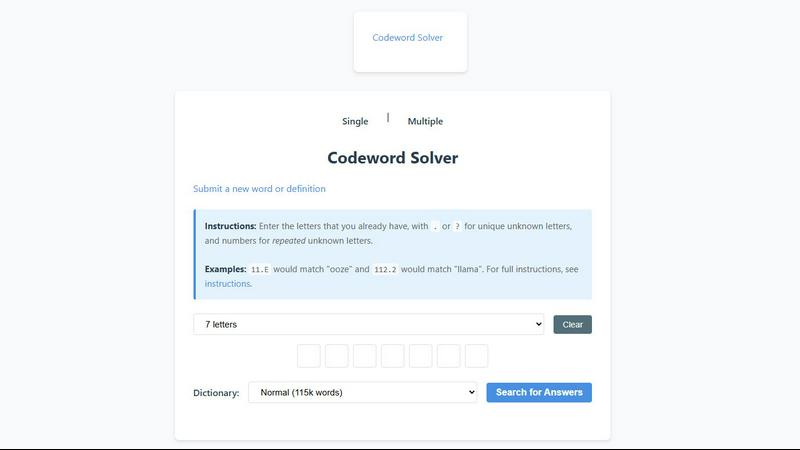
Quickly find missing words in your codewords with our intuitive solver, designed for efficiency and accuracy.
Last updated: February 26, 2026

Interactive Circle of Fifths
Master music theory with an interactive Circle of Fifths for scales, chords, and instrument visualization.
Last updated: March 1, 2026
Visual Comparison
Code Word Solver - Missing Words Finder
Interactive Circle of Fifths
Feature Comparison
Code Word Solver - Missing Words Finder
Single Pattern Solving
The single pattern solving feature allows users to input a specific word pattern and receive a list of matching word candidates. This functionality is particularly useful for solvers who may have identified a few letters in the grid but are unsure about the remaining characters. By inputting the known letters along with placeholders for unknown ones, the solver quickly narrows down possible words, enhancing the overall solving experience.
Multi-Pattern Solving
The multi-pattern solving capability lets users enter two patterns simultaneously to find linked words side-by-side. This feature is essential when the same number-to-letter relationships exist across multiple words in the puzzle. By analyzing these relationships, users can gain insights and solve for interconnected terms more efficiently, ultimately speeding up their puzzle-solving process.
Flexible Pattern Input
Code Word Solver offers a flexible pattern input system. Users can utilize placeholders such as "." or "?" to indicate unknown letters, while numbers can be used to denote repeated unknown letters. For instance, entering "112.2" can match words like "llama," which helps maintain consistency in solving. This versatility allows for a more tailored approach to different puzzles, accommodating various levels of complexity.
Customizable Dictionary Selection
Understanding that different puzzles require different word lists, the tool provides three dictionary sizes: Hard (260k words), Normal (115k words), and Easy (20k words). This feature allows users to select a dictionary that best suits their skill level and the complexity of the codeword puzzle they are tackling. By tailoring the word list, players can enjoy a more personalized experience that aligns with their puzzle-solving preferences.
Interactive Circle of Fifths
Dynamic Circle Interface
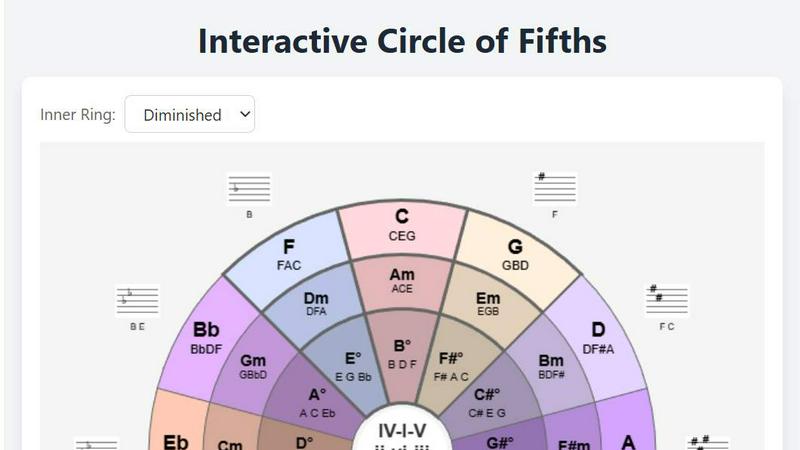
The central feature is a fully interactive, clickable Circle of Fifths diagram. Users can select any key as the tonic, and the entire interface updates in real-time to reflect all harmonic relationships originating from that tonal center. This includes the immediate display of the seven diatonic chords, their Roman numeral functions, and their parallel connections across the circle. The dynamic nature allows for instant transposition and visualization of key relationships, such as relative majors/minors and closely related keys, far surpassing the utility of a static image.
Integrated Scale & Chord Explorer
This feature provides detailed analysis of scale structures and their harmonized chords. Users can select from a comprehensive library of scales, including Diatonic, Pentatonic, Blues, and Diminished scales. Upon selection, the tool displays the precise notes of the scale and, crucially, automatically generates the complete set of chords that are built from each scale degree. This allows for deep study of scale harmonization principles and provides the foundational chords for composition and improvisation within that specific tonal color.
Visual Instrument Fingering Diagrams
To directly connect theory with physical execution, the tool incorporates precise, interactive fingering diagrams for both piano keyboard and guitar fretboard. When a chord or scale is selected, the corresponding finger positions are highlighted on these instrumental diagrams. This specification is critical for instrumentalists to translate theoretical chord symbols and scale notes into accurate, playable shapes on their instrument, facilitating efficient practice and performance application.
Chord Sequencer & Functional Analysis Panel
This advanced panel enables the construction and analysis of chord progressions. Users can sequence chords (e.g., C, Dm, Em, F) and the interface will display their functional Roman numeral analysis (I, ii, iii, IV) within the active key. Additional metadata for each chord, such as its scale degree and typical resolution target ("Resolves To"), is provided. This feature is essential for understanding cadential motion, composing logically flowing progressions, and studying the syntactic rules of functional harmony in a practical, hands-on environment.
Use Cases
Code Word Solver - Missing Words Finder
Improving Puzzle Solving Efficiency
For avid codeword puzzle enthusiasts, the Code Word Solver can significantly improve solving efficiency. By narrowing down potential answers quickly, users can spend less time guessing and more time enjoying the challenge of the puzzle. This tool is a game-changer for anyone looking to solve puzzles faster without sacrificing accuracy.
Learning Tool for New Solvers
Newcomers to codeword puzzles can benefit from the solver as a learning tool. By inputting patterns and observing the solver's output, beginners can develop a better understanding of common letter patterns and relationships in codewords. This educational aspect can enhance their skills and confidence in tackling more complex puzzles in the future.
Competitive Puzzle Solving
In competitive puzzle-solving environments, speed and accuracy are paramount. The Code Word Solver is an invaluable asset for competitors looking to gain an edge over their peers. By using the solver to quickly identify potential words, competitors can improve their performance and increase their chances of winning puzzle-solving events.
Community Contributions for Enhanced Word Coverage
The software encourages community engagement by allowing users to submit new words or definitions to improve the database over time. This feature not only enhances word coverage but also fosters a sense of community among puzzle solvers. Users can contribute to the tool's evolution, ensuring that it remains comprehensive and up-to-date with the latest language trends.
Interactive Circle of Fifths
Music Theory Education & Homework
Students can use the tool to visualize and verify complex theoretical concepts taught in class. Instead of manually drawing circles or calculating chords, they can instantly see the structure of any key, harmonize any scale, and check the functional analysis of progressions. This interactive verification accelerates comprehension and serves as a powerful aid for completing assignments on harmony, scale construction, and chord progression analysis with accurate, immediate feedback.
Songwriting & Chord Progression Development
Songwriters and composers can leverage the Chord Sequencer and interactive circle to break out of creative ruts. By experimenting with different tonal centers and viewing the available diatonic chords, they can construct novel progressions. The "Resolves To" functionality suggests conventional harmonic movements, which can be followed or subverted intentionally. This use case transforms the tool from a reference into an active brainstorming partner for harmonic development.
Instrumental Practice & Fretboard/Keyboard Mastery
Guitarists and pianists utilize the integrated fingering diagrams to learn chord voicings and scale patterns in all keys. A user can select a challenging chord, such as B° (B diminished), and instantly see its formation on their instrument across different positions. This is invaluable for systematic practice, memorizing the fretboard or keyboard geography, and applying new theoretical scales like the Diminished or Blues scale directly to their instrument in a musical context.
Analytical Reference for Arranging & Transcription
When arranging music or transcribing songs, musicians often need to quickly identify the key, analyze borrowed chords, or understand modal interchange. The Interactive Circle provides a central reference to identify non-diatonic chords by showing their relationship to the primary key and suggesting their possible origin from parallel modes or closely related keys, thereby clarifying the harmonic structure of complex pieces.
Overview
About Code Word Solver - Missing Words Finder
Code Word Solver - Missing Words Finder is an advanced tool designed specifically for enthusiasts and puzzle solvers who enjoy tackling codeword puzzles. This software enhances the solving experience by eliminating the guesswork typically involved in these puzzles. When faced with a challenging codeword grid, users can input known letter patterns into the solver, which then filters and presents potential word candidates. This tool is particularly beneficial for players who are often stuck and need a reliable method to decode the letters associated with numbers ranging from 1 to 26. Whether you are a seasoned puzzle expert or a casual player, this tool empowers you to decode grids with increased accuracy and confidence. Its user-friendly interface makes it accessible to everyone, ensuring that you can enjoy solving puzzles without the frustration of unproductive guessing.
About Interactive Circle of Fifths
The Interactive Circle of Fifths is a sophisticated digital music theory platform engineered to transform the foundational concepts of Western harmony into a dynamic, multi-sensory learning and composition tool. It transcends the limitations of static textbook diagrams by providing a fully interactive, clickable interface that visually and audibly maps the complex relationships between keys, chords, and scales in real-time. This tool is architected for serious musicians, including students, composers, songwriters, and instrumentalists, who require a deep, practical understanding of music theory applicable to their craft. Its core value proposition is the seamless integration of abstract theoretical knowledge with immediate auditory feedback and instrumental application. By centralizing critical concepts such as scale harmonization, chord function (I, ii, iii, IV, V, vi, vii°), modal interchange, and scale construction (Diatonic, Pentatonic, Blues, Diminished), it serves as both an accelerated learning system and an indispensable creative reference. Users can instantly visualize chord relationships within any key, hear their sonic character, and study precise fingerings on integrated piano and guitar fretboard diagrams, thereby effectively bridging the gap between theoretical study and practical performance or composition.
Frequently Asked Questions
Code Word Solver - Missing Words Finder FAQ
How do I use the pattern input feature?
To use the pattern input feature, simply enter the letters you already know, using "." or "?" for unknown letters, and numbers for repeated unknown letters. For example, "11.E" would match the word "ooze," while "112.2" could match "llama."
Can I solve multiple patterns at once?
Yes, the Code Word Solver allows for multi-pattern solving, enabling you to enter two patterns simultaneously. This is particularly useful when working with linked words that share similar number-to-letter relationships.
What dictionary sizes can I choose from?
The Code Word Solver offers three dictionary sizes: Hard (260k words), Normal (115k words), and Easy (20k words). You can select the dictionary that best matches your skill level and the complexity of the puzzle you are solving.
How can I contribute to the word database?
If you come across a word that is not in the database or wish to add a definition, you can submit it directly through the tool. This community-powered feature helps improve the solver's word coverage over time and ensures that the database remains current and comprehensive.
Interactive Circle of Fifths FAQ
What instruments does the Interactive Circle of Fifths support?
The tool provides dedicated visual fingering diagrams for two primary instruments: the piano (keyboard) and the guitar (fretboard). When any chord or scale is selected, the correct notes and recommended fingerings are displayed on clear, interactive diagrams for these instruments. This direct application helps bridge theory and practice for players of these instruments.
Can I use it to learn about modes and non-diatonic scales?
Yes. Beyond the standard major (Ionian) scale, the tool includes analysis for various scale structures. By selecting different scales from the inner ring, such as the Pentatonic or Blues scale, you can see their unique interval patterns and the chords derived from them. This functionality is fundamental for studying modes and understanding the harmonic flavor of non-diatonic scales in composition and improvisation.
How does the Chord Sequencer and "Resolves To" feature work?
The Chord Sequencer allows you to build a progression by selecting chords. The tool then analyzes each chord's function within the currently active key, displaying its Roman numeral (e.g., IV, V, vi). The "Resolves To" information indicates the chord's typical tendency tone resolution based on classical and common-practice harmony, such as the dominant (V) chord strongly resolving to the tonic (I). This guides users in creating progressions with strong cadential movement.
Is this tool suitable for complete beginners in music theory?
While the interface is designed for clarity, the tool is most effective for users with a basic foundational understanding of notes, chords, and what the Circle of Fifths represents. It is engineered to deepen theoretical knowledge and apply it practically. A true beginner might benefit from introductory resources first, but the interactive nature can significantly accelerate the learning curve for those already familiar with basic terminology.
Alternatives
Code Word Solver - Missing Words Finder Alternatives
Code Word Solver - Missing Words Finder is a specialized online tool designed to assist users in solving codeword puzzles efficiently. This tool falls under the category of puzzle-solving aids, focusing on enhancing the user experience through advanced pattern recognition and filtering capabilities. Many users seek alternatives to such tools for various reasons, including pricing concerns, feature sets that better match their needs, or compatibility with different platforms. When looking for an alternative, it’s essential to consider factors such as user interface, available dictionaries, and additional features that can enhance the puzzle-solving experience.
Interactive Circle of Fifths Alternatives
The Interactive Circle of Fifths is a specialized digital music theory tool within the Education & Learning category. It functions as a dynamic, interactive reference designed to visualize harmonic relationships, chord progressions, and scale structures, integrating auditory feedback and instrumental visualizations for practical application. Users may seek alternatives for various technical and practical reasons. These include budget constraints, specific feature requirements not addressed by the core product, or compatibility needs with different operating systems and platforms. The search often extends to finding solutions that align with particular pedagogical approaches or workflow integrations. When evaluating an alternative, key considerations should include the depth of theoretical coverage, the quality and accuracy of auditory playback, the range of supported instrument visualizations, and the overall user interface design. The optimal tool should effectively bridge abstract music theory concepts with executable instrumental knowledge, matching the user's specific learning or compositional objectives.