ltx2.site vs Project20x
Side-by-side comparison to help you choose the right tool.

ltx2.site
LTX-2 is an open-source AI that generates synchronized 4K video and audio locally in one step.
Last updated: February 28, 2026

Project20x
Project20x delivers AI governance solutions that ensure compliance and effectiveness for modern organizational policies.
Last updated: March 4, 2026
Visual Comparison
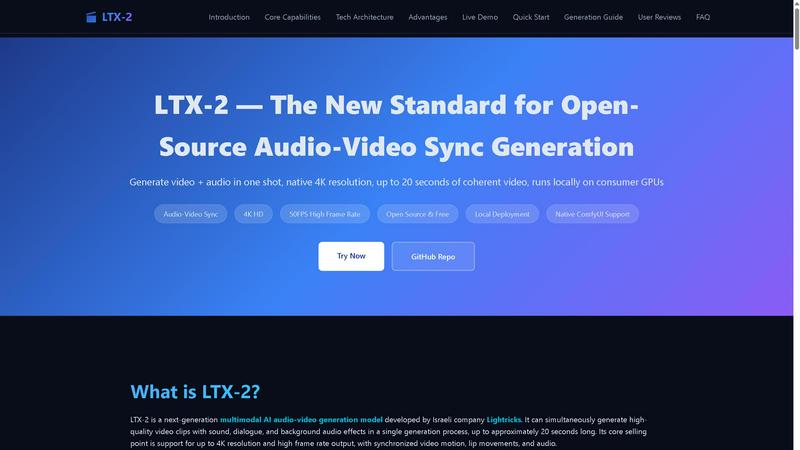
ltx2.site
Project20x
Feature Comparison
ltx2.site
Unified Audio-Video Generation
LTX-2's core capability is its one-shot generation of synchronized video and audio within a single diffusion process. This eliminates the need for separate audio dubbing, post-production compositing, and tedious timeline alignment. The model is trained to understand physical correspondences, ensuring character lip movements align with speech, actions like door openings are accompanied by matching sound effects, and background music rhythm coordinates with on-screen motion. This integrated approach delivers a complete, coherent audiovisual clip directly from the generation.
Professional 4K Resolution & High Frame Rate
The model is architected to support output at professional cinematic standards, specifically up to 4096x2160 (4K) resolution and approximately 50 frames per second. This high-fidelity output is sufficient for short films and commercial-grade content, providing outstanding detail and lighting performance. The native high-quality generation means the output can be used directly in professional editing pipelines without requiring additional upscaling or frame interpolation steps, a significant advantage among open-source models.
Local Deployment on Consumer GPUs
A major technical advantage of LTX-2 is its deep optimization for local deployment on mainstream NVIDIA consumer graphics cards with high VRAM. The model's architecture offers inference efficiency several times higher than previous generations and reduces computational cost by approximately 50%. With support for low-precision weights (NVFP4/NVFP8), generating 4K video locally becomes feasible, granting users full data privacy, workflow control, and freedom from cloud service dependencies and recurring subscription fees.
Native ComfyUI Integration & Flexible Control
LTX-2 offers advanced users a highly flexible and powerful workflow through its native integration with ComfyUI, a node-based visual programming interface. This allows for intricate pipeline building, customization, and experimentation. The model supports multiple control methods including text prompts, image inputs, and sketches, and provides configurable quality and speed modes (Fast, Pro, Ultra) to allow users to perfectly balance generation quality against processing time for their specific project needs.
Project20x
Governance Layer
The Governance Layer employs a sophisticated ten-step AI methodology that aids lawmakers in developing sound policies. This feature analyzes legislative texts for clarity, identifying potential conflicts to enhance the overall quality and effectiveness of policy-making.
Management Layer
The Management Layer transforms approved policies into functional code by implementing "Rules as Code." This feature streamlines the process of creating automated workflows, significantly improving operational efficiency within government agencies.
Interface Layer
Citizens benefit from the Interface Layer, which provides 24/7 access to AI agents trained on codified policies. This feature allows for streamlined public service interactions, enabling citizens to engage with their government effortlessly and receive real-time assistance.
Transparency and Accountability
Project20x prioritizes transparency and accountability by ensuring that all governmental activities are traceable and quantifiable. This feature guarantees that policies and processes are subject to rigorous human oversight, fostering trust and confidence among citizens.
Use Cases
ltx2.site
Prototyping for Film and Animation
Independent filmmakers and animation studios can use LTX-2 to rapidly prototype scenes, generate concept clips, and visualize storyboards with synchronized sound. The ability to produce up to 20 seconds of coherent, high-frame-rate 4K video with matching audio allows for the creation of compelling pitch materials and pre-visualization assets without the massive time and resource investment of traditional production methods, accelerating the creative development cycle.
AI Research and Model Development
AI researchers and developers working on multimodal systems can utilize the open-source LTX-2 model as a state-of-the-art baseline or a component for further experimentation. Its publicly available architecture and code allow for deep study into joint audio-video diffusion processes, fine-tuning on custom datasets, and the development of new control mechanisms or extensions, pushing forward the entire field of generative multimedia AI.
Dynamic Content for Social Media & Marketing
Digital marketers and social media content creators can leverage LTX-2 to produce unique, eye-catching short-form video content with perfect audio sync. This is ideal for creating engaging advertisements, product showcases, or branded storytelling clips where high production value is key. The local operation ensures brand assets and prompts remain confidential, and the speed enables rapid iteration on content ideas.
Game Development and Interactive Media
Game developers can integrate LTX-2 into their workflow to dynamically generate in-game cutscenes, character dialogue sequences, or environmental ambiance videos with matching sound effects. The model's ability to sync actions with sounds (like footsteps or door creaks) and dialogue with lip movements makes it a powerful tool for creating immersive, responsive narrative elements, especially for indie developers with limited voice-acting and animation budgets.
Project20x
Policy Development
Lawmakers can utilize Project20x to develop sound policies efficiently. By leveraging the Governance Layer, they can analyze complex legislative texts, ensuring clarity and identifying conflicts, ultimately leading to better-informed decision-making.
Workflow Automation
Government agencies can implement the Management Layer to automate workflows based on approved policies. This use case significantly enhances operational efficiency, reduces manual errors, and accelerates service delivery to citizens.
Public Engagement
Project20x facilitates enhanced public engagement through its Interface Layer, where citizens can access AI agents. This use case allows for real-time interactions, empowering citizens to seek information and clarify doubts regarding policies and services.
Compliance Monitoring
The platform can also be used for compliance monitoring, where government agencies track adherence to established policies. By leveraging the transparency and accountability feature, agencies can ensure that all activities align with regulatory requirements.
Overview
About ltx2.site
LTX-2, accessible via ltx2.site, is a groundbreaking open-source multimodal AI model developed by Lightricks, representing a significant leap forward in synchronized audio-video generation. This next-generation technology is engineered to produce high-quality, cinematic video clips complete with perfectly synchronized audio in a single, unified generation process. It is specifically designed for AI researchers, developers, digital artists, and professional content creators who require professional-grade output without the constraints of cloud-based subscriptions or proprietary software. The core value proposition of LTX-2 lies in its ability to generate up to 20 seconds of coherent 4K resolution video at approximately 50 frames per second, with audio elements such as dialogue, sound effects, and background music aligned precisely with on-screen actions. A key differentiator is its support for local deployment on consumer-grade NVIDIA GPUs, granting users full control over their workflow, data, and computational resources. Furthermore, its native integration with ComfyUI provides a flexible and powerful node-based interface for advanced customization and pipeline building, making it an indispensable tool for anyone pushing the boundaries of AI-generated multimedia and seeking a viable, high-quality open-source alternative.
About Project20x
Project20x is an innovative AI-driven platform specifically engineered to transform governmental operations by simplifying complex regulatory frameworks into accessible, actionable digital processes. It is designed for government agencies, lawmakers, and citizens alike, with the primary aim of fostering a seamless interaction between policy creation and public engagement. The platform is structured into three distinct layers: Governance, Management, and Interface. The Governance Layer utilizes a ten-step AI methodology to assist lawmakers in crafting robust policies by meticulously analyzing legislative texts for clarity and potential discrepancies. The Management Layer translates these approved policies into executable code through the implementation of "Rules as Code," facilitating the creation of efficient and automated workflows. Lastly, the Interface Layer grants citizens 24/7 access to AI agents that are well-versed in codified policies, thereby streamlining interactions with public services. Project20x is committed to ensuring transparency, accountability, and security, enabling all governmental activities to be traceable, quantifiable, and under rigorous human oversight.
Frequently Asked Questions
ltx2.site FAQ
What hardware is required to run LTX-2 locally?
LTX-2 is optimized for local deployment on consumer-grade NVIDIA GPUs. The primary requirement is a graphics card with sufficient VRAM (Video RAM). For generating high-quality 4K video, a high-VRAM GPU is recommended. The model's efficiency improvements and support for low-precision weights (like NVFP4/NVFP8) make it feasible to run on capable consumer hardware, significantly reducing the barrier to entry for professional-grade local audio-video generation compared to previous models.
How does LTX-2 achieve synchronization between audio and video?
LTX-2 uses a multimodal diffusion architecture that jointly models three dimensions: temporal (video motion between frames), spatial (visual content per frame), and acoustic (audio waveforms). During its training on vast datasets, the model learns the physical and semantic correspondences between actions and sounds. This allows it to generate, in a single cohesive process, video where elements like lip movements are temporally aligned with generated speech waveforms, and on-screen actions are paired with appropriate sound effects.
What is the maximum output length and quality?
A single generation with LTX-2 can produce up to approximately 20 seconds of continuous, coherent audio-video content. In terms of quality, the model officially supports output resolutions up to 4096x2160 (4K) and frame rates around 50 FPS. This emphasis on coherence reduces visual flicker and structural collapse across frames, making the output suitable for narrative scenes and camera movements, rather than just short, disjointed animated clips.
Is LTX-2 completely free to use?
Yes, LTX-2 is an open-source project. The model weights, code, and architecture are publicly available, typically through its GitHub repository. This means there are no licensing fees or subscription costs to use the core technology. The only potential costs are the computational resources required to run it, namely the electricity and hardware (GPU), which you own and control when running the model locally on your own machine.
Project20x FAQ
What is the main purpose of Project20x?
Project20x is designed to revolutionize governmental operations by translating complex regulatory frameworks into user-friendly digital processes, streamlining interactions between lawmakers, agencies, and citizens.
Who can benefit from using Project20x?
Government agencies, lawmakers, and citizens are the primary beneficiaries of Project20x, as it enhances policy development, public service interactions, and overall operational efficiency in governmental operations.
How does Project20x ensure transparency and accountability?
The platform ensures transparency and accountability by making all governmental activities traceable and quantifiable, subject to rigorous human oversight, which fosters trust among citizens.
Are there any training resources available for using Project20x?
Yes, Project20x offers comprehensive training resources and support to aid government agencies and lawmakers in effectively utilizing the platform for policy development and public engagement.
Alternatives
ltx2.site Alternatives
LTX-2, accessible via ltx2.site, is an open-source multimodal AI model for synchronized audio-video generation. It represents a significant advancement in the AI video creation category, producing high-quality 4K clips with aligned audio in a single, local process. Users may seek alternatives for various reasons, including different pricing models, the need for cloud-based accessibility, specific feature sets like longer generation times or different artistic styles, or simpler user interfaces that do not require technical deployment. When evaluating alternatives, key considerations include the core technology (text-to-video, image-to-video), output quality (resolution, frame rate), audio synchronization capabilities, deployment method (cloud vs. local), cost structure, and the required level of technical expertise for operation and customization.
Project20x Alternatives
Project20x is a cutting-edge AI governance platform designed to streamline governmental processes by transforming complex regulatory frameworks into actionable digital workflows. It serves government agencies, lawmakers, and citizens, enabling better policy creation and public engagement through its structured layers of Governance, Management, and Interface. Users often search for alternatives to Project20x due to factors such as pricing, diverse feature sets, or specific platform requirements that may not be fully met by this solution. When considering an alternative, it is essential to evaluate key aspects like compatibility with existing systems, the comprehensiveness of features offered, user-friendliness, and the level of customer support provided.