Finsi OS vs Prefactor
Side-by-side comparison to help you choose the right tool.

Finsi OS
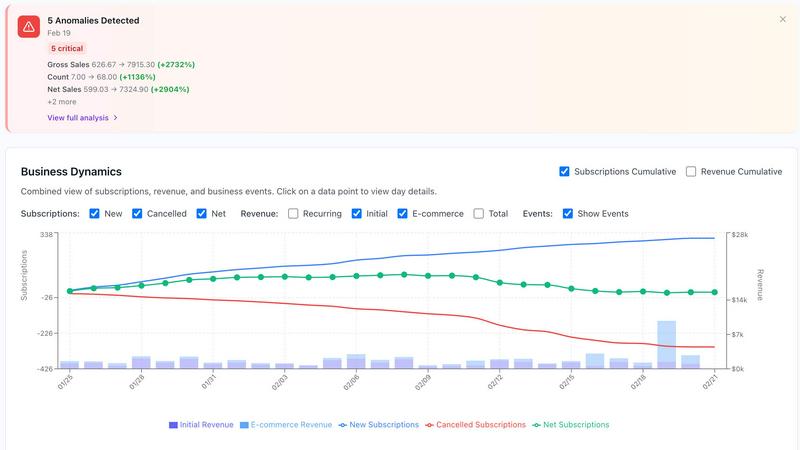
Finsi OS is an AI operating system that surfaces e-commerce insights and automates actions to increase customer.
Last updated: February 27, 2026

Prefactor
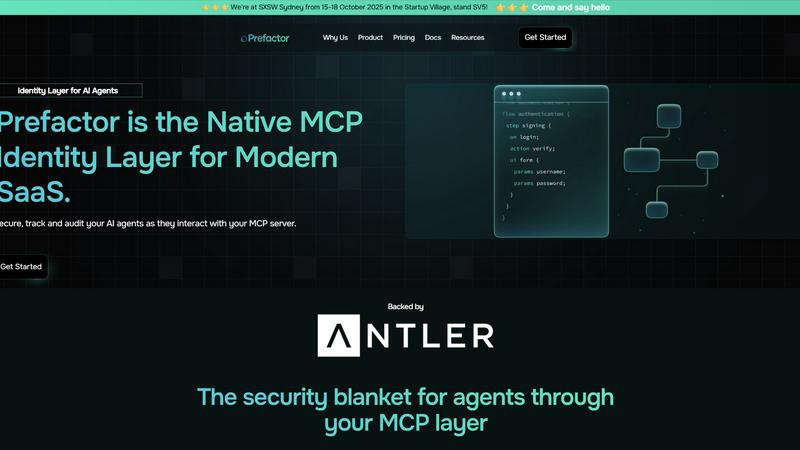
Prefactor is the identity and control plane for governing AI agents in production at scale.
Last updated: March 1, 2026
Visual Comparison
Finsi OS
Prefactor
Feature Comparison
Finsi OS
Retention Intelligence
This module provides deep cohort analysis, churn prediction algorithms, and customer health scoring to identify at-risk subscribers before they cancel. It orchestrates automated, personalized lifecycle campaigns across email and other channels based on these predictions. The system integrates behavioral data from platforms like Recharge and Shopify to trigger proactive retention actions, moving from reactive support to intelligent, pre-emptive customer retention.
Profit Intelligence
Finsi OS delivers real-time P&L analytics, unit economics, and contribution margin tracking updated daily, not monthly. It connects advertising spend from Meta and Google directly to revenue and profit data, allowing brands to understand the true profitability of each customer cohort, product, and marketing channel. This feature shifts financial reporting from a backward-looking monthly exercise to a daily operational tool for strategic decision-making.
Ads Autopilot
This AI-powered execution module manages Meta and Google Ads campaigns autonomously. It applies performance rules to pause underperforming ad sets, scale winners, and optimize budgets in real-time based on profitability goals. The system continuously tests and learns, removing manual guesswork and constant monitoring to drive efficient customer acquisition at scale.
AI Recommendations Engine
The platform's central intelligence layer unifies data from all connected sources to generate a ranked, weekly list of actionable recommendations. Each recommendation specifies what action to take, why it matters, and its estimated revenue impact across all modules—from launching a win-back campaign to adjusting ad creative. This prioritizes efforts on the highest-value opportunities.
Prefactor
Real-Time Agent Monitoring & Dashboard
The Prefactor control plane dashboard provides complete operational visibility across your entire agent infrastructure. It allows teams to monitor all agents in one centralized location, tracking which agents are active or idle, what resources and tools they are accessing in real-time, and where failures or anomalous behaviors emerge. This capability enables proactive incident management by identifying issues before they cascade, giving platform and engineering teams immediate answers to critical questions about agent activity and system health.
Identity-First Access Control & Governance
Prefactor applies established human identity governance principles to AI agents. Every agent is provisioned with a unique, first-class identity, and every action it performs is authenticated. This foundation enables fine-grained, policy-driven access management, ensuring each agent's permissions are precisely scoped to the minimum required for its function. This "identity-first" approach is fundamental for enforcing security boundaries, preventing unauthorized access to sensitive data or tools, and implementing a zero-trust architecture for autonomous systems.
Compliance-Ready Audit Trails & Reporting
The platform generates detailed audit logs that do not merely record low-level technical events like API calls. Instead, Prefactor translates agent actions into clear business context and understandable language for stakeholders. This functionality allows compliance, security, and audit teams to generate audit-ready reports in minutes, not weeks, providing definitive answers to regulatory inquiries about what an agent did and why. The trails are designed to withstand rigorous regulatory scrutiny in industries like finance and healthcare.
Emergency Kill Switches & Operational Control
Prefactor provides enterprise-grade operational controls, including emergency kill switches, to manage agent deployments safely. This feature allows administrators to immediately halt specific agents or groups of agents in the event of unexpected behavior, security incidents, or policy violations. It is a critical safety mechanism for maintaining operational control in production environments, especially when deploying autonomous systems that interact with business-critical data and processes.
Use Cases
Finsi OS
Proactive Subscription Churn Reduction
For DTC subscription brands, Finsi OS analyzes usage patterns, payment history, and engagement signals to assign a churn risk score to each subscriber. It then automatically triggers tailored email sequences or offer flows via Klaviyo or Recharge to re-engage at-risk customers before they cancel, directly improving retention rates and LTV without manual segment building.
Profit-Optimized Ad Spend Management
E-commerce brands can connect their ad accounts to shift from cost-based to profit-based bidding. The Ads Autopilot module uses real-time profit data from the Profit Intelligence layer to automatically reallocate budgets away from channels or campaigns that drive volume but low lifetime value, and towards those that acquire genuinely profitable customers.
Automated Customer Lifecycle Campaign Orchestration
Marketing teams can leverage Smart Segmentation with natural language queries and predictive LTV models to build dynamic customer segments. These segments are instantly pushed to execution platforms like Klaviyo to launch automated, multi-stage campaigns for onboarding, cross-selling, win-back, and loyalty, all orchestrated and measured within Finsi OS.
Data Unification and Insight Acceleration
Operators drowning in data silos use Finsi OS to connect Shopify, Recharge, Klaviyo, and ad platforms in minutes. The AI then analyzes everything, saving an average of 4 hours weekly on manual reporting and reconciliation. Teams gain a single source of truth for performance, enabling faster, more confident strategic decisions based on unified analytics.
Prefactor
Scaling AI Agent Pilots in Regulated Financial Services
A Fortune 500 financial institution can use Prefactor to move AI agent pilots for tasks like automated financial analysis or customer service triage into full production. The platform provides the necessary audit trails, identity governance, and real-time monitoring to satisfy internal compliance and external regulatory requirements (e.g., SOX, GDPR), turning a governance blocker into an enabler for secure, scalable deployment.
Managing Autonomous Systems in Healthcare Technology
Healthcare technology companies deploying agents for tasks such as patient data summarization or operational scheduling require strict HIPAA compliance and data access governance. Prefactor enables this by providing immutable audit logs of all agent interactions with protected health information (PHI), enforcing strict access policies, and ensuring every agent action is tied to a verifiable identity for accountability.
Operational Governance in Mining and Heavy Industry
For a mining technology company using AI agents to optimize logistics or monitor equipment, operational reliability and safety are paramount. Prefactor offers the visibility to track agent decisions affecting physical operations and the control mechanisms, like kill switches, to immediately intervene if an agent's behavior could lead to safety risks or costly operational downtime.
Centralized Governance for Multi-Framework AI Development
Organizations using a mix of AI agent frameworks (e.g., LangChain, CrewAI, AutoGen) for different use cases face fragmented governance. Prefactor acts as a unified control plane across all frameworks, providing consistent identity management, access control, and monitoring regardless of the underlying technology. This simplifies security policy enforcement and reduces the overhead of managing disparate systems.
Overview
About Finsi OS
Finsi OS is a comprehensive AI Revenue Intelligence platform engineered specifically for direct-to-consumer (DTC) e-commerce and subscription brands. It functions as an AI operating system, moving beyond traditional dashboards by unifying a brand's entire tech stack—including Shopify, Recharge, Klaviyo, Meta Ads, Google Ads, Stripe, Chargebee, and Zendesk—into a single, actionable interface. The platform's core purpose is to transform data chaos into strategic clarity, enabling brands to reduce customer churn, maximize customer lifetime value (LTV), and acquire customers profitably. It achieves this through 12 integrated modules that span two core functions: "Understand" and "Act." The system employs AI agents to analyze customer behavior, predict churn risk, surface ranked recommendations, and automate execution across retention campaigns and paid advertising. Built by the team that scaled Scentbird, it encapsulates over 11 years of retention expertise. Finsi OS is designed for e-commerce operators, marketers, and founders who seek to act on insights rather than spend time hunting for them, delivering proven results like a 20% average LTV increase and significant weekly time savings on manual reporting.
About Prefactor
Prefactor is the definitive control plane for AI agents, engineered to solve the critical governance, security, and operational challenges that arise when scaling autonomous agents from proof-of-concept demonstrations to regulated, production-scale deployments. It provides a centralized platform for managing agent identity, access control, and observability across an organization's entire AI agent infrastructure. The product is specifically designed for product, engineering, security, and compliance teams within SaaS companies and regulated enterprises—such as those in financial services, healthcare, and mining—who are running multiple AI agent pilots and require enterprise-grade security, auditability, and operational control. Its core value proposition is transforming the complex, fragmented challenge of agent authentication and governance into a single, elegant layer of trust. By providing every AI agent with a first-class, auditable identity and enabling fine-grained, policy-driven access management, Prefactor allows organizations to scale their agent deployments with confidence, maintain full visibility over every agent action, and generate compliance-ready audit trails that translate technical events into clear business context. It aligns security, product, engineering, and compliance teams around one source of truth, enabling governed scaling with shared visibility and control.
Frequently Asked Questions
Finsi OS FAQ
What makes Finsi OS different from other analytics dashboards?
Finsi OS is an AI operating system, not just a dashboard. While dashboards visualize data, Finsi OS unifies data from your entire stack, analyzes it with AI to surface specific, ranked recommendations, and provides built-in tools to execute those actions—from automated ad management to triggered email campaigns. It closes the loop from insight to action.
How does the platform's AI predict customer churn?
The churn prediction model analyzes a multitude of behavioral and transactional signals, including purchase frequency, engagement with emails, product usage patterns, support ticket sentiment, and payment history. It uses machine learning algorithms trained on over 11 years of subscription commerce data to identify patterns indicative of future cancellation and assigns a dynamic risk score to each customer.
Which integrations does Finsi OS support?
The platform offers native, pre-built integrations with core e-commerce and marketing systems including Shopify, Recharge, Klaviyo, Meta Ads, Google Ads, Stripe, Chargebee, and Zendesk. These connections are typically established in minutes via OAuth, ensuring secure and seamless data synchronization for real-time analysis and execution.
Is there a free trial or pilot program available?
Yes, Finsi OS offers a Start Free Pilot program. This allows qualified e-commerce brands to connect their data sources and experience the platform's modules—such as Profit Intelligence, Retention Intelligence, and AI Recommendations—firsthand to validate the impact and ROI before committing to a full subscription.
Prefactor FAQ
What is an AI Agent Control Plane?
An AI Agent Control Plane is a centralized management layer that provides governance, security, and operational oversight for autonomous AI agents. It functions similarly to an identity and access management (IAM) system or a Kubernetes control plane but is specifically designed for the unique challenges of AI agents, managing their identities, permissions, runtime behavior, and compliance postures across an organization.
How does Prefactor integrate with existing AI agent frameworks?
Prefactor is designed to be integration-ready and works with popular AI agent frameworks such as LangChain, CrewAI, and AutoGen, as well as custom-built agents. Integration typically involves using Prefactor's SDKs to instrument agents, allowing them to authenticate, check permissions, and stream activity logs to the control plane. This design enables deployment and integration within hours, not months.
What industries is Prefactor built for?
Prefactor is engineered for regulated industries and enterprises where security, compliance, and operational control are non-negotiable. Primary verticals include financial services (banking, insurance), healthcare and life sciences, mining and heavy industry, and any SaaS company handling sensitive customer data. It is for environments where "move fast and break things" is not a viable strategy.
Can Prefactor help optimize the cost of running AI agents?
Yes, Prefactor includes cost tracking and optimization features. It provides visibility into agent compute costs across different cloud providers and models. By analyzing activity logs and resource consumption patterns, teams can identify inefficient or expensive agent behaviors, right-size agent resources, and optimize spending as they scale their deployments.
Alternatives
Finsi OS Alternatives
Finsi OS is an AI Revenue Intelligence platform within the e-commerce marketing and customer retention category. It leverages artificial intelligence to automate churn prediction and execute personalized retention campaigns, aiming to increase customer lifetime value for direct-to-consumer brands. Users may explore alternatives for various reasons, including budget constraints, specific feature requirements not covered by the platform, or the need for integration with a niche technology stack outside of Finsi OS's core connectors. The search often stems from a desire for different pricing models, more granular control over automation workflows, or a platform with a broader or more specialized focus. When evaluating an alternative, key considerations should include the depth of AI and predictive analytics capabilities, the range and reliability of native integrations with your existing e-commerce and subscription tools, the level of automation versus manual intervention required, and the platform's proven impact on measurable metrics like LTV and churn rate. Scalability and the vendor's specific expertise in your vertical are also critical factors.
Prefactor Alternatives
Prefactor is an identity and control plane solution designed for governing AI agents in production at scale. It belongs to the AI infrastructure and governance category, providing centralized management for agent identity, access control, and observability. This platform is critical for organizations scaling autonomous agents beyond pilot phases. Users may explore alternatives for several reasons. These include budget constraints and specific pricing model requirements, the need for different feature integrations, or a preference for a broader platform suite versus a specialized tool. The technical architecture, such as on-premises versus SaaS deployment, and the depth of compliance certifications for regulated industries are also key decision factors. When evaluating alternatives, key criteria should include the robustness of the agent identity and authentication framework, the granularity of policy-based access controls, and the comprehensiveness of real-time monitoring and audit logging. The solution must also align with the organization's security posture and compliance mandates, ensuring it can translate technical agent actions into auditable business events.