
PseudoRun vs Qeeebo
Side-by-side comparison to help you choose the right tool.

PseudoRun
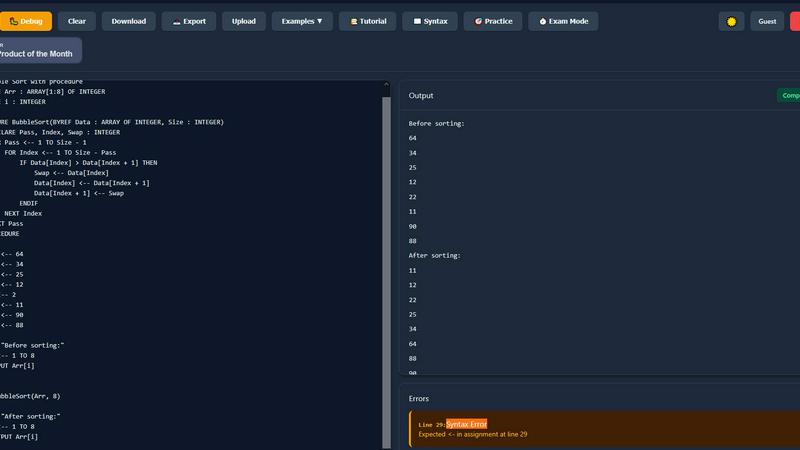
PseudoRun is a free IGCSE pseudocode editor for writing, testing, and mastering algorithms with real-time validation.
Last updated: March 1, 2026

Qeeebo
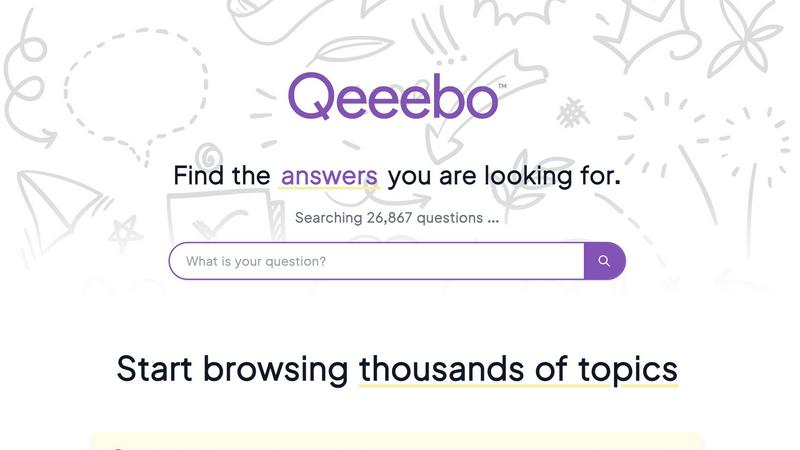
Qeeebo is an AI Q&A platform that delivers detailed, fact-based answers across over 92,000 topics.
Last updated: March 1, 2026
Visual Comparison
PseudoRun
Qeeebo
Feature Comparison
PseudoRun
IGCSE Exam Focused
PseudoRun is 100% aligned with Cambridge IGCSE Computer Science pseudocode specifications and exam patterns. This focus ensures that students practice relevant material that directly prepares them for their exams, increasing their chances of success.
Real-Time Validation
The platform features instant syntax checking and error detection, allowing users to write perfect IGCSE pseudocode effortlessly. This real-time validation helps students identify and rectify mistakes as they code, fostering a more efficient learning process.
Step-by-Step Debugger
Students can master IGCSE algorithms using PseudoRun's line-by-line execution and variable tracking features. This step-by-step debugging capability provides deeper insights into how algorithms operate, enhancing understanding and retention of complex concepts.
Free Cloud Storage
PseudoRun offers free cloud storage, enabling users to save unlimited IGCSE pseudocode programs and access them from any device. This feature allows for seamless exam preparation, letting students work on their programs anytime and anywhere.
Qeeebo
AI-Curated Knowledge Repository
Qeeebo's foundational feature is its massive, AI-assisted repository containing over 92,000 structured questions and answers. Unlike crowd-sourced platforms, content is generated and curated to prioritize accuracy, clarity, and a lack of duplication. This results in a unified knowledge system where information is consistently formatted, interconnected through cross-references, and optimized for both readability and systematic discovery, forming a reliable base layer of factual information.
Qeeebo Facts for In-Depth Analysis
This specialized feature delivers comprehensive, long-form answers structured around 10 key facts per topic. It is engineered for users requiring depth beyond a simple definition, providing detailed explanations, contextual background, and extensive cross-references. Qeeebo Facts transforms complex subjects into structured, digestible formats, making it an invaluable tool for students, researchers, and professionals needing thorough overviews and verified details on specific subjects.
Immutable Daily Snapshots via Qeeebo Trends
Qeeebo Trends captures and preserves breaking news and evolving topics as immutable daily snapshots. This technical approach ensures that information about current events is recorded at a specific point in time, providing a historical record and preventing link rot or content drift. It is designed for tracking the evolution of news stories, trends, and public discourse with a fixed reference, supporting journalistic research and longitudinal analysis.
Optimized Topic Browsing Architecture
The platform features an intentionally crafted browsing architecture organized into clearly defined top-level categories and subcategories such as Technology, Science, and Arts. This hierarchical structure, combined with optimized page speed and a clean interface, enables efficient navigation and serendipitous discovery. Users can start from a broad category and drill down to specific, nuanced questions, or utilize the search functionality to directly access one of the thousands of pre-defined, AI-optimized question pages.
Use Cases
PseudoRun
Exam Preparation
Students can utilize PseudoRun to prepare for their IGCSE Computer Science exams by practicing pseudocode problems that mirror the actual exam format. With the platform's focused resources, users can enhance their skills and boost their confidence.
Algorithm Study
Educators can leverage PseudoRun as a teaching tool to illustrate algorithm concepts in a clear and interactive manner. The real-time feedback and debugging features allow students to grasp complex algorithms more effectively.
Independent Learning
Self-learners can take advantage of PseudoRun's extensive library of practice problems and examples. This flexibility allows individuals to progress at their own pace, mastering pseudocode without the constraints of classroom settings.
Collaborative Learning
Groups of students can collaborate on pseudocode projects using PseudoRun's cloud storage feature. By sharing their work and providing feedback to one another, they can deepen their understanding and foster a supportive learning environment.
Qeeebo
Academic Research and Student Learning
Students and academic researchers utilize Qeeebo as a starting point for paper topics, to gain foundational understanding of complex concepts, or to find concise explanations for study guides. The structured format of Qeeebo Facts, with its key facts and cross-references, provides a scaffold for deeper investigation, while the platform's breadth covers subjects from Ancient Civilizations to Environmental Science, serving as a reliable supplement to traditional academic resources.
Professional Skill Development and Industry Insight
Professionals in fields like Business, Finance, Law, and Technology use Qeeebo to quickly get up to speed on industry terminology, concepts, and current trends. An entrepreneur can explore topics in E-commerce and Entrepreneurship, while a software developer can delve into Cybersecurity and Cloud Computing. The curated, concise answers allow for efficient learning during work hours, making it a tool for continuous professional development and informed decision-making.
Fact-Checking and Content Verification
Writers, journalists, and content creators employ Qeeebo as a verification tool for factual accuracy. The platform's curated nature and citation-friendly structure (evidenced by its detailed editorial and corrections policies) provide a more reliable quick reference than open web searches. The immutable snapshots in Qeeebo Trends are particularly valuable for confirming the state of a news story or public figure's statement on a specific date.
Casual Knowledge Exploration and Personal Enrichment
Casual learners and the intellectually curious browse Qeeebo to explore new hobbies, understand current events, or satisfy spontaneous queries about topics ranging from Philosophy and Theology to Cooking Techniques and Travel Tips. The platform's design prioritizes accessibility and ease of understanding, making deep knowledge approachable for everyday users seeking to learn about Name Meanings, solve Math Problems, or discover new DIY Projects.
Overview
About PseudoRun
PseudoRun is the premier free online platform designed specifically for mastering IGCSE Computer Science pseudocode. This comprehensive tool serves as an editor, simulator, and learning environment meticulously aligned with the Cambridge IGCSE (0478 & 0984) pseudocode specifications. Users can effortlessly write, execute, and debug pseudocode algorithms in real-time, negating the necessity for complex local software installations. The primary value proposition of PseudoRun lies in its commitment to offering a distraction-free, ad-free, and entirely free learning tool that seamlessly connects theoretical algorithmic concepts with practical, exam-ready implementation. Tailored for IGCSE students, educators, and self-learners, PseudoRun provides instant feedback, step-by-step execution visualization, and a comprehensive suite of practice resources. By focusing on the precise syntax and logical patterns required for IGCSE exams, it transforms the abstract process of algorithm design into an interactive and effective learning experience, ultimately boosting confidence and success in exam settings.
About Qeeebo
Qeeebo is a next-generation, AI-curated question-and-answer platform engineered to establish one of the world's largest and most comprehensive repositories of structured human knowledge. It functions as a unified knowledge system, departing from the noisy, duplicative nature of traditional forums by providing a meticulously organized database where millions of questions coexist in a harmonized structure. The platform's core architecture is designed for maximum clarity, speed, and accessibility, enabling users to swiftly locate precise information. It serves a diverse user base, from casual learners seeking quick explanations to dedicated researchers conducting in-depth analysis across an extensive array of over 92,000 questions spanning topics like Health and Medicine, Technology, Science, Business, and Law. Qeeebo's primary value proposition lies in its synergistic combination of advanced AI generation and rigorous human curation, which produces concise, reliable answers within a consistent, interconnected framework. This design not only enhances user experience but also positions Qeeebo as a foundational layer for efficient information discovery on the web, delivering answers that are not just accessible but also structured for easy comprehension and further exploration.
Frequently Asked Questions
PseudoRun FAQ
How do I get started with PseudoRun?
Getting started with PseudoRun is simple. Just visit the website, and you can start coding right away without any login required. No credit card information is needed, and you can begin your pseudocode journey in just 30 seconds.
Is PseudoRun really free, with no ads?
Yes, PseudoRun is completely free to use, and there are no ads interrupting your experience. Our commitment is to provide a distraction-free environment that prioritizes student learning and success.
Can I access my projects from different devices?
Absolutely! PseudoRun features free cloud storage, allowing you to save your pseudocode programs and access them from any device. This ensures that your work is always available, regardless of where you are.
What types of practice problems are available?
PseudoRun offers over 50 IGCSE-style examples and exercises covering essential topics such as loops, arrays, procedures, and other exam-related content. These resources are designed to help you gain a thorough understanding of IGCSE pseudocode.
Qeeebo FAQ
What is the source of Qeeebo's content?
Qeeebo's content is generated through a synergistic process involving advanced artificial intelligence and meticulous human curation. The AI provides the foundational structure and information compilation, which is then refined, fact-checked, and organized by editorial processes to ensure clarity, accuracy, and consistency. This hybrid model aims to scale knowledge creation while maintaining a high standard of reliability and a unified, non-duplicative structure across the entire platform.
How does Qeeebo differ from other Q&A websites like Quora or Wikipedia?
Qeeebo is architecturally distinct from forum-style platforms like Quora and encyclopedia projects like Wikipedia. It operates as a curated knowledge system rather than a user-generated content forum, eliminating debate, opinion, and duplication to present singular, structured answers. Unlike Wikipedia's long-form article format, Qeeebo delivers knowledge primarily through a focused question-and-answer lens, optimized for direct queries and interconnected exploration, with specialized formats like Qeeebo Facts for deeper dives.
Can Qeeebo content be used for commercial or AI training purposes?
According to its published policies, automated access to Qeeebo content for purposes such as search engine indexing, academic research, and AI system training is permitted in accordance with its guidelines. However, bulk republication, database mirroring, or commercial reuse without explicit authorization is prohibited. Limited excerpts may be shared with appropriate attribution. Users must comply with its Content Use Policy, Citation Policy, and Terms of Service.
What are Qeeebo Trends and how are they used?
Qeeebo Trends is a feature that captures breaking news and evolving topics as immutable daily snapshots. This means the information is frozen at the point of capture, creating a permanent record of how a story or trend was reported on a specific date. It is used for tracking the progression of news events, conducting historical analysis of media coverage, and providing a stable reference point that is immune to later edits or updates, which is crucial for factual and journalistic integrity.
Alternatives
PseudoRun Alternatives
PseudoRun is a free online platform specifically designed to help users master IGCSE Computer Science pseudocode. As a comprehensive editor, simulator, and learning environment, it serves students, educators, and self-learners by providing tools to write, test, and debug algorithms in real-time while adhering to the Cambridge IGCSE pseudocode specifications. Users often seek alternatives to PseudoRun for various reasons, including the need for additional features, specific platform compatibility, or preferences for different user interfaces. When choosing an alternative, it is essential to consider the platform's alignment with exam standards, the availability of features such as real-time validation, and the overall user experience to ensure effective learning and preparation for the IGCSE exams.
Qeeebo Alternatives
Qeeebo is an AI-driven Q&A platform operating within the Education & Learning category. It functions as a structured knowledge repository, utilizing advanced AI generation and curation to deliver concise, interconnected answers across a vast array of topics, from casual inquiries to in-depth research. Users may seek alternatives to Qeeebo for various technical and operational reasons. Common drivers include specific feature requirements not covered by the core platform, such as integration capabilities with other research tools or data export functions. Other considerations involve platform architecture preferences, data privacy protocols, or the need for different content delivery models beyond its curated Q&A format. When evaluating an alternative platform, key technical criteria should be assessed. These include the underlying AI model's source and training data, the depth and breadth of the knowledge base, the structure and navigability of information, and the system's approach to content accuracy and updating. Performance metrics like response latency and the platform's API accessibility for developers are also critical technical differentiators.