
Interactive Circle of Fifths vs Psychiatry Exams
Side-by-side comparison to help you choose the right tool.

Interactive Circle of Fifths
Master music theory with an interactive Circle of Fifths for scales, chords, and instrument visualization.
Last updated: March 1, 2026

Psychiatry Exams
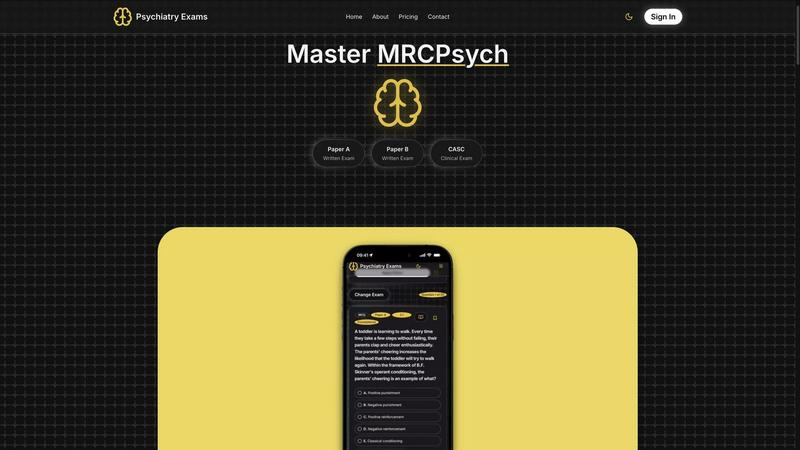
Psychiatry Exams provides AI-powered MRCPsych revision with verified recalled questions and expert explanations.
Last updated: March 1, 2026
Visual Comparison
Interactive Circle of Fifths
Psychiatry Exams
Feature Comparison
Interactive Circle of Fifths
Dynamic Circle Interface
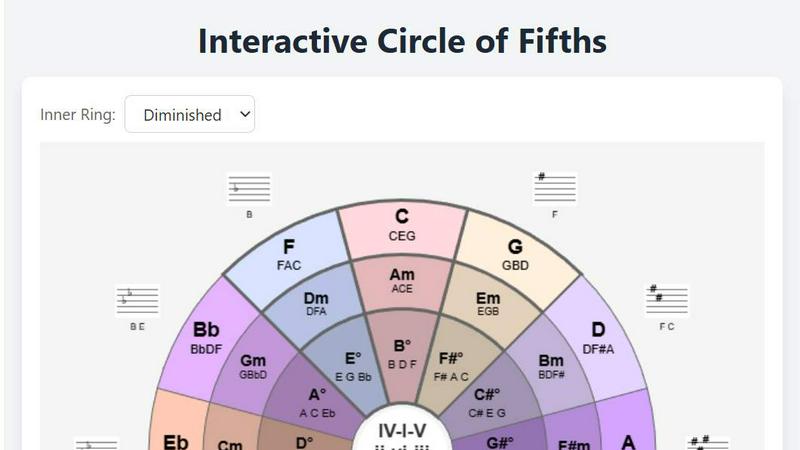
The central feature is a fully interactive, clickable Circle of Fifths diagram. Users can select any key as the tonic, and the entire interface updates in real-time to reflect all harmonic relationships originating from that tonal center. This includes the immediate display of the seven diatonic chords, their Roman numeral functions, and their parallel connections across the circle. The dynamic nature allows for instant transposition and visualization of key relationships, such as relative majors/minors and closely related keys, far surpassing the utility of a static image.
Integrated Scale & Chord Explorer
This feature provides detailed analysis of scale structures and their harmonized chords. Users can select from a comprehensive library of scales, including Diatonic, Pentatonic, Blues, and Diminished scales. Upon selection, the tool displays the precise notes of the scale and, crucially, automatically generates the complete set of chords that are built from each scale degree. This allows for deep study of scale harmonization principles and provides the foundational chords for composition and improvisation within that specific tonal color.
Visual Instrument Fingering Diagrams
To directly connect theory with physical execution, the tool incorporates precise, interactive fingering diagrams for both piano keyboard and guitar fretboard. When a chord or scale is selected, the corresponding finger positions are highlighted on these instrumental diagrams. This specification is critical for instrumentalists to translate theoretical chord symbols and scale notes into accurate, playable shapes on their instrument, facilitating efficient practice and performance application.
Chord Sequencer & Functional Analysis Panel
This advanced panel enables the construction and analysis of chord progressions. Users can sequence chords (e.g., C, Dm, Em, F) and the interface will display their functional Roman numeral analysis (I, ii, iii, IV) within the active key. Additional metadata for each chord, such as its scale degree and typical resolution target ("Resolves To"), is provided. This feature is essential for understanding cadential motion, composing logically flowing progressions, and studying the syntactic rules of functional harmony in a practical, hands-on environment.
Psychiatry Exams
Recalled & Consultant-Verified Question Bank
The platform hosts a comprehensive repository of over 2,446 questions directly recalled from actual MRCPsych exam sittings. Each question is rigorously adapted, verified, and quality-assured by a team of eight NHS consultants to ensure clinical accuracy, relevance, and alignment with current examination standards. This provides users with an authentic practice environment that closely mirrors the content and difficulty of the real examinations.
Multi-Model AI-Powered Explanations
Every question is supported by detailed explanations generated through a sophisticated AI engine that leverages top-tier models including Claude Opus 4.5, Gemini 3, and GPT 5.2. These AI insights are then cross-referenced with consultant expertise and the official Royal College syllabus to provide nuanced, accurate, and pedagogically sound rationales for both correct and incorrect answer choices, deepening conceptual understanding.
Structured Spaced Repetition Flashcard System
Integrated within the platform is a systematic flashcard system comprising 108 core concept cards designed for optimal long-term knowledge retention. The system employs evidence-based spaced repetition algorithms, prompting users to review material at strategically increasing intervals to combat memory decay and cement foundational psychiatry knowledge essential for exam success.
Consultant-Moderated Active Learning Community
A unique feature is the active, community-driven learning model. Users can contribute their own questions to earn AI credits (+2 per submission, +3 upon approval). These submissions enter a peer-review pipeline moderated by NHS consultants within a dedicated WhatsApp community, which includes discussion areas for each exam sitting and group calls, fostering collaborative learning and knowledge refinement.
Use Cases
Interactive Circle of Fifths
Music Theory Education & Homework
Students can use the tool to visualize and verify complex theoretical concepts taught in class. Instead of manually drawing circles or calculating chords, they can instantly see the structure of any key, harmonize any scale, and check the functional analysis of progressions. This interactive verification accelerates comprehension and serves as a powerful aid for completing assignments on harmony, scale construction, and chord progression analysis with accurate, immediate feedback.
Songwriting & Chord Progression Development
Songwriters and composers can leverage the Chord Sequencer and interactive circle to break out of creative ruts. By experimenting with different tonal centers and viewing the available diatonic chords, they can construct novel progressions. The "Resolves To" functionality suggests conventional harmonic movements, which can be followed or subverted intentionally. This use case transforms the tool from a reference into an active brainstorming partner for harmonic development.
Instrumental Practice & Fretboard/Keyboard Mastery
Guitarists and pianists utilize the integrated fingering diagrams to learn chord voicings and scale patterns in all keys. A user can select a challenging chord, such as B° (B diminished), and instantly see its formation on their instrument across different positions. This is invaluable for systematic practice, memorizing the fretboard or keyboard geography, and applying new theoretical scales like the Diminished or Blues scale directly to their instrument in a musical context.
Analytical Reference for Arranging & Transcription
When arranging music or transcribing songs, musicians often need to quickly identify the key, analyze borrowed chords, or understand modal interchange. The Interactive Circle provides a central reference to identify non-diatonic chords by showing their relationship to the primary key and suggesting their possible origin from parallel modes or closely related keys, thereby clarifying the harmonic structure of complex pieces.
Psychiatry Exams
Structured Syllabus Revision for Core Trainees (CT1-CT3)
CT1-CT3 trainees can utilize the platform to systematically cover the entire MRCPsych syllabus. The content is fully mapped to official Royal College learning objectives, and study notes reflect the latest recommended reading materials. This ensures trainees build a comprehensive knowledge base in a structured, efficient manner, directly targeting examinable content.
Targeted Practice for Higher Specialty Trainees (ST4-ST6)
Higher trainees preparing for Paper B and CASC components can focus on advanced topics and clinical application. The platform provides access to 15 CASC clinical vignettes and complex scenario-based questions from the recalled bank, allowing for targeted practice of diagnostic reasoning, management planning, and communication skills required at the ST4+ level.
Exam Technique Refinement and Mock Simulation
Trainees can use the vast question bank to simulate exam conditions and refine their test-taking strategy. Practicing with timed questions, especially those recalled from recent exam sittings, helps users improve time management, question interpretation skills, and build the stamina needed for the lengthy Paper A and Paper B examinations.
Knowledge Gap Identification and Remediation
The combination of detailed AI/consultant explanations, the flashcard system, and performance analytics allows users to identify persistent areas of weakness. They can then focus their revision on these specific topics, using targeted question filters and spaced repetition flashcards to efficiently remediate knowledge gaps before the exam.
Overview
About Interactive Circle of Fifths
The Interactive Circle of Fifths is a sophisticated digital music theory platform engineered to transform the foundational concepts of Western harmony into a dynamic, multi-sensory learning and composition tool. It transcends the limitations of static textbook diagrams by providing a fully interactive, clickable interface that visually and audibly maps the complex relationships between keys, chords, and scales in real-time. This tool is architected for serious musicians, including students, composers, songwriters, and instrumentalists, who require a deep, practical understanding of music theory applicable to their craft. Its core value proposition is the seamless integration of abstract theoretical knowledge with immediate auditory feedback and instrumental application. By centralizing critical concepts such as scale harmonization, chord function (I, ii, iii, IV, V, vi, vii°), modal interchange, and scale construction (Diatonic, Pentatonic, Blues, Diminished), it serves as both an accelerated learning system and an indispensable creative reference. Users can instantly visualize chord relationships within any key, hear their sonic character, and study precise fingerings on integrated piano and guitar fretboard diagrams, thereby effectively bridging the gap between theoretical study and practical performance or composition.
About Psychiatry Exams
Psychiatry Exams is a sophisticated, mobile-optimized digital platform engineered specifically for psychiatry trainees preparing for the demanding Membership of the Royal College of Psychiatrists (MRCPsych) examination suite. It directly addresses the significant financial and logistical burdens of traditional exam preparation, which typically involve costly exam fees, textbooks, question banks, and mock exams, by consolidating all essential revision resources into a single, accessible membership. The platform's core value proposition is its active learning ecosystem, which moves beyond passive question practice. It integrates a vast repository of over 2,400 recalled and consultant-verified exam questions with an advanced AI-powered explanation engine, a structured flashcard system utilizing spaced repetition algorithms, and a unique, consultant-moderated community-driven question generation methodology. Meticulously aligned with the latest Royal College of Psychiatrists syllabus updates, the platform ensures content relevance and clinical accuracy. Its primary user base comprises CT1-ST6 trainees, SAS doctors, and international medical graduates seeking a structured, evidence-based, and collaborative approach to mastering the Paper A, Paper B, and Clinical Assessment of Skills and Competencies (CASC) components.
Frequently Asked Questions
Interactive Circle of Fifths FAQ
What instruments does the Interactive Circle of Fifths support?
The tool provides dedicated visual fingering diagrams for two primary instruments: the piano (keyboard) and the guitar (fretboard). When any chord or scale is selected, the correct notes and recommended fingerings are displayed on clear, interactive diagrams for these instruments. This direct application helps bridge theory and practice for players of these instruments.
Can I use it to learn about modes and non-diatonic scales?
Yes. Beyond the standard major (Ionian) scale, the tool includes analysis for various scale structures. By selecting different scales from the inner ring, such as the Pentatonic or Blues scale, you can see their unique interval patterns and the chords derived from them. This functionality is fundamental for studying modes and understanding the harmonic flavor of non-diatonic scales in composition and improvisation.
How does the Chord Sequencer and "Resolves To" feature work?
The Chord Sequencer allows you to build a progression by selecting chords. The tool then analyzes each chord's function within the currently active key, displaying its Roman numeral (e.g., IV, V, vi). The "Resolves To" information indicates the chord's typical tendency tone resolution based on classical and common-practice harmony, such as the dominant (V) chord strongly resolving to the tonic (I). This guides users in creating progressions with strong cadential movement.
Is this tool suitable for complete beginners in music theory?
While the interface is designed for clarity, the tool is most effective for users with a basic foundational understanding of notes, chords, and what the Circle of Fifths represents. It is engineered to deepen theoretical knowledge and apply it practically. A true beginner might benefit from introductory resources first, but the interactive nature can significantly accelerate the learning curve for those already familiar with basic terminology.
Psychiatry Exams FAQ
How current and reliable is the question bank content?
The question bank is dynamically updated with questions recalled from the most recent MRCPsych exam sittings, such as the July 2024 sitting. All content is meticulously verified and adapted by a panel of eight practicing NHS consultants to ensure clinical accuracy and alignment with the latest Royal College of Psychiatrists syllabus and guidelines, guaranteeing high reliability and relevance.
What is the "active learning" and "earn AI credits" system?
This is a core pedagogical methodology of the platform. Users actively contribute to the question bank by submitting their own high-quality questions. They earn +2 AI credits for each submission and a +3 bonus when a question is approved by consultant moderators. This process deepens understanding, encourages critical engagement with the syllabus, and fosters a collaborative learning community.
Does the platform cover all parts of the MRCPsych exam?
Yes, the platform provides complete coverage for the entire MRCPsych examination suite. This includes comprehensive resources for Paper A (written exam), Paper B (written exam), and the Clinical Assessment of Skills and Competencies (CASC). Content is specifically mapped to the learning objectives for each component, including dedicated CASC vignettes.
What is the structure of the learning community?
The platform is supported by a thriving, consultant-moderated WhatsApp community. This community is organized with dedicated discussion channels for each upcoming exam sitting, facilitating peer-to-peer support. NHS consultants moderate discussions, provide guidance, and host group calls, creating a structured yet collaborative environment for shared learning and motivation.
Alternatives
Interactive Circle of Fifths Alternatives
The Interactive Circle of Fifths is a specialized digital music theory tool within the Education & Learning category. It functions as a dynamic, interactive reference designed to visualize harmonic relationships, chord progressions, and scale structures, integrating auditory feedback and instrumental visualizations for practical application. Users may seek alternatives for various technical and practical reasons. These include budget constraints, specific feature requirements not addressed by the core product, or compatibility needs with different operating systems and platforms. The search often extends to finding solutions that align with particular pedagogical approaches or workflow integrations. When evaluating an alternative, key considerations should include the depth of theoretical coverage, the quality and accuracy of auditory playback, the range of supported instrument visualizations, and the overall user interface design. The optimal tool should effectively bridge abstract music theory concepts with executable instrumental knowledge, matching the user's specific learning or compositional objectives.
Psychiatry Exams Alternatives
Psychiatry Exams is a specialized digital education platform within the MRCPsych exam preparation category. It provides an AI-integrated, mobile-optimized ecosystem for psychiatry trainees, consolidating verified recalled questions, structured flashcards, and a collaborative community into a single membership to mitigate the high cost and fragmentation of traditional revision resources. Users may seek alternatives for various reasons, including budget constraints, a preference for different learning methodologies such as purely textbook-based study or in-person courses, or a need for platform-specific features like offline access or integration with other institutional systems. The search often centers on finding a solution that aligns with individual study habits, financial considerations, and specific syllabus coverage requirements. When evaluating alternatives, key criteria should include the provenance and clinical verification of question banks, alignment with the latest Royal College of Psychiatrists syllabus, the pedagogical depth of answer explanations, and the overall cost-effectiveness of the resource package. The platform's technological robustness, including mobile optimization and data security, is also a critical consideration for modern, on-the-go trainees.