Renderly vs WebPageSnap - Professional Web Scraper API
Side-by-side comparison to help you choose the right tool.

Renderly
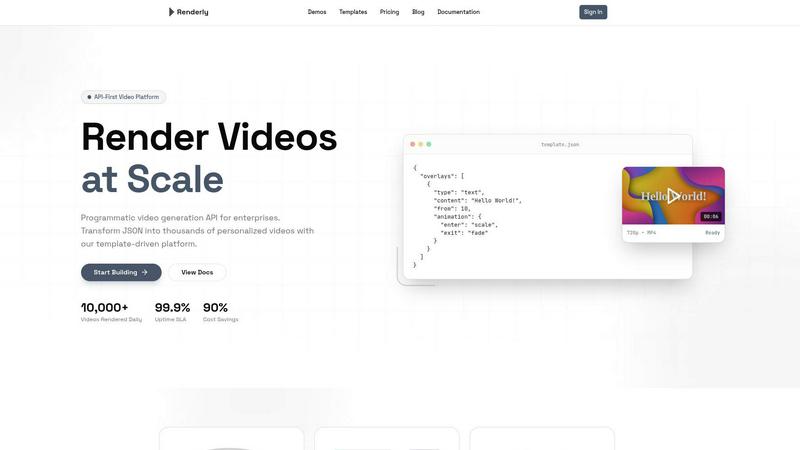
Renderly automates video production at scale, enabling thousands of personalized videos to be generated via a robust.
Last updated: February 26, 2026

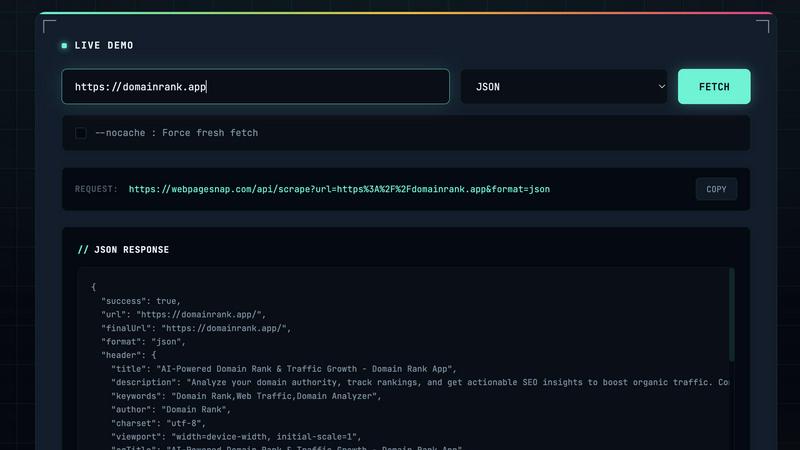
WebPageSnap is a high-performance API that scrapes web pages into structured JSON or raw HTML with global edge caching.
Last updated: February 28, 2026
Visual Comparison
Renderly
WebPageSnap - Professional Web Scraper API
Feature Comparison
Renderly
API-First Architecture
Renderly boasts a RESTful API designed specifically for high-volume video generation, allowing developers to integrate video production seamlessly into their applications. The comprehensive documentation and SDKs facilitate easy implementation, ensuring that users can leverage programmatic video generation effectively.
Template Management
The platform features a centralized template library equipped with version control and JSON configuration. This allows users to manage their video templates efficiently, enabling dynamic content replacement to create personalized videos that cater to diverse audiences without manual editing.
Scalable Infrastructure
Renderly's cloud-native architecture is engineered for auto-scaling, ensuring that it can handle thousands of concurrent video renders. Whether creating a single video or scaling up to 100,000+, the infrastructure adapts to meet demand, maintaining performance and reliability throughout the rendering process.
Credit-Based Billing
Renderly offers a transparent pay-per-render pricing model, allowing users to pay only for the videos they produce. This credit-based system includes volume discounts for enterprise customers, making it a cost-effective choice for businesses engaged in high-volume video production.
WebPageSnap - Professional Web Scraper API
Smart Cache with KV Storage
The API incorporates an intelligent caching mechanism backed by Cloudflare's KV storage. Each fetched webpage is cached with a configurable 7-day Time-To-Live (TTL). This system achieves a cache hit rate of over 95%, meaning subsequent requests for the same URL are served from the nearest edge location in under 50ms. This feature minimizes bandwidth usage, reduces load on target servers, and ensures blazing-fast data retrieval for applications requiring frequent access to the same web resources.
Global Edge Network Deployment
WebPageSnap is deployed across a globally distributed network of more than 200 Cloudflare edge nodes. This architecture ensures that every API request is processed from the data center geographically nearest to the user or application server. The result is consistently low-latency response times, regardless of the location of the user or the target website, providing a reliable and fast scraping experience on a global scale.
Multi-Format Output (JSON & HTML)
The API provides versatile output formats to suit different application needs. By default, it returns a structured JSON object containing parsed metadata (title, description, Open Graph tags, Twitter cards, etc.) and the raw HTML body. Alternatively, users can specify the format=html parameter to receive the complete, raw HTML source of the page directly. This flexibility allows developers to easily integrate extracted data into applications, databases, or analytical pipelines without manual parsing.
Smart Redirect Following & Anti-Bot Bypass
WebPageSnap is engineered to handle modern web complexities. It automatically detects and follows JavaScript-based redirects, ensuring the API returns content from the final destination URL. Furthermore, it employs realistic browser simulation and header management to mimic human-like traffic, enhancing its ability to bypass common anti-bot and scraping protection mechanisms deployed on websites, thereby improving success rates for data extraction.
Use Cases
Renderly
Personalized Marketing Videos
Businesses can utilize Renderly to create personalized marketing videos at scale. By leveraging customer data, companies can generate tailored video content seamlessly, enhancing engagement and improving conversion rates for their marketing campaigns.
Bulk Social Media Content
Renderly is ideal for generating bulk social media videos. Brands can automate the creation of numerous video assets tailored for various platforms, ensuring consistent and timely content delivery while saving valuable time and resources.
Data-Driven Motion Graphics
Organizations can use Renderly to create dynamic motion graphics that respond to real-time data inputs. This capability is particularly useful for finance, sports, and news industries where timely and relevant visual content is crucial for audience engagement.
Event Highlights and Recaps
Renderly can be employed to produce event highlight reels and recaps. By automating the video generation process, event organizers can quickly create engaging content that showcases key moments, enhancing post-event marketing efforts and audience reach.
WebPageSnap - Professional Web Scraper API
Market Research and Competitive Analysis
Businesses can systematically monitor competitor websites, tracking changes in product listings, pricing strategies, promotional content, and feature announcements. By automating data extraction into a structured JSON format, companies can feed this information into dashboards and analytical models to gain actionable market insights and maintain a competitive edge without manual oversight.
Content Aggregation and News Monitoring
Media companies and content platforms can use the API to aggregate articles, blog posts, or news updates from various sources across the web. The ability to fetch raw HTML or specific metadata like titles, descriptions, and publication images allows for the automated curation and syndication of content, powering news feeds, summary applications, and trend analysis reports.
SEO and Digital Marketing Analytics
SEO professionals and digital marketers can leverage the API to audit and analyze website metadata at scale. They can extract title tags, meta descriptions, header structures, and Open Graph data from thousands of pages to conduct technical SEO audits, track search engine result page (SERP) changes, and verify the correct implementation of social media tags across client portfolios.
Academic Research and Data Mining
Researchers and data scientists can utilize WebPageSnap to collect large datasets from publicly available websites for quantitative analysis, sentiment analysis, or social science research. The reliable fetching mechanism and structured JSON output facilitate the creation of clean, analyzable datasets from web content, supporting academic studies and machine learning model training.
Overview
About Renderly
Renderly is an advanced video infrastructure platform designed for developers and content creators who seek to automate video production at scale. With a focus on programmatic video generation, Renderly empowers users to transform structured data, such as JSON, into thousands of personalized videos seamlessly. Whether you're generating bulk content for social media campaigns, creating personalized marketing videos, or developing dynamic motion graphics driven by data, Renderly offers the tools and APIs necessary for instant video creation. The platform is particularly suited for enterprises looking to enhance their video output efficiently while significantly reducing costs. With Renderly, users benefit from a robust, scalable solution that ensures high performance, reliability, and a customizable experience tailored to their specific needs.
About WebPageSnap - Professional Web Scraper API
WebPageSnap is an enterprise-grade web scraping API engineered for developers, data scientists, and businesses that demand reliable, high-performance access to web content. Built on the globally distributed infrastructure of Cloudflare Workers and leveraging a network of over 200 edge nodes, the API is designed for low-latency data extraction from any public webpage. Its core value proposition lies in simplifying the complex process of web scraping by providing a single, robust REST API endpoint that handles the technical challenges of fetching, parsing, and caching. The service features an intelligent caching system with a Key-Value (KV) storage backend, offering a 7-day Time-To-Live (TTL) and achieving a cache hit rate exceeding 95%, which drastically reduces redundant requests and ensures sub-50ms response times for cached content. Users can extract comprehensive page metadata and choose between cleanly structured JSON or raw HTML output, making it adaptable for a wide array of technical applications. With built-in capabilities like automatic JavaScript redirect following and realistic browser simulation to bypass anti-bot measures, WebPageSnap delivers the final, rendered page content consistently. Its bilingual interface (English and Chinese) and generous free tier of 100,000 requests per day further enhance its accessibility and utility for global users.
Frequently Asked Questions
Renderly FAQ
What types of videos can I create with Renderly?
Renderly allows users to create a wide range of videos, including personalized marketing videos, bulk social media content, data-driven motion graphics, and event highlight reels. The template-driven approach enables customization for various use cases.
How does Renderly ensure video quality during rendering?
Renderly maintains high-quality video output through a sophisticated rendering engine that optimizes the video generation process. The platform supports various resolutions, including 720p, ensuring that videos meet industry standards.
Is Renderly suitable for small businesses or just enterprises?
While Renderly is built with enterprise-grade capabilities, it is also suitable for small businesses seeking to scale their video production efficiently. The credit-based pricing model allows businesses of all sizes to pay only for the videos they produce.
How does Renderly handle data security?
Renderly is committed to security and compliance, featuring SOC 2 compliant infrastructure. Data encryption, access controls, and audit logging are integral to the platform, ensuring that user data and content are protected throughout the video production process.
WebPageSnap - Professional Web Scraper API FAQ
What is a web scraper API?
A web scraper API is a programmatic interface designed to automate the extraction of content and data from websites. Unlike building and maintaining a custom scraping infrastructure, an API like WebPageSnap handles the complexities of HTTP requests, parsing, rendering, and anti-bot mitigation. It provides the extracted data in ready-to-use formats such as JSON or HTML, allowing developers to integrate live web data directly into their applications, databases, or analytical workflows with minimal overhead.
How does this web scraper API handle JavaScript pages?
WebPageSnap is equipped with smart redirect-following capabilities. It automatically detects and processes JavaScript-driven redirects and meta-refresh tags that are commonly used in modern web applications. The API simulates the behavior of a real browser to execute these client-side instructions, ensuring that the response contains the content from the final, rendered destination page, not just the initial HTML response that may contain redirect code.
Is the web scraper API free to use?
Yes, WebPageSnap offers a generous free tier designed for development, testing, and low-volume projects. This tier provides up to 100,000 API requests per day at no cost. This allows users to evaluate the API's performance, integrate it into prototypes, and run small-scale operations without any financial commitment, making it highly accessible for individual developers and startups.
What is the Claude Code Skill for WebPageSnap?
The Claude Code Skill is an integration that allows users of Claude Code (an AI coding assistant) to directly utilize the WebPageSnap API through natural language commands. Once installed, users can simply ask Claude to "fetch" or "scrape" a webpage, and the skill will automatically format the request, call the WebPageSnap API, and return the structured results, streamlining the data-gathering process within the development environment.
Alternatives
Renderly Alternatives
Renderly is an advanced video infrastructure platform designed to automate video production through code. It allows developers and content creators to generate thousands of videos in a matter of minutes, utilizing a powerful API and an intuitive online editor. This automation capability places Renderly firmly in the category of video production tools, specifically tailored for those in need of scaling their video content effectively. Users often seek alternatives to Renderly for various reasons, including pricing models, feature sets, and compatibility with existing workflows or platforms. As organizations grow and their needs evolve, they may find that their current solution does not meet their requirements for scalability, customization, or integration. When exploring alternatives, it is crucial to consider aspects such as ease of use, API capabilities, support for bulk video generation, and the ability to create personalized or data-driven content effectively.
WebPageSnap - Professional Web Scraper API Alternatives
WebPageSnap - Professional Web Scraper API is a robust tool within the web data extraction and tech tools category. It provides a streamlined API for developers and businesses to scrape public web pages, delivering structured JSON or raw HTML content with integrated metadata extraction and intelligent caching. Users often explore alternatives to find a solution that aligns precisely with their project's technical specifications, budget constraints, or specific feature requirements. Common considerations include the need for different output formats, more granular control over caching parameters, specific geographic data center locations, or pricing models that better suit varying usage volumes. When evaluating an alternative web scraping API, key technical criteria include the reliability and speed of the infrastructure, the comprehensiveness of data extraction capabilities, and the flexibility of the output. It is also crucial to assess the caching strategy's efficiency, the clarity and robustness of the API documentation, and the overall security and compliance posture of the service.