
Renderly vs Seedance 2 AI Video Generator
Side-by-side comparison to help you choose the right tool.

Renderly
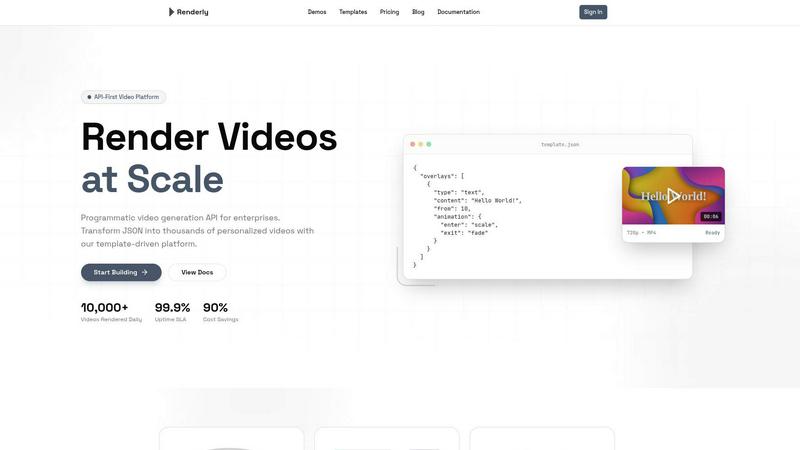
Renderly automates video production at scale, enabling thousands of personalized videos to be generated via a robust.
Last updated: February 26, 2026

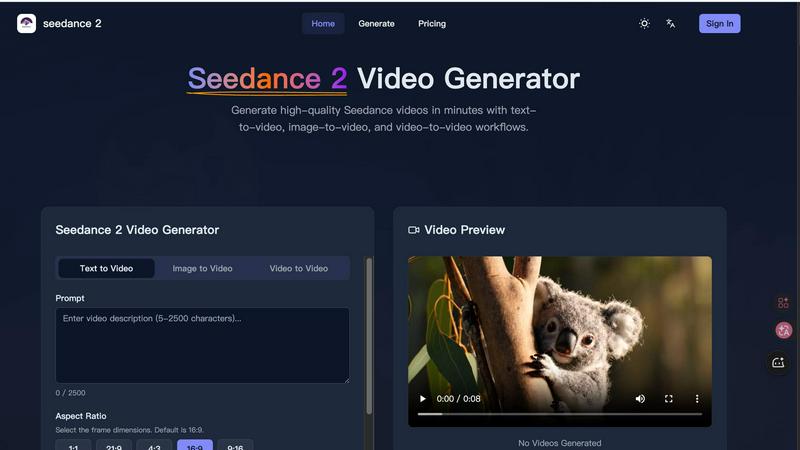
Seedance 2.0 transforms text, images, or clips into high-quality cinematic videos with precise control and consistent.
Last updated: March 1, 2026
Visual Comparison
Renderly
Seedance 2 AI Video Generator
Feature Comparison
Renderly
API-First Architecture
Renderly boasts a RESTful API designed specifically for high-volume video generation, allowing developers to integrate video production seamlessly into their applications. The comprehensive documentation and SDKs facilitate easy implementation, ensuring that users can leverage programmatic video generation effectively.
Template Management
The platform features a centralized template library equipped with version control and JSON configuration. This allows users to manage their video templates efficiently, enabling dynamic content replacement to create personalized videos that cater to diverse audiences without manual editing.
Scalable Infrastructure
Renderly's cloud-native architecture is engineered for auto-scaling, ensuring that it can handle thousands of concurrent video renders. Whether creating a single video or scaling up to 100,000+, the infrastructure adapts to meet demand, maintaining performance and reliability throughout the rendering process.
Credit-Based Billing
Renderly offers a transparent pay-per-render pricing model, allowing users to pay only for the videos they produce. This credit-based system includes volume discounts for enterprise customers, making it a cost-effective choice for businesses engaged in high-volume video production.
Seedance 2 AI Video Generator
Multimodal Input Generation
Seedance 2.0 supports three distinct generation modes: Text-to-Video, Image-to-Video, and Video-to-Video. This multimodal flexibility allows users to initiate creation from a written concept, a visual reference image to maintain style consistency, or existing source footage for controllable restyling and motion transfer. Each mode is optimized for specific workflows, providing maximum creative flexibility whether you are concepting from scratch or iterating on established visual material.
Reference-First Workflow for Consistency
A key technical differentiator is its reference-first generation approach. By using an image or video clip as a reference input, the model anchors the output's character design, artistic style, color palette, and camera perspective. This significantly reduces the guesswork and iterative prompting often required in AI video generation, leading to more predictable, coherent, and brand-consistent results essential for professional projects and serialized content.
Joint Audio-Video Synthesis
The platform features advanced joint audio-video synthesis in a single generation pass. This includes synchronized audio generation encompassing sound effects (SFX), background music scoring, and voice dialogue. Critically, it supports accurate lip-sync for over ten languages, including English, Chinese, Japanese, and Korean. This integrated feature streamlines post-production by delivering a complete audiovisual package, eliminating the need for separate audio editing and syncing steps.
High-Fidelity Output Specifications
Seedance 2.0 delivers professional-grade output specifications. It generates videos up to 1080p resolution at a cinema-standard frame rate of up to 24fps for smooth playback. Videos can be created in durations of 5 to 10 seconds per generation, with extension capabilities, and in aspect ratios of 16:9, 9:16, and 1:1 for optimal display across social platforms, widescreen formats, and mobile screens. All output is delivered in the universally compatible MP4 (H.264) format.
Use Cases
Renderly
Personalized Marketing Videos
Businesses can utilize Renderly to create personalized marketing videos at scale. By leveraging customer data, companies can generate tailored video content seamlessly, enhancing engagement and improving conversion rates for their marketing campaigns.
Bulk Social Media Content
Renderly is ideal for generating bulk social media videos. Brands can automate the creation of numerous video assets tailored for various platforms, ensuring consistent and timely content delivery while saving valuable time and resources.
Data-Driven Motion Graphics
Organizations can use Renderly to create dynamic motion graphics that respond to real-time data inputs. This capability is particularly useful for finance, sports, and news industries where timely and relevant visual content is crucial for audience engagement.
Event Highlights and Recaps
Renderly can be employed to produce event highlight reels and recaps. By automating the video generation process, event organizers can quickly create engaging content that showcases key moments, enhancing post-event marketing efforts and audience reach.
Seedance 2 AI Video Generator
Rapid Social Media Content Creation
Marketing teams and social media managers can leverage Seedance 2.0 to rapidly produce a high volume of platform-specific video content. By quickly generating multiple versions of promotional clips, animated explainers, or engaging short-form videos in various aspect ratios (9:16 for Reels/TikTok, 1:1 for Instagram), teams can maintain a consistent posting schedule and A/B test content without extensive production timelines or resource allocation.
Concept Visualization and Storyboarding
Filmmakers, ad agencies, and creative directors can use the Text-to-Video and Image-to-Video modes to visualize concepts and create dynamic storyboards. This allows for the fast iteration of visual ideas, camera movements, and scene compositions during pre-production. Teams can evaluate creative directions and present tangible visual concepts to clients or stakeholders before committing to full-scale filming.
Product Demonstration and Explainer Videos
Businesses can create polished product demo and explainer videos directly from reference images of their products or UI screenshots. The Image-to-Video mode can animate the product, showcase features, or simulate user interactions. The integrated audio generation can add voiceover and sound effects, resulting in a professional, engaging video asset suitable for websites, sales pitches, and customer education.
Brand-Consistent Advertising Campaigns
For brands running multi-channel advertising campaigns, Seedance 2.0's reference-first workflow ensures visual consistency across all assets. A core brand image or style guide can be used as a reference to generate a series of video ads, ensuring uniform character appearance, color grading, and aesthetic tone. This maintains brand integrity while enabling the scalable production of video ads tailored for different platforms and messaging angles.
Overview
About Renderly
Renderly is an advanced video infrastructure platform designed for developers and content creators who seek to automate video production at scale. With a focus on programmatic video generation, Renderly empowers users to transform structured data, such as JSON, into thousands of personalized videos seamlessly. Whether you're generating bulk content for social media campaigns, creating personalized marketing videos, or developing dynamic motion graphics driven by data, Renderly offers the tools and APIs necessary for instant video creation. The platform is particularly suited for enterprises looking to enhance their video output efficiently while significantly reducing costs. With Renderly, users benefit from a robust, scalable solution that ensures high performance, reliability, and a customizable experience tailored to their specific needs.
About Seedance 2 AI Video Generator
Seedance 2.0 is a state-of-the-art AI video generation platform engineered to transform text prompts, reference images, or existing source footage into high-quality, cinematic video clips. It represents a significant advancement in controllable AI video synthesis, prioritizing a fast, all-in-one workflow that minimizes traditional editing overhead. The platform is built upon the proprietary Seedance 2.0 model, which delivers enhanced motion smoothness, superior temporal consistency, and robust reference-driven generation. This allows users to anchor creative outputs to specific visual styles, characters, or camera feels with greater precision than prompt wording alone. Designed for professional creators, marketing teams, and agencies, Seedance 2.0 accelerates video production for advertising, social media content, product demos, and more. Its core value proposition lies in combining best-in-class motion synthesis and character consistency with practical features like integrated multilingual lip-sync and joint audio-video generation, enabling the rapid creation of polished, production-ready video assets directly from conceptual inputs.
Frequently Asked Questions
Renderly FAQ
What types of videos can I create with Renderly?
Renderly allows users to create a wide range of videos, including personalized marketing videos, bulk social media content, data-driven motion graphics, and event highlight reels. The template-driven approach enables customization for various use cases.
How does Renderly ensure video quality during rendering?
Renderly maintains high-quality video output through a sophisticated rendering engine that optimizes the video generation process. The platform supports various resolutions, including 720p, ensuring that videos meet industry standards.
Is Renderly suitable for small businesses or just enterprises?
While Renderly is built with enterprise-grade capabilities, it is also suitable for small businesses seeking to scale their video production efficiently. The credit-based pricing model allows businesses of all sizes to pay only for the videos they produce.
How does Renderly handle data security?
Renderly is committed to security and compliance, featuring SOC 2 compliant infrastructure. Data encryption, access controls, and audit logging are integral to the platform, ensuring that user data and content are protected throughout the video production process.
Seedance 2 AI Video Generator FAQ
What are the main technical specifications for video output?
Seedance 2.0 generates videos with a maximum resolution of 1080p, a frame rate of up to 24fps, and durations between 5 to 10 seconds per generation (extendable). Supported aspect ratios are 16:9 (widescreen), 9:16 (vertical), and 1:1 (square). All videos are output in the standard MP4 (H.264) format for universal compatibility with editing software and digital platforms.
How does the reference-first workflow improve video quality?
The reference-first workflow uses an uploaded image or video clip as a visual anchor for the generation process. This direct input provides the AI model with concrete data on style, composition, color, and character details, leading to outputs with significantly higher consistency and fidelity to the intended vision. It reduces reliance on ambiguous text prompts, resulting in less guesswork, fewer failed generations, and more controllable, production-ready results.
Which languages are supported for lip-sync in audio generation?
The joint audio-video synthesis feature includes accurate lip-sync support for over ten languages. Confirmed languages include English, Chinese, Japanese, and Korean. This multilingual capability allows for the creation of localized video content with synchronized spoken dialogue, making the tool effective for global marketing campaigns and content aimed at diverse linguistic audiences.
How does Seedance 2.0 compare to other AI video models like Sora or Runway?
Based on provided comparisons, Seedance 2.0 competes strongly in areas of cinematic quality, motion realism, and character consistency. Its distinct advantages include integrated audio generation with multilingual lip-sync (a feature absent in several competitors) and a reference-first workflow designed for precise control. It is engineered for rapid iteration and production-readiness, positioning it as a practical tool for professional workflows requiring both high quality and efficient output speed.
Alternatives
Renderly Alternatives
Renderly is an advanced video infrastructure platform designed to automate video production through code. It allows developers and content creators to generate thousands of videos in a matter of minutes, utilizing a powerful API and an intuitive online editor. This automation capability places Renderly firmly in the category of video production tools, specifically tailored for those in need of scaling their video content effectively. Users often seek alternatives to Renderly for various reasons, including pricing models, feature sets, and compatibility with existing workflows or platforms. As organizations grow and their needs evolve, they may find that their current solution does not meet their requirements for scalability, customization, or integration. When exploring alternatives, it is crucial to consider aspects such as ease of use, API capabilities, support for bulk video generation, and the ability to create personalized or data-driven content effectively.
Seedance 2 AI Video Generator Alternatives
Seedance 2 AI Video Generator is a specialized tool within the AI video synthesis category, designed to transform text prompts, reference images, and source clips into cinematic-quality videos. Its core value proposition lies in a streamlined, all-in-one workflow that emphasizes consistent character and scene generation, smooth video extensions, and precise prompt control for rapid content creation. Users often explore alternatives to Seedance 2 for various practical reasons. These can include budget constraints and specific pricing model requirements, the need for different feature sets or output styles, and compatibility with particular operating systems or hardware. The search may also be driven by workflow integration needs, such as compatibility with existing editing software or cloud storage platforms. When evaluating an alternative AI video generator, key technical considerations should guide the decision. Assess the model's core capabilities in text-to-video, image-to-video, and video-to-video generation, along with its output resolution, frame rate consistency, and control over motion dynamics. Equally important are the platform's user interface complexity, rendering speed, available export formats, and the transparency of its usage policies and data security measures.