rfpaihub vs UndercoverGPT
Side-by-side comparison to help you choose the right tool.

rfpaihub
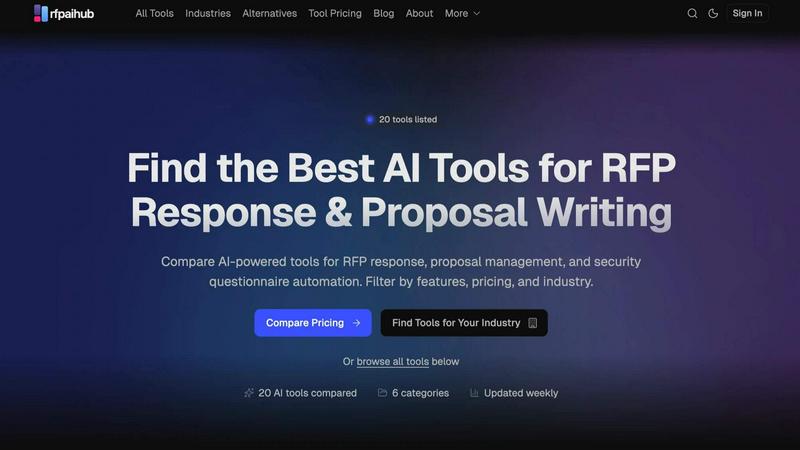
RFP AI Hub is a comprehensive directory for comparing AI-powered RFP response, proposal management, and security questionnaire automation tools.
Last updated: April 13, 2026

UndercoverGPT
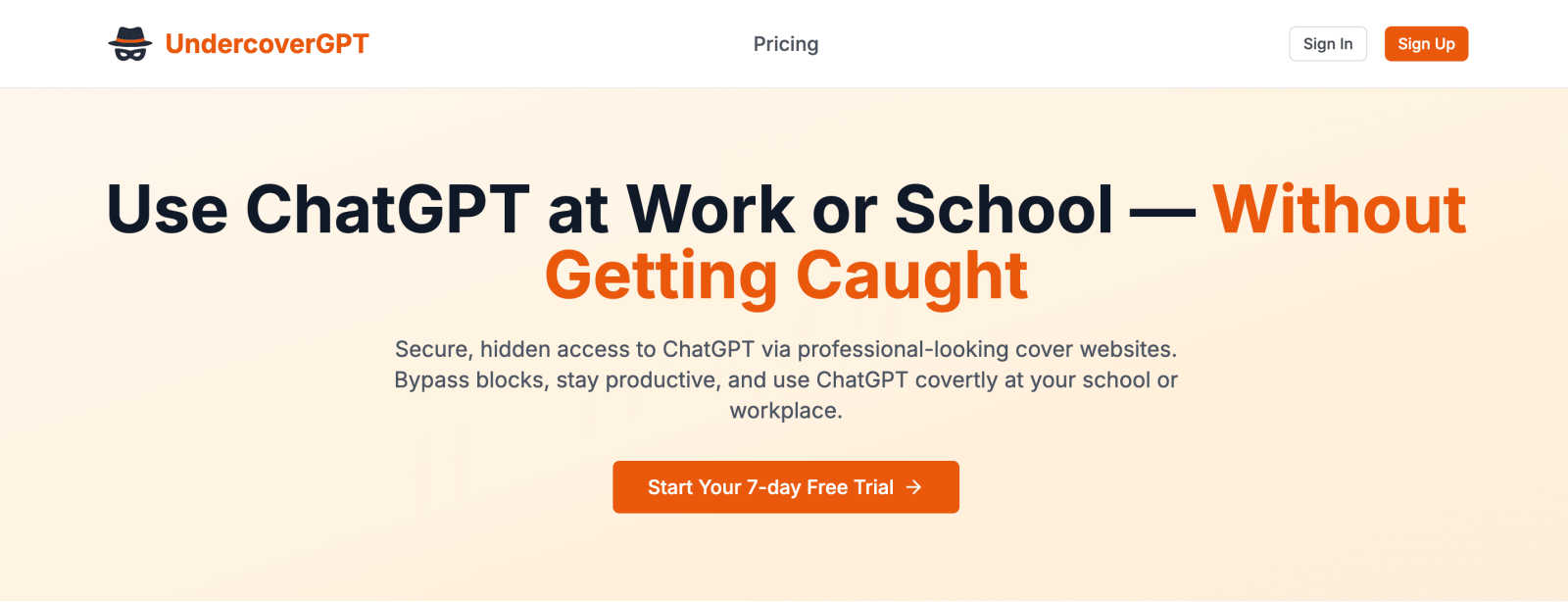
UndercoverGPT provides secure, covert access to ChatGPT via professional cover websites to bypass network restrictions.
Last updated: March 1, 2026
Visual Comparison
rfpaihub
UndercoverGPT
Feature Comparison
rfpaihub
Curated Tool Directory
The platform maintains a meticulously researched and regularly updated directory of AI-powered RFP and proposal software. Each tool listing includes detailed specifications, categorized features, and verified information to ensure users are comparing accurate and current data. This curation eliminates the need for manual web searches and unreliable third-party reviews.
Advanced Filtering System
Users can refine the tool database using multiple, simultaneous filters. Key filter criteria include software categories (e.g., RFP Response vs. Security Automation), specific features (like AI drafting or content library integration), target industry (such as SaaS, Healthcare, or Finance), and published pricing tiers. This granular filtering allows for highly targeted discovery based on precise workflow needs.
Comparative Analysis Framework
RFP AI Hub provides a structured framework for comparing tools side-by-side. This goes beyond basic feature lists to include practical differentiators relevant to response teams, enabling direct comparison of AI capabilities, integration options, collaboration features, and security protocols to identify the optimal solution for complex organizational requirements.
Vendor-Neutral Educational Content
The site supplements its directory with a dedicated blog and resource sections that offer unbiased educational content on selecting and implementing RFP technology. This includes guides on workflow assessment, ROI justification, and best practices for leveraging AI in proposal processes, positioning the hub as an authoritative source rather than a lead-generation portal.
UndercoverGPT
Dynamic Cover Website Obfuscation
UndercoverGPT employs a sophisticated engine that dynamically generates and serves a selection of professional-grade cover websites. These sites are not static facades but fully interactive web applications that mimic legitimate business tools like project dashboards, data visualization platforms, and corporate wikis. This layer of obfuscation is designed to withstand casual and automated inspection by network monitoring systems, ensuring the user's activity appears as routine work on approved web services, thereby effectively concealing the underlying ChatGPT session.
Stealthy ChatGPT Integration Panel
At the core of the software is a seamlessly integrated, fully-featured ChatGPT panel that remains hidden within the cover website interface. This panel is activated through configurable and discreet UI triggers, such as a specific key combination or a hidden button element. Once activated, it provides the complete functionality of ChatGPT, including conversation history, model selection, and text generation, all within the same browser tab and without redirecting to OpenAI's domains, thus eliminating a primary network-level detection vector.
Local Session & Data Isolation
The product is engineered to prevent digital trace leakage on the local machine. It operates by isolating all ChatGPT-related queries, responses, and session data within a secured, ephemeral container that is not written to the device's permanent storage or standard browser history. This ensures that forensic examination of the local machine post-session will not reveal evidence of AI tool usage, providing an additional layer of security for the user in tightly controlled environments.
Configurable Activation & UI Triggers
UndercoverGPT offers advanced configurability for the user interface elements that trigger the hidden ChatGPT panel. Users can define custom hotkeys, invisible click zones, or sequence-based triggers to activate the AI assistant. This allows for personalized operational security (OPSEC) protocols, enabling users to tailor the access method to their specific risk environment and workflow, making the tool adaptable to various levels of network monitoring sophistication.
Use Cases
rfpaihub
Procurement for Sales Operations Teams
Sales operations leaders tasked with selecting an enterprise RFP response platform can use RFP AI Hub to create a shortlist of qualified vendors. By filtering for tools with specific AI-matching algorithms, Salesforce integration, and enterprise-grade security, they can efficiently evaluate options that meet strict corporate procurement and technical requirements.
Tool Selection by Security & Compliance Teams
Security and compliance professionals overwhelmed by vendor security questionnaires (VSQs) and due diligence queries can utilize the directory to find specialized security questionnaire automation tools. They can filter for platforms with capabilities like automated mapping to frameworks (e.g., SOC 2, ISO 27001) and library management for standardized security responses.
Evaluation by Proposal Management Consultants
Independent consultants or agencies that manage proposals for multiple clients need to recommend tools appropriate for different business sizes and industries. RFP AI Hub allows them to quickly compare pricing models, feature sets, and industry specializations across the market to provide tailored, evidence-based recommendations to each client.
Market Research by Software Vendors
Competing software vendors in the RFP technology space can use the directory to conduct competitive analysis. The structured presentation of features and categories provides a clear overview of the competitive landscape, highlighting market gaps, feature differentiators, and prevailing pricing strategies within specific tool categories.
UndercoverGPT
Corporate Research & Competitive Analysis
Professionals in competitive industries can utilize UndercoverGPT to conduct market research, analyze competitor announcements, and draft strategic documents without alerting internal security teams or leaving a query log on corporate servers. This enables faster, AI-assisted insights while complying with, or discreetly navigating, broad IT policies that may block AI tools due to data privacy concerns but not outright malicious intent.
Academic Writing & Research Assistance
Students and academics in institutions with restrictive AI policies can leverage the tool for brainstorming, drafting research papers, simplifying complex concepts, and checking code without violating academic integrity policies that block direct access to ChatGPT. The cover site allows them to utilize AI as a productivity aid while their activity blends in as legitimate academic database or writing platform research.
Confidential Document Drafting & Editing
Consultants, lawyers, and government contractors working on sensitive projects can use UndercoverGPT to iteratively draft, edit, and refine confidential documents. By avoiding direct connections to OpenAI, they mitigate the risk of sensitive prompt or output data being logged by external services or internal data loss prevention (DLP) systems flagged for external AI communication, all while enhancing their drafting efficiency.
Software Development & Code Debugging
Developers in enterprises with locked-down development environments can employ UndercoverGPT to explain error messages, generate code snippets, or debug algorithms in real-time. The tool's covert operation allows them to bypass network blocks on AI coding assistants, accelerating problem-solving and learning without requiring formal exceptions to IT security protocols that can be slow to obtain.
Overview
About rfpaihub
RFP AI Hub is a specialized, free-to-use online directory dedicated to the systematic evaluation and comparison of AI-powered software tools designed for the request for proposal (RFP) response lifecycle, proposal management, and security questionnaire automation. The platform serves as a centralized resource for sales operations teams, proposal managers, security compliance officers, and business development professionals who are seeking to modernize and accelerate their response processes. Its core value proposition lies in its ability to cut through market noise by providing detailed, filterable listings that allow users to identify the most suitable software based on specific functional requirements, industry vertical, team size, and budget constraints. By aggregating and categorizing tools across six distinct categories—including RFP Response, Proposal Writing, Security Questionnaire Automation, Knowledge Base management, Document Generation, and Contract & Bid Management—RFP AI Hub enables informed procurement decisions, potentially reducing tool evaluation time by providing transparent, side-by-side comparisons of capabilities and pricing structures.
About UndercoverGPT
UndercoverGPT is a sophisticated software solution engineered to bypass network restrictions and provide secure, covert access to OpenAI's ChatGPT in monitored environments. It is specifically designed for corporate networks, educational institutions, and government offices where direct access to generative AI platforms is blocked or heavily scrutinized. The product operates through an advanced obfuscation layer that presents users with a selection of fully functional, professional-looking cover websites. These sites convincingly mimic common business and academic tools such as project management dashboards, data analytics interfaces, and internal knowledge bases. The core value proposition lies in its ability to seamlessly integrate a hidden, fully-featured ChatGPT panel within these benign interfaces. This panel is activated via discreet, configurable UI elements, allowing for real-time AI assistance without triggering network monitoring tools or leaving detectable traces in local machine logs or network traffic. Its primary user base includes students, researchers, and professionals who rely on large language model capabilities for enhanced productivity but are constrained by restrictive IT policies. UndercoverGPT ensures uninterrupted workflow and intellectual freedom by effectively camouflaging AI interactions within a legitimate-looking digital facade.
Frequently Asked Questions
rfpaihub FAQ
What types of tools does RFP AI Hub compare?
RFP AI Hub compares AI-powered software across six primary operational categories: RFP Response software, Proposal Writing and management platforms, Security Questionnaire Automation tools, Knowledge Base & Answer Library systems, Document Generation engines, and comprehensive Contract & Bid Management suites. This categorization helps users align their search with their core workflow.
How does the platform ensure the accuracy of its tool information?
The platform employs a documented methodology involving direct vendor submissions, verification of public information, and ongoing updates. Vendors are encouraged to submit their product details for review at no cost, and the editorial team cross-references this data with publicly available specifications on vendor websites and product documentation.
Is there a cost to use RFP AI Hub for browsing and comparison?
No, RFP AI Hub operates as a free directory for all end-users. Individuals and teams can browse the entire tool database, utilize all filtering and comparison features, and access educational blog content without any requirement to create an account or pay a subscription fee.
Can I submit a tool to be listed on RFP AI Hub?
Yes, software vendors are invited to submit their AI-powered RFP, proposal, or security questionnaire products for inclusion in the directory. The submission process is free of charge. The editorial team reviews each submission against the platform's inclusion criteria to ensure it fits the defined categories and offers relevant AI-driven functionality before listing.
UndercoverGPT FAQ
How does UndercoverGPT avoid detection by network administrators?
UndercoverGPT avoids detection by not establishing a direct connection to OpenAI's domains, which are commonly blacklisted. All traffic is routed through and masked by the professional cover website, which is hosted on a separate, whitelisted domain. The ChatGPT queries and responses are embedded within the normal-looking data flow of the cover site, using encryption and non-standard data packaging to evade deep packet inspection (DPI) and signature-based detection systems.
Does UndercoverGPT store any of my conversation data?
No, UndercoverGPT is designed with privacy as a core principle. Conversations are processed in a transient session with no persistent logging on our intermediary servers. The local session isolation feature also ensures that your query history and generated text are not saved to your computer's hard drive or browser cache in a recoverable format, minimizing the digital footprint of your usage.
What happens if the cover website is itself blocked by my network?
The product includes a mechanism for rotating and updating its library of cover website templates and domains. If a particular cover site is flagged and blocked, the system can deploy an alternative site that mimics a different type of legitimate service. This adaptive obfuscation increases longevity and resilience against evolving network security filters.
Is using UndercoverGPT against my organization's policy?
UndercoverGPT is a tool that provides access in restricted environments. It is the user's sole responsibility to understand and comply with their organization's Acceptable Use Policy (AUP), IT security guidelines, and any relevant laws. The software enables access but does not condone or encourage policy violation. Users should be aware of the potential professional consequences of bypassing established network controls.
Alternatives
rfpaihub Alternatives
RFP AI Hub is a specialized directory and comparison platform within the proposal management and productivity software category. It provides a centralized resource for teams to discover, evaluate, and compare AI-powered tools designed for RFP response, proposal creation, and security questionnaire automation. The platform allows users to filter options based on specific features, pricing models, and industry relevance to aid in the software selection process. Users often seek alternatives to any software directory, including RFP AI Hub, for several practical reasons. These can include the need for a platform with different curation criteria, more granular comparison metrics, or integration with existing procurement workflows. Budget constraints may also drive the search for free or lower-cost information sources, while some organizations require evaluation frameworks tailored to highly specific compliance or technical requirements. When evaluating an alternative resource, key considerations should include the depth and accuracy of the tool database, the recency and objectivity of the information provided, and the availability of detailed feature breakdowns. The ideal platform should offer transparent filtering capabilities that align with your team's primary needs, whether that's advanced AI functionality, robust security features, or specific integration capabilities, to ensure an efficient and informed decision-making process.
UndercoverGPT Alternatives
UndercoverGPT is a specialized AI assistant and productivity tool designed to provide secure, covert access to ChatGPT in restricted network environments. It operates by utilizing professional cover websites that mimic legitimate business and academic interfaces, effectively camouflaging AI interactions to bypass monitoring and blocking systems. Users may seek alternatives to UndercoverGPT for various reasons, including differing budget constraints, the need for alternative feature sets, or compatibility with specific operating systems and devices. Some may require solutions with different obfuscation methodologies, varied levels of customer support, or deployment models that better align with their organizational or personal technical infrastructure. When evaluating alternatives, key considerations should include the robustness of the stealth technology, the authenticity and interactivity of any cover interfaces, the security and privacy guarantees for user data, and the overall reliability of the service. The chosen solution must effectively balance seamless access with operational security to meet the user's specific risk profile and workflow requirements.