Caller vs RocketShare
Side-by-side comparison to help you choose the right tool.

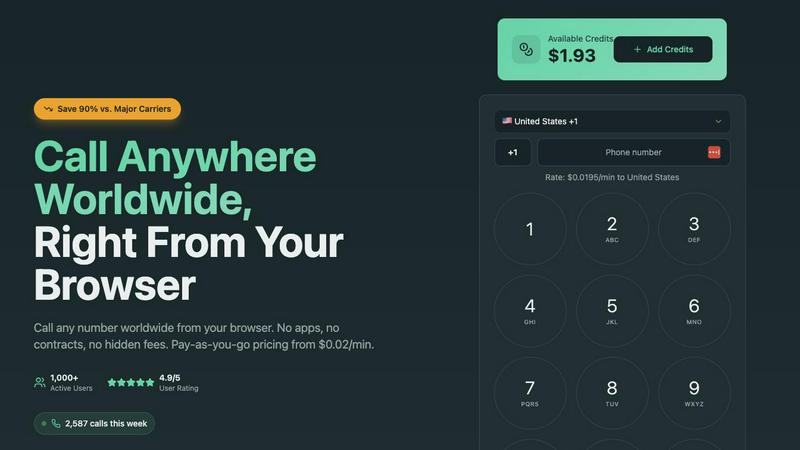
Caller enables secure, pay-as-you-go international calls from any browser at rates from $0.02/min.
Last updated: March 1, 2026

RocketShare
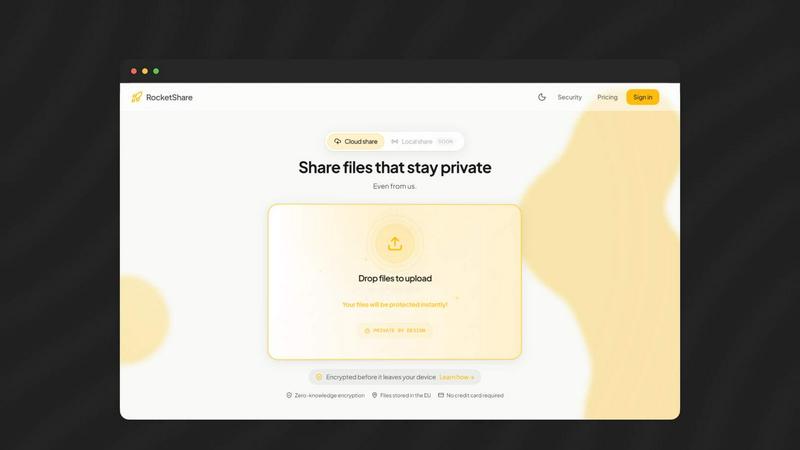
RocketShare provides secure, zero-knowledge encrypted file sharing where only you control access.
Last updated: March 4, 2026
Visual Comparison
Caller
RocketShare
Feature Comparison
Caller
Browser-Based WebRTC Telephony
Caller operates entirely within a modern web browser using Web Real-Time Communication (WebRTC) protocols, requiring no downloads, plugins, or external software. This architecture enables instant call initiation from any device—desktop, laptop, tablet, or smartphone—with a compatible browser and internet connection. The platform handles all signaling and media processing server-side, abstracting the technical complexity of VoIP configuration from the end-user. This feature ensures maximum accessibility and eliminates platform-specific dependencies, providing a uniform experience across operating systems.
Transparent Pay-As-You-Go Billing
The platform employs a straightforward, consumption-based billing model where users only pay for completed call minutes. Credits are purchased upfront and never expire, with no monthly subscriptions, minimum commitments, or hidden fees. Rates start from $0.01 to $0.02 per minute to numerous destinations, offering cost savings of up to 90% compared to traditional carriers. Real-time usage tracking within the user dashboard provides complete visibility into credit consumption and call history, ensuring financial predictability and control.
Global Direct Dial Coverage
Caller provides direct-dial access to telephone numbers in over 200 countries and territories worldwide, encompassing all major and numerous regional destinations. The platform connects seamlessly to both landline and mobile networks without requiring intermediary access numbers or PIN codes. This feature is powered by a globally distributed network of carrier partnerships and SIP trunks, engineered for low-latency routing to ensure call quality and connection reliability irrespective of the destination.
Dedicated Virtual Phone Numbers
For professional use, Caller offers the capability to purchase dedicated virtual phone numbers for use as outbound caller ID or for receiving calls. Numbers are available in various formats, including local, toll-free, and mobile, from countries such as the United States, United Kingdom, and Canada. These numbers are activated instantly upon purchase and can be managed directly from the web interface, enhancing professional presence and enabling localized business communications without physical presence.
RocketShare
Zero-Knowledge, End-to-End Encryption
RocketShare implements a true zero-knowledge encryption model where files are encrypted locally on the sender's device using strong cryptographic standards before upload. The platform's servers never receive or have access to the unencrypted data or the decryption keys. This means that even in the event of a server breach, the encrypted data remains computationally infeasible to decipher. The decryption key is typically part of the shareable URL, granting access only to intended recipients with the complete link.
Dual Sharing Modes: Cloud and Local (P2P)
The platform provides two technical methodologies for file transfer. The Cloud Share mode uploads encrypted files to secure, EU-based data centers for persistent, time-limited access. The Local Share (peer-to-peer) mode establishes a direct, encrypted connection between the sender's and recipient's devices for the transfer, with files never stored on RocketShare's servers. This P2P option is ideal for transient data exchange where cloud persistence is not required.
EU-Based Data Sovereignty
For cloud-based transfers, all encrypted file data is stored exclusively on servers located within the European Union. This provides users with the legal and regulatory assurances associated with EU data protection jurisdiction, including adherence to the General Data Protection Regulation (GDPR) framework for data handling and storage practices.
No-Account Required File Sharing
RocketShare operates on a frictionless, self-serve model that does not mandate account creation for basic file sending. Users can initiate secure transfers immediately without providing personal information or payment details. This reduces barriers to adoption while maintaining full security, as the encryption process is device-based and independent of user authentication on the platform's servers.
Use Cases
Caller
International Business Development and Sales
Sales professionals and business developers conducting outbound calls to international prospects can leverage Caller for its cost-effective global rates and professional caller ID options. The ability to present a local or toll-free number increases answer rates, while the pay-as-you-go model aligns costs directly with sales activity. The platform's HD audio quality ensures clear communication during critical negotiations, and its browser-based nature allows for immediate use from any workstation or while traveling.
Remote Team and Distributed Workforce Communication
Companies with remote employees, freelancers, or contractors spread across different countries can utilize Caller for internal and external communication without incurring prohibitive long-distance charges. Team members can call each other or contact local vendors and services in their respective regions directly from their browsers. This eliminates the need for expensed personal mobile plans or complex corporate VoIP setups, streamlining operational overhead.
Personal and Family International Calling
Individuals with family, friends, or contacts abroad can use Caller for affordable personal communication. The service is ideal for frequent, long-duration calls to international mobile and landline numbers, offering significant savings compared to standard mobile carrier international plans. The simple interface and lack of contracts make it accessible for non-technical users, requiring only an internet connection to maintain global personal connections.
Customer Support and Service Outreach
Small to medium-sized businesses providing customer support to an international clientele can deploy Caller for outbound service calls, follow-ups, and technical support. The transparent pricing allows for precise cost allocation per client or department. Support agents can operate the system from any browser, facilitating flexible and remote work arrangements. The option to use a dedicated business number reinforces brand professionalism.
RocketShare
Legal Document Exchange
Law firms and legal professionals can securely share sensitive case files, contracts, deposition transcripts, and client communications. The zero-knowledge architecture ensures attorney-client privilege and work-product doctrine protections are technically enforced, as no third party can intercept or access the confidential materials during transfer or storage.
Healthcare Data Transmission
Medical practices, therapists, and healthcare administrators can use RocketShare to exchange protected health information (PHI), patient records, lab results, and imaging files in compliance with stringent regulations like HIPAA. The platform's encryption and EU data storage provide a robust technical safeguard for patient privacy.
Creative Asset Delivery
Photographers, videographers, and design agencies can deliver high-resolution client galleries, raw footage, and creative proofs. The ability to send files of any size, coupled with guaranteed privacy, protects intellectual property and ensures only paying clients access the final deliverables via the unique, key-embedded link.
Confidential Corporate Collaboration
Teams working on proprietary projects, financial reports, merger & acquisition documents, or source code can collaborate securely. The local P2P sharing option is particularly valuable for transferring draft documents or sensitive data between team members without creating a cloud-based copy, minimizing the digital footprint.
Pricing Comparison
Caller
Caller operates on a transparent, credit-based pay-as-you-go model. There are no monthly subscriptions, contracts, or minimum spend requirements. Users purchase account credits that never expire and are charged only for completed call minutes. Outbound calling rates start as low as $0.01 to $0.02 per minute to numerous destinations, such as the United States. Dedicated virtual phone numbers for caller ID or inbound purposes are available as a separate add-on, with monthly fees starting from $1.99 for a US local number, $2.50 for a UK toll-free number, and $3.00 for a Canadian mobile number. All pricing is listed transparently on the platform, and users can track their credit usage in real-time.
RocketShare
The provided context indicates that specific pricing plans, tiers, or costs are not detailed in the available material. The website highlights a "No credit card required" approach for initial use, suggesting a possible freemium model or free tier for basic services. For detailed, current pricing information regarding premium features, storage limits, or team plans, users are directed to visit the official RocketShare website and navigate to its dedicated "Pricing" section.
Overview
About Caller
Caller is a sophisticated, browser-based Voice over Internet Protocol (VoIP) telephony platform engineered to facilitate high-quality, cost-effective international voice communications. It functions as a pure web application, eliminating the need for traditional hardware, software installations, SIM cards, or complex carrier contracts. The platform establishes direct, encrypted audio connections between a user's web browser and any global telephone number, including landlines and mobile devices, leveraging enterprise-grade infrastructure for reliability. Its core architectural principle is the elimination of infrastructural complexity, providing instant access to a global telephony network through a simple, intuitive web interface. Caller is architected for a broad user base, including individual consumers, freelancers, digital nomads, remote workers, and businesses of all sizes seeking a streamlined, software-defined communication solution. The value proposition is anchored in a transparent, consumption-based pricing model that operates strictly on a pay-as-you-go basis, with per-minute rates demonstrably lower—up to 90% cheaper—than those of conventional mobile and landline carriers. This combination of technical simplicity, global reach, and economic efficiency positions Caller as a modern alternative to legacy telephony systems.
About RocketShare
RocketShare is a secure file-sharing platform engineered to provide absolute data privacy through a zero-knowledge encryption architecture. The core operational principle is that user privacy is non-negotiable; the platform is designed so that no entity, including RocketShare's own administrators, can access the content of shared files. This is achieved by performing client-side encryption on the user's device before any data is transmitted. The encryption keys remain solely with the user, often embedded directly within the shareable link, ensuring servers only process cryptographically secure, unreadable data. The platform supports the transfer of files of any size and offers two distinct sharing modalities: cloud-based storage with data housed in EU-based facilities, and a local, peer-to-peer transfer option that minimizes data persistence. Targeted at professionals and organizations handling sensitive information, RocketShare delivers enterprise-grade security within a self-serve, user-friendly interface. Its value proposition is providing top-tier cryptographic security without compromising on simplicity, making robust privacy accessible for legal, creative, healthcare, and corporate sectors.
Frequently Asked Questions
Caller FAQ
How does Caller achieve such low international calling rates?
Caller leverages Voice over Internet Protocol (VoIP) technology and direct peering agreements with tier-1 telecommunications carriers and local providers globally. By routing calls over the internet to the nearest point of entry to the destination's public switched telephone network (PSTN), the platform bypasses the traditional, costly international long-distance circuits used by mobile operators. This software-defined network architecture, combined with a high-volume operational model, allows for drastically reduced per-minute costs which are passed directly to the user.
What are the technical requirements to use Caller?
The primary requirement is a stable broadband internet connection. For the application itself, you need a modern web browser (e.g., Chrome, Firefox, Safari, Edge) that supports WebRTC standards, which includes most browsers released within the last 5 years. You will also need a functional microphone and speakers or a headset. No specific hardware, SIM card, or landline is required. The service is accessible from desktop computers, laptops, tablets, and smartphones.
Is call quality reliable and secure?
Yes, Caller utilizes enterprise-grade global infrastructure with multiple points of presence to ensure reliable, low-latency connections. Calls are encoded in high-definition (HD) voice codecs for crystal-clear audio. All call signaling and media streams are secured with bank-level SSL/TLS encryption, ensuring that your conversations are private and protected from interception. Payment transactions are also processed through PCI-compliant systems.
Can I receive calls on a Caller virtual number?
The provided context primarily details Caller's outbound calling functionality from the browser. While the platform offers dedicated virtual phone numbers, the current documentation emphasizes their use for outbound caller ID to enhance professional presence. For definitive information on inbound call capabilities to these numbers, users should consult the official "Buy Numbers" section or contact support, as features may be expanded or configured differently for inbound services.
RocketShare FAQ
How does zero-knowledge encryption work on RocketShare?
Zero-knowledge encryption means the encryption and decryption processes occur exclusively on user devices. When you upload a file, the RocketShare client application on your computer or browser encrypts it using a strong, randomly generated key before it leaves your system. This key is not sent to RocketShare. The encrypted data is then transmitted to our servers. The decryption key is typically appended to the shareable link. Only someone with the full link possesses the key needed to decrypt the file, and this decryption happens locally on the recipient's device.
Where are my files stored?
For files sent via the Cloud Share option, the encrypted data is stored on secure servers located within the European Union. We do not utilize or replicate data to servers outside the EU. For files sent via the Local Share (peer-to-peer) option, the files are never stored on our servers; they are transferred directly between the devices of the sender and recipient over an encrypted channel.
Can RocketShare access or view my files?
No. Under no circumstances can RocketShare or its personnel access the content of your files. The cryptographic design ensures we only handle encrypted data blobs. We do not possess the encryption keys required to decrypt them. This architecture is fundamental to our service and is technically enforced.
Is there a file size limit for transfers?
RocketShare is designed to send files of any size. The platform does not impose artificial caps on file dimensions for its core transfer functionality. Performance will be subject to the sender's and recipient's respective network bandwidth and connectivity, especially for very large files or when using the Local Share mode.
Alternatives
Caller Alternatives
Caller is a browser-based telephony platform within the productivity and management software category. It facilitates international voice calls directly from a web browser using VoIP technology, operating on a transparent pay-as-you-go pricing model without requiring hardware or long-term contracts. Users may seek alternatives for various technical and operational reasons. Common drivers include the need for different pricing structures such as monthly subscriptions or bundled minutes, requirements for specific features like call recording or advanced team management, and preferences for native desktop or mobile applications over a purely browser-based interface. Platform compatibility and integration needs with existing business software stacks are also significant factors. When evaluating an alternative platform, key technical criteria include the core architecture (WebRTC, SIP, or proprietary app), supported audio codecs and network protocols for call quality, and the granularity of the billing model. Operational considerations should encompass the availability of essential telephony features, the depth of administrative controls for business deployments, and the robustness of security measures such as end-to-end encryption for sensitive communications.
RocketShare Alternatives
RocketShare is a secure file-sharing and collaboration platform within the productivity and management software category. It distinguishes itself through a strict zero-knowledge encryption model, ensuring that all file data is encrypted client-side before upload, making it inaccessible to the service provider itself. Users may seek alternatives to RocketShare for various reasons, including specific budget constraints, the need for integrated collaboration features like real-time document editing, or requirements for different deployment models such as on-premises solutions. Platform compatibility, storage limits, and administrative control levels are also common decision factors. When evaluating an alternative, key technical criteria include the encryption standard employed (e.g., AES-256), the jurisdiction of data storage, the availability of client-side encryption, and the granularity of user permission controls. The chosen solution should align with both the operational workflow and the specific compliance or security mandates of the user or organization.