Changeflow vs Gaffa
Side-by-side comparison to help you choose the right tool.

Changeflow
Changeflow delivers AI-driven insights on critical market and competitor website changes, keeping you informed.
Last updated: March 4, 2026

Gaffa is a scalable REST API for web automation and data extraction using real browsers.
Last updated: March 1, 2026
Visual Comparison
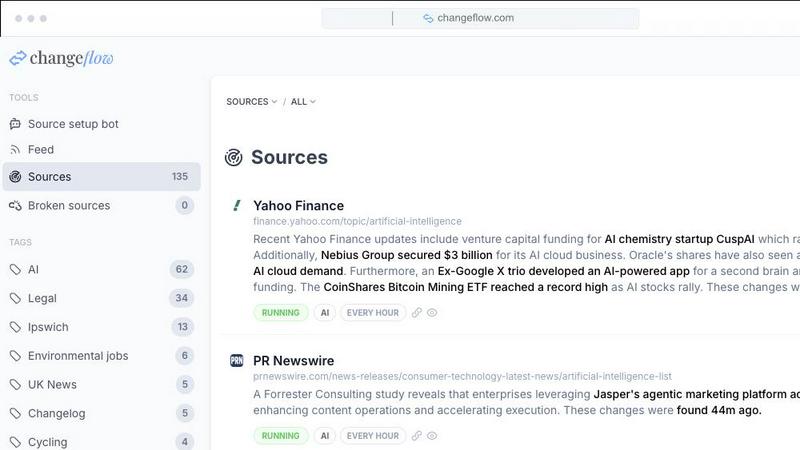
Changeflow
Gaffa

Feature Comparison
Changeflow
AI-Powered Change Detection
Changeflow employs sophisticated AI algorithms to monitor specified web pages and filter out irrelevant updates. This ensures users receive only the changes that are significant to their interests, eliminating false alerts and minimizing distractions.
Natural Language Setup
With Changeflow, users can easily initiate monitoring by simply describing what they want to track in plain English. This user-friendly setup eliminates the need for complex technical configurations or manual setup processes, making it accessible for all users.
Customized Summaries of Updates
Changeflow delivers AI-generated summaries that highlight the changes and their relevance to the user's specific interests. This feature saves time by providing concise insights rather than requiring users to read through entire web pages.
Advanced Notification System
Users receive timely notifications via their preferred channels, including email and dashboards. Changeflow's notifications are designed to be clear and descriptive, ensuring that users can quickly grasp the importance of updates without sifting through unnecessary information.
Gaffa
Simple REST API for Browser Control
Gaffa abstracts the complexities of frameworks like Playwright, Selenium, and Puppeteer into a straightforward REST API. Developers can execute sophisticated browser automation tasks—such as navigation, interaction, and data extraction—with a single HTTP request. This eliminates the learning curve and maintenance burden associated with direct browser automation libraries, streamlining integration into existing data workflows and applications.
Stealth Mode with Resilient Infrastructure
The platform is engineered to target the hardest-to-scrape websites. Its stealth mode integrates a global network of residential proxies, automated CAPTCHA-solving capabilities, and real browser instances that execute JavaScript and render pages identically to a human user. Gaffa automatically handles proxy rotation, request throttling, and fingerprint management to bypass advanced anti-bot defenses, ensuring high success rates for data extraction missions.
Automated Data Processing and Output Formats
Gaffa goes beyond returning raw HTML. It includes built-in data processing to transform web content into immediately usable formats. Users can specify output as clean, simplified HTML; structured JSON via CSS selectors; LLM-ready markdown optimized for AI ingestion; full-page screenshots; or even self-contained offline page archives. This feature saves significant post-processing time and computational resources.
Full Observability and Request Recording
Every automation executed through the Gaffa API is recorded for complete observability. Users can review detailed logs, performance metrics, and visual screen recordings of their browser sessions. This transparency is critical for debugging complex automation scripts, verifying data extraction accuracy, and auditing the behavior of the automation to ensure it operates as intended against target websites.
Use Cases
Changeflow
Competitor Price Tracking
Business teams can use Changeflow to monitor competitor pricing changes in real time. By receiving immediate updates on price fluctuations, companies can make informed pricing decisions and maintain a competitive edge in the market.
Regulatory Change Monitoring
Compliance teams, particularly in regulated industries, can utilize Changeflow to stay updated on relevant regulatory changes. This ensures that organizations remain compliant with the latest guidelines and can respond promptly to new regulations.
Legal Document Tracking
Legal professionals, including librarians at Am Law 200 firms, benefit from Changeflow by tracking court dockets and legal citations. This allows them to stay informed about critical legal developments that may impact their cases or clients.
Market Movement Analysis
Changeflow enables businesses to keep tabs on market movements by monitoring news mentions and industry updates. This proactive approach allows organizations to adjust strategies based on real-time market intelligence.
Gaffa
Competitive Intelligence and Market Research
Businesses can automate the collection of pricing data, product catalogs, feature updates, and promotional content from competitor websites at scale. Gaffa's ability to handle JavaScript-heavy sites and bypass blocks ensures a consistent flow of structured data, enabling companies to perform dynamic pricing analysis, track market trends, and inform strategic decisions with real-time web data.
AI and LLM Training Data Aggregation
For teams building or fine-tuning large language models, Gaffa provides a reliable pipeline for sourcing high-quality, diverse training data from the web. The platform's ability to output clean, LLM-ready markdown and structured JSON simplifies the data preparation pipeline, allowing data scientists to focus on model development rather than the complexities of data collection and cleaning.
Regulatory Compliance and Financial Monitoring
Financial institutions and compliance teams can use Gaffa to automate the monitoring of regulatory publications, news sites, and official registers. The platform's reliability and audit trail via session recording are essential for ensuring data provenance and completeness in regulated environments, supporting activities like KYC (Know Your Customer) checks and adverse media screening.
E-commerce Price and Inventory Monitoring
Retailers and aggregators can deploy Gaffa to track real-time pricing, stock availability, and product descriptions across thousands of e-commerce SKUs. The system's concurrent request handling and proxy rotation allow for high-frequency, large-scale scraping without triggering IP bans, enabling dynamic repricing strategies and supply chain optimization.
Overview
About Changeflow
Changeflow is an advanced web monitoring tool designed to track changes on web pages and deliver precise updates on what truly matters. Utilizing cutting-edge AI technology, Changeflow distinguishes itself by not only identifying changes but also summarizing their significance, ensuring users remain informed without the clutter of irrelevant information. Ideal for business teams, legal professionals, and compliance officers, Changeflow provides a user-friendly setup process that requires simply describing the desired tracking parameters in plain English. With a remarkable 99.9% success rate in bypassing login walls and JavaScript barriers, Changeflow has become a trusted resource for Fortune 500 companies and Am Law 200 firms alike. Organizations leverage Changeflow for various purposes, including competitor analysis, regulatory tracking, and market monitoring, making it an indispensable tool for staying ahead in a rapidly changing digital landscape.
About Gaffa
Gaffa is an API-first platform engineered to solve the complex, infrastructural challenges of large-scale web data extraction and browser automation. It provides developers, data scientists, and businesses with a robust, simplified interface to control real, fully-featured web browsers via a REST API, eliminating the need to build and maintain intricate in-house systems. The platform's core value proposition is its abstraction of the entire technical stack required for reliable scraping, including proxy management, CAPTCHA solving, browser orchestration, and failure handling. This allows technical teams to focus entirely on data utilization rather than pipeline management. Gaffa is specifically architected for resilience against sophisticated anti-bot measures, employing stealth techniques, residential proxy networks, and real browser instances to mimic genuine human interaction. It supports sophisticated automation actions like scrolling, clicking, and form submission, and delivers processed data in multiple formats including raw HTML, structured JSON, LLM-ready markdown, and images. Ideal for startups, growth-stage companies, and enterprises, Gaffa delivers consistent, high-volume access to web data with minimal operational overhead.
Frequently Asked Questions
Changeflow FAQ
How does Changeflow ensure accurate tracking?
Changeflow uses advanced AI technology to analyze and summarize changes on monitored web pages. Its algorithms are designed to filter out irrelevant updates, ensuring users receive only the most pertinent information.
Is there a limit to the number of pages I can track?
Changeflow offers various plans that accommodate different user needs. The Plus plan allows tracking of up to 300 pages, while the Business plan expands this to 500 pages, making it scalable for growing organizations.
How quickly am I notified of changes?
Changeflow is designed to provide timely notifications as soon as changes are detected. Users can choose to receive updates through email, dashboards, or integrations with other platforms via Zapier, ensuring they stay informed without delay.
Can I collaborate with my team using Changeflow?
Yes, Changeflow includes shared workspaces that facilitate team collaboration. This feature allows teams to stay aligned on monitoring tasks, share insights, and collectively respond to important updates, enhancing overall efficiency.
Gaffa FAQ
What is a credit and how is it calculated?
A credit is Gaffa's unit of consumption for its API. Usage is calculated based on two primary factors: request duration and proxy bandwidth. Browser runtime is billed at 1 credit per 30 seconds (or 2 credits per 30 seconds if screen recording is enabled). Additionally, any request utilizing a residential proxy (proxy_location parameter) incurs a bandwidth charge of 1500 credits per 1GB of data transferred. Each successful API call deducts the corresponding credits from your monthly allowance.
Does Gaffa offer a free trial?
Yes, Gaffa provides a free tier that allows users to sign up and experiment with the full API feature set without a credit card. This trial is conducted on a dedicated demo site (demo.gaffa.dev), enabling users to build and test automations, understand the workflow, and assess output formats before upgrading to a paid plan for use on the open internet.
What is Gaffa's refund policy?
Gaffa is happy to offer a refund upon request, provided the request is made before any credits have been consumed within the current billing cycle. Once credits have been used, refunds are not typically issued. Users are encouraged to review the detailed refund policy on the Gaffa website for specific terms and conditions.
Do unused credits roll over to the next month?
No, credits do not roll over. The credit allowance included with your monthly subscription plan is reset at the start of each new billing cycle. Any unused credits from the previous period are forfeited. This applies to both monthly plans and pay-as-you-go credit packs, which also have no expiration unless specified otherwise at purchase.
Alternatives
Changeflow Alternatives
Changeflow is an AI-driven tool designed to provide market and competitor insights by monitoring web pages for changes that matter. It falls under the Productivity & Management category, enabling users to track crucial updates in a streamlined manner. Businesses often seek alternatives to Changeflow for various reasons, including pricing, specific feature requirements, or compatibility with existing platforms and workflows. When considering an alternative, it is essential to evaluate the tool’s ability to handle complex pages, the breadth of monitoring capabilities, user-friendliness, and integration options with existing systems.
Gaffa Alternatives
Gaffa is a REST API platform in the web automation and data extraction category. It provides a managed service for controlling real browsers at scale, abstracting the infrastructure complexities of proxy management, CAPTCHA solving, and anti-bot evasion to deliver reliable data. Users may seek alternatives for various reasons, including budget constraints, specific feature requirements not covered by the platform, or a need for greater control over the underlying infrastructure. Some organizations might prefer an open-source framework to build a custom solution, while others might require different pricing models or integration capabilities. When evaluating alternatives, key considerations include the core technology stack, such as whether it uses headless browsers or HTTP clients, its ability to handle JavaScript-rendered content and bypass anti-bot measures, and the scalability of its proxy network. The format and reliability of data output, along with the total cost of ownership for development and maintenance, are also critical decision factors.