dmaya vs Gomotion
Side-by-side comparison to help you choose the right tool.

dmaya
dMaya is an AI design platform for agencies that generates production-ready UI designs and exports them to code.
Last updated: April 13, 2026

Gomotion
Gomotion is an AI-powered platform that instantly generates professional motion graphics and animated videos from text.
Last updated: February 28, 2026
Visual Comparison
dmaya
Gomotion
Feature Comparison
dmaya
Conversational AI Design Generation
This core feature allows users to generate initial UI designs by describing their vision in plain English. Input a prompt for a specific interface, such as "a minimalist SaaS admin dashboard with dark mode," and dMaya's AI agent will produce a complete set of screens with coherent layouts, component systems, and responsive considerations. The generation process accounts for standard UI patterns and design principles, delivering a professional starting point in seconds, drastically reducing the time from concept to visual prototype.
Real-Time Conversational Iteration
Beyond initial generation, dMaya enables detailed refinement through an integrated chat interface. Designers can instruct the AI to make precise modifications using natural language, such as "swap the primary color to a blue palette," "convert this layout to a three-column grid," or "add a user profile section to the top navbar." Every change is applied instantly and accurately across the design, with underlying design tokens ensuring visual consistency is automatically maintained throughout all screens and components.
Client Presentation & Feedback Portal
dMaya streamlines the client review process by allowing designers to share projects via a simple, secure URL. Clients can view interactive, browser-based previews of the designs without needing to create an account. They can leave contextual feedback directly on the designs. This functionality consolidates the entire approval cycle within the platform, turning a process that traditionally takes days of email exchanges and meetings into one that can be completed in minutes, with all feedback tracked and actionable.
Design-to-Code Export for AI Development
Once a design is approved, dMaya provides a one-click export function that outputs production-ready front-end code. The export includes clean, well-structured HTML, CSS, and JavaScript that accurately reflects the visual design. This code is specifically formatted to be optimally consumed by AI coding assistants and agents like Claude Code, Cursor, or GitHub Copilot, enabling a seamless handoff for developers to build the final product in any modern framework like React, Next.js, or Flutter.
Gomotion
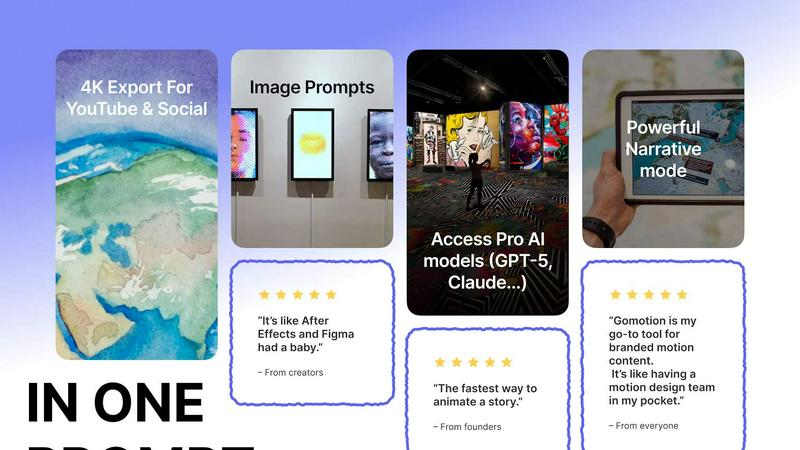
AI-Powered Text-to-Motion Generation
This core feature allows users to generate cinematic animations from simple text prompts. By describing the desired motion in natural language, users can animate titles, captions, and logos without manually setting keyframes. The system interprets the prompt's intent to apply movements with professional flair, drastically simplifying the workflow for creating animated text elements commonly used in product demos and promotional content.
Narrative Mode for End-to-End Video Creation
Narrative Mode is a comprehensive workflow tool that transforms a written script into a complete, synchronized animated story. It automates the process of pairing script segments with relevant images, video clips, and animations, enabling the creation of ready-to-publish advertisements or short narrative videos in minutes. This feature is designed for producing cohesive visual stories with minimal manual editing and sequencing effort.
Multi-Platform Responsive Design Engine
Gomotion's rendering engine is specifically designed to create animations that are perfectly aligned for any display format. Users can design content with the confidence that it will render correctly across all screen sizes, from smartphone vertical feeds (Instagram Reels, TikTok) to tablet and desktop displays. This ensures brand consistency and visual integrity regardless of where the final content is published.
Advanced Data Visualization and Simulation
Beyond basic text and logo animation, Gomotion includes capabilities for creating complex animated charts and simulations directly from data inputs. This feature is engineered for explainer videos, business presentations, and educational content, transforming static data into engaging, dynamic visualizations that enhance comprehension and impact without requiring specialized data animation software.
Use Cases
dmaya
Agency Client Pitches and Concepting
Agencies can use dMaya to rapidly visualize client ideas during discovery calls or pitch meetings. By generating multiple high-fidelity design directions from a brief in real-time, agencies can demonstrate capability and align on visual direction faster. This accelerates the sales cycle, improves win rates, and provides tangible assets for proposals and statements of work, all before committing significant internal resources to detailed design work.
Product Team UI Exploration and Prototyping
Product managers and designers can leverage dMaya to explore diverse UI solutions for new features or products without extensive manual design work. The platform allows for quick A/B testing of different layouts, color schemes, and information architectures. This enables data-informed visual decisions early in the product lifecycle, ensuring engineering resources are only committed to building well-validated and stakeholder-approved interfaces.
Freelancer Project Delivery and Scalability
Freelancers and independent contractors can utilize dMaya to increase their project throughput and service offerings. The tool enables a single designer to handle the ideation, iteration, and client approval phases for multiple projects concurrently with greater speed. This efficiency allows freelancers to take on more work or deliver higher-fidelity results in less time, directly increasing their earning potential and competitive advantage.
Cross-Functional Team Alignment and Handoff
dMaya serves as a single source of truth for design concepts within cross-functional teams. Designers, product managers, and engineers can collaborate in the shared workspace, review iterations, and leave comments. The definitive, approved design and its accompanying exported code package create a clear, unambiguous handoff point from design to development, reducing misinterpretation and rework.
Gomotion
Rapid Social Media Ad Production
Marketing teams and solo creators can use Gomotion to rapidly prototype and produce high-volume social media advertisements. By inputting ad copy and brand assets, users can generate multiple animated ad variants optimized for platforms like Instagram, TikTok, and Facebook in a fraction of the time required for manual design, allowing for agile campaign testing and deployment.
Brand Identity and Promotional Video Development
Businesses launching new products or reinforcing brand identity can leverage Gomotion to create consistent promotional videos. The one-click brand import feature allows for quick integration of logos, color palettes, and fonts, enabling the rapid generation of on-brand animations for product teasers, launch announcements, and corporate overviews without constant designer intervention.
Educational and Explainer Content Creation
Educators, trainers, and B2B companies can utilize Gomotion's data visualization and Narrative Mode to produce engaging explainer videos. Complex concepts, processes, or data sets can be transformed into clear, animated stories, making them more accessible and memorable for audiences in e-learning modules, sales presentations, or internal training materials.
Agency Workflow Augmentation
Creative and digital agencies can integrate Gomotion into their workflow to handle routine animation tasks or create initial motion graphic concepts for client presentations. This tool allows agencies to increase throughput on projects requiring motion design, allocate senior designer time to more complex tasks, and provide clients with quick turnarounds on animation-heavy projects like website banners or digital ad campaigns.
Overview
About dmaya
dMaya is a professional AI-powered design platform engineered specifically for agencies, product teams, and freelancers who operate within a client-driven, design-first workflow. It addresses a critical gap in the current AI tool landscape, which often bypasses visual design to generate code directly. dMaya reinstates the essential design phase, enabling teams to make intentional visual decisions, align stakeholders, and secure approvals before any development begins. The core value proposition lies in its conversational AI interface that generates complete, professional UI designs from text descriptions. Users can describe a SaaS dashboard, e-commerce user flow, or mobile application and receive polished, multi-screen designs in seconds. The platform facilitates rapid iteration through natural language commands to adjust colors, layouts, typography, and components. Once a design is finalized, it can be shared via a client-ready preview link for feedback and approval, eliminating lengthy review cycles. Finally, approved designs are exported as clean, structured HTML, CSS, and JavaScript code, ready to be handed off to AI coding agents like Cursor or Claude Code for implementation in frameworks such as React, Next.js, or Flutter. dMaya is built for speed, collaboration, and precision, ensuring teams can present, approve, and ship with confidence.
About Gomotion
Gomotion is a sophisticated AI-driven motion design platform engineered to automate and streamline the creation of professional-grade animations. It functions as an AI Motion Designer, leveraging advanced algorithms, including models like Claude Sonnet 4, to interpret user inputs and generate complex motion graphics. The core functionality revolves around transforming textual prompts or static images into fully animated sequences, effectively bypassing the traditional, labor-intensive keyframing process associated with software like Adobe After Effects. This tool is architected for a broad spectrum of users, from marketing professionals and content creators seeking rapid ad production to businesses and agencies requiring consistent, high-quality brand animations. Its primary value proposition is a significant reduction in production time and technical barrier to entry, enabling users to focus on creative direction and narrative. Gomotion supports multi-platform design, ensuring outputs are optimized for every screen from mobile to desktop, and incorporates specialized modes for creating data visualizations and end-to-end animated stories directly from scripts.
Frequently Asked Questions
dmaya FAQ
How does dMaya differ from other AI design tools?
dMaya is purpose-built for professional, client-facing workflows where design approval precedes development. Unlike tools that generate code directly, dMaya focuses on producing high-fidelity visual designs that can be presented, iterated upon, and formally approved. It includes client collaboration features like shareable preview links and feedback collection, which are essential for agencies and teams but absent in most AI tools aimed at solo builders.
What kind of code does dMaya export?
dMaya exports clean, vanilla front-end code consisting of semantic HTML, CSS (including Flexbox/Grid for layout), and JavaScript for basic interactivity. The code is not tied to a specific framework but is structured and commented to be easily interpreted and adapted by AI coding agents or developers into any target framework such as React, Next.js, Vue, or Flutter.
Can I collaborate with my team on dMaya?
Yes, dMaya includes built-in team collaboration features. You can invite team members to projects with role-based permissions, work together in real-time on the same canvas, and use comment threads for discussion. This makes it suitable for design teams, product squads, and agency groups needing a shared environment for creation and review.
Do clients need a dMaya account to review designs?
No, clients and external stakeholders do not require any account to review designs. Designers simply generate a shareable preview link from within a dMaya project and send it to their clients. Clients can view the design in their web browser, interact with it, and leave feedback directly on the design without any login or software installation.
Gomotion FAQ
What is the primary technology behind Gomotion's animation generation?
Gomotion utilizes advanced AI algorithms, including large language and diffusion models, to interpret user prompts. Specifically, it employs systems like Claude Sonnet 4 to understand textual descriptions and generate corresponding motion paths, easing, and stylistic effects. This AI-driven approach automates the translation of creative intent into technical animation parameters.
Can I use my own brand assets within Gomotion?
Yes, Gomotion features a dedicated brand import function. Users can upload their logo, define brand colors, and select fonts in a centralized brand kit. Once imported, these assets can be automatically applied to new projects, ensuring all generated animations maintain consistent brand identity across social media, ads, and other promotional materials.
What output formats and resolutions does Gomotion support?
Gomotion is engineered for multi-platform use and supports standard video output formats suitable for web and social media distribution. It specifically offers a 16:9 aspect ratio as a primary format and is built with a responsive design engine that ensures animations scale and render correctly for various resolutions, from mobile device screens to desktop monitors.
Is Gomotion suitable for users with no prior animation experience?
Absolutely. Gomotion is designed to democratize motion design by removing the technical complexity of traditional animation software. Its intuitive, prompt-based interface allows novices to describe their vision in words and receive professional-looking animations. However, it also provides enough depth and control to appeal to seasoned designers looking to accelerate their workflow.
Alternatives
dmaya Alternatives
dmaya is an AI-powered vibe design platform that operates within the design-to-code software category. It enables agencies, teams, and freelancers to generate, iterate, and finalize professional UI designs through conversational AI before exporting clean, production-ready code. This process bridges the critical gap between conceptualization and development, ensuring visual and functional alignment before any engineering resources are committed. Users may explore alternatives to dmaya for various practical reasons. Common considerations include budget constraints and specific pricing models, the need for different feature sets or integration capabilities, and platform requirements such as operating system compatibility or collaboration tools. The search often stems from a need to find a tool that aligns precisely with a team's existing workflow, technical stack, or project scope. When evaluating an alternative design platform, key criteria should include the fidelity and control of the AI-generated output, the efficiency of the client review and approval cycle, and the quality and framework specificity of the exported code. The ideal solution should not only accelerate the initial design phase but also seamlessly integrate into the subsequent development pipeline without creating technical debt or requiring significant rework.
Gomotion Alternatives
Gomotion is an AI-powered motion design tool within the design software category. It specializes in generating professional-grade animations from text or image prompts, significantly streamlining the workflow for creators and marketers. This positions it as a solution for users seeking to produce high-quality motion graphics without extensive manual animation expertise. Users may explore alternatives to Gomotion for several practical reasons. Common considerations include budget constraints and specific pricing model requirements, such as subscription tiers versus one-time purchases. Other factors encompass the need for different feature sets, platform compatibility, advanced customization depth, or integration capabilities with existing software ecosystems. When evaluating an alternative motion design solution, key criteria should include the core AI generation capabilities, the quality and flexibility of the output formats, and the sophistication of real-time collaboration features. Additionally, assess the tool's template library scope, export options for various platforms, and the overall user interface complexity relative to the intended user's skill level.