
Fallom vs Hostim.dev
Side-by-side comparison to help you choose the right tool.

Fallom is an AI-native observability platform for real-time tracing and cost tracking of LLMs and agents, ensuring.
Last updated: February 28, 2026

Hostim.dev
Hostim.dev deploys Docker apps with managed databases on GDPR-compliant EU bare-metal servers.
Last updated: March 1, 2026
Visual Comparison
Fallom
Hostim.dev
Feature Comparison
Fallom
Real-time Observability
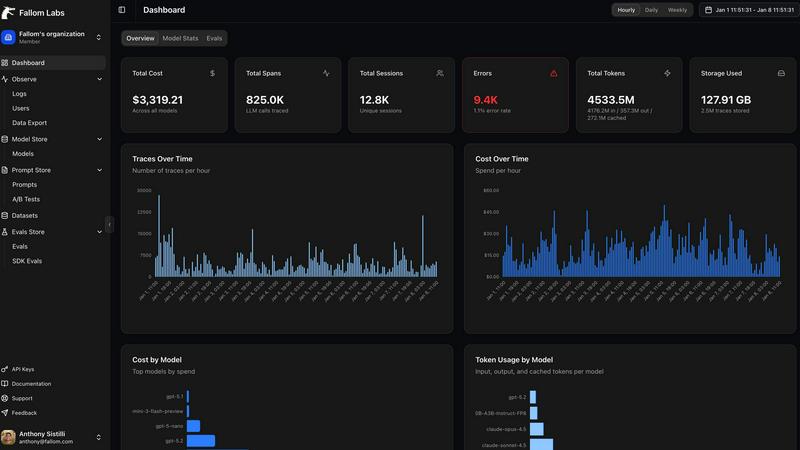
Fallom provides real-time observability for AI agents, allowing users to track tool calls, analyze timing, and debug issues effectively. By visualizing every LLM call, teams can gain insights into performance and usage patterns, ensuring swift identification and resolution of anomalies.
Cost Attribution
The platform offers detailed cost attribution features that track spending per model, user, and team. This transparency aids in budgeting and chargeback processes, enabling organizations to understand their operational costs clearly and allocate resources efficiently.
Compliance and Audit Trails
Fallom is equipped with comprehensive audit trails to support regulatory compliance requirements. With features like input/output logging, model versioning, and user consent tracking, it ensures that organizations can meet stringent standards such as the EU AI Act and GDPR with confidence.
Session Tracking
Fallom allows users to group traces by session, user, or customer, providing complete context for each interaction. This feature enhances the ability to analyze workflows and improves the debugging process by maintaining a clear record of user activities and associated costs.
Hostim.dev
EU Bare-Metal Hosting with GDPR Compliance
Hostim.dev operates on dedicated bare-metal servers located in Germany, ensuring high performance and low latency for European users. This architecture provides a solid foundation for applications requiring consistent resource allocation. By being hosted exclusively within the EU, the platform guarantees GDPR compliance by default, addressing data sovereignty concerns for businesses and developers handling European user data without requiring additional configuration or legal vetting of third-party data processors.
Docker, Git, and Docker Compose Deployment
The platform supports multiple deployment methodologies natively. Developers can launch applications directly from a public or private Docker image, connect a Git repository for continuous deployment, or paste a complete Docker Compose file to deploy multi-service application stacks. This flexibility allows teams to migrate existing containerized workflows without modification. The system automatically parses the Compose file, provisions the defined services, and establishes the necessary networking between containers, removing the need for manual orchestration setup.
Integrated Managed Databases and Volumes
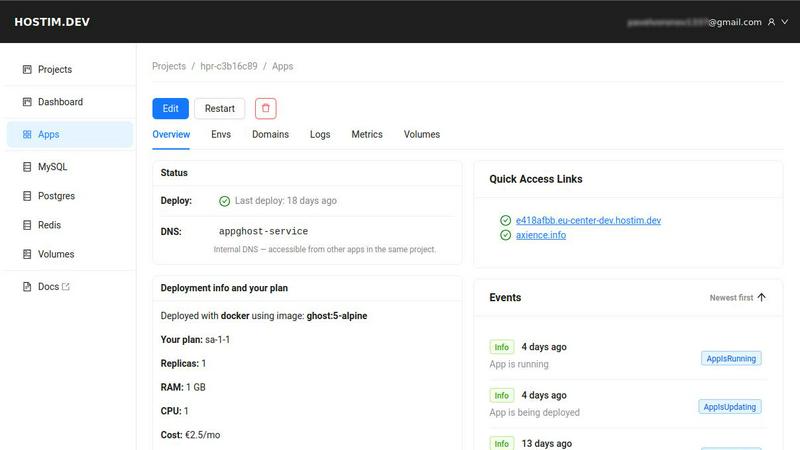
Hostim.dev provides built-in, managed database services including MySQL, PostgreSQL, and Redis, which are provisioned instantly alongside your application. These databases are pre-wired to your application containers with environment variables, eliminating manual connection string configuration. Persistent block storage volumes are also available, offering reliable data storage for stateful services. This integration consolidates the application stack management into a single interface and billing point.
Per-Project Isolation and Cost Tracking
Every application or client project is encapsulated within its own fully isolated environment, encompassing compute, networking, and data. This ensures security and prevents resource conflicts. Crucially, each project has its own dedicated cost tracking and billing, starting from €2.5 per month. This model provides absolute financial transparency, making it simple for freelancers and agencies to quote fixed prices to clients and track profitability per project without unexpected cross-charges.
Use Cases
Fallom
Debugging AI Workflows
Organizations can utilize Fallom to debug complex agentic workflows by tracing each step of LLM interactions. This capability allows teams to identify bottlenecks or failures in real-time, facilitating quicker resolutions and improving overall system performance.
Cost Management
Fallom’s cost attribution features enable organizations to manage and analyze their AI-related expenses effectively. By tracking costs at granular levels, teams can make informed decisions regarding resource allocation and budget adjustments, enhancing financial oversight.
Compliance Audits
For companies operating under strict regulatory frameworks, Fallom provides the necessary tools to maintain compliance. Its comprehensive audit trails and logging capabilities support organizations in preparing for audits and ensuring adherence to laws such as GDPR and SOC 2.
Performance Monitoring
Fallom allows organizations to monitor LLM performance continuously, spotting anomalies before they escalate into significant issues. With real-time dashboards and detailed latency metrics, teams can maintain optimal performance levels for their AI systems.
Hostim.dev
Freelancer Client Project Delivery
Freelancers can use Hostim.dev to rapidly deploy and deliver web applications for clients. By using Docker Compose, they can ship complex stacks (app, database, cache) in minutes. The per-project billing allows for clean cost pass-through or markup, and the isolated project environment enables easy, secure handover of the running application to the client post-engagement, without providing access to other projects or underlying infrastructure.
Agency Managing Multiple Client Portfolios
Digital agencies benefit from the strict per-client project isolation, which provides security and operational boundaries between different client workloads. The platform offers clear cost breakdowns for each project, simplifying internal accounting and client invoicing. The EU-based, GDPR-compliant hosting is a key selling point for agencies serving European customers, ensuring regulatory adherence is built into the service.
Startup Prototyping and MVP Launch
Startups and small teams can leverage Hostim.dev to go from code to a live, scalable prototype or Minimum Viable Product (MVP) with minimal DevOps investment. The built-in databases, automatic HTTPS, and monitoring allow developers to focus on product features. The predictable flat pricing protects against unforeseen cloud bills during the early, unpredictable usage stages, aiding in budget control.
Student and Developer Learning Projects
Students and developers building portfolio projects can access professional-grade deployment tooling without complexity or high cost. The free trial and student credits provide a risk-free environment to learn Docker, database integration, and deployment workflows on real, production-like infrastructure. This results in tangible, publicly accessible projects that demonstrate practical skills to potential employers.
Overview
About Fallom
Fallom is an advanced AI-native observability platform meticulously designed for monitoring and optimizing Large Language Model (LLM) and AI agent workloads in real-time production environments. It serves the needs of engineering, product, and compliance teams by providing comprehensive visibility into every interaction with LLMs. The platform's core value proposition lies in its ability to deliver end-to-end tracing of AI calls, capturing essential data such as detailed prompts, model outputs, function/tool calls, token usage, latency metrics, and precise cost calculations per call. Built on the OpenTelemetry standard, Fallom ensures a vendor-agnostic approach with an SDK that allows teams to instrument their applications quickly and efficiently. This eliminates the complexities associated with integrating various monitoring tools. As organizations scale their AI-powered features, Fallom enables them to debug intricate workflows promptly, accurately attribute operational costs, and maintain robust audit trails. This capability is particularly crucial for compliance with stringent regulations such as the EU AI Act, SOC 2, and GDPR. By centralizing observability, Fallom transforms AI operations into a transparent, manageable, and cost-controllable aspect of the modern software stack.
About Hostim.dev
Hostim.dev is a specialized Platform-as-a-Service (PaaS) engineered to streamline the deployment and management of containerized applications. It functions as a managed bare-metal platform, hosted exclusively on infrastructure within Germany, providing a robust, GDPR-compliant foundation for modern software. The core value proposition is the complete abstraction of infrastructure complexity, allowing developers to focus exclusively on building their applications rather than managing servers, networking, or orchestration systems. Users can deploy directly from existing Docker images, Git repositories, or full Docker Compose configurations without any rewrites, with the platform automatically handling provisioning, networking, service integration, and security. It is designed for freelancers, agencies, startups, and students who require a simple, transparent, and controlled environment to launch personal projects, client work, or SaaS products. Hostim.dev eliminates the need to navigate intricate cloud provider consoles, write extensive YAML configurations, or deal with unpredictable usage-based billing, offering a flat, per-project pricing model instead.
Frequently Asked Questions
Fallom FAQ
What is Fallom?
Fallom is an AI-native observability platform designed to monitor and optimize Large Language Model interactions in production environments, providing real-time visibility into AI workloads.
How does Fallom ensure compliance?
Fallom supports compliance through comprehensive audit trails, logging of input and output, model versioning, and user consent tracking, ensuring organizations can meet regulatory requirements.
Can Fallom be integrated with existing tools?
Yes, Fallom is built on the OpenTelemetry standard and offers a vendor-agnostic SDK that allows for quick integration into existing applications, simplifying the observability process.
What types of organizations benefit from using Fallom?
Engineering, product, and compliance teams within organizations that leverage AI and LLM technologies benefit significantly from Fallom's real-time monitoring and optimization capabilities, especially those needing to adhere to strict compliance standards.
Hostim.dev FAQ
What does the free tier include?
The free tier is structured as a 5-day trial project, requiring no credit card for signup. During this trial, users have full access to the platform's capabilities to deploy a complete application stack. This includes deploying from Docker, Git, or Compose files, and utilizing built-in services like managed databases (MySQL, PostgreSQL, Redis) and volumes. The trial encompasses all features such as automatic HTTPS, live logs, metrics, and project isolation, allowing for a comprehensive evaluation of the service.
Can I deploy with just a Docker Compose file?
Yes, deploying with a Docker Compose file is a primary workflow supported by Hostim.dev. You can directly paste your existing docker-compose.yml file into the platform's interface. The system will automatically interpret the file, provision all defined services, set up the private network between the containers as specified, and deploy the entire stack. No rewriting or adaptation for a proprietary platform format is required, ensuring portability and simplicity.
Where is my application hosted?
All applications deployed on Hostim.dev are hosted exclusively on bare-metal servers within professional data centers located in Germany. This provides the performance benefits of dedicated hardware while ensuring all data remains within the European Union. This geographic and jurisdictional specificity is fundamental to the platform's guarantee of GDPR compliance by default for data storage and processing.
Do I need to know Kubernetes or DevOps to use this?
No, knowledge of Kubernetes or advanced DevOps practices is not required to use Hostim.dev. The platform is explicitly designed to abstract away the complexity of container orchestration, cluster management, and infrastructure provisioning. Developers only need familiarity with Docker and, optionally, Docker Compose to define their application services. The platform manages all underlying operations, including scaling, networking, load balancing, and security patching.
Alternatives
Fallom Alternatives
Fallom is an AI-native observability platform specifically designed for monitoring and optimizing Large Language Model (LLM) and AI agent workloads in production environments. It offers real-time tracing and cost tracking, providing teams with comprehensive visibility into LLM interactions and improving their debugging processes. Users often seek alternatives to Fallom for various reasons, including pricing considerations, the need for specific features, or compatibility with different platforms. When searching for an alternative, it's essential to evaluate the observability capabilities, compliance features, ease of integration, and overall cost-effectiveness to ensure the chosen solution aligns with organizational goals and operational requirements.
Hostim.dev Alternatives
Hostim.dev is a specialized Platform-as-a-Service (PaaS) focused on deploying Docker-based applications on managed bare-metal servers in Germany. It caters to developers seeking a streamlined, GDPR-compliant hosting environment with integrated databases, eliminating infrastructure management complexity. Users may explore alternatives for various reasons, including budget constraints, a need for global server locations outside the EU, requirements for specific cloud provider integrations, or a preference for different pricing models such as pure usage-based billing over fixed plans. The feature set, particularly around scaling granularity and supported orchestration tools, also drives comparison. When evaluating an alternative, key considerations include the core infrastructure type (shared, virtualized, or bare-metal), compliance certifications, native service integrations like databases, deployment workflow simplicity, pricing transparency, and the geographical distribution of data centers relative to your target audience.