Gaffa vs qtrl.ai
Side-by-side comparison to help you choose the right tool.

Gaffa is a scalable REST API for web automation and data extraction using real browsers.
Last updated: March 1, 2026

qtrl.ai
qtrl.ai empowers QA teams to scale testing with AI while maintaining control, governance, and seamless integration.
Last updated: March 4, 2026
Visual Comparison
Gaffa

qtrl.ai
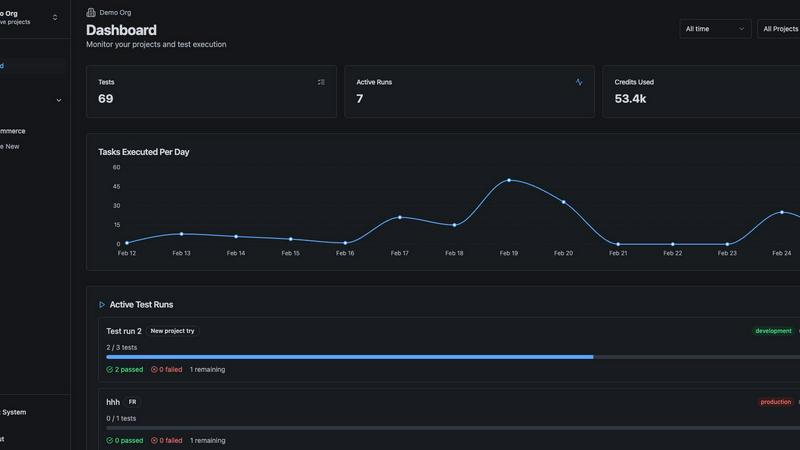
Feature Comparison
Gaffa
Simple REST API for Browser Control
Gaffa abstracts the complexities of frameworks like Playwright, Selenium, and Puppeteer into a straightforward REST API. Developers can execute sophisticated browser automation tasks—such as navigation, interaction, and data extraction—with a single HTTP request. This eliminates the learning curve and maintenance burden associated with direct browser automation libraries, streamlining integration into existing data workflows and applications.
Stealth Mode with Resilient Infrastructure
The platform is engineered to target the hardest-to-scrape websites. Its stealth mode integrates a global network of residential proxies, automated CAPTCHA-solving capabilities, and real browser instances that execute JavaScript and render pages identically to a human user. Gaffa automatically handles proxy rotation, request throttling, and fingerprint management to bypass advanced anti-bot defenses, ensuring high success rates for data extraction missions.
Automated Data Processing and Output Formats
Gaffa goes beyond returning raw HTML. It includes built-in data processing to transform web content into immediately usable formats. Users can specify output as clean, simplified HTML; structured JSON via CSS selectors; LLM-ready markdown optimized for AI ingestion; full-page screenshots; or even self-contained offline page archives. This feature saves significant post-processing time and computational resources.
Full Observability and Request Recording
Every automation executed through the Gaffa API is recorded for complete observability. Users can review detailed logs, performance metrics, and visual screen recordings of their browser sessions. This transparency is critical for debugging complex automation scripts, verifying data extraction accuracy, and auditing the behavior of the automation to ensure it operates as intended against target websites.
qtrl.ai
Autonomous QA Agents
qtrl.ai's autonomous QA agents are designed to execute instructions on demand or continuously, enabling teams to run tests across multiple environments at scale. These agents operate within predefined rules to ensure compliance and quality, conducting real browser executions instead of relying on simulations. This feature allows teams to maintain a high degree of control while benefiting from automation.
Enterprise-Grade Test Management
The platform provides a centralized system for managing test cases, plans, and execution runs. With full traceability and audit trails, teams can easily track their testing efforts, ensuring transparency and accountability. This feature supports both manual and automated workflows, making it ideal for organizations that prioritize compliance and auditability in their QA processes.
Progressive Automation
qtrl.ai implements a progressive automation approach that allows teams to start with human-written instructions and gradually transition to AI-generated tests. This feature includes intelligent suggestions for new tests based on existing coverage, ensuring that teams can continuously improve their testing processes. Review, approval, and refinement are integral to every step, providing teams with the flexibility to control their automation journey.
Adaptive Memory
The adaptive memory feature builds a living knowledge base of the application by learning from exploration, test execution, and identified issues. This capability powers smarter, context-aware test generation, making the testing process more effective with every interaction. As teams engage with the platform, it becomes increasingly adept at understanding application behavior, resulting in more accurate and efficient testing.
Use Cases
Gaffa
Competitive Intelligence and Market Research
Businesses can automate the collection of pricing data, product catalogs, feature updates, and promotional content from competitor websites at scale. Gaffa's ability to handle JavaScript-heavy sites and bypass blocks ensures a consistent flow of structured data, enabling companies to perform dynamic pricing analysis, track market trends, and inform strategic decisions with real-time web data.
AI and LLM Training Data Aggregation
For teams building or fine-tuning large language models, Gaffa provides a reliable pipeline for sourcing high-quality, diverse training data from the web. The platform's ability to output clean, LLM-ready markdown and structured JSON simplifies the data preparation pipeline, allowing data scientists to focus on model development rather than the complexities of data collection and cleaning.
Regulatory Compliance and Financial Monitoring
Financial institutions and compliance teams can use Gaffa to automate the monitoring of regulatory publications, news sites, and official registers. The platform's reliability and audit trail via session recording are essential for ensuring data provenance and completeness in regulated environments, supporting activities like KYC (Know Your Customer) checks and adverse media screening.
E-commerce Price and Inventory Monitoring
Retailers and aggregators can deploy Gaffa to track real-time pricing, stock availability, and product descriptions across thousands of e-commerce SKUs. The system's concurrent request handling and proxy rotation allow for high-frequency, large-scale scraping without triggering IP bans, enabling dynamic repricing strategies and supply chain optimization.
qtrl.ai
Product-Led Engineering Teams
For product-led engineering teams, qtrl.ai offers a robust framework to manage and scale quality assurance practices without losing oversight. With its AI-driven automation, these teams can accelerate their development cycles while maintaining high-quality standards, ensuring that new features are rigorously tested before release.
QA Teams Scaling Beyond Manual Testing
QA departments transitioning from manual testing to automated solutions find qtrl.ai particularly valuable. The platform supports a gradual shift to automation, allowing teams to begin with manual test management before incorporating AI-generated tests. This empowers QA teams to enhance their productivity and coverage without compromising control.
Companies Modernizing Legacy QA Workflows
Organizations looking to modernize outdated QA workflows can leverage qtrl.ai to integrate advanced test management and automation capabilities. The platform's flexibility allows companies to adopt new testing methodologies while ensuring compliance and traceability, ultimately improving the efficiency of their QA processes.
Enterprises Requiring Governance and Traceability
For enterprises that necessitate strict governance and audit trails in their QA processes, qtrl.ai provides the necessary tools to maintain visibility and control. The platform's comprehensive test management features and adaptive memory capabilities ensure that all testing activities are documented and traceable, meeting the demands of regulatory compliance.
Overview
About Gaffa
Gaffa is an API-first platform engineered to solve the complex, infrastructural challenges of large-scale web data extraction and browser automation. It provides developers, data scientists, and businesses with a robust, simplified interface to control real, fully-featured web browsers via a REST API, eliminating the need to build and maintain intricate in-house systems. The platform's core value proposition is its abstraction of the entire technical stack required for reliable scraping, including proxy management, CAPTCHA solving, browser orchestration, and failure handling. This allows technical teams to focus entirely on data utilization rather than pipeline management. Gaffa is specifically architected for resilience against sophisticated anti-bot measures, employing stealth techniques, residential proxy networks, and real browser instances to mimic genuine human interaction. It supports sophisticated automation actions like scrolling, clicking, and form submission, and delivers processed data in multiple formats including raw HTML, structured JSON, LLM-ready markdown, and images. Ideal for startups, growth-stage companies, and enterprises, Gaffa delivers consistent, high-volume access to web data with minimal operational overhead.
About qtrl.ai
qtrl.ai is an advanced quality assurance (QA) platform designed to streamline and enhance software testing processes for teams of all sizes. By integrating enterprise-grade test management with sophisticated AI-driven automation, qtrl.ai provides a comprehensive solution that empowers software teams to scale their QA efforts effectively without sacrificing control or governance. This platform serves a diverse range of users, including product-led engineering teams, QA departments transitioning from manual testing, organizations modernizing outdated workflows, and enterprises that require strict compliance and traceability. At its core, qtrl.ai offers a centralized hub for organizing test cases, planning test runs, tracing requirements to coverage, and tracking quality metrics through real-time dashboards. Its intelligent automation features enable teams to incrementally adopt AI-driven testing solutions, ensuring that they maintain oversight and control while enhancing their testing capabilities. Ultimately, qtrl.ai's mission is to bridge the gap between the traditional slow pace of manual testing and the complex nature of conventional automation, delivering a reliable pathway to faster and more intelligent quality assurance.
Frequently Asked Questions
Gaffa FAQ
What is a credit and how is it calculated?
A credit is Gaffa's unit of consumption for its API. Usage is calculated based on two primary factors: request duration and proxy bandwidth. Browser runtime is billed at 1 credit per 30 seconds (or 2 credits per 30 seconds if screen recording is enabled). Additionally, any request utilizing a residential proxy (proxy_location parameter) incurs a bandwidth charge of 1500 credits per 1GB of data transferred. Each successful API call deducts the corresponding credits from your monthly allowance.
Does Gaffa offer a free trial?
Yes, Gaffa provides a free tier that allows users to sign up and experiment with the full API feature set without a credit card. This trial is conducted on a dedicated demo site (demo.gaffa.dev), enabling users to build and test automations, understand the workflow, and assess output formats before upgrading to a paid plan for use on the open internet.
What is Gaffa's refund policy?
Gaffa is happy to offer a refund upon request, provided the request is made before any credits have been consumed within the current billing cycle. Once credits have been used, refunds are not typically issued. Users are encouraged to review the detailed refund policy on the Gaffa website for specific terms and conditions.
Do unused credits roll over to the next month?
No, credits do not roll over. The credit allowance included with your monthly subscription plan is reset at the start of each new billing cycle. Any unused credits from the previous period are forfeited. This applies to both monthly plans and pay-as-you-go credit packs, which also have no expiration unless specified otherwise at purchase.
qtrl.ai FAQ
How does qtrl.ai ensure the quality of AI-generated tests?
qtrl.ai ensures the quality of AI-generated tests by implementing a review and approval process. Teams can assess suggested tests based on coverage and context, allowing for refinement before execution. This oversight minimizes the risks associated with automated testing.
Can qtrl.ai integrate with existing CI/CD pipelines?
Yes, qtrl.ai supports integration with existing CI/CD pipelines. This capability allows teams to seamlessly incorporate quality assurance into their development workflows, facilitating continuous quality feedback loops and improving overall efficiency.
What types of environments can qtrl.ai run tests in?
qtrl.ai can execute tests across various environments, including development, testing, staging, and production. The platform allows for per-environment variables and encrypted secrets, ensuring secure and consistent test execution across all stages of the application lifecycle.
Is there support available for new users of qtrl.ai?
Yes, qtrl.ai provides comprehensive support for new users, including documentation, tutorials, and customer assistance. This ensures that teams can effectively utilize the platform's features and maximize their quality assurance efforts from the outset.
Alternatives
Gaffa Alternatives
Gaffa is a REST API platform in the web automation and data extraction category. It provides a managed service for controlling real browsers at scale, abstracting the infrastructure complexities of proxy management, CAPTCHA solving, and anti-bot evasion to deliver reliable data. Users may seek alternatives for various reasons, including budget constraints, specific feature requirements not covered by the platform, or a need for greater control over the underlying infrastructure. Some organizations might prefer an open-source framework to build a custom solution, while others might require different pricing models or integration capabilities. When evaluating alternatives, key considerations include the core technology stack, such as whether it uses headless browsers or HTTP clients, its ability to handle JavaScript-rendered content and bypass anti-bot measures, and the scalability of its proxy network. The format and reliability of data output, along with the total cost of ownership for development and maintenance, are also critical decision factors.
qtrl.ai Alternatives
qtrl.ai is a modern quality assurance (QA) platform that enables software teams to enhance their testing processes through AI-driven automation while maintaining full control and governance. By combining enterprise-grade test management with intelligent automation, qtrl.ai provides a centralized hub for organizing test cases, planning runs, and tracking quality metrics, making it particularly appealing to product-led engineering teams and companies seeking to modernize their QA workflows. Users often search for alternatives to qtrl.ai due to various reasons, including pricing, specific feature requirements, or compatibility with existing platforms. When selecting an alternative, it's essential to consider factors such as the level of automation offered, ease of integration with current systems, user experience, and the ability to maintain compliance and governance standards. Finding a solution that aligns with your team's needs is crucial for effective quality assurance.