Gaffa vs RocketShare
Side-by-side comparison to help you choose the right tool.

Gaffa is a scalable REST API for web automation and data extraction using real browsers.
Last updated: March 1, 2026

RocketShare
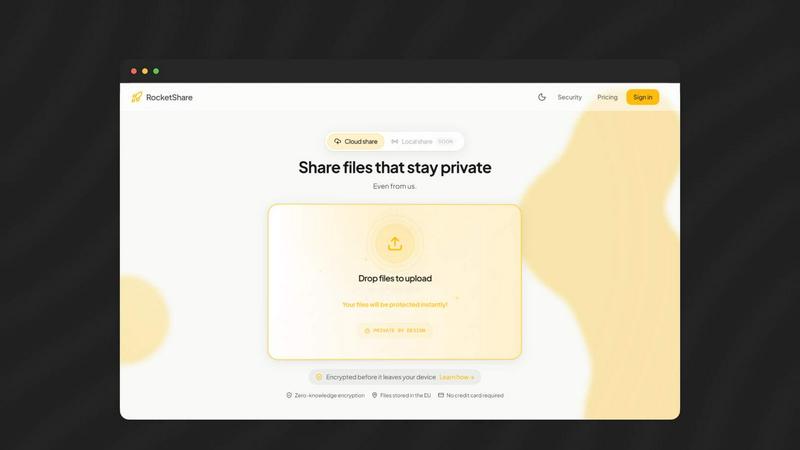
RocketShare provides secure, zero-knowledge encrypted file sharing where only you control access.
Last updated: March 4, 2026
Visual Comparison
Gaffa

RocketShare
Feature Comparison
Gaffa
Simple REST API for Browser Control
Gaffa abstracts the complexities of frameworks like Playwright, Selenium, and Puppeteer into a straightforward REST API. Developers can execute sophisticated browser automation tasks—such as navigation, interaction, and data extraction—with a single HTTP request. This eliminates the learning curve and maintenance burden associated with direct browser automation libraries, streamlining integration into existing data workflows and applications.
Stealth Mode with Resilient Infrastructure
The platform is engineered to target the hardest-to-scrape websites. Its stealth mode integrates a global network of residential proxies, automated CAPTCHA-solving capabilities, and real browser instances that execute JavaScript and render pages identically to a human user. Gaffa automatically handles proxy rotation, request throttling, and fingerprint management to bypass advanced anti-bot defenses, ensuring high success rates for data extraction missions.
Automated Data Processing and Output Formats
Gaffa goes beyond returning raw HTML. It includes built-in data processing to transform web content into immediately usable formats. Users can specify output as clean, simplified HTML; structured JSON via CSS selectors; LLM-ready markdown optimized for AI ingestion; full-page screenshots; or even self-contained offline page archives. This feature saves significant post-processing time and computational resources.
Full Observability and Request Recording
Every automation executed through the Gaffa API is recorded for complete observability. Users can review detailed logs, performance metrics, and visual screen recordings of their browser sessions. This transparency is critical for debugging complex automation scripts, verifying data extraction accuracy, and auditing the behavior of the automation to ensure it operates as intended against target websites.
RocketShare
Zero-Knowledge, End-to-End Encryption
RocketShare implements a true zero-knowledge encryption model where files are encrypted locally on the sender's device using strong cryptographic standards before upload. The platform's servers never receive or have access to the unencrypted data or the decryption keys. This means that even in the event of a server breach, the encrypted data remains computationally infeasible to decipher. The decryption key is typically part of the shareable URL, granting access only to intended recipients with the complete link.
Dual Sharing Modes: Cloud and Local (P2P)
The platform provides two technical methodologies for file transfer. The Cloud Share mode uploads encrypted files to secure, EU-based data centers for persistent, time-limited access. The Local Share (peer-to-peer) mode establishes a direct, encrypted connection between the sender's and recipient's devices for the transfer, with files never stored on RocketShare's servers. This P2P option is ideal for transient data exchange where cloud persistence is not required.
EU-Based Data Sovereignty
For cloud-based transfers, all encrypted file data is stored exclusively on servers located within the European Union. This provides users with the legal and regulatory assurances associated with EU data protection jurisdiction, including adherence to the General Data Protection Regulation (GDPR) framework for data handling and storage practices.
No-Account Required File Sharing
RocketShare operates on a frictionless, self-serve model that does not mandate account creation for basic file sending. Users can initiate secure transfers immediately without providing personal information or payment details. This reduces barriers to adoption while maintaining full security, as the encryption process is device-based and independent of user authentication on the platform's servers.
Use Cases
Gaffa
Competitive Intelligence and Market Research
Businesses can automate the collection of pricing data, product catalogs, feature updates, and promotional content from competitor websites at scale. Gaffa's ability to handle JavaScript-heavy sites and bypass blocks ensures a consistent flow of structured data, enabling companies to perform dynamic pricing analysis, track market trends, and inform strategic decisions with real-time web data.
AI and LLM Training Data Aggregation
For teams building or fine-tuning large language models, Gaffa provides a reliable pipeline for sourcing high-quality, diverse training data from the web. The platform's ability to output clean, LLM-ready markdown and structured JSON simplifies the data preparation pipeline, allowing data scientists to focus on model development rather than the complexities of data collection and cleaning.
Regulatory Compliance and Financial Monitoring
Financial institutions and compliance teams can use Gaffa to automate the monitoring of regulatory publications, news sites, and official registers. The platform's reliability and audit trail via session recording are essential for ensuring data provenance and completeness in regulated environments, supporting activities like KYC (Know Your Customer) checks and adverse media screening.
E-commerce Price and Inventory Monitoring
Retailers and aggregators can deploy Gaffa to track real-time pricing, stock availability, and product descriptions across thousands of e-commerce SKUs. The system's concurrent request handling and proxy rotation allow for high-frequency, large-scale scraping without triggering IP bans, enabling dynamic repricing strategies and supply chain optimization.
RocketShare
Legal Document Exchange
Law firms and legal professionals can securely share sensitive case files, contracts, deposition transcripts, and client communications. The zero-knowledge architecture ensures attorney-client privilege and work-product doctrine protections are technically enforced, as no third party can intercept or access the confidential materials during transfer or storage.
Healthcare Data Transmission
Medical practices, therapists, and healthcare administrators can use RocketShare to exchange protected health information (PHI), patient records, lab results, and imaging files in compliance with stringent regulations like HIPAA. The platform's encryption and EU data storage provide a robust technical safeguard for patient privacy.
Creative Asset Delivery
Photographers, videographers, and design agencies can deliver high-resolution client galleries, raw footage, and creative proofs. The ability to send files of any size, coupled with guaranteed privacy, protects intellectual property and ensures only paying clients access the final deliverables via the unique, key-embedded link.
Confidential Corporate Collaboration
Teams working on proprietary projects, financial reports, merger & acquisition documents, or source code can collaborate securely. The local P2P sharing option is particularly valuable for transferring draft documents or sensitive data between team members without creating a cloud-based copy, minimizing the digital footprint.
Pricing Comparison
Gaffa
Gaffa offers tiered monthly subscriptions and a pay-as-you-go credit system. The Starter plan is $29/month, including 9,000 credits, 1 concurrent request, and 7-day data retention. The Startup plan is $99/month, offering 35,000 credits, 3 concurrent requests, and 30-day retention. The Growth plan is $249/month, providing 100,000 credits, 10 concurrent requests, and 3-month retention. All plans include access to the Browser Request API and residential proxies. Additionally, users can Get Credits on a flexible basis at $20 per 5,000 credits, which come with Starter-plan allowances. For high-volume or custom requirements, Gaffa provides the option to Contact Us for a bespoke enterprise plan.
RocketShare
The provided context indicates that specific pricing plans, tiers, or costs are not detailed in the available material. The website highlights a "No credit card required" approach for initial use, suggesting a possible freemium model or free tier for basic services. For detailed, current pricing information regarding premium features, storage limits, or team plans, users are directed to visit the official RocketShare website and navigate to its dedicated "Pricing" section.
Overview
About Gaffa
Gaffa is an API-first platform engineered to solve the complex, infrastructural challenges of large-scale web data extraction and browser automation. It provides developers, data scientists, and businesses with a robust, simplified interface to control real, fully-featured web browsers via a REST API, eliminating the need to build and maintain intricate in-house systems. The platform's core value proposition is its abstraction of the entire technical stack required for reliable scraping, including proxy management, CAPTCHA solving, browser orchestration, and failure handling. This allows technical teams to focus entirely on data utilization rather than pipeline management. Gaffa is specifically architected for resilience against sophisticated anti-bot measures, employing stealth techniques, residential proxy networks, and real browser instances to mimic genuine human interaction. It supports sophisticated automation actions like scrolling, clicking, and form submission, and delivers processed data in multiple formats including raw HTML, structured JSON, LLM-ready markdown, and images. Ideal for startups, growth-stage companies, and enterprises, Gaffa delivers consistent, high-volume access to web data with minimal operational overhead.
About RocketShare
RocketShare is a secure file-sharing platform engineered to provide absolute data privacy through a zero-knowledge encryption architecture. The core operational principle is that user privacy is non-negotiable; the platform is designed so that no entity, including RocketShare's own administrators, can access the content of shared files. This is achieved by performing client-side encryption on the user's device before any data is transmitted. The encryption keys remain solely with the user, often embedded directly within the shareable link, ensuring servers only process cryptographically secure, unreadable data. The platform supports the transfer of files of any size and offers two distinct sharing modalities: cloud-based storage with data housed in EU-based facilities, and a local, peer-to-peer transfer option that minimizes data persistence. Targeted at professionals and organizations handling sensitive information, RocketShare delivers enterprise-grade security within a self-serve, user-friendly interface. Its value proposition is providing top-tier cryptographic security without compromising on simplicity, making robust privacy accessible for legal, creative, healthcare, and corporate sectors.
Frequently Asked Questions
Gaffa FAQ
What is a credit and how is it calculated?
A credit is Gaffa's unit of consumption for its API. Usage is calculated based on two primary factors: request duration and proxy bandwidth. Browser runtime is billed at 1 credit per 30 seconds (or 2 credits per 30 seconds if screen recording is enabled). Additionally, any request utilizing a residential proxy (proxy_location parameter) incurs a bandwidth charge of 1500 credits per 1GB of data transferred. Each successful API call deducts the corresponding credits from your monthly allowance.
Does Gaffa offer a free trial?
Yes, Gaffa provides a free tier that allows users to sign up and experiment with the full API feature set without a credit card. This trial is conducted on a dedicated demo site (demo.gaffa.dev), enabling users to build and test automations, understand the workflow, and assess output formats before upgrading to a paid plan for use on the open internet.
What is Gaffa's refund policy?
Gaffa is happy to offer a refund upon request, provided the request is made before any credits have been consumed within the current billing cycle. Once credits have been used, refunds are not typically issued. Users are encouraged to review the detailed refund policy on the Gaffa website for specific terms and conditions.
Do unused credits roll over to the next month?
No, credits do not roll over. The credit allowance included with your monthly subscription plan is reset at the start of each new billing cycle. Any unused credits from the previous period are forfeited. This applies to both monthly plans and pay-as-you-go credit packs, which also have no expiration unless specified otherwise at purchase.
RocketShare FAQ
How does zero-knowledge encryption work on RocketShare?
Zero-knowledge encryption means the encryption and decryption processes occur exclusively on user devices. When you upload a file, the RocketShare client application on your computer or browser encrypts it using a strong, randomly generated key before it leaves your system. This key is not sent to RocketShare. The encrypted data is then transmitted to our servers. The decryption key is typically appended to the shareable link. Only someone with the full link possesses the key needed to decrypt the file, and this decryption happens locally on the recipient's device.
Where are my files stored?
For files sent via the Cloud Share option, the encrypted data is stored on secure servers located within the European Union. We do not utilize or replicate data to servers outside the EU. For files sent via the Local Share (peer-to-peer) option, the files are never stored on our servers; they are transferred directly between the devices of the sender and recipient over an encrypted channel.
Can RocketShare access or view my files?
No. Under no circumstances can RocketShare or its personnel access the content of your files. The cryptographic design ensures we only handle encrypted data blobs. We do not possess the encryption keys required to decrypt them. This architecture is fundamental to our service and is technically enforced.
Is there a file size limit for transfers?
RocketShare is designed to send files of any size. The platform does not impose artificial caps on file dimensions for its core transfer functionality. Performance will be subject to the sender's and recipient's respective network bandwidth and connectivity, especially for very large files or when using the Local Share mode.
Alternatives
Gaffa Alternatives
Gaffa is a REST API platform in the web automation and data extraction category. It provides a managed service for controlling real browsers at scale, abstracting the infrastructure complexities of proxy management, CAPTCHA solving, and anti-bot evasion to deliver reliable data. Users may seek alternatives for various reasons, including budget constraints, specific feature requirements not covered by the platform, or a need for greater control over the underlying infrastructure. Some organizations might prefer an open-source framework to build a custom solution, while others might require different pricing models or integration capabilities. When evaluating alternatives, key considerations include the core technology stack, such as whether it uses headless browsers or HTTP clients, its ability to handle JavaScript-rendered content and bypass anti-bot measures, and the scalability of its proxy network. The format and reliability of data output, along with the total cost of ownership for development and maintenance, are also critical decision factors.
RocketShare Alternatives
RocketShare is a secure file-sharing and collaboration platform within the productivity and management software category. It distinguishes itself through a strict zero-knowledge encryption model, ensuring that all file data is encrypted client-side before upload, making it inaccessible to the service provider itself. Users may seek alternatives to RocketShare for various reasons, including specific budget constraints, the need for integrated collaboration features like real-time document editing, or requirements for different deployment models such as on-premises solutions. Platform compatibility, storage limits, and administrative control levels are also common decision factors. When evaluating an alternative, key technical criteria include the encryption standard employed (e.g., AES-256), the jurisdiction of data storage, the availability of client-side encryption, and the granularity of user permission controls. The chosen solution should align with both the operational workflow and the specific compliance or security mandates of the user or organization.