Hostim.dev vs OGimagen
Side-by-side comparison to help you choose the right tool.

Hostim.dev
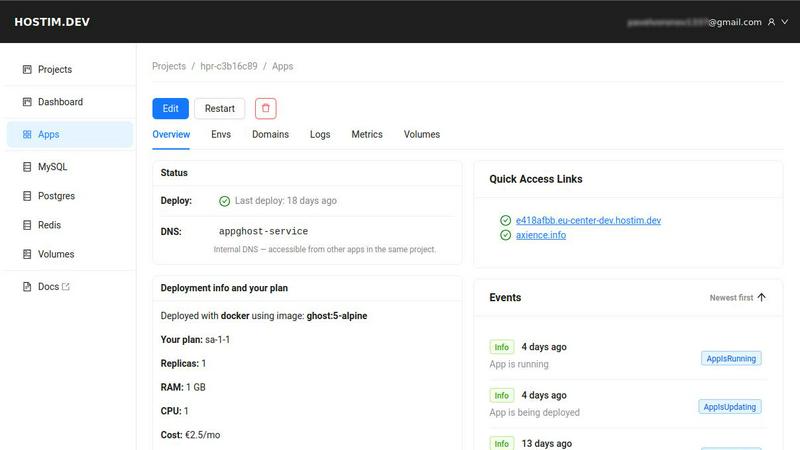
Hostim.dev deploys Docker apps with managed databases on GDPR-compliant EU bare-metal servers.
Last updated: March 1, 2026

OGImagen is an AI-powered generator that creates and delivers optimized Open Graph, Twitter, and LinkedIn images with ready-to-use meta tags.
Last updated: March 11, 2026
Visual Comparison
Hostim.dev
OGimagen
Feature Comparison
Hostim.dev
EU Bare-Metal Hosting with GDPR Compliance
Hostim.dev operates on dedicated bare-metal servers located in Germany, ensuring high performance and low latency for European users. This architecture provides a solid foundation for applications requiring consistent resource allocation. By being hosted exclusively within the EU, the platform guarantees GDPR compliance by default, addressing data sovereignty concerns for businesses and developers handling European user data without requiring additional configuration or legal vetting of third-party data processors.
Docker, Git, and Docker Compose Deployment
The platform supports multiple deployment methodologies natively. Developers can launch applications directly from a public or private Docker image, connect a Git repository for continuous deployment, or paste a complete Docker Compose file to deploy multi-service application stacks. This flexibility allows teams to migrate existing containerized workflows without modification. The system automatically parses the Compose file, provisions the defined services, and establishes the necessary networking between containers, removing the need for manual orchestration setup.
Integrated Managed Databases and Volumes
Hostim.dev provides built-in, managed database services including MySQL, PostgreSQL, and Redis, which are provisioned instantly alongside your application. These databases are pre-wired to your application containers with environment variables, eliminating manual connection string configuration. Persistent block storage volumes are also available, offering reliable data storage for stateful services. This integration consolidates the application stack management into a single interface and billing point.
Per-Project Isolation and Cost Tracking
Every application or client project is encapsulated within its own fully isolated environment, encompassing compute, networking, and data. This ensures security and prevents resource conflicts. Crucially, each project has its own dedicated cost tracking and billing, starting from €2.5 per month. This model provides absolute financial transparency, making it simple for freelancers and agencies to quote fixed prices to clients and track profitability per project without unexpected cross-charges.
OGimagen
AI-Powered Multi-Platform Generation
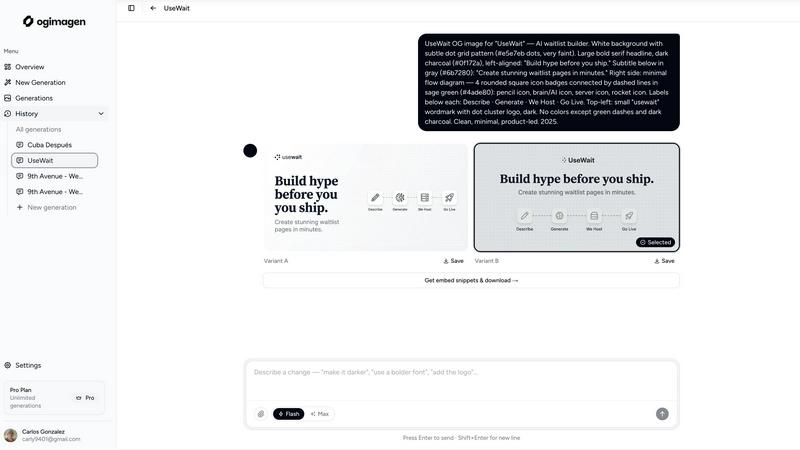
OGimagen's core engine uses artificial intelligence to generate two distinct visual variants (A & B) from user-provided titles, descriptions, and brand colors. The system is specifically tuned to create pixel-perfect images optimized for the precise specifications of each social platform. With a single generation action, it automatically produces three correctly sized assets: a standard Open Graph image, a Twitter Card, and a LinkedIn Card. This eliminates the need for manual resizing, reformatting, or maintaining multiple design templates.
Framework-Specific Meta Tag Snippets
Following image generation, OGimagen provides immediate access to copy-paste code snippets for embedding the generated images into a website's HTML <head> section. While free users receive a standard HTML snippet, Pro subscribers unlock framework-specific code for Next.js (App Router and Pages Router), Astro, SvelteKit, and Remix. These snippets include correctly formatted openGraph and twitter metadata objects, ensuring proper integration and immediate preview functionality upon deployment.
Model Context Protocol (MCP) Integration
For Pro users, OGimagen offers deep integration into the developer workflow via Model Context Protocol (MCP). This allows developers to generate, list, and manage OG images directly from within compatible code editors and AI agents like Claude Code, Cursor, and Windsurf. Users can attach brand logos as reference images and fetch meta tag snippets without leaving their coding environment, dramatically streamlining the content creation and deployment pipeline.
Global CDN Hosting & Management
All generated images are automatically uploaded and served from a global Cloudflare Content Delivery Network (CDN). This ensures high-performance image deliverability with low latency worldwide, which is critical for social platform crawlers that fetch preview images. Hosting duration varies by plan, from 45 days for Starter to permanent hosting for Pro. The platform manages the entire asset lifecycle, including storage, optimization, and global distribution.
Use Cases
Hostim.dev
Freelancer Client Project Delivery
Freelancers can use Hostim.dev to rapidly deploy and deliver web applications for clients. By using Docker Compose, they can ship complex stacks (app, database, cache) in minutes. The per-project billing allows for clean cost pass-through or markup, and the isolated project environment enables easy, secure handover of the running application to the client post-engagement, without providing access to other projects or underlying infrastructure.
Agency Managing Multiple Client Portfolios
Digital agencies benefit from the strict per-client project isolation, which provides security and operational boundaries between different client workloads. The platform offers clear cost breakdowns for each project, simplifying internal accounting and client invoicing. The EU-based, GDPR-compliant hosting is a key selling point for agencies serving European customers, ensuring regulatory adherence is built into the service.
Startup Prototyping and MVP Launch
Startups and small teams can leverage Hostim.dev to go from code to a live, scalable prototype or Minimum Viable Product (MVP) with minimal DevOps investment. The built-in databases, automatic HTTPS, and monitoring allow developers to focus on product features. The predictable flat pricing protects against unforeseen cloud bills during the early, unpredictable usage stages, aiding in budget control.
Student and Developer Learning Projects
Students and developers building portfolio projects can access professional-grade deployment tooling without complexity or high cost. The free trial and student credits provide a risk-free environment to learn Docker, database integration, and deployment workflows on real, production-like infrastructure. This results in tangible, publicly accessible projects that demonstrate practical skills to potential employers.
OGimagen
Technical Blog and Documentation Sites
Developers maintaining technical blogs or documentation can use OGimagen to automatically generate relevant social cards for every new article or API reference page. By simply inputting the post title and a brief description, they receive a professional, code-themed image and the exact meta tags needed for their static site generator (like Next.js or Astro), ensuring every shared link presents a polished, credible preview.
SaaS Product Launch and Feature Updates
SaaS companies can maintain a consistent brand image across social media when announcing new features or product launches. Marketing teams can quickly generate on-brand social cards using company colors and logos, creating engaging previews for shared announcement links on LinkedIn, Twitter, and community platforms like Discord or Slack, thereby increasing engagement and click-through rates.
E-commerce and Product Marketing
E-commerce stores can automate the creation of social preview images for individual product pages. By pulling in product titles and descriptions, OGimagen can generate attractive card images that showcase the product contextually. This improves the visual appeal when products are shared on social platforms or messaging apps like WhatsApp, directly influencing potential customer clicks.
Content Agencies and Freelancers
Agencies and freelancers managing multiple client websites can standardize and scale their OG image production. OGimagen allows them to swiftly create client-specific images by adjusting brand colors and styles, then provide clients with the correct embed code for their specific web framework. This saves significant design and development time while delivering a high-value, consistent service.
Pricing Comparison
Hostim.dev
Hostim.dev operates on a simple, flat pricing model based on per-project resource allocation, starting at €2.5 per month per project. This contrasts sharply with the granular, usage-based billing of large cloud providers. Pricing is determined by the amount of CPU and RAM allocated to a project, which can be scaled up or down from the user interface. Notably, managed database services (MySQL, PostgreSQL, Redis) include free tiers with specific resource limits. The model ensures predictable costs, allowing developers and agencies to quote fixed prices to clients without fear of hidden fees or unexpected bills from traffic spikes or auxiliary services.
OGimagen
OGimagen offers flexible pricing with one-time credit packs and a monthly subscription. The Starter pack is $5 for 10 generations, including both image variants, all framework snippets, and 45-day CDN hosting. The Growth pack is $15 for 25 generations, extending hosting to 90 days and adding priority queue access. The Pro subscription is $29 per month, providing 50 monthly generations, permanent CDN hosting, all framework snippets, and exclusive MCP integration for editor workflow tools. All payments are securely processed by Stripe.
Overview
About Hostim.dev
Hostim.dev is a specialized Platform-as-a-Service (PaaS) engineered to streamline the deployment and management of containerized applications. It functions as a managed bare-metal platform, hosted exclusively on infrastructure within Germany, providing a robust, GDPR-compliant foundation for modern software. The core value proposition is the complete abstraction of infrastructure complexity, allowing developers to focus exclusively on building their applications rather than managing servers, networking, or orchestration systems. Users can deploy directly from existing Docker images, Git repositories, or full Docker Compose configurations without any rewrites, with the platform automatically handling provisioning, networking, service integration, and security. It is designed for freelancers, agencies, startups, and students who require a simple, transparent, and controlled environment to launch personal projects, client work, or SaaS products. Hostim.dev eliminates the need to navigate intricate cloud provider consoles, write extensive YAML configurations, or deal with unpredictable usage-based billing, offering a flat, per-project pricing model instead.
About OGimagen
OGimagen is an AI-powered platform engineered to automate and optimize the creation of Open Graph (OG) images and social media cards. It addresses the technical and design challenges developers and content creators face when generating platform-specific preview images for shared links. The core value proposition lies in its ability to transform simple text inputs—like a title and description—into production-ready, visually compelling social cards within seconds. The tool is built for developers, marketers, and website owners who require professional-looking link previews for platforms like Facebook, X (Twitter), and LinkedIn without needing design software or manual image editing. OGimagen ensures technical compliance by generating images in the exact pixel dimensions required by each major platform (1200x630 for OG, 1200x600 for Twitter, 1200x627 for LinkedIn) and delivers them via a global Cloudflare CDN for fast, reliable delivery. Furthermore, it streamlines the implementation workflow by providing ready-to-paste meta tag snippets for all major web frameworks, including Next.js, Astro, and SvelteKit. This end-to-end solution significantly improves click-through rates by guaranteeing that shared links display engaging, on-brand preview imagery with minimal effort and zero design skills required.
Frequently Asked Questions
Hostim.dev FAQ
What does the free tier include?
The free tier is structured as a 5-day trial project, requiring no credit card for signup. During this trial, users have full access to the platform's capabilities to deploy a complete application stack. This includes deploying from Docker, Git, or Compose files, and utilizing built-in services like managed databases (MySQL, PostgreSQL, Redis) and volumes. The trial encompasses all features such as automatic HTTPS, live logs, metrics, and project isolation, allowing for a comprehensive evaluation of the service.
Can I deploy with just a Docker Compose file?
Yes, deploying with a Docker Compose file is a primary workflow supported by Hostim.dev. You can directly paste your existing docker-compose.yml file into the platform's interface. The system will automatically interpret the file, provision all defined services, set up the private network between the containers as specified, and deploy the entire stack. No rewriting or adaptation for a proprietary platform format is required, ensuring portability and simplicity.
Where is my application hosted?
All applications deployed on Hostim.dev are hosted exclusively on bare-metal servers within professional data centers located in Germany. This provides the performance benefits of dedicated hardware while ensuring all data remains within the European Union. This geographic and jurisdictional specificity is fundamental to the platform's guarantee of GDPR compliance by default for data storage and processing.
Do I need to know Kubernetes or DevOps to use this?
No, knowledge of Kubernetes or advanced DevOps practices is not required to use Hostim.dev. The platform is explicitly designed to abstract away the complexity of container orchestration, cluster management, and infrastructure provisioning. Developers only need familiarity with Docker and, optionally, Docker Compose to define their application services. The platform manages all underlying operations, including scaling, networking, load balancing, and security patching.
OGimagen FAQ
What exactly is an OG image?
An OG (Open Graph) image is the preview picture that appears when a website link is shared on social media platforms, messaging apps, or other services that support the Open Graph protocol. It is defined by specific HTML meta tags (og:image, og:image:width, og:image:height) in your webpage's code. This image is crucial for engagement as it provides a visual context for your link, significantly impacting whether users decide to click.
How does AI generation work?
OGimagen's AI generation process analyzes the text inputs you provide—such as title, description, and selected style preset—to create a coherent visual representation. The AI is trained to combine typography, layout, color theory, and thematic elements to produce two unique, aesthetically balanced image variants optimized for readability and visual impact at social card dimensions. You do not need to provide image prompts; the system constructs the design based on your content.
What is MCP integration?
MCP (Model Context Protocol) integration allows OGimagen to connect directly with your code editor or AI-assisted development environment. For Pro users, this means you can invoke OGimagen's functionality—such as generating a new image or fetching an embed snippet—via commands within tools like Claude Code, Cursor, or Windsurf. This bridges the gap between content creation and development, enabling you to manage social images as part of your core coding workflow.
What happens when CDN hosting expires?
When the CDN hosting period for your generated image expires (e.g., after 45 days on the Starter plan), the image file is removed from the active CDN cache and will no longer be publicly accessible. If a social platform or user tries to load the preview after expiration, they will encounter a broken image link. To prevent this, you can extend hosting by purchasing additional generation packs, upgrading your plan, or downloading and self-hosting the image assets before the expiry date.
Alternatives
Hostim.dev Alternatives
Hostim.dev is a specialized Platform-as-a-Service (PaaS) focused on deploying Docker-based applications on managed bare-metal servers in Germany. It caters to developers seeking a streamlined, GDPR-compliant hosting environment with integrated databases, eliminating infrastructure management complexity. Users may explore alternatives for various reasons, including budget constraints, a need for global server locations outside the EU, requirements for specific cloud provider integrations, or a preference for different pricing models such as pure usage-based billing over fixed plans. The feature set, particularly around scaling granularity and supported orchestration tools, also drives comparison. When evaluating an alternative, key considerations include the core infrastructure type (shared, virtualized, or bare-metal), compliance certifications, native service integrations like databases, deployment workflow simplicity, pricing transparency, and the geographical distribution of data centers relative to your target audience.
OGimagen Alternatives
OGimagen is an AI-powered Open Graph image generator, categorized as a developer tool. It enables the rapid creation of production-ready social card images to enhance link previews across social platforms, aiming to improve engagement and click-through rates with minimal developer effort. Users may seek alternatives to OGimagen for various reasons. Common factors include specific budget constraints or pricing models, the need for different feature sets such as advanced branding controls or integration capabilities, and platform-specific requirements like compatibility with certain frameworks or content management systems beyond the tool's native support. When evaluating an alternative, key considerations should include the tool's core technology and output quality, its integration and automation potential within your existing development workflow, and the overall cost structure relative to the value provided. The ideal solution should balance ease of use with the technical flexibility required for scalable, maintainable social image generation.