
Interactive Circle of Fifths vs Polym
Side-by-side comparison to help you choose the right tool.

Interactive Circle of Fifths
Master music theory with an interactive Circle of Fifths for scales, chords, and instrument visualization.
Last updated: March 1, 2026

Polym is an audio learning app that uses cognitive science techniques to enhance knowledge retention and recall.
Last updated: March 1, 2026
Visual Comparison
Interactive Circle of Fifths
Polym
Feature Comparison
Interactive Circle of Fifths
Dynamic Circle Interface
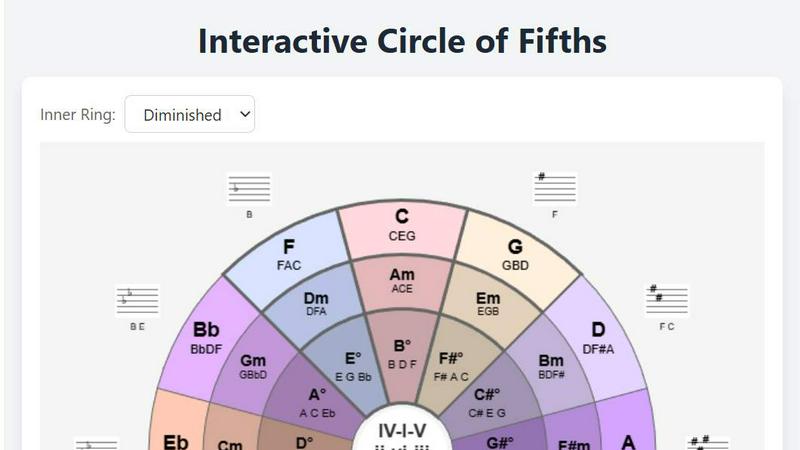
The central feature is a fully interactive, clickable Circle of Fifths diagram. Users can select any key as the tonic, and the entire interface updates in real-time to reflect all harmonic relationships originating from that tonal center. This includes the immediate display of the seven diatonic chords, their Roman numeral functions, and their parallel connections across the circle. The dynamic nature allows for instant transposition and visualization of key relationships, such as relative majors/minors and closely related keys, far surpassing the utility of a static image.
Integrated Scale & Chord Explorer
This feature provides detailed analysis of scale structures and their harmonized chords. Users can select from a comprehensive library of scales, including Diatonic, Pentatonic, Blues, and Diminished scales. Upon selection, the tool displays the precise notes of the scale and, crucially, automatically generates the complete set of chords that are built from each scale degree. This allows for deep study of scale harmonization principles and provides the foundational chords for composition and improvisation within that specific tonal color.
Visual Instrument Fingering Diagrams
To directly connect theory with physical execution, the tool incorporates precise, interactive fingering diagrams for both piano keyboard and guitar fretboard. When a chord or scale is selected, the corresponding finger positions are highlighted on these instrumental diagrams. This specification is critical for instrumentalists to translate theoretical chord symbols and scale notes into accurate, playable shapes on their instrument, facilitating efficient practice and performance application.
Chord Sequencer & Functional Analysis Panel
This advanced panel enables the construction and analysis of chord progressions. Users can sequence chords (e.g., C, Dm, Em, F) and the interface will display their functional Roman numeral analysis (I, ii, iii, IV) within the active key. Additional metadata for each chord, such as its scale degree and typical resolution target ("Resolves To"), is provided. This feature is essential for understanding cadential motion, composing logically flowing progressions, and studying the syntactic rules of functional harmony in a practical, hands-on environment.
Polym
Medium-Form Content on Foundation Knowledge
Polym offers a diverse selection of medium-form audio courses focused on foundational knowledge across various fields. This content is tailored not only for professional development but also for individuals who seek to broaden their intellectual horizons.
Retrieval Practice
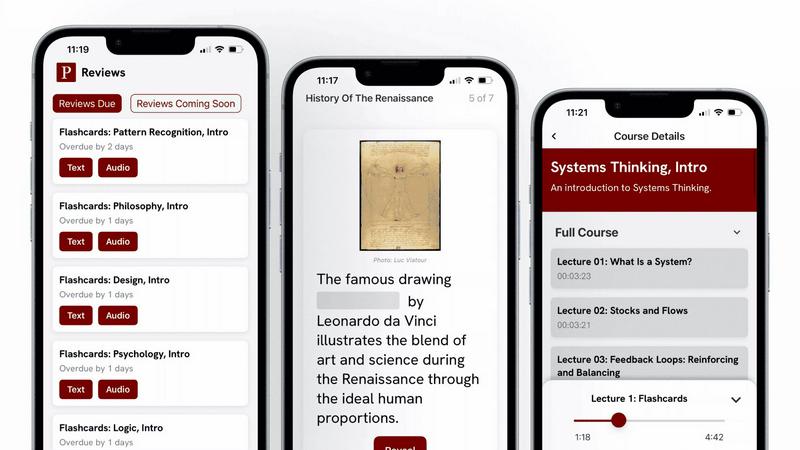
The app leverages active learning techniques by incorporating retrieval practice through audio flashcards. This strategy enhances the user's ability to recall information, significantly improving long-term retention and understanding of the subject matter.
Spaced Repetition
Polym implements spaced repetition to optimize the learning process. By prompting users to revisit essential subjects at strategic intervals, the app strengthens memory retention and aids in the effective consolidation of knowledge.
Interleaving
The interleaving feature allows users to study multiple topics in a single session, enhancing connections between concepts. By mixing related content from different courses, Polym promotes a deeper understanding and application of knowledge across various contexts.
Use Cases
Interactive Circle of Fifths
Music Theory Education & Homework
Students can use the tool to visualize and verify complex theoretical concepts taught in class. Instead of manually drawing circles or calculating chords, they can instantly see the structure of any key, harmonize any scale, and check the functional analysis of progressions. This interactive verification accelerates comprehension and serves as a powerful aid for completing assignments on harmony, scale construction, and chord progression analysis with accurate, immediate feedback.
Songwriting & Chord Progression Development
Songwriters and composers can leverage the Chord Sequencer and interactive circle to break out of creative ruts. By experimenting with different tonal centers and viewing the available diatonic chords, they can construct novel progressions. The "Resolves To" functionality suggests conventional harmonic movements, which can be followed or subverted intentionally. This use case transforms the tool from a reference into an active brainstorming partner for harmonic development.
Instrumental Practice & Fretboard/Keyboard Mastery
Guitarists and pianists utilize the integrated fingering diagrams to learn chord voicings and scale patterns in all keys. A user can select a challenging chord, such as B° (B diminished), and instantly see its formation on their instrument across different positions. This is invaluable for systematic practice, memorizing the fretboard or keyboard geography, and applying new theoretical scales like the Diminished or Blues scale directly to their instrument in a musical context.
Analytical Reference for Arranging & Transcription
When arranging music or transcribing songs, musicians often need to quickly identify the key, analyze borrowed chords, or understand modal interchange. The Interactive Circle provides a central reference to identify non-diatonic chords by showing their relationship to the primary key and suggesting their possible origin from parallel modes or closely related keys, thereby clarifying the harmonic structure of complex pieces.
Polym
Commuting
Polym is an excellent companion for daily commutes, transforming travel time into productive learning sessions. Users can absorb critical knowledge while on the go, making the most of their time spent in transit.
Workouts
During workouts, users can engage with Polym’s audio content, allowing them to learn while exercising. This dual-focus approach helps integrate learning into daily routines without the need for visual engagement.
Continuous Professional Development
Professionals aiming to cross-skill or deepen their expertise can utilize Polym to access relevant courses in their field. The app's structured content ensures that users can efficiently acquire new knowledge that is applicable to their careers.
Self-Study and Exploration
Curious learners can explore a wide range of subjects at their own pace. Polym allows users to delve into topics of interest, encouraging a lifelong commitment to learning and discovery without the constraints of traditional educational formats.
Overview
About Interactive Circle of Fifths
The Interactive Circle of Fifths is a sophisticated digital music theory platform engineered to transform the foundational concepts of Western harmony into a dynamic, multi-sensory learning and composition tool. It transcends the limitations of static textbook diagrams by providing a fully interactive, clickable interface that visually and audibly maps the complex relationships between keys, chords, and scales in real-time. This tool is architected for serious musicians, including students, composers, songwriters, and instrumentalists, who require a deep, practical understanding of music theory applicable to their craft. Its core value proposition is the seamless integration of abstract theoretical knowledge with immediate auditory feedback and instrumental application. By centralizing critical concepts such as scale harmonization, chord function (I, ii, iii, IV, V, vi, vii°), modal interchange, and scale construction (Diatonic, Pentatonic, Blues, Diminished), it serves as both an accelerated learning system and an indispensable creative reference. Users can instantly visualize chord relationships within any key, hear their sonic character, and study precise fingerings on integrated piano and guitar fretboard diagrams, thereby effectively bridging the gap between theoretical study and practical performance or composition.
About Polym
Polym is an innovative audio application designed specifically for lifelong learners who aspire to master essential subjects through effective audio learning. It serves as a comprehensive platform that prioritizes active learning principles while addressing the issue of knowledge decay. By integrating scientifically validated techniques, Polym ensures that users not only absorb information but also retain it for the long term. With a rich library of medium-form audio courses, succinct summaries, and interactive audio flashcards, the app covers a range of subjects including Statistics, Probability, Logic, Economics, Computer Science, Artificial Intelligence, Philosophy, and History. Polym caters to aspiring polymaths, professionals looking to enhance their skill sets, and curious individuals dedicated to self-study, fostering a systematic approach to learning. The application utilizes retrieval practice, spaced repetition, and interleaving strategies to facilitate deeper understanding and retention of complex concepts, making it an ideal companion for learning during commutes, workouts, or any situations requiring visual attention.
Frequently Asked Questions
Interactive Circle of Fifths FAQ
What instruments does the Interactive Circle of Fifths support?
The tool provides dedicated visual fingering diagrams for two primary instruments: the piano (keyboard) and the guitar (fretboard). When any chord or scale is selected, the correct notes and recommended fingerings are displayed on clear, interactive diagrams for these instruments. This direct application helps bridge theory and practice for players of these instruments.
Can I use it to learn about modes and non-diatonic scales?
Yes. Beyond the standard major (Ionian) scale, the tool includes analysis for various scale structures. By selecting different scales from the inner ring, such as the Pentatonic or Blues scale, you can see their unique interval patterns and the chords derived from them. This functionality is fundamental for studying modes and understanding the harmonic flavor of non-diatonic scales in composition and improvisation.
How does the Chord Sequencer and "Resolves To" feature work?
The Chord Sequencer allows you to build a progression by selecting chords. The tool then analyzes each chord's function within the currently active key, displaying its Roman numeral (e.g., IV, V, vi). The "Resolves To" information indicates the chord's typical tendency tone resolution based on classical and common-practice harmony, such as the dominant (V) chord strongly resolving to the tonic (I). This guides users in creating progressions with strong cadential movement.
Is this tool suitable for complete beginners in music theory?
While the interface is designed for clarity, the tool is most effective for users with a basic foundational understanding of notes, chords, and what the Circle of Fifths represents. It is engineered to deepen theoretical knowledge and apply it practically. A true beginner might benefit from introductory resources first, but the interactive nature can significantly accelerate the learning curve for those already familiar with basic terminology.
Polym FAQ
What research supports the long-term learning strategies mentioned above?
Numerous studies in cognitive science validate the effectiveness of active learning strategies such as retrieval practice, spaced repetition, and interleaving. For more information, visit this resource.
What are some of the subjects covered by Polym?
Polym covers a broad spectrum of subjects including Logic, logical fallacies, cognitive biases, statistics, probability, scientific research, algorithms, economics, philosophy, history, and many more essential topics.
When is the official launch date of Polym?
Polym is now officially available for download on both iOS and Android platforms, making it accessible to a wide audience of learners across different devices.
Who is Polym designed for?
Polym is designed for anyone eager to enhance their retention and recall of key subjects. Whether for professional advancement or personal growth, the app serves those who wish to integrate learning into their everyday lives.
Alternatives
Interactive Circle of Fifths Alternatives
The Interactive Circle of Fifths is a specialized digital music theory tool within the Education & Learning category. It functions as a dynamic, interactive reference designed to visualize harmonic relationships, chord progressions, and scale structures, integrating auditory feedback and instrumental visualizations for practical application. Users may seek alternatives for various technical and practical reasons. These include budget constraints, specific feature requirements not addressed by the core product, or compatibility needs with different operating systems and platforms. The search often extends to finding solutions that align with particular pedagogical approaches or workflow integrations. When evaluating an alternative, key considerations should include the depth of theoretical coverage, the quality and accuracy of auditory playback, the range of supported instrument visualizations, and the overall user interface design. The optimal tool should effectively bridge abstract music theory concepts with executable instrumental knowledge, matching the user's specific learning or compositional objectives.
Polym Alternatives
Polym is an innovative audio learning app designed to enhance long-term knowledge retention through active recall and spaced repetition techniques. Positioned within the education and learning category, it serves as a comprehensive platform for users eager to deepen their understanding of various essential subjects, ranging from statistics to philosophy. Many users seek alternatives to Polym for several reasons, including pricing, feature sets, compatibility with different devices, or specific learning preferences. When choosing an alternative, it’s crucial to consider factors such as the quality of content, the effectiveness of the learning methods employed, user interface design, and the overall user experience to ensure that the chosen app meets individual learning goals and preferred study habits.