KeywordRanker vs Storydoc
Side-by-side comparison to help you choose the right tool.

KeywordRanker
KeywordRanker swiftly identifies low-competition, high-value SEO keywords using the Keyword Golden Ratio for optimal.
Last updated: February 28, 2026

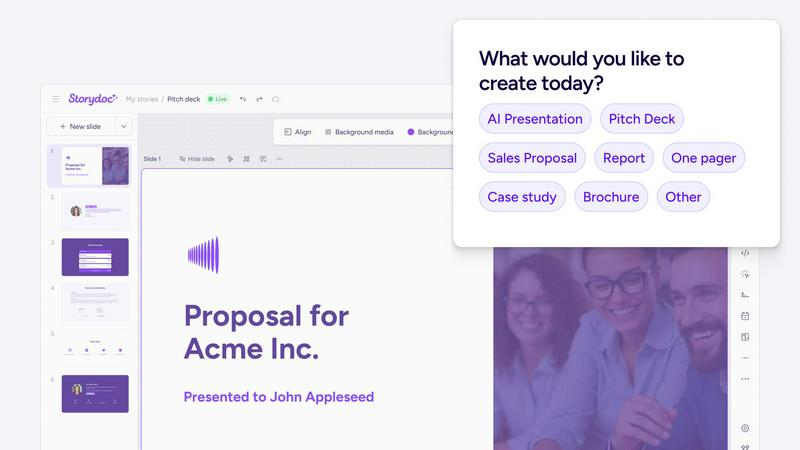
Storydoc is an AI-native platform that automates the creation of interactive business presentations and documents with deep analytics.
Last updated: March 26, 2026
Visual Comparison
KeywordRanker
Storydoc
Feature Comparison
KeywordRanker
KGR Calculator
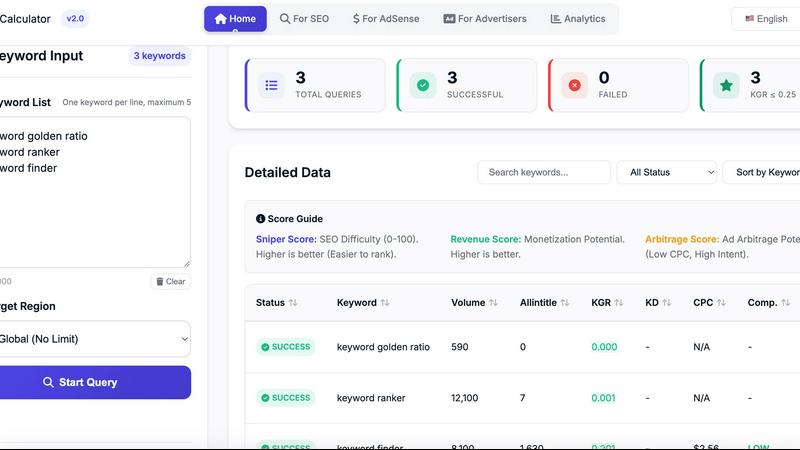
The KGR Calculator allows users to input multiple keywords and obtain their KGR values rapidly. This feature automates the tedious process of calculating competition against search volume, providing actionable insights in seconds without the need for a sign-up.
Bulk Keyword Analysis
KeywordRanker supports bulk analysis for up to 5 keywords simultaneously. This feature is designed to enhance efficiency, enabling users to analyze large keyword lists quickly and identify optimal targets for their SEO strategies.
Real-Time Data Integration
The platform seamlessly integrates real-time data from prominent APIs like Google Ads and Ahrefs. This integration ensures that users have access to the latest search volume and keyword difficulty metrics, allowing for informed decision-making in their keyword selection processes.
Regional Targeting
KeywordRanker offers granular targeting capabilities across multiple regions, including the United States, China, and Europe. This feature allows users to tailor their keyword strategies according to specific geographical markets, enhancing the relevance and effectiveness of their SEO efforts.
Storydoc
AI-Powered Document Creation
Storydoc's AI engine allows users to generate professionally structured and visually coherent business documents in seconds. By inputting basic prompts or objectives, the system automatically produces complete drafts for presentations, one-pagers, or reports, eliminating the need for advanced design or copywriting skills. This feature significantly accelerates the initial creation phase, ensuring a consistent starting point that adheres to brand guidelines and best practices in business communication, allowing professionals to focus on strategic customization rather than foundational formatting.
Interactive & Dynamic Elements
The platform enables the direct embedding of a wide array of interactive components within any document. Users can integrate tools like Calendly scheduling widgets, YouTube videos, clickable buttons, dynamic calls-to-action (CTAs), and embedded data capture forms. This functionality transforms linear documents into non-linear, engaging experiences where recipients can take immediate action—such as booking a meeting or submitting information—without leaving the document, thereby reducing friction and increasing conversion rates directly from the collateral itself.
Personalization & Automation at Scale
Storydoc facilitates large-scale personalization through smart workflows and integration capabilities. By connecting to CRM systems and data sources via Zapier and Make, users can pull live customer data (e.g., company name, industry, past interactions) to populate dynamic fields automatically. This allows teams to create a single master document template and generate hundreds of personalized versions for different leads or deal stages, ensuring relevant messaging while maintaining operational efficiency and a consistent brand voice across all communications.
Centralized Management & Deep Analytics
The platform provides a unified hub for all business documents, making them searchable, easily editable, and consistently on-brand. Coupled with this is a robust analytics suite that tracks granular engagement metrics, including document opens, time spent on each section, scroll depth, and clicks on interactive elements. These insights reveal what content resonates with audiences, what gets skipped, and how leads progress through the material, enabling data-driven optimizations to document strategy and providing sales teams with actionable intelligence on prospect interest.
Use Cases
KeywordRanker
SEO Optimization for Blogs
Bloggers can utilize KeywordRanker to find low-competition keywords that align with their niche. By focusing on KGR keywords, they can create content that ranks quickly on search engines, driving organic traffic and improving visibility.
Affiliate Marketing Strategies
Affiliate marketers can leverage the KGR methodology to discover hidden long-tail keywords that yield high conversion rates. Targeting these keywords can significantly enhance affiliate revenue by attracting more qualified leads.
Local Business SEO
Local businesses can use KeywordRanker to identify KGR keywords specific to their services and locations, such as "City + Service." This targeted approach helps in dominating local search results and increasing inquiries from potential customers.
Content Creation Planning
Content creators can benefit from KeywordRanker by systematically identifying a series of related KGR keywords. This helps in planning content calendars and building topical authority, ultimately boosting the overall performance of their websites.
Storydoc
Sales Proposal & Pitch Deck Creation
Sales teams utilize Storydoc to create compelling, interactive pitch decks and proposals that stand out from static PDFs. By embedding demo videos, personalized ROI calculators, and instant meeting scheduling links, sales representatives can deliver tailored narratives that address specific prospect pain points. The deep analytics then provide visibility into which parts of the proposal the client engaged with most, enabling informed follow-ups and helping to accelerate the sales cycle and improve win rates.
Marketing & Lead Generation Collateral
Marketing departments leverage the platform to produce high-conversion lead generation assets such as interactive whitepapers, one-pagers, and case studies. Embedding forms directly within these documents allows for seamless lead capture without redirecting users to external landing pages. The ability to personalize content based on lead source or segment increases relevance, while engagement tracking helps marketing teams identify the most effective content for moving leads through the funnel.
Investor & Board Reporting
Executives and finance teams use Storydoc to create dynamic quarterly business reviews and investor reports. Instead of distributing dense, static slides, they can build interactive reports with embedded data visualizations, video commentary from leadership, and expandable sections for detailed financials. This enhances comprehension and engagement during critical presentations, ensuring key stakeholders can easily navigate to the information most pertinent to them.
Client Onboarding & Success Materials
Customer success and account management teams implement Storydoc to develop interactive onboarding guides, training manuals, and business review documents. Embedding tutorial videos, feedback forms, and links to support resources directly within the guide creates a more engaging and effective onboarding experience. This interactive approach improves product adoption, client satisfaction, and provides teams with data on which sections clients find most useful or confusing.
Overview
About KeywordRanker
KeywordRanker is an advanced SEO analysis platform designed to help users discover high-value, low-competition keywords through the innovative application of the Keyword Golden Ratio (KGR) methodology. This tool is essential for SEO professionals, digital marketers, content creators, and affiliate bloggers who seek a systematic approach to navigating saturated markets. KeywordRanker's primary value proposition is its ability to automate the complex KGR calculation, streamlining the process of dividing the number of competing pages, identified through Google's allintitle: operator, by the keyword's monthly search volume. By focusing on keywords with a KGR of 0.25 or lower, users can uncover "blue ocean" long-tail keywords that are frequently overlooked, thereby fostering rapid organic growth and optimizing content creation efforts. The platform offers bulk keyword analysis, integrates real-time data from APIs like Google Ads and Ahrefs for accurate search volume and competition metrics, and supports granular targeting across various global regions, making it an indispensable tool for data-driven SEO strategies.
About Storydoc
Storydoc is an AI-native business documents platform engineered to transform static presentations, proposals, pitch decks, and reports into dynamic, interactive storytelling experiences. It serves as a comprehensive alternative to traditional file formats like PDFs and PowerPoint slides, specifically built to capture and retain the attention of modern decision-makers. The platform is designed for sales, marketing, and business development professionals, from solo entrepreneurs to large enterprise teams, who need to create persuasive, on-brand collateral efficiently. Its core value proposition lies in centralizing the entire document lifecycle—creation, personalization, distribution, and analytics—into a single, scalable workflow. By enabling the embedding of interactive elements such as calendars, videos, forms, and live data, Storydoc converts passive document consumption into actionable engagement, directly linking content to measurable business outcomes like increased meeting bookings and faster deal cycles. The platform prioritizes enterprise-grade security with ISO 27001 compliance, GDPR adherence, and secure SSO authentication, ensuring that data integrity and privacy are maintained throughout the user experience.
Frequently Asked Questions
KeywordRanker FAQ
What is the Keyword Golden Ratio (KGR)?
The Keyword Golden Ratio (KGR) is a metric used to evaluate the competition and value of keywords. It is calculated by dividing the number of Google results for the keyword (using the allintitle: operator) by the monthly search volume. A KGR of 0.25 or lower indicates an excellent opportunity for ranking.
How does KeywordRanker help with SEO?
KeywordRanker helps users identify low-competition, high-value keywords quickly. By focusing on KGR keywords, users can bypass saturated markets, achieve faster rankings, and attract targeted traffic to their websites.
Can I analyze multiple keywords at once?
Yes, KeywordRanker supports bulk keyword analysis, allowing users to analyze up to 5 keywords simultaneously. This feature is designed to enhance efficiency and streamline the keyword research process.
Is there a free version of KeywordRanker?
Yes, KeywordRanker offers a free KGR calculator that provides results without requiring user registration. This allows potential users to experience the tool's capabilities before committing to any paid plans.
Storydoc FAQ
What types of documents can I create with Storydoc?
Storydoc is designed for a wide range of business documents. Primary document types include sales pitch decks, business proposals, quarterly and annual reports, investor updates, one-pager sales sheets, case studies, and interactive whitepapers. The AI creation tool and customizable templates are structured to support these specific formats, ensuring each document type follows best-practice layouts and storytelling flows for its intended purpose.
How does Storydoc ensure the security of my data?
Storydoc is built with enterprise-grade security protocols. The platform is ISO 27001 certified, adhering to internationally recognized standards for information security management. It is fully compliant with GDPR for data protection and privacy. Furthermore, it offers secure Single Sign-On (SSO) authentication for team access, and all data transmission is encrypted. These measures ensure that both your company's internal data and the information shared with clients through documents are handled with the highest security standards.
Can I integrate Storydoc with my existing tech stack?
Yes, Storydoc offers extensive integration capabilities primarily through native connectors to automation platforms like Zapier and Make. These integrations allow you to connect Storydoc to hundreds of other applications, including popular CRM systems like Salesforce and HubSpot, marketing automation tools, data warehouses, and calendar applications. This enables automated workflows for pulling live data into documents, triggering document creation based on deal stages, or logging engagement analytics back to your CRM.
How does the interactive element tracking and analytics work?
Storydoc embeds tracking code into every document you create and share. When a recipient opens the document, the platform begins collecting anonymized engagement data. This includes metrics such as total view time, scroll depth (how far down the document they read), and specific interactions like clicks on embedded videos, buttons, or forms. This data is presented in a dashboard, showing you exactly how each contact engaged with your content, providing valuable insights for sales follow-up and content optimization.
Alternatives
KeywordRanker Alternatives
KeywordRanker is a powerful SEO analysis tool designed to calculate the Keyword Golden Ratio (KGR) to uncover low-competition, high-value keywords for users in the marketing and SEO sectors. It simplifies the complex process of keyword research, enabling professionals such as digital marketers, content creators, and affiliate bloggers to identify lucrative opportunities that are often overlooked. Users often seek alternatives to KeywordRanker due to various reasons, including pricing structures, feature sets, or compatibility with their existing platforms and workflows. When considering an alternative, users should evaluate the tool's ability to provide accurate data, ease of use, scalability for bulk analysis, and the availability of integrations with other essential marketing tools. A thorough understanding of these factors will help users select a suitable replacement that meets their specific needs.
Storydoc Alternatives
Storydoc is an AI-powered platform in the interactive content and document automation category. It transforms static business presentations, proposals, and pitch decks into dynamic, interactive experiences designed to engage decision-makers and drive measurable actions. Users may seek alternatives for various strategic reasons. Common drivers include budget constraints, the need for different feature sets like advanced design control or native CRM integrations, or a requirement for a platform that aligns with a specific existing tech stack and workflow philosophy. When evaluating alternatives, key considerations should include the core automation and AI capabilities, the depth of interactivity and embeddable elements offered, the sophistication of personalization and data-merge functionalities, and the robustness of engagement analytics. Enterprise-grade security certifications and the flexibility of the platform's API and connector ecosystem are also critical technical specifications.