Lovalingo vs Wire
Side-by-side comparison to help you choose the right tool.

Lovalingo
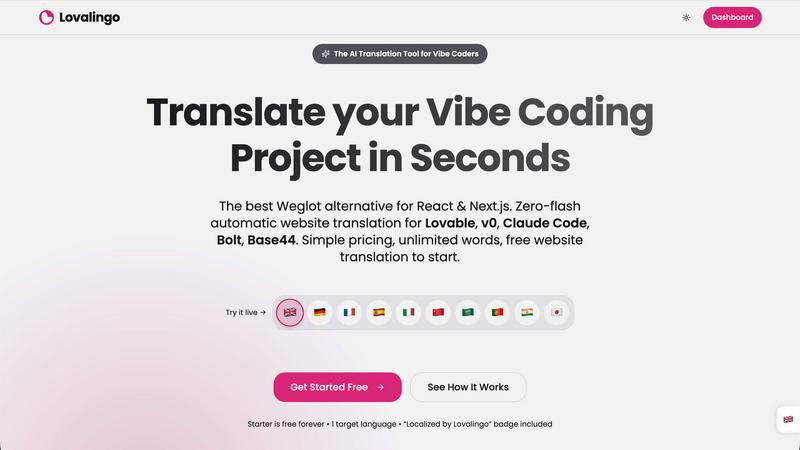
Lovalingo enables seamless, zero-flash translation of React apps in 60 seconds with automated SEO and sitemaps.
Last updated: February 26, 2026

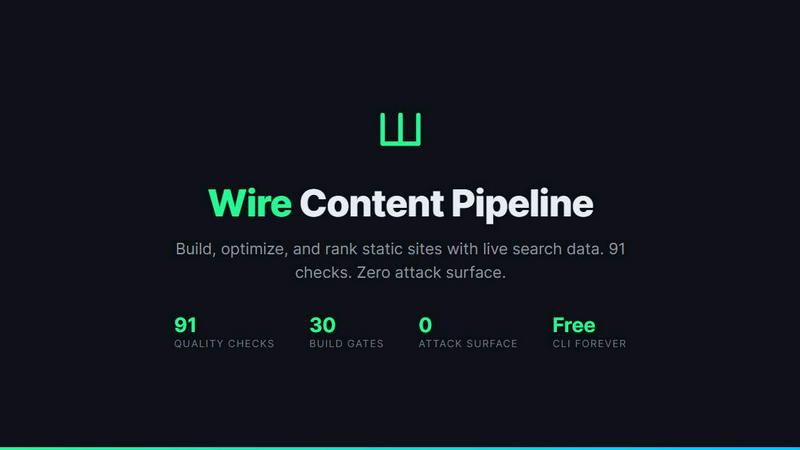
Wire is a content operations CLI that uses AI and 91 quality checks to replace your entire SEO and publishing stack.
Last updated: April 4, 2026
Visual Comparison
Lovalingo
Wire
Feature Comparison
Lovalingo
Native SEO Optimization
Lovalingo automatically generates essential multilingual SEO components such as sitemaps, hreflang tags, and meta descriptions. This feature ensures that your website is indexed globally from day one, significantly improving your visibility in international search engines.
Zero-Flash User Interface
Unlike other translation tools like Weglot, Lovalingo integrates directly into the React render process, eliminating any flickering or layout shifts. This zero-flash UI approach ensures a stable and smooth user experience, providing immediate content in the correct language without post-load manipulations.
Vibe-Coding Compatibility
Fully compatible with popular coding tools such as Lovable, Bolt, and v0, Lovalingo allows developers to scale their applications to any language with just one script. This capability ensures that developers can maintain coding efficiency while reaching a broader audience effortlessly.
Automatic Content Updates
Lovalingo offers real-time content updates without the need for managing JSON files or translation strings. It automatically detects routes and translates new content as it is created, thus minimizing the workload for developers and ensuring that users always receive the latest information in their preferred language.
Wire
Integrated SEO & Content Pipeline
Wire consolidates the functions of keyword research tools, content optimizers, CMS platforms, and quality checkers into a single, automated command-line pipeline. It directly analyzes your Google Search Console data to find ranking opportunities, handles on-page optimization against a comprehensive rule set, generates the static site, and performs final verification—all in one sequential process. This eliminates the need for manual data transfer between platforms like Ahrefs, SurferSEO, and WordPress, ensuring actions are based on your actual performance data and executed consistently.
Autonomous AI Agent Protocol
The "Bot Protocol" allows you to configure an AI agent (using models like Claude) to operate your content site autonomously. Once set up with your styleguide and search data, the agent can continuously audit existing pages, rewrite underperforming content, integrate relevant news, manage internal linking, and deploy updates without manual intervention. This transforms AI from a one-off writing assistant into a fully operational, self-correcting content manager that works within the guardrails of Wire's strict quality enforcement system.
91-Point Pre-Publish Verification
Before any static site build is completed, Wire subjects every page to a battery of 91 automated checks. These rules cover critical areas including title tag length and alignment, content depth to prevent thin pages, internal link integrity, keyword cannibalization, AI writing pattern detection, and citation requirements. This system acts as a mandatory quality gate; if any check fails, the build is aborted. This ensures no warnings are ignored and only compliant, high-quality content is ever published.
Local-First Static Site Generation
All of Wire's processing occurs locally on your machine. Your search console data, content drafts, and final site never touch an external server, guaranteeing privacy and data ownership. The output is a static HTML site with no database or server-side runtime, drastically reducing the attack surface and complexity. This generated site can be deployed for free via services like GitHub Pages, or you can opt for Wire's managed service for hands-off hosting and operation.
Use Cases
Lovalingo
SaaS Founders Targeting International Markets
SaaS founders can leverage Lovalingo to effortlessly scale their applications across multiple languages. By automating the translation process, they can focus on product development while ensuring a consistent and professional user experience for international customers.
Agencies Building on Lovable
Agencies that utilize Lovable can integrate Lovalingo to enhance their service offerings. With simple implementation and no translation management headaches, agencies can deliver multilingual websites to clients quickly and efficiently, thus broadening their market appeal.
Developers Who Dislike Manual i18n
Developers often find traditional i18n processes cumbersome and time-consuming. Lovalingo simplifies this by automating translations and eliminating the need for manual entries. Developers can enjoy a streamlined workflow, allowing them to focus on building features rather than managing translations.
E-commerce Platforms Reaching Global Customers
E-commerce platforms can benefit from Lovalingo’s seamless integration to provide a localized shopping experience for global customers. By automatically translating product descriptions, checkout processes, and customer support content, businesses can enhance customer satisfaction and drive sales in new markets.
Wire
Migrating from WordPress to a Static Stack
Teams burdened by WordPress hosting costs, plugin bloat, security vulnerabilities, and slow performance can use Wire to migrate their entire site. Wire can ingest existing content, reformat it, apply all SEO and quality checks, and output a clean, fast static version. This eliminates monthly hosting fees, reduces maintenance overhead, and improves site speed and security, all while automating ongoing SEO best practices that were previously managed manually via plugins like Yoast.
Scaling Content Production with AI Safely
Organizations using AI writers like ChatGPT or Claude to scale content creation face risks of inconsistent voice, SEO oversights, and quality decay. Wire provides the necessary governance: its styleguide enforces brand voice, its pipeline checks for SEO and cannibalization issues, and its verification layer blocks publication of low-quality or non-compliant output. This allows teams to safely scale AI-assisted writing while maintaining high editorial and technical standards.
Autonomous Site Maintenance and Recovery
For sites hit by Google algorithm updates or suffering from content decay, Wire enables automated recovery. An AI agent configured with the Bot Protocol can systematically audit the site against current search data, identify pages with title drifts, broken links, or stale content, and rewrite them to meet Wire's quality standards. This turns a typically manual, expensive recovery process into a continuous, automated maintenance operation.
Consolidating the SEO Tool Stack
Businesses spending hundreds to thousands monthly on separate tools for keyword research (Ahrefs/Semrush), content grading (Clearscope/Surfer), site crawling (Screaming Frog), and CMS hosting can replace them all with Wire. It provides integrated functionality for data analysis, optimization, and technical auditing in one tool, reducing costs and operational complexity while providing a single source of truth based on your actual search performance.
Overview
About Lovalingo
Lovalingo is a cutting-edge translation tool designed for the AI era, specifically tailored to streamline the internationalization (i18n) process for developers using React and Next.js frameworks. Unlike traditional translation methods that rely on manual JSON string management and can lead to broken layouts and SEO challenges, Lovalingo leverages advanced automated, render-native translation techniques. This innovation allows developers to eliminate the cumbersome maintenance associated with legacy i18n systems. Lovalingo is particularly valuable for SaaS founders aiming to expand into global markets, agencies leveraging Lovable, and developers seeking a hassle-free approach to multilingual content. With Lovalingo, users can achieve instant, seamless translations that enhance user experience and boost global reach without the usual complexities.
About Wire
Wire is a comprehensive, local-first content operations CLI designed to replace and consolidate the entire modern SEO and publishing technology stack. It is engineered for technical marketers, content teams, and developers who manage content at scale and are frustrated by the cost, complexity, and data leakage of disparate SaaS tools. Wire's core value proposition is ownership, automation, and enforced quality. It operates by ingesting your proprietary Google Search Console data to identify genuine content gaps and underperforming pages, then uses AI (wrapped in strict governance layers) to rewrite and optimize content directly in your brand's voice. Crucially, it functions as a rigorous build system: every piece of content must pass 91 automated checks for SEO health, writing quality, and structural integrity before the static site is generated. If violations like thin content, title misalignment, or broken links are detected, the build fails outright, preventing substandard content from being published. This pipeline enables autonomous AI agents to safely manage a site—from audit and rewrite to deployment—while you retain full ownership of your data and output, which is compiled into secure, fast static HTML.
Frequently Asked Questions
Lovalingo FAQ
How does Lovalingo handle SEO for multilingual websites?
Lovalingo automatically generates SEO-friendly components such as hreflang tags and multilingual sitemaps. This ensures that your website is indexed correctly on a global scale, enhancing visibility in different regions without requiring manual intervention.
Is Lovalingo easy to integrate with my existing React app?
Yes, Lovalingo is designed for quick and easy integration with React and Next.js applications. You can set it up in under a minute by simply copying a prompt into your coding assistant, making it accessible for developers of all skill levels.
What happens when I add new content to my site?
Lovalingo automatically detects new content and translates it in real-time, ensuring that all updates are reflected in the appropriate languages without any manual effort required. This feature keeps your site up-to-date and improves user experience.
Are there any limitations on the number of languages I can use?
Lovalingo offers a flexible pricing model that allows you to start with 1-3 languages for free and upgrade to unlimited languages as your project grows. This ensures you only pay for what you need, making it a cost-effective solution for businesses of any size.
Wire FAQ
How does Wire handle my Google Search Console data?
Wire requires read-only access to your Google Search Console data via an API key. This data is downloaded and processed entirely on your local machine; it is never sent to Wire's servers or any third party. The analysis identifies your pages that rank but have low click-through rates, pages that are losing traffic, and keywords you already rank for but lack dedicated content, providing a factual foundation for content updates grounded in your actual site performance.
What happens if my content fails one of the 91 checks?
The build process is designed to fail fast. If any page violates a rule—such as having a title outside the optimal character range, containing broken internal links, or being flagged for thin content—Wire will abort the static site generation entirely. It will provide a detailed error report specifying the file and the exact rule violated. You must fix the issue in the source content before Wire will proceed to publish, ensuring no substandard content is ever deployed.
Can I use Wire with any AI model?
Wire is designed to work with AI models via their API, with specific integration and prompting optimized for Anthropic's Claude model. The system's architecture—including the styleguide pre-prompt, deterministic auto-fix layers, and rule-based verification—is built around structured prompting. While it may be adaptable to other models with similar capabilities, its documented workflows and the Bot Protocol are specifically tailored for Claude to ensure reliable, high-quality output that aligns with its enforcement layers.
How does the "Bot Protocol" differ from just using ChatGPT?
Using ChatGPT or Claude interactively is a manual, session-based process with no memory of your site's full structure, existing content, or historical performance. The Bot Protocol configures an AI agent as an autonomous system operator. It has persistent access to your site's entire page graph, your search console data, and your styleguide. It can make planned, site-wide decisions—like updating internal links after a rewrite or identifying cannibalization—and execute them through Wire's pipeline, which is impossible with a standard chat interface.
Alternatives
Lovalingo Alternatives
Lovalingo is an innovative translation tool designed specifically for React applications, enabling developers to translate and index their apps in under 60 seconds. It falls into the category of internationalization (i18n) solutions, offering a seamless, zero-flash translation experience that enhances SEO performance by generating multilingual sitemaps and meta descriptions automatically. With Lovalingo, users can eliminate the cumbersome maintenance associated with traditional i18n methods, paving the way for global growth. Despite its advanced features, users may seek alternatives due to considerations like pricing, specific platform compatibility, or unique feature sets that better address their needs. When choosing an alternative, it's essential to evaluate the functionality, ease of integration, user support, and how well the solution aligns with your project's goals, especially regarding SEO and rendering performance.
Wire Alternatives
Wire is a content operations CLI tool that consolidates the SEO and publishing stack into a single, locally-executed pipeline. It belongs to the technical SEO and content automation category, designed for users who prioritize data privacy, automation, and a unified workflow over disparate SaaS tools. Users may seek alternatives to Wire for various reasons. These include budget constraints requiring a different pricing model, the need for specific integrations not supported, or a preference for a cloud-based graphical interface over a command-line tool. Some organizations may also require less stringent publishing controls or a different deployment methodology. When evaluating alternatives, key considerations should include the core capabilities offered, such as automated SEO audits, content optimization, and static site generation. Other critical factors are data handling policies, the required technical expertise for setup and maintenance, the total cost of ownership, and the flexibility of the publishing and enforcement workflow to match team processes.