Fallom vs OpenMark AI
Side-by-side comparison to help you choose the right tool.

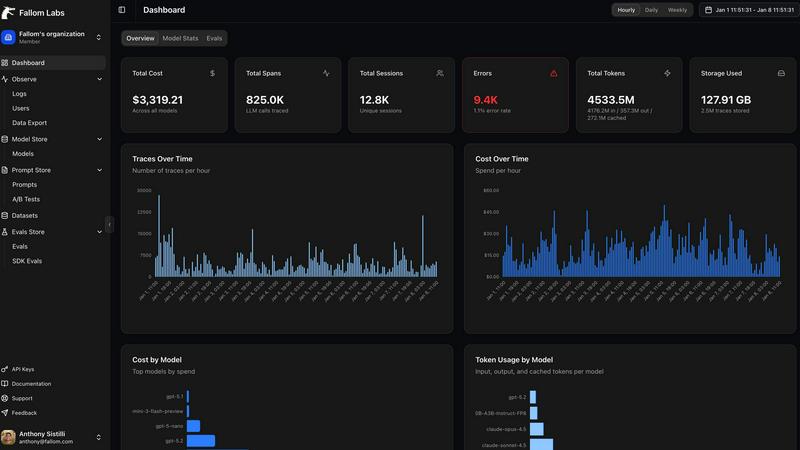
Fallom is an AI-native observability platform for real-time tracing and cost tracking of LLMs and agents, ensuring.
Last updated: February 28, 2026

OpenMark AI benchmarks 100+ LLMs on your task: cost, speed, quality & stability. Browser-based; no provider API keys for hosted runs.
Visual Comparison
Fallom
OpenMark AI
Overview
About Fallom
Fallom is an advanced AI-native observability platform meticulously designed for monitoring and optimizing Large Language Model (LLM) and AI agent workloads in real-time production environments. It serves the needs of engineering, product, and compliance teams by providing comprehensive visibility into every interaction with LLMs. The platform's core value proposition lies in its ability to deliver end-to-end tracing of AI calls, capturing essential data such as detailed prompts, model outputs, function/tool calls, token usage, latency metrics, and precise cost calculations per call. Built on the OpenTelemetry standard, Fallom ensures a vendor-agnostic approach with an SDK that allows teams to instrument their applications quickly and efficiently. This eliminates the complexities associated with integrating various monitoring tools. As organizations scale their AI-powered features, Fallom enables them to debug intricate workflows promptly, accurately attribute operational costs, and maintain robust audit trails. This capability is particularly crucial for compliance with stringent regulations such as the EU AI Act, SOC 2, and GDPR. By centralizing observability, Fallom transforms AI operations into a transparent, manageable, and cost-controllable aspect of the modern software stack.
About OpenMark AI
OpenMark AI is a web application for task-level LLM benchmarking. You describe what you want to test in plain language, run the same prompts against many models in one session, and compare cost per request, latency, scored quality, and stability across repeat runs, so you see variance, not a single lucky output.
The product is built for developers and product teams who need to choose or validate a model before shipping an AI feature. Hosted benchmarking uses credits, so you do not need to configure separate OpenAI, Anthropic, or Google API keys for every comparison.
You get side-by-side results with real API calls to models, not cached marketing numbers. Use it when you care about cost efficiency (quality relative to what you pay), not just the cheapest token price on a datasheet.
OpenMark AI supports a large catalog of models and focuses on pre-deployment decisions: which model fits this workflow, at what cost, and whether outputs are consistent when you run the same task again. Free and paid plans are available; details are shown in the in-app billing section.