Prefactor vs Prompt Builder
Side-by-side comparison to help you choose the right tool.

Prefactor
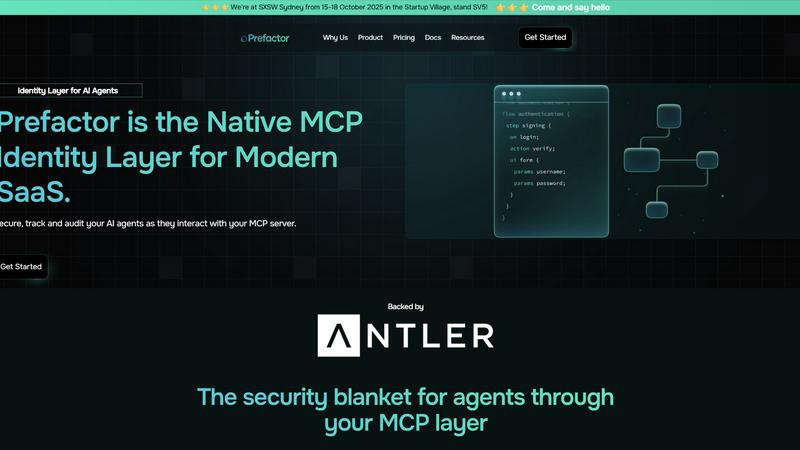
Prefactor is the identity and control plane for governing AI agents in production at scale.
Last updated: March 1, 2026

Prompt Builder
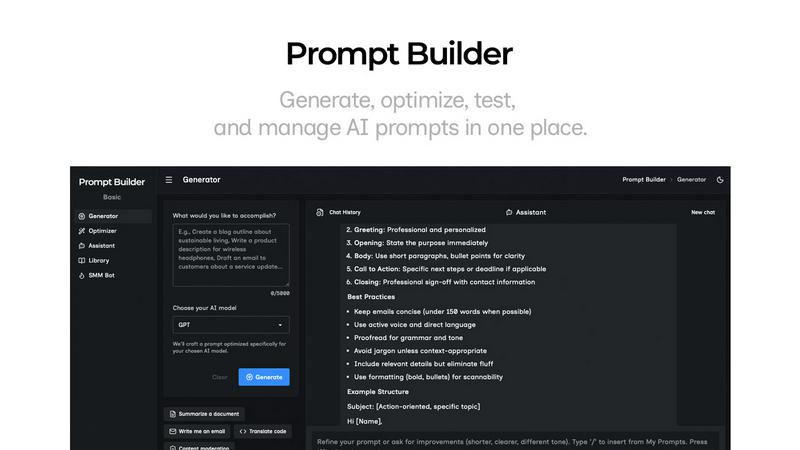
Prompt Builder allows you to generate, refine, and manage optimized AI prompts for multiple models in one seamless platform.
Last updated: April 13, 2026
Visual Comparison
Prefactor
Prompt Builder
Feature Comparison
Prefactor
Real-Time Agent Monitoring & Dashboard
The Prefactor control plane dashboard provides complete operational visibility across your entire agent infrastructure. It allows teams to monitor all agents in one centralized location, tracking which agents are active or idle, what resources and tools they are accessing in real-time, and where failures or anomalous behaviors emerge. This capability enables proactive incident management by identifying issues before they cascade, giving platform and engineering teams immediate answers to critical questions about agent activity and system health.
Identity-First Access Control & Governance
Prefactor applies established human identity governance principles to AI agents. Every agent is provisioned with a unique, first-class identity, and every action it performs is authenticated. This foundation enables fine-grained, policy-driven access management, ensuring each agent's permissions are precisely scoped to the minimum required for its function. This "identity-first" approach is fundamental for enforcing security boundaries, preventing unauthorized access to sensitive data or tools, and implementing a zero-trust architecture for autonomous systems.
Compliance-Ready Audit Trails & Reporting
The platform generates detailed audit logs that do not merely record low-level technical events like API calls. Instead, Prefactor translates agent actions into clear business context and understandable language for stakeholders. This functionality allows compliance, security, and audit teams to generate audit-ready reports in minutes, not weeks, providing definitive answers to regulatory inquiries about what an agent did and why. The trails are designed to withstand rigorous regulatory scrutiny in industries like finance and healthcare.
Emergency Kill Switches & Operational Control
Prefactor provides enterprise-grade operational controls, including emergency kill switches, to manage agent deployments safely. This feature allows administrators to immediately halt specific agents or groups of agents in the event of unexpected behavior, security incidents, or policy violations. It is a critical safety mechanism for maintaining operational control in production environments, especially when deploying autonomous systems that interact with business-critical data and processes.
Prompt Builder
Prompt Generator
The Prompt Generator feature allows users to describe their ideas and select a target AI model to produce a professional-grade prompt quickly. This tool is designed to optimize prompts according to the specifications of the chosen model, ensuring that users get tailored outputs that meet their needs effectively.
Chat Refinement
The Chat Refinement feature enables users to engage in a dynamic chat with an assistant model, allowing for real-time adjustments to prompts. This iterative process helps in enhancing clarity and specificity, leading to better outputs and reducing the need for multiple revisions.
Prompt Optimizer
With the Prompt Optimizer, users can take existing prompts and enhance them for improved performance. By pasting a prompt or selecting one from the library, the tool provides structured improvements focusing on clarity, constraints, and output format, resulting in a more effective prompt with minimal effort.
Prompt Library
The Prompt Library serves as a personal storage system where users can save, organize, and retrieve their best prompts. It includes community contributions, allowing users to explore a wide range of prompts, filter by category or model, and pin favorites for easy access, ultimately enhancing collaboration and efficiency.
Use Cases
Prefactor
Scaling AI Agent Pilots in Regulated Financial Services
A Fortune 500 financial institution can use Prefactor to move AI agent pilots for tasks like automated financial analysis or customer service triage into full production. The platform provides the necessary audit trails, identity governance, and real-time monitoring to satisfy internal compliance and external regulatory requirements (e.g., SOX, GDPR), turning a governance blocker into an enabler for secure, scalable deployment.
Managing Autonomous Systems in Healthcare Technology
Healthcare technology companies deploying agents for tasks such as patient data summarization or operational scheduling require strict HIPAA compliance and data access governance. Prefactor enables this by providing immutable audit logs of all agent interactions with protected health information (PHI), enforcing strict access policies, and ensuring every agent action is tied to a verifiable identity for accountability.
Operational Governance in Mining and Heavy Industry
For a mining technology company using AI agents to optimize logistics or monitor equipment, operational reliability and safety are paramount. Prefactor offers the visibility to track agent decisions affecting physical operations and the control mechanisms, like kill switches, to immediately intervene if an agent's behavior could lead to safety risks or costly operational downtime.
Centralized Governance for Multi-Framework AI Development
Organizations using a mix of AI agent frameworks (e.g., LangChain, CrewAI, AutoGen) for different use cases face fragmented governance. Prefactor acts as a unified control plane across all frameworks, providing consistent identity management, access control, and monitoring regardless of the underlying technology. This simplifies security policy enforcement and reduces the overhead of managing disparate systems.
Prompt Builder
Content Creation
Content creators can utilize Prompt Builder to generate tailored prompts for writing articles, social media posts, and marketing materials. By refining prompts in a dedicated chat environment, they can produce high-quality content that resonates with their target audience.
Software Development
Developers can leverage Prompt Builder to create prompts for coding assistance or technical documentation. The ability to test and refine prompts tailored for specific AI models ensures accurate and relevant results, improving productivity and reducing errors in programming tasks.
Education and Training
Educators can employ Prompt Builder to generate prompts for quizzes, assignments, or educational materials. The tool's capability to refine and optimize prompts ensures that the content is engaging and aligned with learning objectives, enhancing the educational experience for students.
Research and Data Analysis
Researchers can use Prompt Builder to formulate prompts that extract insights from data or generate hypotheses. The platform's ability to customize prompts for different AI models helps in obtaining precise and relevant information, streamlining the research process and improving outcomes.
Overview
About Prefactor
Prefactor is the definitive control plane for AI agents, engineered to solve the critical governance, security, and operational challenges that arise when scaling autonomous agents from proof-of-concept demonstrations to regulated, production-scale deployments. It provides a centralized platform for managing agent identity, access control, and observability across an organization's entire AI agent infrastructure. The product is specifically designed for product, engineering, security, and compliance teams within SaaS companies and regulated enterprises—such as those in financial services, healthcare, and mining—who are running multiple AI agent pilots and require enterprise-grade security, auditability, and operational control. Its core value proposition is transforming the complex, fragmented challenge of agent authentication and governance into a single, elegant layer of trust. By providing every AI agent with a first-class, auditable identity and enabling fine-grained, policy-driven access management, Prefactor allows organizations to scale their agent deployments with confidence, maintain full visibility over every agent action, and generate compliance-ready audit trails that translate technical events into clear business context. It aligns security, product, engineering, and compliance teams around one source of truth, enabling governed scaling with shared visibility and control.
About Prompt Builder
Prompt Builder is an advanced prompt engineering workspace designed to streamline the process of creating, testing, and saving prompts for various AI models. It serves as an essential tool for content creators, developers, and AI enthusiasts who seek to optimize their interactions with AI models such as GPT, Claude, Gemini, Llama, Mistral, DeepSeek, and Grok. The platform allows users to start with a draft prompt, refine it in a chat interface, save or pin different versions, and execute them at their convenience. This capability not only saves time but also ensures that users can generate high-quality, model-specific prompts without the hassle of rewriting for each AI. With an integrated Optimizer and a community-driven library of reusable prompts, Prompt Builder empowers users to transform their ideas into actionable prompts in mere seconds, making it a valuable asset in the rapidly evolving AI landscape.
Frequently Asked Questions
Prefactor FAQ
What is an AI Agent Control Plane?
An AI Agent Control Plane is a centralized management layer that provides governance, security, and operational oversight for autonomous AI agents. It functions similarly to an identity and access management (IAM) system or a Kubernetes control plane but is specifically designed for the unique challenges of AI agents, managing their identities, permissions, runtime behavior, and compliance postures across an organization.
How does Prefactor integrate with existing AI agent frameworks?
Prefactor is designed to be integration-ready and works with popular AI agent frameworks such as LangChain, CrewAI, and AutoGen, as well as custom-built agents. Integration typically involves using Prefactor's SDKs to instrument agents, allowing them to authenticate, check permissions, and stream activity logs to the control plane. This design enables deployment and integration within hours, not months.
What industries is Prefactor built for?
Prefactor is engineered for regulated industries and enterprises where security, compliance, and operational control are non-negotiable. Primary verticals include financial services (banking, insurance), healthcare and life sciences, mining and heavy industry, and any SaaS company handling sensitive customer data. It is for environments where "move fast and break things" is not a viable strategy.
Can Prefactor help optimize the cost of running AI agents?
Yes, Prefactor includes cost tracking and optimization features. It provides visibility into agent compute costs across different cloud providers and models. By analyzing activity logs and resource consumption patterns, teams can identify inefficient or expensive agent behaviors, right-size agent resources, and optimize spending as they scale their deployments.
Prompt Builder FAQ
What AI models does Prompt Builder support?
Prompt Builder is compatible with various AI models including GPT, Claude, Gemini, Llama, Mistral, DeepSeek, Grok, and Perplexity. This versatility allows users to generate prompts optimized for their specific needs.
How does the Prompt Generator work?
The Prompt Generator allows users to describe their idea and select a target model. It then creates a model-optimized prompt that can be further refined in a chat interface, facilitating a smooth transition from concept to execution.
Can I reuse prompts created in Prompt Builder?
Yes, users can save and organize their best prompts in the Prompt Library. This feature enables easy access to previously created prompts, allowing for efficient reuse across different projects or use cases.
Is there a free trial available for Prompt Builder?
Prompt Builder offers a free plan that includes 25 assistant requests per month without the need for a credit card. This allows potential users to explore the features and capabilities of the tool before committing to a paid plan.
Alternatives
Prefactor Alternatives
Prefactor is an identity and control plane solution designed for governing AI agents in production at scale. It belongs to the AI infrastructure and governance category, providing centralized management for agent identity, access control, and observability. This platform is critical for organizations scaling autonomous agents beyond pilot phases. Users may explore alternatives for several reasons. These include budget constraints and specific pricing model requirements, the need for different feature integrations, or a preference for a broader platform suite versus a specialized tool. The technical architecture, such as on-premises versus SaaS deployment, and the depth of compliance certifications for regulated industries are also key decision factors. When evaluating alternatives, key criteria should include the robustness of the agent identity and authentication framework, the granularity of policy-based access controls, and the comprehensiveness of real-time monitoring and audit logging. The solution must also align with the organization's security posture and compliance mandates, ensuring it can translate technical agent actions into auditable business events.
Prompt Builder Alternatives
Prompt Builder is an advanced prompt engineering workspace designed to help users generate, optimize, test, and manage AI prompts effectively. This product falls under the category of AI Assistants, providing a seamless environment for crafting prompts tailored to various AI models such as GPT, Claude, and others. Users often seek alternatives to Prompt Builder due to factors like pricing, specific feature sets, or compatibility with different platforms, which can influence their overall experience and satisfaction. When searching for alternatives, it is crucial to evaluate the range of features offered, ease of use, integration capabilities, and community support. A robust alternative should enable users to create and refine prompts effortlessly while providing additional tools for testing and saving versions. Additionally, the availability of a library for reusable prompts can significantly enhance productivity and efficiency in prompt engineering tasks.