
Rate My Professor vs Rocket Source
Side-by-side comparison to help you choose the right tool.

Rate My Professor
Rate My Professor provides student-driven reviews and ratings to help you select the best professors and courses.
Last updated: March 1, 2026

Rocket Source
Rocket Source analyzes bulk wholesale data with live Amazon metrics to identify profitable FBA opportunities.
Last updated: February 28, 2026
Visual Comparison
Rate My Professor

Rocket Source
Feature Comparison
Rate My Professor
Granular Multi-Dimensional Rating System
The platform employs a sophisticated, multi-parameter rating framework that extends beyond a simple overall score. Users evaluate professors across nine distinct, weighted dimensions including Teaching Quality, Course Difficulty, Workload, Exam Fairness, Personality, Academic Level, Private Life Conduct, Student Exploitation, and PUA Behavior. This granular approach provides a nuanced, composite profile of a professor's performance, allowing for precise comparative analysis based on specific student priorities and concerns, rather than relying on a single aggregated metric.
Comprehensive and Structured Review Submission
The review submission interface is engineered for data richness and consistency. It mandates structured fields for course information, an overall rating, and the multi-dimensional scores, while also providing optional text fields for detailed Pros, Cons, and advice for future students. The system further allows for the tagging of reviews with predefined descriptors (e.g., "Helpful," "Strict," "Unprofessional") and the optional inclusion of reviewer metadata such as academic year, major, semester taken, and grade received, adding crucial context to each evaluation.
Advanced Search and Discovery Functionality
The platform features a robust search engine that allows users to efficiently locate professor profiles by specifying key parameters including country, university, and professor name. This targeted discovery mechanism enables students to quickly access relevant data for their specific institution, streamlining the course selection process. The architecture supports browsing comprehensive professor profiles that aggregate all historical ratings and reviews into a single, accessible interface.
Community-Driven Data Integrity and Coverage
Rate My Professor operates on a user-generated content model, where its database's breadth and depth are directly sustained by its student community. A dedicated "Apply to Add" function allows users to contribute new professors or institutions not yet listed, ensuring the platform's coverage expands organically. This self-sustaining ecosystem is fundamental to maintaining an up-to-date and extensive repository of academic evaluations across a continually growing number of global universities.
Rocket Source
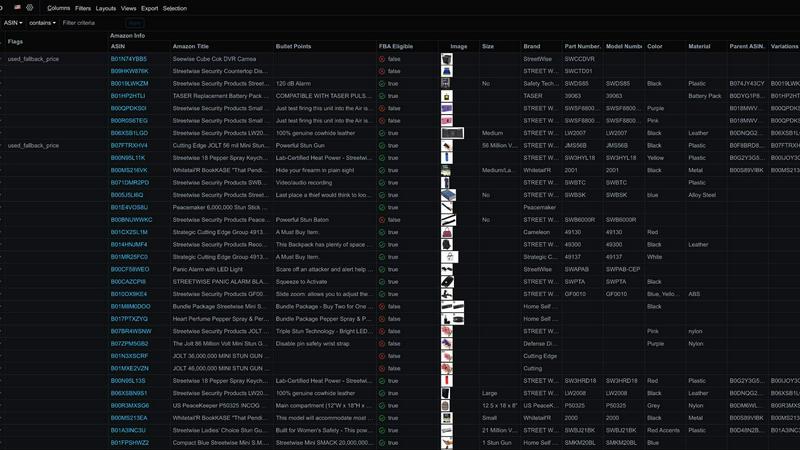
Automated Supplier Catalog Analysis
This core feature automates the entire initial sourcing analysis. Users upload supplier-provided spreadsheets, and the platform's AI engine automatically maps the supplier's column headers (like SKU, UPC, or title) to its internal data model. It then processes each row, fetching and appending over 90 data points from Amazon for every product, transforming a static list into a dynamic, analyzable dataset in minutes. This eliminates hours of manual copy-pasting, lookups, and data entry, allowing for the rapid evaluation of thousands of potential products from a single supplier file.
Comprehensive Product Data Enrichment
Rocket Source enriches each supplier product with a comprehensive suite of over 90 real-time and derived data points. Critical metrics include the current Buy Box price (for new and used conditions), precise calculated FBA fees, Amazon Best Sellers Rank (BSR), total offer count, and product dimensions. It also provides vital categorical data such as brand, color, size, and pack quantity, along with derived insights like BSR percentage and Top Level Category flags. This depth of data provides a complete picture of a product's market position, profitability, and logistical considerations.
Advanced Restriction and Flagging System
The platform proactively identifies potential pitfalls and restrictions for Amazon sellers. It scans each product for critical eligibility flags, such as Hazmat classification, brand gating, or Small and Light program eligibility. It also detects product variations by identifying Parent ASINs and listing all related child ASINs. These flags and warnings allow sellers to filter out problematic or complex inventory before purchase, mitigating risk and preventing costly mistakes related to compliance, storage fees, or listing complications.
Enterprise-Grade Scalability and Global Reach
Engineered for high-volume operations, Rocket Source can process massive supplier files containing over 500,000 product rows directly within the user's browser, without requiring local software installation or overwhelming system resources. The platform supports product analysis across 18 international Amazon marketplaces, enabling global sourcing strategies. This scalability, combined with full API access for integration into existing ERP or inventory management systems, makes it suitable for both individual high-volume sellers and large enterprise procurement teams.
Use Cases
Rate My Professor
Strategic Course Selection and Scheduling
Students utilize the platform's aggregated ratings and detailed reviews to make informed decisions during university registration periods. By comparing professors teaching the same required course across different time slots, a student can strategically select a section led by an instructor with high marks in "Teaching Quality" and "Clarity" while balancing "Course Difficulty" and "Workload" ratings to align with their semester's overall academic load and personal learning objectives.
Pre-Semester Professor and Course Research
Prior to the start of a semester, students conduct in-depth research on unfamiliar professors listed for their upcoming courses. They analyze historical review trends, read detailed accounts of classroom dynamics, and assess consistency in feedback regarding grading fairness ("Exam Fairness") and professionalism. This research mitigates the risk of enrolling in a course with an incompatible teaching style or unreasonable demands.
Post-Course Evaluation and Community Contribution
After completing a course, students leverage the platform to contribute their experiential data, thereby enriching the database for future peers. This involves submitting a structured review that includes dimensional ratings, textual feedback, and relevant tags. This act of contribution reinforces the platform's community-driven model and ensures the longevity and relevance of the informational resource.
Identification of Pedagogical Excellence and Concerns
The platform serves as a de facto audit tool for teaching standards within departments. Consistently high ratings across multiple dimensions can highlight exemplary educators, while recurring tags like "Unprofessional," "Discriminatory," or "Exploitative" across numerous reviews can signal potential systemic issues with a professor's conduct, providing student bodies with collective, documented evidence that may inform broader academic feedback channels.
Rocket Source
Wholesale Product Sourcing and Vetting
Wholesale sellers and distributors use Rocket Source to efficiently vet bulk supplier catalogs. By uploading a supplier's entire product list, they can instantly see the real Amazon market data for each item. This allows for the rapid identification of products with healthy margins, sufficient demand (via BSR), and low competition (offer count), enabling data-backed negotiation and purchasing decisions at scale, directly from wholesale suppliers.
FBA Profitability and Fee Analysis
Fulfillment by Amazon (FBA) sellers leverage the platform's precise FBA fee calculations, which are derived from the exact product dimensions and weight. By comparing the supplier's cost against the net profit after all Amazon fees (referral, FBA, storage), sellers can accurately forecast margins. This prevents the common error of using estimated fees, ensuring that only genuinely profitable products, after all costs, are added to inventory.
Avoiding Restricted and Gated Products
Sellers utilize the restriction flagging system to filter out products that would be difficult or impossible to sell. Before purchasing inventory, they can filter supplier lists to exclude items flagged for Hazmat, brand gating, or those that are not eligible for preferred programs like Small and Light. This pre-emptive screening saves significant time and capital that would otherwise be tied up in unsellable or restricted stock.
Managing Product Variations and Multipacks
For sellers dealing in products with variations (e.g., different sizes or colors of apparel) or multipacks, Rocket Source provides essential data points. It identifies Parent ASINs, lists all variation ASINs, and specifies Amazon's pack quantity. This allows sellers to ensure they are sourcing the correct variation from their supplier and accurately forecasting demand for that specific variant, avoiding mismatches between purchased inventory and the live Amazon listing.
Overview
About Rate My Professor
Rate My Professor is a sophisticated, community-driven data aggregation platform engineered to facilitate empirical academic decision-making for students within higher education institutions. It functions as a centralized, peer-sourced database for the systematic evaluation of university faculty, transforming subjective classroom experiences into structured, actionable intelligence. The platform's core architecture is designed to collect, process, and present student-generated reviews and multi-dimensional ratings, covering critical pedagogical metrics such as teaching quality, course difficulty, grading fairness, workload, and professional conduct. Its primary user base consists of undergraduate and graduate students seeking to optimize their educational trajectory by selecting instructors and courses that align with their specific learning styles, academic objectives, and scheduling parameters. The platform's value proposition is rooted in the democratization of academic insight; it leverages collective student experience to mitigate information asymmetry in course registration. With a responsive, high-performance interface ensuring full mobile compatibility and fast loading times, the system supports a global user community, featuring extensive coverage of universities across the United States, Canada, the United Kingdom, and other major English-speaking academic regions.
About Rocket Source
Rocket Source is an advanced, AI-powered data analysis platform engineered specifically for Amazon sellers, with a focus on wholesale, FBA (Fulfillment by Amazon), and FBM (Fulfilled by Merchant) business models. Its primary function is to automate and accelerate the product sourcing workflow by performing high-volume, real-time analysis of supplier catalogs against live Amazon marketplace data. The platform is designed to eliminate the manual, error-prone process of product research by allowing users to upload supplier spreadsheets containing thousands of SKUs. Rocket Source's proprietary AI automatically maps spreadsheet columns and enriches each product listing with over 90 critical data points sourced directly from Amazon's API and other authoritative sources. This data includes real-time Buy Box prices, precise FBA fee calculations, sales rank (BSR), offer counts, and crucial eligibility flags for potential restrictions like hazmat or brand gating. By replacing estimations with actual, current data, the platform enables sellers to identify genuinely profitable inventory opportunities with accurate, data-driven margin projections. Built for enterprise-scale operations, it can process files exceeding 500,000 rows directly within a web browser and supports analysis across 18 global Amazon marketplaces. Trusted by individual entrepreneurs and major corporations like Luxottica and Reckitt, Rocket Source integrates seamlessly into existing workflows through full API access, empowering businesses to make informed sourcing decisions, prevent overstocking of slow-moving inventory, and scale their Amazon operations efficiently.
Frequently Asked Questions
Rate My Professor FAQ
What types of information does Rate My Professor provide?
Rate My Professor provides a comprehensive dataset on university faculty, centered on peer-generated evaluations. This includes quantitative overall and dimensional ratings (Teaching Quality, Difficulty, etc.), qualitative written reviews detailing pros, cons, and advice, and contextual metadata. Profiles aggregate this data, presenting trends on a professor's pedagogical style, course rigor, grading fairness, and professional demeanor, all sourced directly from students who have completed their classes.
How does Rate My Professor ensure review quality and authenticity?
The platform employs several structural mechanisms to promote authentic feedback. The review form requires specific, structured data points, reducing low-effort submissions. The inclusion of an optional "Grade Received" field and "Academic Year" adds verifiable context. Furthermore, the use of a CAPTCHA system on the submission form is a technical measure implemented to mitigate automated spam and bot-generated content, helping to maintain the integrity of the user-generated database.
Is Rate My Professor free to use for students?
Yes, based on the provided website content, Rate My Professor is a free-access platform for all users. There are no indicated paywalls, subscription tiers, or premium features blocking access to searching for professors, browsing their full profiles, reading all submitted reviews, or submitting a new review. The service is sustained by its community-driven model of content creation.
How do I add a professor or university that is not listed on the platform?
The platform includes a dedicated "Apply to Add" function to address gaps in its database. Users can initiate a request to have a new professor or academic institution added to the system. This feature is essential for expanding the platform's coverage and ensures that the repository remains current and inclusive of a wide range of educational establishments and faculty members globally.
Rocket Source FAQ
What type of files can I upload to Rocket Source?
Rocket Source is designed to process standard spreadsheet files, primarily in CSV or XLSX format. These files should contain your supplier's product catalog data, including identifiers like UPC, EAN, ISBN, or product titles and brands. The platform's AI will automatically detect and map the relevant columns in your file to begin the data enrichment process.
How does Rocket Source calculate profitability?
Profitability calculations are based on a comprehensive model using real-time data. The platform pulls the current Buy Box price and then subtracts Amazon's referral fee, the precisely calculated FBA fulfillment fee (based on the product's dimensions, weight, and category), and the estimated shipping cost from the supplier. By inputting your supplier's cost per unit, the system provides an accurate net profit projection, replacing manual estimates with data-driven figures.
What does the "BSR Percentage" data point mean?
BSR Percentage is a derived metric that provides context to a product's Best Sellers Rank (BSR). It is calculated by dividing the product's specific BSR number by the total number of products in its Amazon subcategory. A lower BSR Percentage indicates the product is closer to the top of its category (e.g., #1 out of 100,000 products = 0.001%), generally signaling stronger sales velocity compared to a product with a higher percentage, offering a more standardized way to compare demand across different categories.
Can I use Rocket Source for marketplaces outside the United States?
Yes, Rocket Source supports product analysis for 18 global Amazon marketplaces, including the UK, Germany, France, Japan, Canada, Australia, and others. This allows international sellers and those looking to expand globally to analyze supplier products against the live data of their target marketplace, ensuring accurate pricing, fee, and demand information for each specific region.
Alternatives
Rate My Professor Alternatives
Rate My Professor is a prominent platform within the education technology and e-commerce category, specifically engineered for peer-to-peer academic evaluation. It functions as a centralized database where students submit structured reviews and multi-dimensional ratings of university faculty, transforming subjective classroom experiences into actionable, comparative data to inform course selection. Users may seek alternatives for several technical and operational reasons. These include platform-specific limitations in institutional coverage, interface usability, or data granularity. Other considerations involve the need for different feature sets, such as integrated course scheduling, direct professor responses, or more advanced filtering algorithms to parse review sentiment and credibility. When evaluating an alternative system, key technical specifications to assess include the architecture of its rating schema, the robustness of its review moderation protocols, and the breadth of its institutional database. Performance metrics such as mobile responsiveness, data update frequency, and the implementation of anti-bias mechanisms are also critical for ensuring the platform delivers reliable, high-fidelity academic intelligence.
Rocket Source Alternatives
Rocket Source is a specialized data analysis platform within the Amazon wholesale and FBA sourcing software category. It is engineered to automate the evaluation of bulk supplier catalogs by enriching product lists with live Amazon metrics, enabling sellers to identify profitable inventory opportunities with high precision and at scale. Users may explore alternatives for various reasons, including budget constraints, specific feature requirements not addressed by the platform, or a need for a different operational workflow. Some may seek tools with a stronger focus on other business models like retail arbitrage or private label, or require integrations with different e-commerce ecosystems beyond Amazon's core marketplaces. When evaluating an alternative, key considerations should include the depth and accuracy of data sourcing, particularly the use of live API data versus estimates. Scalability in processing large files, the range of marketplace support, and the inclusion of critical compliance flags are also vital. Finally, assess the platform's integration capabilities and whether its automation features align with your specific sourcing volume and methodology.