Shadow OS vs TripleTen Burnout Test
Side-by-side comparison to help you choose the right tool.

Shadow OS
Shadow OS is a decision app that provides clear answers using a 3,000-year-old system of 64 hexagrams for definitive guidance.
Last updated: April 13, 2026

TripleTen Burnout Test
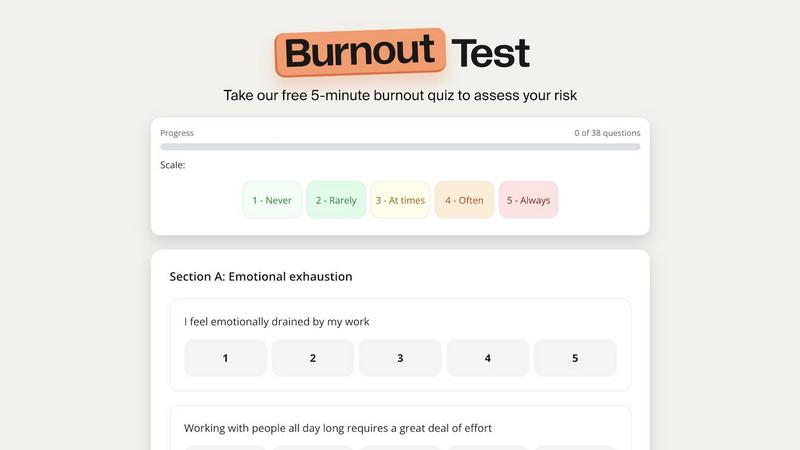
TripleTen's Burnout Test instantly assesses your risk and provides a personalized recovery plan.
Last updated: March 1, 2026
Visual Comparison
Shadow OS

TripleTen Burnout Test
Feature Comparison
Shadow OS
Hexagram-Based Decision Engine
At the core of Shadow OS is a deterministic algorithm based on the 64 hexagrams of the I Ching. Users cast three virtual coins, a process taking approximately sixty seconds, to generate a specific hexagram relevant to their query. This system, distinct from random number generation, provides a structured and historically-rooted analytical framework for evaluating situations, moving beyond entertainment-based tools like coin flips or wheel spinners to deliver a reasoned directional answer.
Psychological Pattern Recognition
Beyond delivering a direct answer, Shadow OS performs concurrent analysis to identify the user's most likely psychological blind spot or recurring behavioral pattern related to the decision context. This feature names and surfaces these subconscious tendencies, such as impulsivity, avoidance, or people-pleasing, providing critical meta-awareness that traditional decision aids lack. This transforms the app from a simple oracle into a tool for cognitive-behavioral insight.
Five-Dimensional Query Framework
The application categorizes all user inquiries into five specific life dimensions: Career, Love, Energy, Conflict, and Timing. This structured taxonomy ensures that the algorithmic analysis is contextually appropriate and focused. It allows users to precisely frame their dilemma and enables the system to apply the most relevant interpretative layers from the hexagramic database, ensuring answers are tailored to the specific domain of concern.
Decision History & Cycle Tracking
Shadow OS includes a proprietary tracking module that records user decisions and outcomes over time. The system actively follows up to inquire about the real-world action taken. This longitudinal data is compiled to visualize decision-making patterns and behavioral cycles. This feature provides users with empirical feedback on their tendencies, enabling them to recognize and break counterproductive cycles, a functionality absent from one-off reading or journaling apps.
TripleTen Burnout Test
Validated Multi-Dimensional Assessment
The test employs a rigorously validated 38-item questionnaire designed to measure burnout across five distinct, clinically recognized dimensions: emotional exhaustion, depersonalization, reduced personal accomplishment, cognitive weariness, and physical fatigue. This multi-axis analysis ensures a comprehensive diagnostic profile that captures the full spectrum of burnout symptomatology, moving beyond simplistic single-score evaluations to provide a nuanced understanding of an individual's specific risk factors and symptomatic presentation.
AI-Powered Personalized Recovery Plan
Upon completion of the assessment, the system utilizes proprietary algorithms to analyze individual responses and generate a tailored recovery plan. This plan is not a generic set of recommendations but a customized strategy that addresses the specific dimensions where the user's risk score is highest. It provides structured, actionable steps for intervention, ranging from immediate crisis management techniques to longer-term behavioral and environmental modifications for sustainable resilience.
Quantifiable Burnout Risk Scoring
The tool outputs a precise, numerical Burnout Risk Score, providing an objective benchmark of an individual's current state. This quantifiable metric allows users to track their status over time, measure the efficacy of implemented interventions, and understand their position on a continuum from low risk to critical burnout. The score brings data-driven clarity to a condition often characterized by subjective and confusing symptoms.
Evidence-Based Diagnostic Framework
The entire assessment is grounded in established psychological and occupational health research. The question set and analytical model are constructed upon validated clinical frameworks for identifying and measuring burnout, ensuring the diagnostic output is reliable and clinically relevant. This evidence-based approach differentiates it from informal online quizzes and provides users with credible, actionable insights into their mental well-being.
Use Cases
Shadow OS
Navigating Career Transitions
Professionals uncertain about job changes, promotions, or entrepreneurial ventures can use Shadow OS to gain clarity. By inputting a specific career-related question, the app provides a definitive direction while highlighting patterns like risk-aversion or impatience that may cloud judgment. This use case is critical for making strategic, long-term professional moves with greater confidence and self-awareness, moving beyond paralyzing indecision.
Resolving Interpersonal Conflict
Individuals facing dilemmas in relationships, whether concerning setting boundaries, addressing betrayal, or deciding to reconcile, can utilize the Conflict and Love dimensions. The app offers a clear course of action and identifies the user's typical conflict-response pattern, such as avoidance or confrontation. This facilitates more objective and constructive approaches to emotionally charged interpersonal situations.
Managing Personal Resources and Timing
For decisions related to personal energy management, major purchases (like a house), financial choices (invest vs. pay debt), or optimal timing for actions, the Energy and Timing dimensions provide structured guidance. This use case helps users align their actions with perceived situational currents, reducing anxiety around "when to act" and preventing burnout or poorly timed initiatives.
Breaking Repetitive Behavioral Cycles
Users who find themselves repeatedly in similar undesirable situations, such as toxic relationships or unfulfilling jobs, can employ Shadow OS's tracking functionality. By consistently logging decisions and outcomes, the app aggregates data to clearly display the self-sabotaging or repetitive cycle at play. This evidence-based insight is the first step toward implementing lasting behavioral change and making fundamentally different choices.
TripleTen Burnout Test
Proactive Wellness Screening for High-Stress Professions
Individuals in high-demand roles such as healthcare, technology, education, and client services can utilize the test as a periodic wellness check. By proactively assessing their burnout risk before reaching a crisis point, professionals can identify early warning signs and implement preventive strategies, thereby maintaining long-term career sustainability and performance without succumbing to complete emotional and physical depletion.
Diagnostic Clarification for Ambiguous Symptoms
For professionals experiencing chronic fatigue, cynicism, or a sense of ineffectiveness but who are uncertain if these constitute clinical burnout, the test provides definitive diagnostic clarification. It differentiates between temporary stress, general fatigue, and the specific, multi-dimensional syndrome of burnout, enabling individuals to seek appropriate and targeted help rather than dismissing their experience.
Guided Intervention Planning Post-Recognition
After an individual has recognized they are burned out, the test serves as the foundational step for structured recovery. The personalized plan generated from the results offers a clear, phased roadmap out of the crisis management phase and into the rebuilding stage, outlining specific actions to address root causes such as workload, lack of control, value misalignment, or insufficient recovery time.
Organizational Wellbeing Program Integration
HR departments and organizational leaders can integrate the Burnout Test as a confidential self-assessment tool within broader employee wellbeing initiatives. It provides employees with a private, accessible means to evaluate their own risk, while aggregated, anonymized data can help leadership identify systemic stressors within specific teams or company-wide practices that contribute to burnout risk.
Overview
About Shadow OS
Shadow OS is a specialized mobile application engineered for definitive decision-making. It represents a significant departure from conventional, often ambiguous methods like pros-and-cons lists or seeking multiple opinions. The application's core functionality is to provide a single, clear answer to a user's specific, pressing question. It achieves this by leveraging a sophisticated algorithmic framework based on the ancient I Ching, a system of 64 hexagrams that psychologist Carl Jung studied as a method for understanding synchronicity. This technical foundation allows Shadow OS to analyze a query and deliver targeted guidance while simultaneously identifying the user's recurring psychological patterns or blind spots that may impede objective judgment. The platform is structured across five defined life dimensions: Career, Love, Energy, Conflict, and Timing, ensuring its utility for both major life crossroads and daily dilemmas. A key technical capability is its longitudinal tracking function, which logs user decisions over time to reveal behavioral cycles, thereby facilitating more informed future choices. Shadow OS is architected for individuals seeking clarity and a structured, non-random methodology for personal and professional decisions. It is available as a free download on iOS and Android, with persistent access to one dimension, while a premium subscription unlocks comprehensive insights and historical data analytics.
About TripleTen Burnout Test
The TripleTen Burnout Test is a sophisticated, data-driven diagnostic instrument engineered to quantify an individual's risk of professional burnout with clinical precision. It functions as a comprehensive screening tool that transcends subjective self-assessment by deploying a validated, multi-dimensional psychometric questionnaire. The core operational mechanism requires a user to respond to 38 targeted questions, which the system's analytical engine processes across five critical psychological and physiological dimensions: emotional exhaustion, depersonalization, reduced personal accomplishment, cognitive weariness, and physical fatigue. This multi-factorial analysis yields a quantifiable Burnout Risk Score and subsequently generates a highly personalized, actionable recovery protocol. The product is engineered for professionals across all industries who are experiencing symptoms of chronic workplace stress, emotional exhaustion, or a measurable decline in professional efficacy. Its primary value proposition is the transformation of vague, overwhelming feelings into a structured, evidence-based diagnostic framework, coupled with AI-tailored strategic interventions. It serves not only as a diagnostic checkpoint but as the initial phase of a guided recovery process, providing immediate analytical clarity and a concrete, data-informed path toward sustainable well-being and professional resilience.
Frequently Asked Questions
Shadow OS FAQ
Is Shadow OS an astrology or horoscope app?
No. Shadow OS is fundamentally different from astrology applications. It does not require or utilize any birth data, location, or planetary positions. Its operation is based solely on the user's current question and the structured, hexagram-based algorithmic system. It provides a specific directional answer to a specific query, not a vague daily forecast or personality profile based on zodiac signs.
How does Shadow OS differ from an AI chatbot like ChatGPT?
AI chatbots are designed to be conversational and are statistically biased toward validating user sentiment. Shadow OS is engineered as a decision tool. It provides an answer independent of the user's pre-existing desires or biases. It does not generate open-ended discussion but applies a fixed analytical framework (the 64 hexagrams) to deliver a clear, non-random direction and pattern analysis, avoiding the "yes-man" effect.
What data does Shadow OS collect from me?
Shadow OS is architected with a privacy-first protocol. It requires no birth data, location data, or social media login. The primary data points are the questions you ask, the hexagrams generated, your recorded decisions, and follow-up actions. According to the provided specifications, the company states it does not sell user data. The app functions without requiring an account, further minimizing data footprint.
What is included in the free version versus the premium subscription?
The free version of Shadow OS provides permanent, unlimited access to one of the five life dimensions (e.g., Career or Love), allowing users to ask questions within that category daily. The premium subscription, priced at $9.99 monthly or $79.99 annually, unlocks full access to all five dimensions, provides comprehensive historical data and pattern tracking analytics, and offers deeper insights from the hexagramic system. A lifetime access option is also available for a one-time fee.
TripleTen Burnout Test FAQ
How is the TripleTen Burnout Test different from a standard online quiz?
The TripleTen Burnout Test is distinguished by its clinical foundation and multi-dimensional analytical model. Unlike generic quizzes, it utilizes a 38-item questionnaire validated against established psychological frameworks to assess five specific dimensions of burnout. The output is not merely a label but a quantifiable risk score and a personalized, actionable recovery plan generated by proprietary algorithms, providing a diagnostic and prescriptive tool rather than a simplistic categorization.
What are the five dimensions measured by the assessment?
The assessment analyzes responses across five critical dimensions: Emotional Exhaustion (feelings of being emotionally overextended and depleted), Depersonalization (negative, cynical attitudes and detachment from one's job), Reduced Personal Accomplishment (feelings of incompetence and lack of achievement), Cognitive Weariness (persistent mental fatigue and difficulty concentrating), and Physical Fatigue (ongoing bodily tiredness and low energy). This comprehensive model ensures a complete diagnostic picture.
Is the Burnout Risk Score a clinical diagnosis?
No, the Burnout Risk Score generated by the TripleTen Burnout Test is a screening and self-assessment tool, not a formal clinical diagnosis. It is designed to provide a highly accurate, evidence-based indication of an individual's risk level and symptomatic profile. For a formal medical or psychological diagnosis, users should consult with a licensed healthcare professional, using the test results as a detailed reference point to inform that conversation.
How should I use the personalized recovery plan provided?
The personalized recovery plan is a structured, phased guide. It is recommended to first review the plan in its entirety to understand the recommended trajectory. Begin by implementing the immediate "crisis management" strategies, such as establishing emergency boundaries and prioritizing basic self-care. Subsequently, methodically work through the longer-term "rebuilding and prevention" strategies, which may involve negotiating workload changes, improving stress management techniques, or evaluating career alignment. The plan is designed for sequential implementation.
Alternatives
Shadow OS Alternatives
Shadow OS is a specialized mobile application in the personal development category, designed to provide definitive guidance for complex life decisions. It leverages the ancient I Ching system, framed through Carl Jung's psychology, to analyze user queries across five key life dimensions and deliver a singular, insightful answer. Users may seek alternatives for various reasons, including differing budget constraints, a desire for alternative philosophical or methodological frameworks, or the need for features like cross-platform synchronization or more extensive data tracking. Platform exclusivity can also be a deciding factor for those outside the iOS and Android ecosystems. When evaluating an alternative decision-support tool, key considerations include the underlying methodology's credibility, the depth of analysis provided, the range of life areas covered, and long-term value through pattern recognition. Data privacy policies and the overall user experience design are equally critical for a tool handling sensitive personal inquiries.
TripleTen Burnout Test Alternatives
The TripleTen Burnout Test is a specialized AI-powered diagnostic tool within the psychological assessment category. It utilizes a 38-question, five-dimension framework to generate a quantitative Burnout Risk Score and a personalized recovery plan, transforming subjective feelings of workplace stress into structured, actionable data. Users may seek alternatives for various operational reasons. Common factors include budget constraints, as premium diagnostic tools often carry associated costs. Others may require different feature sets, such as integration with specific HR platforms, team-level analytics, or a focus on different psychological constructs beyond the five core dimensions assessed by this test. When evaluating an alternative solution, key criteria should include the scientific validation of its assessment methodology, the specificity and actionability of its output reports, and the platform's data security and privacy protocols. The ideal tool should provide a clear diagnostic differentiation between stress and burnout, offer evidence-based intervention strategies, and align with the user's technical and budgetary requirements.