ScopeSnap vs Skene
Side-by-side comparison to help you choose the right tool.

ScopeSnap
ScopeSnap uses AI to transform discovery notes into structured project scopes and client-ready proposals.
Last updated: March 18, 2026

Skene automates growth signals directly from your codebase, enabling seamless product-led growth without external.
Last updated: February 28, 2026
Visual Comparison
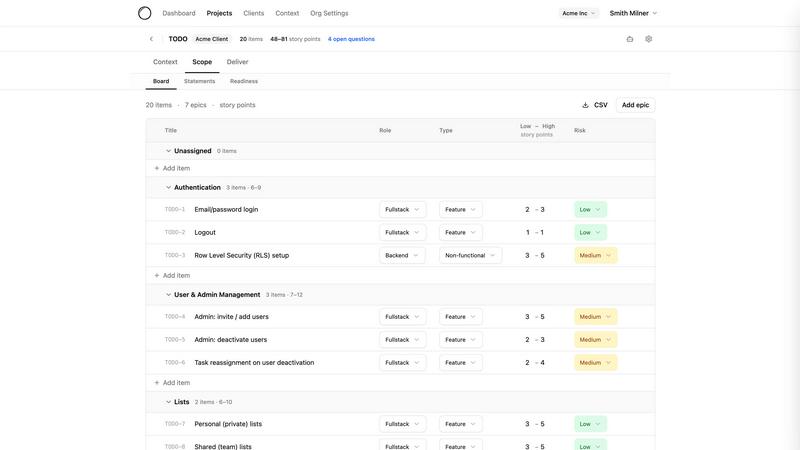
ScopeSnap
Skene
Feature Comparison
ScopeSnap
AI-Powered Scope Decomposition
This core feature processes unstructured discovery artifacts like call transcripts and notes to automatically generate a structured project backlog. The AI identifies key themes and user stories, grouping them into logical epics. It critically analyzes the input to flag ambiguous requirements, underlying assumptions, and open questions that require client clarification, ensuring the foundational scope is comprehensive and well-understood before estimation begins.
Interactive Scope Refinement & Estimation Board
The generated scope is presented within an interactive, kanban-style board where users can review, edit, and organize all scope items. This interface allows for the assignment of roles (e.g., front-end, back-end), the application of story points or hourly estimates to each task, and the direct resolution of AI-identified questions. This feature facilitates collaborative and iterative refinement, turning the initial AI output into a precise, agreed-upon project specification.
Automated Proposal & SOW Generation
Upon finalizing the scope and estimates, ScopeSnap automatically compiles all structured data into a professionally formatted client proposal or Statement of Work. This document includes a detailed breakdown of features, timelines, cost estimates, payment terms, and project assumptions. The automation ensures consistency, eliminates manual copy-pasting errors, and saves hours of document preparation time, delivering a polished deliverable instantly.
Centralized Project Context Repository
ScopeSnap acts as a single source of truth for pre-project discovery. Users can upload and store all relevant context—meeting recordings, transcripts, email chains, and briefs—directly linked to the project scope. This centralized repository ensures that all decisions and scope items are traceable back to original client conversations, providing crucial auditability and reference during both the sales process and subsequent project execution.
Skene
Deep Codebase Integration
Skene’s ability to analyze the product’s own source code allows it to derive contextual signals directly from the codebase. This feature ensures that growth strategies are inherently aligned with the product’s functionalities and user behaviors, leading to more effective optimizations.
Automated User Flow Generation
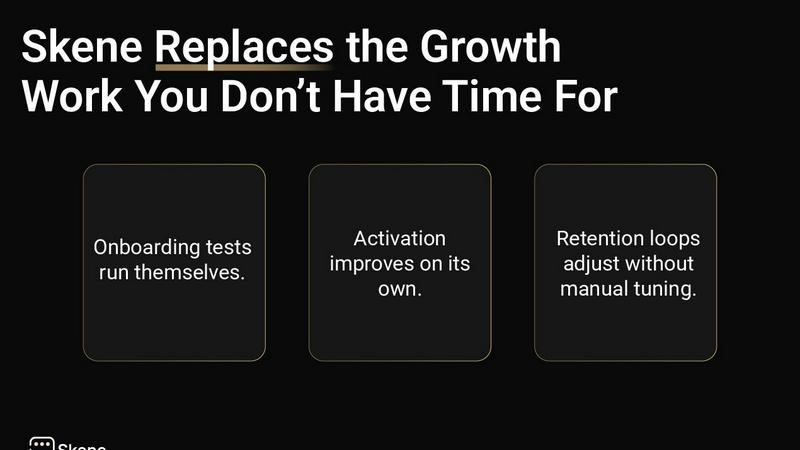
Once Skene analyzes the code, it automatically generates optimized user flows for onboarding, activation, and retention. This feature eliminates the need for manual input and allows for rapid deployment of improvements that enhance user experiences.
Real-Time Analytics Dashboard
Skene provides a comprehensive analytics dashboard that tracks real-time user progress, completion rates, engagement metrics, and identifies bottlenecks. This feature enables product teams to make data-driven decisions and optimize user journeys effectively.
Outcome-Based Pricing Model
Skene incorporates an outcome-based pricing model that charges users only when customers successfully complete their onboarding journey. This feature ensures that users pay for tangible results, making it a cost-effective solution for growth.
Use Cases
ScopeSnap
For Freelance Developers Scoping Solo Projects
Independent developers can use ScopeSnap to efficiently manage client discovery. After a discovery call, they paste their notes or transcript into the platform. The AI creates a first-draft scope, helping the freelancer ensure no critical feature is overlooked. They then refine estimates and quickly generate a professional proposal, allowing them to compete with larger agencies on professionalism while saving valuable time otherwise spent on administrative tasks.
For Software Agencies Standardizing Sales Processes
Development agencies can implement ScopeSnap to create a consistent, scalable workflow for their sales and pre-sales teams. It ensures every project estimate follows the same rigorous decomposition process, improving accuracy and reducing risk. The automated SOW generation enforces brand consistency and legal compliance across all client proposals, making the sales pipeline more efficient and reliable.
For Technical Consultants Defining Project Requirements
Consultants hired to define project specifications for a client's internal team or for another agency can utilize ScopeSnap to structure their findings. The tool helps systematically break down complex business needs into technical requirements, user stories, and acceptance criteria. The final output is a clear, actionable specification document or RFP supplement that accurately communicates project scope.
For Refining and Re-scoping Existing Project Ideas
When a client returns with an existing, vague project idea or a failed previous estimate, ScopeSnap provides a structured method for re-analysis. By inputting the available information, the AI can help deconstruct the problem anew, identify gaps in the previous scope, and build a more solid, estimatable foundation, facilitating a more successful project restart or rescue.
Skene
Optimizing Onboarding Experiences
Skene can be used to streamline the onboarding process for new users by automatically identifying and resolving friction points. This leads to higher activation rates and improved user satisfaction.
Enhancing Feature Adoption
By analyzing user behavior, Skene can identify opportunities for promoting underutilized features. It can dynamically create prompts and flows that encourage users to explore and adopt these features effectively.
Reducing Churn Rates
Skene’s capabilities extend to retention strategies by analyzing user interactions and engagement patterns. This allows businesses to proactively address issues that may lead to user churn and maintain customer loyalty.
Facilitating Continuous Improvement
With its self-learning growth engine, Skene supports continuous improvement of user experiences. By consistently analyzing data and optimizing flows, it helps teams innovate and adapt their offerings to meet evolving user needs.
Overview
About ScopeSnap
ScopeSnap is an AI-powered platform engineered to transform the initial, often chaotic phase of software project discovery into a structured, actionable, and client-ready deliverable. It is specifically designed for freelance developers, technical consultants, and software development agencies who engage in scoping and estimating custom software projects. The core value proposition of ScopeSnap lies in its systematic elimination of manual, error-prone processes associated with project definition. By ingesting raw inputs such as meeting transcripts, email threads, and handwritten notes, its AI engine performs an intelligent breakdown of high-level ideas into discrete, estimatable tasks organized into epics and a clear backlog. This structured approach forces clarity, surfaces implicit assumptions, and identifies open questions early in the cycle. Users can then iteratively refine this scope, assign roles, and attach time or cost estimates with confidence. Finally, the platform automates the generation of professional proposals or Statements of Work (SOW), compiling the refined scope, estimates, and project terms into a polished document ready for client presentation. ScopeSnap directly addresses the critical pain points of missed requirements, scope vagueness, and the extensive time investment required for proposal creation, thereby reducing commercial risk and accelerating the sales cycle for service providers.
About Skene
Skene is an innovative AI-powered, fully automated Product-Led Growth (PLG) iteration engine that serves as intelligent infrastructure for software products. Its core functionality is to enable products to achieve autonomous growth by consistently optimizing critical user lifecycle stages such as onboarding, activation, and retention without the need for dedicated growth teams. Skene’s unique advantage lies in its deep integration with the product’s codebase, allowing it to analyze the source code directly. This analysis helps Skene derive contextual signals to understand user behavior, identify friction points, and uncover activation opportunities. By automating the creation, A/B testing, and deployment of improved user flows, Skene effectively establishes a self-learning growth system. Targeted towards indie developers, early-stage startups, and established PLG companies, Skene replaces fragmented and manual growth stacks with a unified, code-native solution. This allows developers to maintain ownership of their growth strategies, version them alongside their code, and interact with them through prompts, thereby eliminating performance overhead and data silos associated with traditional third-party tools.
Frequently Asked Questions
ScopeSnap FAQ
What types of input does ScopeSnap accept for analysis?
ScopeSnap is designed to process textual input from a variety of discovery sources. This includes direct text entry, pasted content from meeting transcripts (e.g., from Otter.ai or Rev), email correspondence, notes from tools like Notion or Google Docs, and bullet-point lists of client requirements. The system extracts key concepts and requirements from this unstructured data to build the initial scope structure.
How accurate are the AI-generated estimates and scope items?
The AI-generated scope and tasks are a starting point for human refinement, not a final estimate. Accuracy is highly dependent on the quality and detail of the input context provided. The AI's primary role is to ensure comprehensiveness and structure, surfacing potential tasks and questions a human might miss. The final, responsible estimation must be performed by the user within the refinement board, applying their own expertise to adjust story points, hours, and resource assignments.
Can I customize the generated proposal documents?
Yes, the automated Proposal and Statement of Work generation feature is built with customization in mind. Users can typically define company details, standard terms and conditions, payment schedules, and branding elements (like logos and colors) in settings or templates. The content pulled from the refined scope board (features, estimates, assumptions) populates these templates to create a client-ready document that aligns with your professional standards.
Is ScopeSnap suitable for very large or complex enterprise projects?
ScopeSnap is optimized for the workflow of freelancers, small to mid-sized agencies, and consultants. While it can handle substantial projects by breaking them into phases or multiple epics, extremely large enterprise projects with deeply interdependent systems may require more specialized enterprise architecture tools. However, for defining clear scope and deliverables for a specific module, MVP, or well-bounded project within a larger program, ScopeSnap remains highly effective.
Skene FAQ
What is PLG software?
PLG (Product-Led Growth) software automates the user journey, allowing users to discover value in a product without manual intervention from sales or customer success teams. It guides users toward activation and feature adoption through the product itself.
How does Skene differ from traditional customer experience software?
Unlike traditional customer experience tools that require manual setup and maintenance, Skene automatically generates onboarding and lifecycle automation by reading your codebase. This ensures everything updates seamlessly with new code deployments.
How long does it take to set up Skene?
Setting up Skene is remarkably quick, taking less than 60 seconds. Users simply connect their GitHub or GitLab repository on a read-only basis, after which Skene analyzes the codebase to generate PLG flows without requiring code changes.
Is my code secure with Skene?
Yes, Skene ensures the security of your code by only requiring read-only access to your repository. The analysis is conducted in a secure, isolated environment, safeguarding your intellectual property and sensitive data.
Alternatives
ScopeSnap Alternatives
ScopeSnap is a project scoping and proposal generation tool within the productivity and management software category. It leverages artificial intelligence to help freelance developers and software agencies transform unstructured discovery notes into detailed project scopes, accurate estimates, and professional client proposals. Users may explore alternatives to ScopeSnap for various reasons, including budget constraints, specific feature requirements not met by the platform, or integration needs with their existing tech stack. The search for a different solution often stems from a need for more granular control, different pricing models, or platform compatibility issues. When evaluating an alternative, key considerations should include the tool's core methodology for scope decomposition and estimation, the quality and customizability of its output documents, and the overall efficiency it brings to the pre-sales workflow. The ideal solution should demonstrably reduce the time and risk associated with defining software project requirements and communicating them to clients.
Skene Alternatives
Skene is an AI-powered Product-Led Growth (PLG) iteration engine designed to optimize user lifecycle stages such as onboarding, activation, and retention by analyzing the product's codebase. Users often seek alternatives to Skene for various reasons, including pricing considerations, feature sets that may better suit their specific needs, or compatibility with existing platforms. When choosing an alternative, it is crucial to evaluate factors such as the ability to integrate seamlessly with your current infrastructure, the level of automation provided, and the depth of insights into user behavior and growth opportunities.