
Agent to Agent Testing Platform vs Takeorder AI
Side-by-side comparison to help you choose the right tool.

Agent to Agent Testing Platform
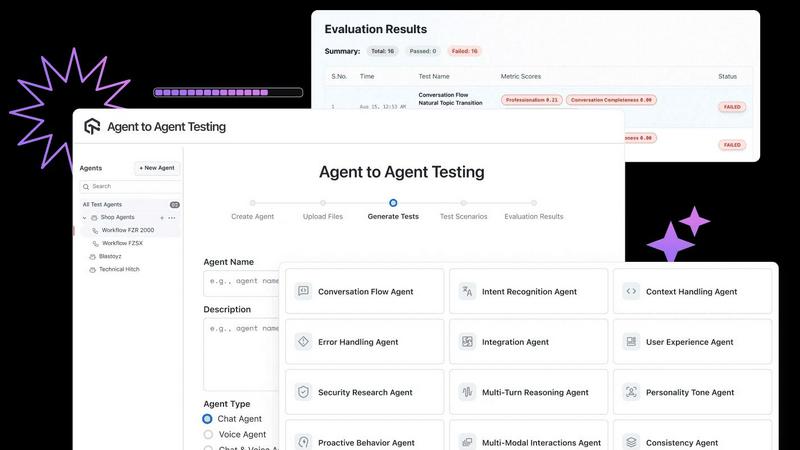
The Agent to Agent Testing Platform validates AI agent behavior across chat, voice, and multimodal systems for security.
Last updated: February 26, 2026
Takeorder AI
Takeorder AI is a 24/7 voice agent that automates restaurant phone orders, reservations, and customer inquiries.
Last updated: March 1, 2026
Visual Comparison
Agent to Agent Testing Platform
Takeorder AI
Feature Comparison
Agent to Agent Testing Platform
Automated Scenario Generation
This feature allows for the automated creation of diverse test cases that simulate real-world interactions for AI agents. By generating scenarios for chat, voice, and hybrid modalities, the platform ensures comprehensive coverage of various interaction possibilities.
True Multi-Modal Understanding
The platform enables users to define detailed requirements or upload Product Requirement Documents (PRDs) that include diverse inputs such as images, audio, and video. This capability allows for a more accurate assessment of how agents respond to a wide range of stimuli reflective of real-world scenarios.
Autonomous Test Scenario Generation
Users can access an extensive library of hundreds of pre-defined scenarios or create custom test scenarios. This flexibility allows organizations to evaluate AI agents based on specific attributes such as personality tone, data privacy compliance, and intent recognition.
Diverse Persona Testing
By leveraging multiple personas, the platform simulates varied end-user behaviors and interactions. This ensures that AI agents are tested for effectiveness across different user types, such as International Callers or Digital Novices, thus facilitating a more comprehensive evaluation.
Takeorder AI
Conversational AI & Natural Language Processing
Takeorder AI leverages state-of-the-art conversational AI models and deep natural language processing (NLP) to understand and respond to customer queries with human-like nuance and context. The system is trained on restaurant-specific terminology, menu items, and common request patterns, enabling it to handle complex order modifications, answer FAQs about hours or ingredients, and manage reservation details through a fluid, natural dialogue, without relying on rigid, scripted interactions.
Intelligent Order Capture & POS Integration
This feature automates the complete phone order lifecycle. The AI agent accurately captures all order details, including items, customizations, quantities, and special instructions. It then interfaces directly with the restaurant's POS system via a secure API integration, pushing the order automatically into the kitchen queue or order management system. This eliminates manual entry errors, speeds up service, and ensures real-time order synchronization.
24/7 Automated Call Management & IVR
Takeorder AI provides uninterrupted, 24/7 call answering capabilities, functioning as an intelligent alternative to traditional Interactive Voice Response (IVR) systems. It greets callers, understands their intent (e.g., "place an order," "book a table," "ask a question"), and routes or handles the request appropriately with zero hold times. This ensures consistent customer service availability during after-hours, holidays, and peak operational periods when staff are at capacity.
Voice Recognition & Operational Analytics
Beyond processing speech, the system employs sophisticated voice recognition to convert customer interactions into structured, actionable data. This capability provides restaurant managers with detailed analytics and insights into call volumes, peak order times, popular menu items, common customer inquiries, and service bottlenecks. These data-driven insights empower smarter business decisions regarding staffing, menu planning, and marketing strategies.
Use Cases
Agent to Agent Testing Platform
Quality Assurance for Enterprises
Enterprises deploying AI agents can utilize the platform to ensure that their agents perform reliably and meet business standards before rollout. This is crucial for maintaining customer satisfaction and safeguarding brand reputation.
Enhancing User Experience
The platform allows organizations to assess how AI agents interact with users across different modalities. By testing under various scenarios, businesses can refine agent responses, leading to improved user interaction and satisfaction.
Compliance and Risk Management
With built-in validation for policy violations and escalation logic, the platform helps organizations ensure their AI agents comply with regulatory standards. This is particularly vital for industries with stringent compliance requirements, such as finance and healthcare.
Performance Optimization
The platform enables regression testing, providing insights into potential areas of concern. This helps organizations prioritize critical issues and optimize their testing efforts, ensuring that AI agents continuously improve in their performance.
Takeorder AI
High-Volume Peak Hour Order Management
For QSRs, pizzerias, and fast-casual restaurants experiencing surge periods during lunch and dinner rushes, Takeorder AI manages the influx of phone orders simultaneously. It prevents the busy signal, eliminates long hold times that lead to abandoned calls, and ensures every order is captured and transmitted to the kitchen efficiently, directly increasing order throughput and revenue during critical business hours.
Automated Reservation Booking for Full-Service Dining
Full-service and fine-dining establishments utilize Takeorder AI to manage table reservation inquiries 24/7. The AI agent interacts with callers to find suitable dates and times, handles party size and special occasion notes, and integrates directly with the restaurant's reservation book or software. This automates a traditionally manual and error-prone process, improves table turnover planning, and enhances the guest booking experience.
Multilingual Customer Support for Diverse Menus
Restaurants specializing in ethnic cuisine or operating in multilingual communities deploy Takeorder AI configured to handle calls in multiple languages. The system can understand and respond to menu inquiries, take orders, and manage reservations in the customer's preferred language, breaking down communication barriers and expanding the restaurant's accessible customer base without requiring multilingual staff on every shift.
Ghost Kitchen & Delivery-Only Operation Support
For ghost kitchens and virtual food brands that operate without a traditional front-of-house, Takeorder AI serves as the primary customer-facing phone agent. It handles all inbound calls for orders and inquiries, integrates with delivery platform APIs and the kitchen display system, and provides a professional, branded voice experience that is critical for customer acquisition and retention in a digital-only model.
Overview
About Agent to Agent Testing Platform
Agent to Agent Testing Platform is an innovative AI-native quality and assurance framework that revolutionizes how AI agents are validated in real-world scenarios. As artificial intelligence systems evolve into more autonomous entities, traditional quality assurance (QA) models that are designed for static software become inadequate. This platform is uniquely designed to engage in comprehensive testing, evaluating full multi-turn conversations across various modalities including chat, voice, and phone interactions. Targeted at enterprises deploying AI agents, this platform ensures that the behavior and performance of these agents are thoroughly vetted before they are rolled out into production environments. By introducing advanced multi-agent test generation using over 17 specialized AI agents, it identifies long-tail failures and edge cases that manual testing often overlooks, providing organizations with the confidence that their AI agents will operate reliably and effectively.
About Takeorder AI
Takeorder AI is a specialized, enterprise-grade voice AI agent engineered exclusively for the operational and communication demands of the restaurant and hospitality industry. It functions as an intelligent, 24/7 voice concierge that automates the complete inbound phone call workflow. The system is designed to handle critical, revenue-generating tasks such as processing food orders, managing table reservations, and responding to a wide array of common customer inquiries with high accuracy. Utilizing advanced conversational AI, natural language processing (NLP), and voice recognition technologies, it delivers interactions that are indistinguishable from human agents, ensuring customer satisfaction and maintaining brand integrity. Its core technical value proposition is the elimination of operational inefficiencies: it prevents missed calls and lost sales during peak hours, significantly reduces staff burnout associated with manual phone management, and enables scalable business growth without the need for proportional increases in front-of-house labor. The platform is architected for seamless, API-driven integration with existing Point of Sale (POS) and reservation management systems, ensuring all captured data is entered directly into the restaurant's operational workflow with zero manual intervention or data entry delays. Target users include restaurant owners, operators, and hospitality managers across the entire spectrum of food service, from Quick Service Restaurants (QSRs), drive-thrus, and pizzerias to full-service casual dining, fine dining establishments, ghost kitchens, and multi-location franchise chains.
Frequently Asked Questions
Agent to Agent Testing Platform FAQ
What types of AI agents can be tested using this platform?
The Agent to Agent Testing Platform supports a variety of AI agents, including chatbots, voice assistants, and phone caller agents, providing a comprehensive testing solution across different modalities.
How does the platform ensure the accuracy of AI agent behavior?
The platform utilizes advanced multi-agent test generation and autonomous synthetic user testing to simulate thousands of production-like interactions, ensuring that AI agent behavior is accurately evaluated under varied real-world conditions.
Can organizations create custom test scenarios?
Yes, organizations can create custom scenarios to evaluate their AI agents based on specific needs or requirements, in addition to accessing a library of hundreds of pre-defined scenarios.
What metrics can be evaluated with this platform?
The platform provides insights on several key metrics, including bias, toxicity, hallucination, effectiveness, empathy, and professionalism, enabling organizations to comprehensively assess their AI agents.
Takeorder AI FAQ
How does Takeorder AI integrate with my existing restaurant systems?
Takeorder AI is designed for seamless integration via robust APIs with most major Point of Sale (POS) systems, reservation platforms (like OpenTable, Resy), and kitchen display systems (KDS). The technical implementation involves connecting your systems to our secure platform, after which all orders and reservations captured by the AI are pushed automatically into your existing workflow without any need for manual re-entry or staff intervention.
Can the AI voice agent handle complex customizations and special requests on orders?
Yes. The system's advanced natural language processing is specifically trained on restaurant order scenarios. It can accurately understand and record detailed customizations (e.g., "no onions, extra sauce, well-done"), special dietary instructions (e.g., gluten-free, vegan substitutions), and specific preparation notes. This data is then formatted and sent clearly to the POS and kitchen for precise order fulfillment.
What happens if the AI cannot understand or resolve a customer's request?
Takeorder AI is programmed with sophisticated fallback protocols. If a query is too complex, ambiguous, or requires human judgment (e.g., a specific complaint), the system can be configured to seamlessly transfer the call to a live staff member or manager. Alternatively, it can take a detailed message and promise a callback, ensuring no customer request is ever completely dropped or lost.
Is my customer data and payment information secure with Takeorder AI?
Security is a foundational technical priority. Takeorder AI is built with enterprise-grade security protocols, including data encryption in transit and at rest. For payment processing, the AI is typically integrated to work with your existing PCI-DSS compliant POS or payment gateway, ensuring sensitive credit card information is handled directly by your secure systems and not stored on our platform.
Alternatives
Agent to Agent Testing Platform Alternatives
Agent to Agent Testing Platform is an innovative AI-native quality assurance framework designed specifically for validating the behavior of AI agents across various communication modalities, including chat, voice, and phone systems. Its primary purpose is to detect security and compliance risks that may arise in real-world interactions, particularly as AI systems become more autonomous and complex. Users typically seek alternatives to this platform for reasons such as pricing considerations, specific feature requirements, or compatibility with their existing technology stacks. When choosing an alternative to the Agent to Agent Testing Platform, it's essential to evaluate several key factors. Look for platforms that offer comprehensive multi-turn conversation testing capabilities, robust support for autonomous synthetic user testing, and effective mechanisms for validating AI behavior in real-world scenarios. Additionally, ensure that the alternative can meet your organization's specific needs regarding scalability, traceability, and compliance validation.
Takeorder AI Alternatives
Takeorder AI is a specialized voice AI agent within the restaurant automation and AI assistant category. It is engineered to function as a 24/7 intelligent concierge, automating phone-based tasks like order taking, reservation management, and customer inquiries through advanced conversational AI and natural language processing. Users may explore alternatives for various reasons, including budget constraints, specific feature requirements not fully met, or the need for integration with a particular set of operational tools beyond standard POS systems. The search often stems from a desire to compare technical capabilities, pricing models, and the depth of platform customization. When evaluating an alternative, key considerations should include the robustness of the conversational AI and natural language processing engine, the breadth and reliability of native integrations with critical systems like POS and reservation platforms, and the solution's proven ability to handle high-volume, complex interactions during peak operational hours without degradation in service quality.