MakerHunt vs TinyHunt
Side-by-side comparison to help you choose the right tool.

MakerHunt
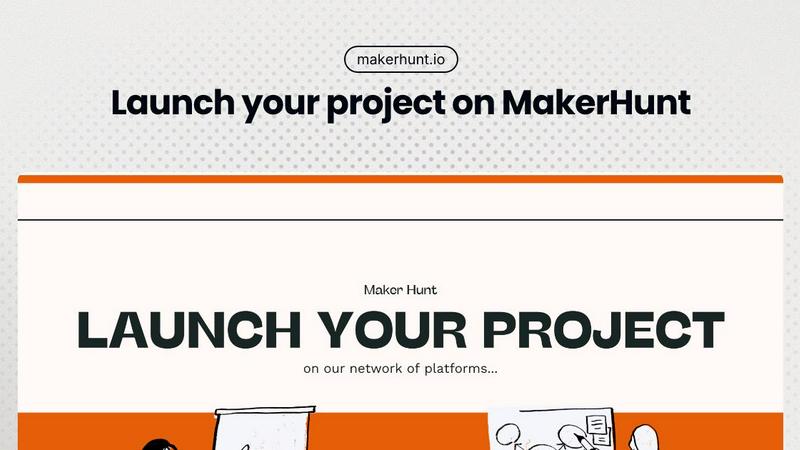
MakerHunt is a weekly launch platform where makers submit products to compete for votes, visibility, and feedback from an early adopter community.
Last updated: April 13, 2026

TinyHunt
TinyHunt is a weekly platform that boosts indie product visibility with a seven-day featured spotlight.
Last updated: March 1, 2026
Visual Comparison
MakerHunt
TinyHunt
Feature Comparison
MakerHunt
Weekly Product Hunt Cycle
The platform operates on a strict seven-day launch cycle. Each week features a single, focused "hunt" where newly submitted products are displayed for community evaluation. This temporal structure creates urgency for both makers and early adopters, ensuring a consistent flow of fresh content and concentrated attention on a manageable batch of launches. The cycle concludes with the declaration of winners based on user votes, providing clear, performance-based outcomes.
Real-User Voting & Feedback System
Integral to the weekly hunt is a transparent voting mechanism that allows registered users to upvote products they find promising. This system generates authentic, crowd-sourced validation metrics, offering makers direct insight into market reception. The aggregated votes serve as a public signal of quality and potential, helping to surface the most compelling tools to the top of the platform's rankings and hall of fame.
Premium Spotlight Placement
Beyond the standard weekly hunt, MakerHunt offers a Premium Spotlight feature. This is a paid, highlighted placement section that grants products enhanced visibility on the platform's main page. This feature operates independently of the weekly competition, providing a guaranteed, prominent promotional slot to increase exposure, drive immediate traffic, and complement the organic reach of the standard launch process.
Categorized Project Directory & Archive
The platform maintains a comprehensive, searchable directory of all launched products, organized by both time (Past Week/Month Hunts) and category (Top Categories like Artificial Intelligence, Productivity). This archive functions as a persistent discovery resource for users and a longitudinal portfolio for makers. The category system allows for targeted browsing, enabling users to efficiently find tools within specific technological or functional domains.
TinyHunt
Weekly Time-Bound Curation
TinyHunt operates on a structured weekly release cycle, where a new cohort of software products is prominently featured for a precise 7-day period. This model ensures that each project receives sustained, undiluted attention from the platform's audience, maximizing engagement potential. It prevents listings from being buried in a perpetually growing feed, a common issue in static directories, and creates a sense of urgency and freshness that encourages regular user return visits.
High-Authority SEO Backlink
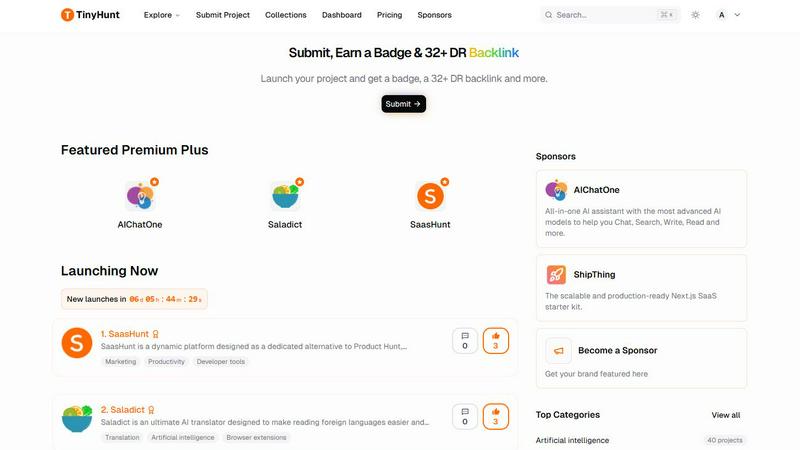
Every project submitted and accepted onto the TinyHunt platform receives a permanent, dofollow backlink from the TinyHunt domain, which boasts a Domain Rating (DR) of 32+. This feature provides immediate and tangible SEO value for makers, enhancing their site's authority and search engine rankings. The backlink is embedded within a detailed, contextually relevant product listing, which search engines weight more favorably than low-quality directory links.
Verified Profile Badge
Upon successful submission and curation, product creators are awarded a verified profile badge. This badge serves as a mark of credibility and validation from the TinyHunt platform, signaling to potential users and customers that the product has been vetted. This social proof can be instrumental in building trust, especially for new products from independent developers or micro-businesses without an established brand presence.
Dual-Pathway Discovery Architecture
The platform is architecturally designed with distinct sections to serve different discovery and promotional needs. The "Launching Now" section provides organic visibility for new products within their dedicated 7-day window. Conversely, the "Featured Premium Plus" section offers a sponsored, high-visibility slot for products seeking amplified promotion. This structure allows users to explore new launches while giving makers options for targeted exposure based on their marketing strategy and budget.
Use Cases
MakerHunt
MVP Launch and Initial Validation
Independent developers and startup teams can utilize MakerHunt as a primary channel for launching their Minimum Viable Product. The platform provides the initial user base necessary to gather critical early feedback, validate core assumptions, and identify potential early adopters, all within a structured one-week timeframe that forces a clear launch milestone.
Feature Update and Re-engagement Campaign
Established products can leverage the weekly hunt to announce and promote significant new features or major version updates. This use case helps re-engage existing users, attract new interest from a relevant audience, and gauge specific reaction to new developments through the platform's voting and comment system.
Backlink Acquisition and SEO Boost
Winning products in the weekly hunt are awarded badges and dofollow backlinks from the MakerHunt domain. This provides a concrete Search Engine Optimization benefit, as makers can use the platform to acquire high-quality, relevant inbound links that improve their site's domain authority and search ranking visibility.
Competitive and Market Research
Product managers, founders, and developers can use MakerHunt's categorized archives and weekly launches as a market intelligence tool. By monitoring trending categories, voting patterns, and newly launched competitors, teams can perform ongoing analysis of market gaps, feature trends, and competitive positioning within specific software niches.
TinyHunt
Product Launch and Initial Traction
Independent developers and solo founders can use TinyHunt as a primary launchpad for their new software product. By being featured in the "Launching Now" section, they gain immediate exposure to a targeted audience of early adopters and professionals. The week-long spotlight drives concentrated traffic, gathers initial user feedback, and can generate the first wave of sign-ups or customers, which is critical for validating product-market fit.
SEO and Domain Authority Building
Makers focused on improving their website's search engine performance utilize TinyHunt to acquire a high-quality backlink from a DR 32+ domain. This is a core use case for SEO strategy, as the contextual link from a relevant, authoritative platform directly contributes to improving the product's own domain authority and organic search rankings, making it easier for potential users to find the product via search engines.
Targeted User Acquisition for Niche Tools
Professionals such as product managers, marketers, and agency owners actively use TinyHunt as a discovery engine to find specialized, niche tools that solve specific productivity or operational challenges. The curated nature of the platform filters out noise, allowing these users to efficiently find and evaluate cutting-edge software that may not be widely advertised on larger, more generic platforms.
Brand Validation and Credibility Enhancement
Early-stage startups and micro-SaaS businesses leverage a TinyHunt feature to build brand credibility. The combination of being listed on a curated platform, receiving a verified badge, and being associated with other innovative products provides third-party validation. This social proof is instrumental in building trust with potential customers, investors, and partners during the critical early growth phases.
Overview
About MakerHunt
MakerHunt is a specialized weekly launch platform engineered for software developers, indie makers, and product builders. Its core operational protocol is a structured, time-boxed launch cycle designed to systematically showcase new products, gather quantifiable user feedback through a voting mechanism, and connect projects with a targeted audience of early adopters. The platform functions as a centralized discovery and validation engine, moving beyond simple listing services by implementing a competitive weekly hunt where products are evaluated by real users. This process generates tangible social proof and actionable data for creators. Its primary value proposition is the reduction of launch ambiguity and resource expenditure by providing a predictable, high-visibility channel to market. The platform is architected for individuals, small teams, and professional organizations seeking to efficiently introduce Minimum Viable Products (MVPs), feature updates, or full-scale applications to a technically-engaged community, thereby accelerating initial user acquisition and idea validation phases.
About TinyHunt
TinyHunt is a specialized, curated discovery platform engineered to surface and promote innovative software products and tools from independent developers, solo founders, and micro-businesses. It operates on a structured, time-bound curation model to maximize visibility and engagement for each featured project. The platform's core value proposition is its dual-function architecture: it serves as a high-signal discovery feed for professionals seeking cutting-edge, niche tools to enhance productivity and drive growth, while simultaneously acting as a powerful launchpad and marketing channel for creators to gain targeted traffic, authoritative backlinks, and community validation. Unlike saturated, broad-based directories, TinyHunt implements a weekly release cycle where a new selection of products is showcased, with each product maintaining a prominent position for a precise 7-day period. This ensures sustained, focused attention and facilitates deeper user exploration and discussion. The platform categorizes listings into distinct sections such as "Launching Now" for new releases and "Featured Premium Plus" for sponsored highlights, providing clear pathways for both organic discovery and amplified promotion. For makers, submission includes tangible benefits like a verified profile badge and a backlink from a domain with a Domain Rating (DR) of 32+, directly impacting SEO and credibility. The target audience includes SaaS founders, product managers, marketers, and tech enthusiasts actively scouting for vetted, emerging solutions.
Frequently Asked Questions
MakerHunt FAQ
What is the cost to launch a product on MakerHunt?
Launching a product in the standard weekly hunt is free of charge. This includes submission, listing in the weekly competition, and eligibility for community votes and rankings. The platform monetizes through optional Premium Spotlight placements and sponsorship slots, which are paid features offering enhanced, guaranteed visibility.
How does the voting and competition work?
Each week, a new batch of submitted products is featured in "This Week's Hunt." Registered community members can browse and upvote products they find valuable during that week. At the cycle's conclusion, the products with the highest number of authentic votes are declared winners. Top winners typically receive promotional badges and dofollow backlinks as rewards.
What are Premium Spotlight and Sponsor placements?
These are paid promotional options. A Premium Spotlight is a fixed, highlighted post on the main page for a single product. Sponsor placements are partnership slots, often labeled as "Featured Partners," that offer promotional space for services or tools relevant to the maker community. Both provide sustained visibility outside the competitive weekly hunt.
Can I launch a product that is not an AI tool?
Absolutely. While Artificial Intelligence is a prominent category, MakerHunt supports launches across a wide spectrum of software and digital products. Key categories include Productivity, Design Tools, SaaS, Developer Tools, Marketing Tools, and Platforms. The platform is designed for any digital product builder seeking early user traction and feedback.
TinyHunt FAQ
What are the benefits of submitting my project to TinyHunt?
Submitting your project to TinyHunt provides multiple tangible benefits. Primarily, you receive a permanent, dofollow backlink from a domain with a Domain Rating (DR) of 32+, which is a significant boost for your site's SEO and authority. You also earn a verified profile badge that adds credibility to your product. Furthermore, your product gains exposure to a targeted audience of professionals and early adopters actively seeking new tools, driving qualified traffic and potential user sign-ups during its featured week.
How does the weekly featuring model work?
TinyHunt operates on a strict weekly curation cycle. A new batch of products is selected and featured every week. Once your product is live, it remains in the prominent "Launching Now" section for exactly 7 days. This time-bound approach ensures that each product receives focused attention without competition from an endless stream of new submissions. After the feature week, the product listing remains accessible on the platform with its associated backlink and badge, but it rotates out of the primary spotlight to make way for the next week's selections.
What is the difference between a standard listing and "Featured Premium Plus"?
A standard listing is an organic feature in the "Launching Now" section, available through the standard submission process, and provides the core benefits (backlink, badge, week-long spotlight). "Featured Premium Plus" is a sponsored, premium placement option. It offers amplified visibility, typically in a dedicated, high-position section on the platform. This option is designed for makers who want to maximize exposure beyond the organic weekly cycle and is part of a paid sponsorship package.
Who is the target audience for TinyHunt?
TinyHunt serves a dual audience. For discoverers, the target audience includes professionals such as SaaS founders, product managers, marketers, developers, and tech enthusiasts who are proactively searching for innovative, niche, and productivity-enhancing software tools. For makers, the platform is tailored for independent developers, solo founders, bootstrapped startups, and micro-businesses who are building software products and need an effective channel for launch, marketing, and gaining authoritative backlinks.
Alternatives
MakerHunt Alternatives
MakerHunt is a specialized weekly launch platform within the product discovery and validation category. It provides a structured environment for makers and builders to introduce new products, collect votes, and gain visibility among a community of early adopters. The platform operates on a focused, weekly hunt model to streamline the launch process. Users may seek alternatives to MakerHunt for various reasons, including different pricing models like subscriptions or free tiers, the need for a different launch frequency such as daily or continuous featuring, or a desire for a larger existing audience or different community focus. Platform-specific needs, such as integration capabilities or more extensive analytics, can also drive the search for other solutions. When evaluating an alternative launch platform, key considerations include the cost structure and overall value, the size and engagement level of the platform's user base, the frequency and prominence of launch opportunities, and the quality of feedback mechanisms. The platform's primary categories and ease of use are also critical factors to ensure it aligns with your product's goals and your team's operational style.
TinyHunt Alternatives
TinyHunt is a curated discovery and launch platform within the product marketing and SEO promotion category. It operates on a weekly cycle, providing independent software products with a structured, seven-day spotlight to gain visibility, targeted traffic, and authoritative backlinks from its domain. Users may seek alternatives to TinyHunt for several operational reasons. These can include budget constraints, a need for different submission or visibility models, or a requirement for platforms with different audience demographics or technical specifications. Some may seek perpetual listings versus time-bound campaigns, or platforms with differing curation standards and editorial focus. When evaluating an alternative platform, key technical criteria include the visibility model's duration and structure, the domain authority and SEO value of provided backlinks, the specificity and size of the platform's audience, and the submission cost or revenue share model. The platform's categorization system and the long-term archival and accessibility of featured product pages are also critical for sustained value.