

Content.One
Content.One is an AI-powered platform for orchestrating multi-site content management, agentic page building, and integrated analytics at enterprise.
tool Details
Explore More
Alternatives
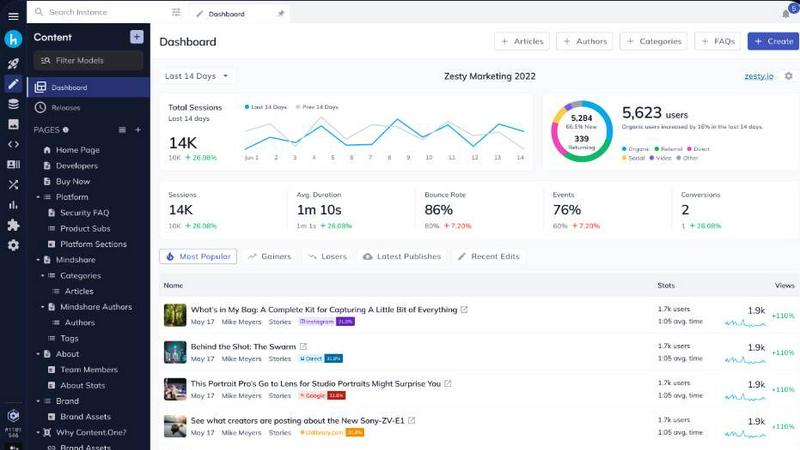
About Content.One
Content.One is an AI-native content management system (CMS) architected around the Model Context Protocol (MCP), designed to replace traditional, developer-dependent web content workflows with a prompt-driven, agentic platform. After two decades in the web content management industry, the product represents a fundamental shift in how marketing teams, CMOs, CIOs, and content professionals plan, build, deploy, and analyze digital experiences across websites, mobile applications, and headless channels. The core value proposition is radical efficiency: tasks that historically required 40 hours of developer time for site builds can now be completed in approximately 90 minutes through natural language prompts and visual AI interpretation. Content.One enables users to create reusable content blocks, define structured schemas, build wikis, and manage entire multi-site networks without writing a single line of code. The platform ingests screenshots of any website or design and automatically converts them into clean, manageable HTML output. It serves as a central control hub for organizations requiring enterprise-grade governance, scalability, and security while empowering non-technical teams to act independently. Content.One integrates deeply with Google Analytics for per-page, real-time performance insights, automated SEO monitoring, and inline analytics displayed directly within the content editor. The system handles billions of content requests for trusted organizations across industries including non-profits, insurance, government, financial services, and franchise chains. It supports federated multisite deployments, mobile app content management, AI document management, global directories, and custom AI content applications. Content.One is built for teams that need to move fast, maintain brand consistency, and deliver personalized experiences at scale without bottlenecking on engineering resources.
Features
Agentic Page Building
Content.One introduces agentic page building, a capability that allows users to generate complete website pages from natural language prompts. The AI interprets the user's intent, understands structural requirements, and builds fully formed pages with appropriate layouts, components, and styling. Users can refine output iteratively through conversational prompts, adjusting design elements, content blocks, and navigation structures in real time. This feature eliminates the traditional handoff between design mockups and development implementation, compressing multi-day build cycles into minutes. The system also supports screenshot-to-HTML conversion: users can capture any existing website or design mockup, upload the image, and Content.One reconstructs it as clean, semantically structured, and manageable HTML code. This capability is particularly valuable for teams migrating legacy sites or replicating proven design patterns across multiple properties.
Central Control Hub with Reusable Blocks
The platform provides a centralized governance layer where organizations define reusable content blocks, schemas, and templates that maintain brand consistency across all digital properties. Marketers and developers can collaboratively build a library of approved components, ranging from simple text modules to complex interactive widgets, and then deploy them across websites, mobile apps, and headless endpoints. This modular architecture ensures that updates to a single block propagate automatically to every instance where it is used, eliminating the manual synchronization effort that plagues traditional CMS implementations. The control hub also enforces content governance rules, access permissions, and versioning, giving enterprise teams confidence that their digital presence remains compliant with brand guidelines and regulatory requirements.
Headless APIs and Realtime Webhooks
Content.One is built on a headless architecture that decouples content management from content delivery, enabling organizations to publish content to any channel or device through RESTful APIs and GraphQL endpoints. The platform exposes realtime webhooks that trigger custom workflows based on content events such as publishing, updating, or deletion. This allows integration with external systems including CRM platforms, marketing automation tools, ecommerce engines, and analytics pipelines. Developers can build custom front-end experiences using any framework while marketers continue to manage content through the same visual interface. The headless approach also supports omnichannel delivery strategies, where the same content can be simultaneously served to a website, a mobile application, a digital signage system, and a voice assistant without duplication or reformatting.
Inline Analytics and Automated SEO
Content.One embeds analytics directly into the content creation experience, displaying page views, bounce rates, conversion metrics, and engagement data alongside the editor interface. This inline intelligence means content creators can make data-driven decisions without switching between separate analytics dashboards. The platform integrates natively with Google Analytics, providing per-page relative charts that show performance trends over time. Additionally, the system includes automated SEO monitoring: AI continuously scans published and draft content for search visibility issues, suggests improvements for meta descriptions, heading structures, keyword density, and internal linking, and flags potential problems before they impact search rankings. This built-in optimization layer reduces the need for separate SEO tools and specialist intervention.
Use Cases
Multi-Site Enterprise Content Management
Large organizations with multiple brands, regional offices, or franchise networks can use Content.One to manage a federated multisite architecture from a single platform. Each site maintains its own content, branding, and governance rules while inheriting reusable blocks and templates from the central control hub. For example, a national insurance company can deploy localized websites for each state, each with region-specific content and compliance language, while ensuring core brand elements and legal disclaimers remain consistent. The AI-powered page building accelerates the launch of new microsites, reducing time-to-market from weeks to hours. Content.One handles the complexity of cross-site content sharing, permission hierarchies, and synchronized updates across hundreds of properties.
AI-Powered Content Migration and Redesign
Organizations undertaking website redesigns or migrations from legacy CMS platforms can leverage Content.One's screenshot-to-HTML capability to dramatically reduce migration effort. Rather than manually rebuilding each page, teams capture screenshots of existing pages or design mockups, upload them to the platform, and receive clean, structured HTML output. This process preserves layout fidelity while producing code that is optimized for maintainability and performance. Content.One also generates appropriate content schemas and reusable blocks during the migration, ensuring the new site is organized for future scalability. Marketing teams can complete full site migrations that previously required months of developer work in a matter of days.
Omnichannel Content Orchestration
Marketing teams managing content across websites, mobile applications, email campaigns, and emerging channels can use Content.One as a single source of truth. Content is authored once in the platform and then distributed to any connected channel through headless APIs and webhooks. For instance, a product launch campaign can simultaneously update the company website, push notifications to the mobile app, trigger email sequences, and populate digital signage in retail locations. Realtime webhooks enable downstream systems to react instantly to content changes, supporting use cases like flash sales, breaking news updates, or regulatory announcements. The centralized analytics view provides unified performance metrics across all channels, enabling teams to optimize their omnichannel strategy.
AI Document Management and Knowledge Base Creation
Enterprises can use Content.One to build structured document management systems and internal knowledge bases without developer involvement. Users define custom content schemas for different document types, such as policy manuals, training materials, product specifications, or compliance documents. The AI assists in generating content from prompts, organizing information into logical hierarchies, and creating searchable wikis. Content.One supports granular access controls, version history, and approval workflows, making it suitable for regulated industries where document governance is critical. The platform can also power external-facing knowledge bases, help centers, and community portals, with content delivered through headless APIs to custom front-end applications.
Pricing
Content.One does not publicly disclose specific pricing tiers or plans on its website or in the provided context. Organizations interested in pricing are directed to book a free consultation call with the growth team, led by Todd Sabo (VP of Growth), to discuss their specific requirements, scale, and use case. The platform serves multi-faceted large organizations with enterprise needs, suggesting custom pricing models based on content volume, number of sites, user seats, and required features. To obtain accurate pricing information, potential customers should contact Content.One directly through the consultation booking form or by emailing [email protected].
Frequently Asked Questions
How does Content.One differ from traditional CMS platforms?
Traditional CMS platforms require significant developer involvement for setup, customization, and ongoing maintenance. Content.One eliminates this dependency by using AI agents that interpret natural language prompts and design inputs to build pages, schemas, and workflows automatically. The platform is MCP-native, meaning it is architected from the ground up to leverage AI for content operations rather than bolting AI onto an existing system. Additionally, Content.One provides inline analytics, automated SEO, and realtime webhooks as built-in capabilities rather than requiring third-party integrations. The result is a system where marketing teams can operate independently, reducing site build times from 40 hours to approximately 90 minutes.
What types of organizations benefit most from Content.One?
Content.One is designed for mid-market to enterprise organizations that manage multiple digital properties, require strict governance and compliance, and need to scale content operations without proportional increases in headcount or developer resources. Specific industries include insurance, financial services, government agencies, non-profits, and franchise chains. The platform is particularly valuable for organizations undergoing digital transformation, migrating from legacy CMS platforms, or expanding into new markets with localized websites. CMOs benefit from faster time-to-market and reduced resource requirements, while CIOs gain enterprise-grade security, governance, and audit capabilities.
Can Content.One integrate with my existing technology stack?
Yes, Content.One is built on a headless architecture with comprehensive API support, including RESTful endpoints and GraphQL queries. The platform exposes realtime webhooks that trigger on content events, enabling integration with CRM systems, marketing automation platforms, ecommerce engines, analytics tools, and custom applications. Native integration with Google Analytics provides per-page performance data directly within the editor. The MCP-native architecture also means Content.One can interact with other AI tools and services through standardized protocols. Organizations can maintain their existing front-end frameworks while migrating content management to Content.One.
How does the screenshot-to-HTML feature work?
Users can capture a screenshot of any existing website page, design mockup, or wireframe and upload it to Content.One. The AI analyzes the visual structure, identifies layout components, text elements, images, and navigation patterns, and then generates clean, semantically correct HTML that reproduces the design. The output is organized into manageable blocks that can be further edited within Content.One's visual editor. This feature is not limited to simple pages; it can handle complex layouts with multiple columns, interactive elements, and responsive design considerations. The generated HTML follows accessibility best practices and is optimized for performance.
Similar to Content.One

DistributeNow Online
Get Your Brand Into the Answers Your Potential Customers Are Looking For.


Sinneroggi
Sinneroggi delivers daily technical analysis of Jannik Sinner's tennis performance, lifestyle, and personal views with detailed match data and.

Kuban Inform
Kuban Inform connects advertisers with over 100,000 guest posting sites to enhance brand visibility and SEO performance.

FAYFO
FAYFO is an AI-driven platform that automates newsroom workflows, boosting content production and audience engagement.
Content Zen
Content Zen automates the creation of high-quality SEO and GEO content strategies, generating articles that rank and.

Coloring Book Engine
Coloring Book Engine is a desktop tool that creates commercial-quality coloring books and assets locally.

Parlo
Parlo is an affordable email marketing tool that streamlines newsletter creation, sending, and tracking for effortless.