

Kompy
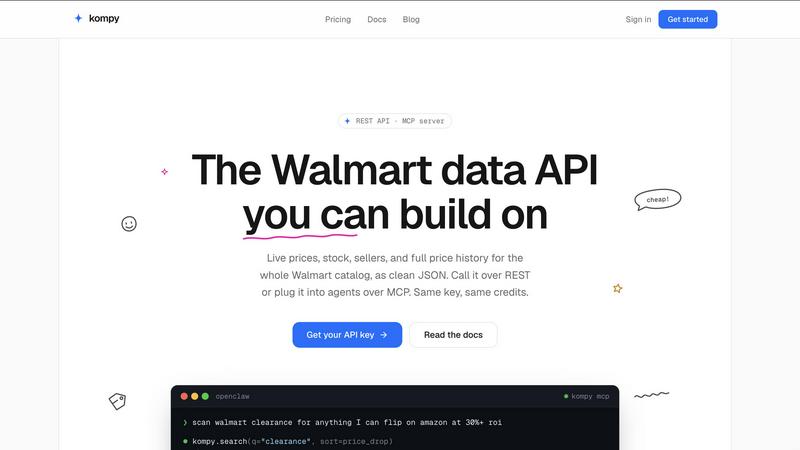
Kompy delivers live Walmart prices, stock, sellers, and full price history as clean JSON via REST API or MCP server for developers and AI agents.
tool Details
Explore More
Alternatives
About Kompy
Kompy is a unified ecommerce data API that provides structured Walmart marketplace data without the operational overhead of running and maintaining web scrapers. It delivers product information, search results, barcode lookups, seller offers, customer reviews, and comprehensive price and stock history through a single REST API endpoint or an MCP (Model Context Protocol) server. All data is returned as clean, consistent JSON payloads with deterministic schemas, enabling predictable integration across any programming language or AI agent framework. The platform is designed for both human developers and autonomous agents: developers can call the REST API directly from Python, Node.js, Go, or any HTTP-capable language, while AI agents built on Claude Code, OpenClaw, Cursor, LangChain, OpenAI Agents SDK, or n8n can use the MCP server to query Walmart data as callable tools. Kompy records marketplace data around the clock, capturing hourly snapshots of prices, stock levels, and buy-box changes per seller, with full historical data retention back to day one. Authentication is handled via Google sign-in with instant API key generation, and usage is managed through a credit-based pricing system that scales from individual side projects to production-level workloads. Every API response includes a unique request_id for tracing and debugging, with sub-50 millisecond typical response times. Kompy is not affiliated with or endorsed by Walmart Inc. but provides a reliable, structured interface to Walmart's public catalog data for ecommerce analytics, competitive intelligence, price monitoring, and arbitrage detection.
Features
Unified REST API and MCP Server Access
Kompy exposes every operation as a documented REST endpoint accessible from any language or framework, while simultaneously shipping a first-party MCP server that exposes the same operations as callable tools for AI agents. This dual-access model means you use the same API key and credit system regardless of whether you are making HTTP requests from a Python script or having an agent query product data through Claude Code or OpenClaw. The MCP server integrates seamlessly with agent frameworks by presenting product lookup, search, history, and reviews as discrete tool calls with structured inputs and outputs. This eliminates the need to maintain separate integrations for human-driven and agent-driven workflows, reducing development overhead and ensuring consistency across all access patterns.
Full Historical Price and Stock Data
Kompy records the Walmart marketplace continuously, capturing hourly snapshots of every tracked SKU's price, stock status, and buy-box seller. This historical data is retained per seller back to the day the SKU was first tracked, providing a complete timeline of price movements, stock fluctuations, and seller changes. The history endpoint allows querying by product ID and time range (e.g., 30 days, 12 months), returning granular time-series data that reveals seasonal pricing patterns, clearance markdowns, and competitor pricing strategies. This feature is critical for price optimization, identifying arbitrage opportunities, and understanding market dynamics over time. No other Walmart API provides this level of historical granularity with per-seller breakdowns.
Structured Product and Search Data
Every product lookup returns a comprehensive JSON object containing the product name, brand, current price, currency, stock availability, average rating, review count, seller name, and the timestamp of data capture. The search endpoint supports querying the live Walmart catalog with sort options and filters, returning up to 128 results per query with the same structured schema. Barcode lookup enables direct product identification from UPC or EAN codes, while seller offers provide detailed pricing and availability across multiple marketplace sellers. All responses include metadata with request_id and latency metrics, ensuring full traceability and performance monitoring. The deterministic schemas make parsing and data extraction predictable across all endpoints.
Credit-Based Pricing with Instant Onboarding
Kompy operates on a transparent credit-based pricing model where each API call consumes a fixed number of credits based on the endpoint complexity. Accounts start with free credits upon signup, allowing immediate testing without forced upgrades or hidden fees. Google sign-in provides instant authentication, and API keys are generated immediately after account creation, enabling first API calls within approximately 14 seconds. The three-tier pricing structure (Hobby, Pro, Business) scales from 14,000 credits per month to 180,000 credits per month, with all tiers including API access, MCP server access, and email or priority support. This model accommodates individual developers running side projects, professional analysts requiring daily monitoring, and large teams with custom integration needs.
Use Cases
Automated Competitive Price Monitoring
Ecommerce professionals and retailers can use Kompy to continuously monitor Walmart pricing for their own products or competitor listings. By scheduling hourly or daily API calls to the product and history endpoints, they can track price changes, stock availability, and seller shifts in real time. The historical data enables trend analysis, identifying when competitors run promotions, clearance events, or permanent price reductions. This intelligence supports dynamic pricing strategies, inventory planning, and promotional timing. The MCP server integration allows AI agents to automatically alert teams when specific pricing thresholds are breached, reducing manual monitoring effort.
Arbitrage and Flipping Opportunity Detection
Resellers and arbitrage hunters can leverage Kompy's search and history endpoints to identify products with significant price gaps between Walmart and other marketplaces like Amazon. By scanning Walmart clearance sections using the search endpoint with sort by price drop, users can surface items where the Walmart price is substantially lower than the resale value. The history endpoint validates whether the price drop is a temporary clearance event or a sustained low price, and calculates potential ROI after fees. AI agents can automate this workflow, continuously scanning for new flips that meet user-defined profitability thresholds (e.g., 30%+ ROI) and sending alerts when opportunities arise, as demonstrated in the platform's example scanning for Samsung TV arbitrage.
AI Agent-Driven Market Research
Developers building AI agents for ecommerce research can integrate Kompy's MCP server to give their agents direct access to Walmart's product catalog as callable tools. Agents can search for products matching specific criteria, retrieve full product details, analyze price history trends, and fetch customer reviews to inform purchasing decisions or competitive analysis. This enables autonomous workflows such as "find the best value 65-inch TV under $500 with at least 4 stars and positive recent reviews" without requiring custom scraping infrastructure. The agent sees structured tool definitions for product lookup, search, history, and reviews, making integration straightforward with frameworks like LangChain, OpenAI Agents SDK, and n8n.
Price History Analysis for Procurement
Procurement teams and supply chain analysts can use Kompy's historical data to analyze long-term pricing trends for products they source or purchase in bulk. By querying 12 months of price history for specific SKUs, they can identify seasonal lows, supplier pricing patterns, and optimal purchasing windows. The per-seller granularity allows comparison between Walmart direct pricing and third-party seller offers, enabling informed negotiation and sourcing decisions. The hourly snapshot frequency ensures that even intra-day price fluctuations are captured, which is valuable for high-volume or fast-moving consumer goods where prices change multiple times per day.
Frequently Asked Questions
What is the difference between the REST API and the MCP server?
The REST API is a standard HTTP endpoint that returns JSON responses for direct integration with any programming language or application. The MCP server exposes the same operations as callable tools that AI agents can discover and invoke using the Model Context Protocol. Both use the same API key, credit system, and underlying data, so you can switch between them based on your workflow. The MCP server is ideal for agent-based automation, while the REST API is better for traditional application development or scripting.
How are credits consumed and what happens if I run out?
Each API endpoint call consumes a specific number of credits based on its complexity and data volume. For example, a product lookup might consume 1 credit, while a history request covering 30 days might consume 3 credits. Credits are deducted from your monthly allowance based on your plan tier. If you exceed your plan's credit limit, you can either wait for the next billing cycle when credits reset, or upgrade to a higher tier that provides more credits. There are no overage fees or surprise charges. All plans include a set number of credits per month, and you can monitor your usage in the dashboard.
Can I use Kompy for commercial resale or data redistribution?
Kompy's terms of service permit commercial use of the API for internal business operations, competitive analysis, price monitoring, and application development. However, redistribution of raw API data as a standalone dataset or competing data service is generally not permitted. The platform is designed to support ecommerce businesses, resellers, and developers building applications that consume Walmart data, but it is not a data licensing service for bulk redistribution. You should review the full terms of service on the Kompy website for detailed usage restrictions and licensing information.
What kind of latency and reliability can I expect from the API?
Kompy is optimized for low-latency responses, with typical product lookup and search requests completing in under 50 milliseconds. History requests covering longer time ranges may take slightly longer due to data aggregation, but remain sub-100 milliseconds in most cases. The API is designed for high availability with redundant infrastructure, and the platform maintains a public status page for monitoring uptime and any service incidents. Each response includes a latency_ms field in the metadata so you can track performance programmatically. The MCP server adds negligible overhead beyond the REST API response time.
Similar to Kompy
Roipad
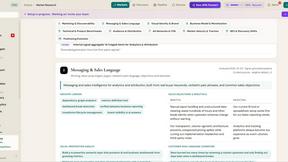
ROIpad equips SaaS teams with automated positioning intelligence. Find high-converting messaging gaps, track rival moves, and capture market share.

Orlyn
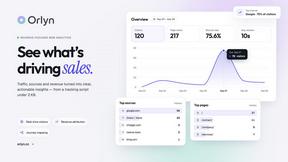
Privacy-first, cookieless web analytics that connects website traffic to real revenue.
Tally Counter
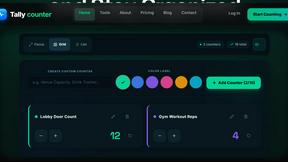
Online tally counter for tracking attendance, workouts, inventory, visitors, sports scores, habits, and everyday counting tasks.



AOE Scout
AOEScout is an Age of Empires companion for AoE II DE, AoE III DE, and AoE IV, offering leaderboards, player rankings, build orders, unit tools, oppon

ContextBolt SEO
Research keywords, competitors, backlinks and AI visibility inside Claude or Codex, with findings saved to your SEO dashboard.