

Serro AI
Serro AI ingests your entire tool stack to automatically build and maintain live memory for every active program, enabling human-agent teams to.
tool Details
Explore More
Alternatives
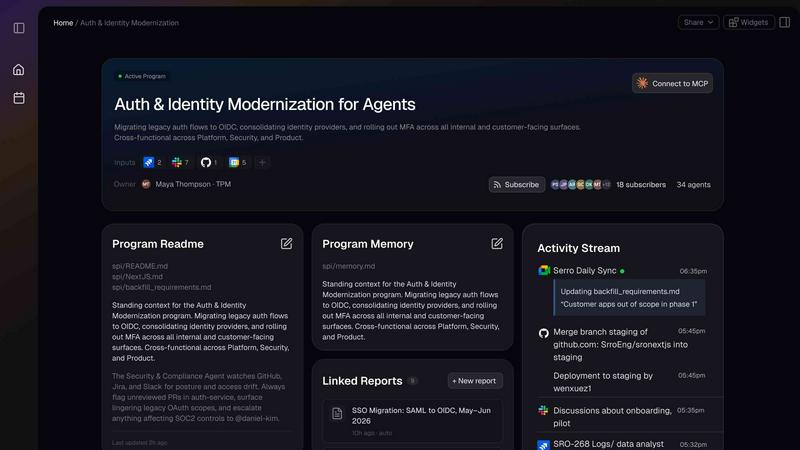
About Serro AI
Serro AI is an agentic Technical Program Management (TPM) infrastructure purpose-built for the Technical Program Management function. It is designed to address the fundamental bottleneck that has emerged in modern engineering organizations: coordination. As AI has dramatically increased code output and decision velocity, the ability to align humans and AI agents across complex programs has not scaled proportionally. Serro solves this by treating programs as first-class units of work, moving beyond the limitations of task trackers, roadmap tools, dashboards, code-wikis, and generic project management platforms. The product ingests scattered execution signals from tools like Jira, GitHub, Linear, Slack, Notion, Zoom, email, and codebases, transforming them into two core outputs: trusted temporal program memory and real-time status coordination. The program memory is a living record of shared goals, decisions, risks, dependencies, and historical context. The coordination layer enables both humans and AI agents to act on current state. Serro offers two tiers: Serro Pro for enterprises seeking to scale existing TPM capacity, and Serro Lite for earlier-stage companies needing AI-powered TPM capacity sooner. The product is built for Technical Program Managers (TPMs), Engineering Managers (EMs), Product Managers (PMs), and engineering leadership who need to collaboratively manage downstream program execution and agent loops in high-velocity work environments.
Features
Program Memory
Serro maintains live, automatically updating memory across every active program. This is not a static document or a wiki. It is a dynamic state that captures decisions, risks, owners, history, and activity as work moves across connected tools. When a decision is made in a Slack thread or a risk is logged in a meeting, Serro ingests that signal and updates the program memory. This eliminates the need for manual status updates and post-hoc context reconstruction. The memory serves as a single source of truth for both human team members and AI agents, ensuring everyone operates from the same current reality. It is designed to be queried, reported on, and used as the foundation for all subsequent coordination.
Loops on Programs
Serro implements automated loops that keep complex, cross-functional work moving. These loops are not simple task reminders. They are intelligent workflows that monitor program state, identify dependencies, detect blockers, and trigger appropriate actions. For example, if a critical dependency is blocked in GitHub, Serro can automatically generate a status update, notify the relevant owner in Slack, and log the risk in the program memory. These loops reduce the manual overhead of chasing updates and following up on action items. They are calibrated for high-velocity environments where the volume of moving parts exceeds human capacity to track manually. Loops can be configured to run on cadence, respond to specific events, or be triggered by human or agent commands.
Agent Governance
Serro provides a control layer for programs and agents. As engineering teams increasingly operate with both human contributors and AI agents, a governance framework is essential. This feature ensures that agents operate within defined boundaries, have appropriate permissions, and are auditable. It prevents agents from making unauthorized changes to program state, overriding human decisions, or acting on stale information. The governance layer includes policies for agent behavior, access controls for different program data, and logging for all agent actions. This enables organizations to safely scale their use of AI agents in program execution without losing control or creating coordination chaos. It is a critical component for enterprises that need to maintain compliance and oversight while leveraging agentic capabilities.
Program Analytics
Serro offers a system-level view across the entire organization. This analytics capability aggregates data from all active programs to provide leadership with a real-time picture of organizational health. It surfaces metrics such as program velocity, blocker density, coordination gaps, risk exposure, and resource allocation. Instead of relying on fragmented updates from multiple tools and meetings, leadership can see a live dashboard of momentum, operational risk, and team health. These analytics are not just historical reports; they are derived from the live program memory and loops, meaning they reflect current reality. This enables faster, data-driven decisions about prioritization, staffing, and strategic direction. The analytics are designed to be actionable, highlighting specific areas that need attention rather than just presenting raw data.
Use Cases
Technical Program Manager (TPM) Delegation and Scaling
A TPM managing multiple cross-functional programs can use Serro to delegate coordination overhead. Instead of manually tracking status across Jira, GitHub, and Slack, the TPM configures Serro to ingest all signals and maintain program memory. Automated loops handle status updates, risk logging, and dependency tracking. The TPM can query any program for its current state, generate reports on cadence, and turn meeting outcomes into actionable items. This allows the TPM to scale their impact, running more programs with less manual effort. Serro Pro is specifically designed for this use case, enabling enterprises to effectively increase TPM capacity without linearly increasing headcount.
Engineering Manager (EM) Real-Time Visibility
An Engineering Manager overseeing multiple teams can use Serro to understand execution reality without chasing updates. By connecting their team's tools, the EM gets a shared view of what is moving, where execution is slipping, and what needs attention next. Serro surfaces blockers, risks, and dependencies that might otherwise be lost in email threads or stand-up meetings. The EM can see team health indicators, identify coordination gaps between teams, and make informed decisions about reprioritization. This reduces the time spent on status meetings and manual reporting, allowing the EM to focus on technical strategy and team development.
Product Manager (PM) Alignment and Execution Tracking
A Product Manager responsible for a roadmap can use Serro to keep decisions, timelines, and execution aligned. As priorities evolve and product direction shifts, Serro captures these changes in the program memory. The PM can connect roadmap shifts to delivery progress, ensuring that the team is always working on the highest-impact items. Serro surfaces when decisions are made in meetings or Slack that affect the program, preventing drift between planning and execution. The PM can generate updates for stakeholders without manual compilation, and can quickly assess the impact of a change on timelines and dependencies.
Engineering Leadership Organizational Health Monitoring
Engineering leaders and executives can use Serro to get a clearer view of organizational health in real time. Instead of relying on weekly reports that are already outdated, leadership can see a live dashboard of momentum, blockers, coordination gaps, and operational risk across all programs. This enables faster strategic decisions, such as reallocating resources to a struggling program or identifying a systemic coordination issue. Serro turns fragmented updates from multiple teams into a coherent, live picture of program health. This is particularly valuable during large migrations, critical launches, or periods of rapid scaling where the cost of misalignment is high.
Frequently Asked Questions
What tools does Serro integrate with?
Serro connects with Slack, Linear, GitHub, Jira, Zoom, Notion, email, and codebases. It ingests signals from these tools to build and maintain program memory. The integration is designed to be bidirectional where possible, allowing Serro to both read state and write updates back to the source tools. This ensures that Serro works where your team already operates, without requiring a forced migration to a new platform.
How does Serro differ from a project management tool like Jira or Asana?
Serro is not a task tracker or a project management platform. It is an agentic TPM infrastructure. While task trackers focus on individual tasks and workflows, Serro treats entire programs as first-class units of work. It ingests signals from multiple tools (including task trackers) to build a living program memory and coordination layer. Unlike generic platforms, Serro is purpose-built for the TPM function, with features like automated loops, agent governance, and program analytics that are not available in traditional project management tools.
Is Serro suitable for small teams or only large enterprises?
Serro offers two tiers to serve different needs. Serro Pro is designed for enterprises with existing TPM capacity that needs to scale. Serro Lite is built for earlier-stage companies that need AI-powered TPM capacity much earlier, allowing smaller teams to scale their live coordination without a dedicated TPM. This means that whether you are a startup with 10 engineers or an enterprise with 1000, Serro has a configuration that can help you manage program execution more effectively.
How does Serro handle AI agent governance?
Serro includes a dedicated Agent Governance feature that provides a control layer for programs and agents. This allows organizations to define policies for agent behavior, set access controls for different program data, and log all agent actions. Agents are prevented from making unauthorized changes or overriding human decisions. This governance framework is essential for safely scaling the use of AI agents in program execution, ensuring compliance, auditability, and human oversight remain in place.
Similar to Serro AI
layahost
Moderation, routing, intent and scoring for any text over one Jev-compatible API, hosted in the EU.


Hailuo AI
Create Hailuo AI videos from text or images with guided prompts, motion and camera controls, flexible settings, and downloadable results.

amaze.directory
A directory of AI tools where somebody actually used the tool.
Speechyou
AI transcription for voice notes, meetings, and audio files in 1,700 languages, with AI summaries and subtitle export and unlimited chat ai usage.
ProspectHalo
AI sales agent that finds qualified leads, runs outreach, follows up automatically, creates content, and helps book more meetings.