

TaleHug AI Story Generator for Kids
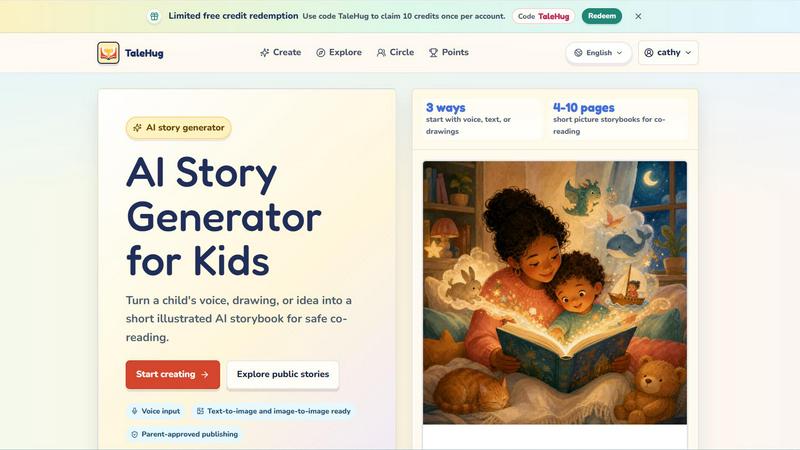
TaleHug is a customizable AI story generator that turns a child's voice, drawing, or idea into a short illustrated picture book for safe co-reading.
tool Details
Explore More
Alternatives
About TaleHug AI Story Generator for Kids
TaleHug is an AI-powered storytelling platform engineered specifically for children aged 3 to 8, enabling them to create personalized, illustrated storybooks through a safe and intuitive interface. The system accepts three primary input modalities: voice recordings, hand-drawn images, and text-based story ideas, which are then processed by a custom AI engine to generate coherent 4 to 10 page picture storybooks suitable for co-reading with parents or educators. The platform prioritizes child safety and parental oversight through a tiered visibility system comprising private drafts, circle sharing, and public publishing, with all non-private publications requiring explicit adult approval. TaleHug incorporates text-to-image and image-to-image generation capabilities, allowing children to see their own drawings transformed into professional-grade illustrations within the story context. The platform is designed for preschool and kindergarten age groups, with content moderation systems that prevent the generation of inappropriate material. Key technical specifications include support for multiple languages (with English and Chinese examples present in the public gallery), a credits-based usage model with limited free credits available via promotional codes, and a zero public comment policy in the MVP phase to eliminate social interaction risks. The platform operates on a private-by-default architecture, storing all drafts as private until explicitly shared, and implements strict data minimization practices by using safe display names instead of full child names and prohibiting the collection of school names, addresses, or contact details.
Features
Multi-Modal Input System
The platform accepts story generation inputs through three distinct channels: voice recording, drawing upload, and text prompts. Voice input captures a child's spoken story idea and converts it to text before processing. Drawing uploads utilize image-to-image AI to transform hand-drawn sketches into full-color story illustrations. Text prompts allow parents or older children to type specific story parameters. Each input method feeds into the same AI pipeline, which generates consistent 4-10 page storybooks with one short sentence per page and a stored prompt for regeneration capabilities.
AI-Powered Storybook Generation Engine
The core generation system produces complete picture storybooks with a technical output of 4 to 10 illustrated pages per story. Each page contains a strong AI-generated image paired with a single short sentence optimized for early readers. The system stores the original generation prompts for each page, enabling users to regenerate individual pages if the output does not match expectations. The AI engine is specifically trained on children's literature patterns, ensuring age-appropriate vocabulary, narrative structures, and illustration styles suitable for preschool and kindergarten comprehension levels.
Parent-Guided Publishing with Safety Tiers
TaleHug implements a three-tier visibility system with strict parental controls. Drafts are automatically set to private by default, visible only to the child creator. The "Circle" tier allows sharing with a curated group of approved contacts, requiring adult authorization before activation. The "Public" tier publishes stories to the community gallery but mandates explicit parent approval before any content becomes visible to other users. The system enforces zero public comments in the MVP phase, eliminating all social interaction vectors. All published content uses safe display names rather than real child names, and the platform prohibits collection of school names, addresses, or contact details.
Parent-Approved Prompt Library
The platform includes a curated library of pre-approved story prompts and scene templates designed for safe, age-appropriate storytelling. Example prompts include "Moon rabbit bedtime" for gentle friendship stories, "Sharing the red truck" for social narratives about taking turns, and "Feelings under the sea" for emotional vocabulary development. These prompts are pre-screened by the development team and serve as starter templates that parents can select for their children, reducing the risk of inappropriate content generation while providing structured creative starting points.
Use Cases
Bedtime Story Creation for Parent-Child Co-Reading
Parents can use TaleHug to generate personalized bedtime stories based on their child's daily experiences or interests. A child might record a voice description of their day at the park, which the AI transforms into a 4-page illustrated storybook that the parent and child can read together before sleep. The short sentence format per page is specifically designed for co-reading, where the parent reads the text while the child engages with the illustrations. The system's gentle, calming prompts like "Cloud hopping" and "Moon rabbit bedtime" are pre-configured for winding-down scenarios.
Classroom Social Story Development for Kindergarten Teachers
Educators can leverage TaleHug to create custom social stories addressing specific classroom situations. A teacher might upload a child's drawing of sharing toys and generate a storybook about taking turns using the "Sharing the red truck" prompt template. The resulting 4-10 page book can be used for whole-class reading or individual counseling sessions. The Circle sharing feature allows teachers to distribute stories to specific families without public exposure, and the zero-comment policy eliminates classroom social dynamics from the platform.
Speech and Language Development Through Voice-to-Story Conversion
Speech therapists and parents working on language development can use the voice input feature to encourage children to narrate their own stories. The AI processes the child's spoken words into a coherent narrative, providing positive reinforcement through the generated illustrations. This use case is particularly effective for children who are reluctant writers or have fine motor skill challenges, as it bypasses the need for typing or drawing. The system's ability to store generation prompts allows for iterative refinement of the story language.
Creative Writing Workshop for Young Authors
After-school programs and homeschooling parents can use TaleHug as a creative writing tool for children aged 6-8. The platform's multi-modal input allows children to start with a drawing, then expand it into a full narrative through the AI generation. The public gallery provides examples of peer-created stories for inspiration, while the private draft system allows children to experiment without performance pressure. The 4-10 page constraint teaches narrative structure, and the image-to-image feature shows children how their original artwork can be professionally rendered.
Frequently Asked Questions
How does the AI ensure story content is safe and appropriate for children?
TaleHug implements multiple safety layers. All AI generation models are trained exclusively on age-appropriate children's literature datasets. The platform uses pre-screened prompt templates as starting points, and any custom text inputs are filtered through content moderation systems before generation. Published content requires explicit parent approval for any visibility tier beyond private drafts. The MVP phase enforces a zero public comment policy, eliminating all user-to-user communication. The system also prohibits the collection of personal identifiable information such as full names, school names, addresses, or contact details.
Can I regenerate specific pages if the AI output is not what I expected?
Yes, each generated story page stores its original creation prompt in the system metadata. Users can access individual page settings to trigger regeneration using the same prompt, which will produce a new AI-generated illustration and text combination. This regeneration capability applies to all pages within a 4-10 page storybook. The system does not charge additional credits for regenerating pages within an existing story, only for initial story creation.
What input formats are supported for creating a story?
TaleHug supports three primary input formats. Voice input captures spoken story ideas through the device microphone and converts them to text using speech recognition. Drawing input accepts uploaded image files of hand-drawn sketches, which are processed through image-to-image AI to generate story illustrations. Text input allows direct typing of story ideas or selection from the pre-approved prompt library. All three inputs feed into the same generation pipeline and produce the standard 4-10 page illustrated storybook output.
How does the credit system work and what are the free options?
TaleHug operates on a credits-based usage model where each story creation consumes a set number of credits. New accounts receive a limited number of free credits upon registration. Users can redeem promotional codes for additional free credits, such as the code "TaleHug" which provides 10 credits once per account. Credits are consumed only when generating new storybooks, not for browsing the public gallery, reading existing stories, or regenerating pages within an already-created story. The platform does not require a subscription for basic usage with available free credits.
Similar to TaleHug AI Story Generator for Kids
PracticeNetworking
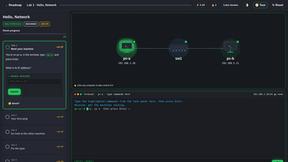
Master networking with interactive, hands-on practice directly in your browser. Solve real terminal challenges, debug routes, and build core IT skills
PythonExercise.com
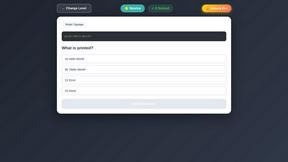
An interactive coding platform featuring bite-sized Python exercises designed to build real coding skills through hands-on practice.

PracticeSIEM
PracticeSIEM.com is an interactive, browser-based hands-on cybersecurity learning platform designed for Security Operations Center (SOC) analysts.
SQLCrab
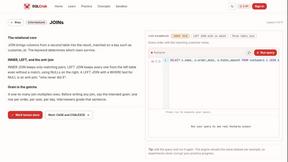
SQLCrab (sqlcrab.com) is an interactive, browser-based SQL learning platform that lets you practice database queries directly in your browser.


Delta Report
Free, Live 3D Satellite, Space Weather & Climate Tracker in real time on an interactive globe alongside articles and insights.

The French Corner
Learn French through visual stories told by a native speaker. Words you meet come back on their own, right before you'd forget them.

Construction Calculator
Free construction calculators with transparent formulas, steps, assumptions, and metric or imperial units.