

Tin Computer
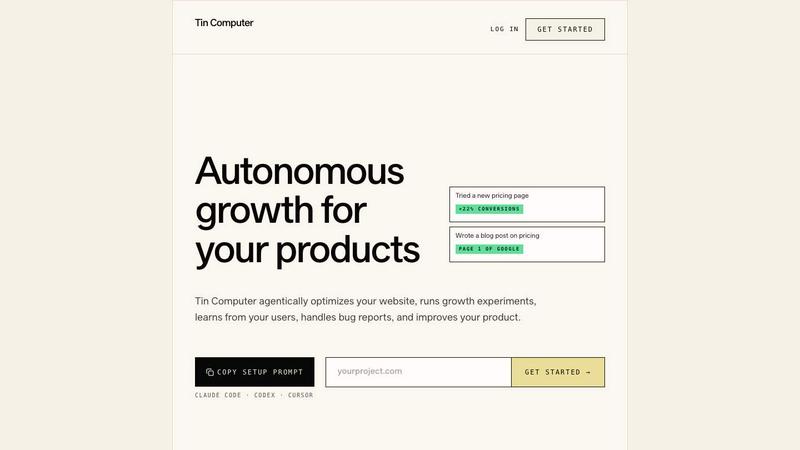
Tin Computer is an autonomous growth agent that connects to your systems to continuously optimize, experiment, ship fixes, and improve your product.
tool Details
Explore More
Alternatives
About Tin Computer
Tin Computer is an autonomous AI growth agent engineered specifically for small SaaS teams that need continuous, data-driven product and marketing improvements without the overhead of a dedicated growth team. The system connects directly to your existing technical stack, including GitHub, Stripe, Google Analytics, Search Console, PostHog, Sentry, and Vercel, and operates as a persistent background process that reads your codebase, analyzes user behavior, identifies growth bottlenecks, and ships real code changes through pull requests that you review and merge. Unlike traditional growth tools that merely provide recommendations or dashboards, Tin Computer takes full ownership of the growth lifecycle: it notices a problem in your funnel, designs an experiment or fix, writes the code, opens a pull request, and then monitors the outcome to learn what works. The core value proposition is replacing a fragmented, manual growth workflow with an always-running agent that handles organic SEO through blog posts and comparison pages, product engineering through bug fixes and onboarding tweaks, and analytics through funnel diagnostics and cohort analysis. This product is built for SaaS founders, indie developers, and small engineering teams who want to grow their products through organic channels and AI-search optimization without spending on ads or cold outreach. The documented case study of Claw Messenger, a dormant side project that grew from $480 to $13,500 ARR and from 4 to 146 paying customers in 112 days, demonstrates the system's capability to autonomously drive measurable revenue growth across multiple dimensions simultaneously.
Features
Autonomous Growth Playbook Execution
Tin Computer operates as a continuous growth engine that does not wait for human briefs or roadmap prioritization. It reads your product funnel through connected analytics tools, identifies where growth is slowing down, and autonomously selects the next experiment or fix from a library of growth tactics. The system then builds the solution, ships it as a pull request to your GitHub repository, and monitors the result. If the change works, it iterates; if it does not, it rolls back and tries a different approach. This closed-loop process runs 24/7, enabling small teams to achieve the output of a full growth team without hiring specialists.
Multi-Specialist Agent Architecture
Behind the single Tin Computer interface operates a team of specialized AI agents, each owning a distinct growth lane analogous to a real hire. The architecture includes a Strategist for high-level direction, a Research Analyst for competitive and user research, an Organic Growth Engineer for SEO and content, a Paid Acquisition Engineer for ad optimization, a Sales Outreach agent, a Product Analyst for funnel and cohort analysis, a Financial Analyst for pricing experiments, a Product Engineer for code changes, and a Customer Support Engineer for handling user inquiries. This modular design allows Tin Computer to simultaneously work on multiple growth vectors, such as shipping a pricing change one week and a comparison page the next, without requiring human coordination.
Deep Stack Integration and Code-Level Access
Tin Computer connects to your existing tool ecosystem through direct API integrations with GitHub, Stripe, Google Analytics, Search Console, PostHog, Sentry, Vercel, and support email systems. The integration with GitHub is particularly critical, as it gives the agent read and write access to your codebase, enabling it to ship real changes by opening pull requests that contain code modifications, configuration updates, and new content files. This code-level access means Tin Computer can implement technical SEO fixes, add new features, adjust pricing logic, modify onboarding flows, and deploy content pages, all while maintaining version control and allowing you to review every change before merging.
Learning and Adaptation Engine
Tin Computer incorporates a feedback loop that tracks the performance of every shipped change against predefined metrics such as conversion rates, user engagement, revenue, and search rankings. The system uses this data to build a model of what works for your specific product and audience, continuously refining its growth strategy over time. If a particular type of experiment consistently yields positive results, the agent prioritizes similar tactics. Conversely, it deprioritizes or abandons strategies that show diminishing returns. This adaptive learning capability ensures that the growth playbook evolves with your product and market conditions, preventing stagnation and maximizing the compound effect of incremental improvements.
Use Cases
Organic SEO and Content Growth for SaaS Products
Small SaaS teams often struggle to maintain a consistent content marketing effort due to limited resources and competing priorities. Tin Computer addresses this by autonomously generating and publishing blog posts, comparison pages, and technical documentation optimized for search engines. The agent analyzes your product's features, competitor content, and search query data from Google Search Console to identify high-value topics. It then writes the content, adds it to your codebase through a pull request, and monitors search rankings and organic traffic. This use case is ideal for products that rely on organic discovery and want to build a content library without dedicating engineering or marketing headcount to writing and publishing.
Continuous Product and Onboarding Optimization
Tin Computer functions as an always-on product engineer that identifies friction points in your user journey and ships fixes autonomously. The agent reads your analytics data from PostHog or Google Analytics to detect funnel drop-offs, such as users abandoning the signup process at a specific step or failing to activate key features. It then designs and implements small experiments, such as simplifying a form field, adding a tooltip, or adjusting a trial length, and opens a pull request with the code changes. After merging, the agent tracks the impact on conversion rates and onboarding completion, iterating on successful changes while reverting those that do not improve metrics. This use case is particularly valuable for SaaS products with complex onboarding flows or high churn rates.
Automated Bug Fixing and Feature Triage
Tin Computer integrates with Sentry and support email to monitor error reports and user feedback in real time. When a new bug is detected or a recurring user complaint surfaces, the agent triages the issue by analyzing the error logs, reproducing the problem in a sandbox environment, and writing a fix. It then opens a pull request with the patch, including test cases and a summary of the root cause. For smaller feature requests that align with growth objectives, such as adding a referral program or a reseller tier, Tin Computer can build and ship the feature autonomously. This use case frees engineering teams from low-priority bug fixing and minor feature work, allowing them to focus on strategic initiatives while the agent handles the backlog.
Experiment-Driven Pricing and Monetization Strategy
Tin Computer can run controlled experiments on pricing models, tier structures, and discount strategies by modifying the code that controls billing logic in your Stripe integration. The agent analyzes user behavior, payment data, and cohort metrics to identify pricing friction, such as users bouncing at the pricing page or choosing the lowest tier despite high engagement. It then designs an experiment, such as adding an enterprise tier, adjusting the trial length, or introducing a referral discount, and ships the change through a pull request. After the experiment runs for a statistically significant period, Tin Computer evaluates the impact on ARR, conversion rates, and average revenue per user, and either keeps the winning variant or rolls back. This use case is ideal for SaaS products that want to optimize their revenue model without the risk of manual, static pricing decisions.
Pricing
Tin Computer offers two subscription tiers. The Standard plan is priced at $99 per month and includes 30 tasks per week. The Unlimited Growth plan is priced at $299 per month and includes unlimited tasks per week. Both plans provide full access to all Tin Computer features and agents, with the ability to cancel at any time. You can move up or down between tiers as your growth needs change. The pricing is designed to be compared against the cost of hiring a growth team or agency, with the product positioning itself as a more cost-effective, always-on alternative.
Frequently Asked Questions
What technical requirements are needed to use Tin Computer?
Tin Computer works with projects that live on the open web and have code hosted on GitHub. The system requires API access to your GitHub repository, Stripe account, and at least one analytics platform such as Google Analytics, Search Console, or PostHog. It is designed for web-based SaaS applications, marketing sites, blogs, indie dev tools, marketplaces, directories, and applications built with Lovable, Bolt, or Replit. The system is not currently compatible with mobile apps, native desktop applications, drag-and-drop no-code platforms like Bubble or Webflow, or e-commerce stores on Shopify or Etsy. You need to grant read and write permissions for GitHub to allow Tin Computer to open pull requests with code changes.
How does Tin Computer ensure the quality and safety of shipped code changes?
All code changes made by Tin Computer are submitted as pull requests to your GitHub repository, giving you full control over what gets merged into your production codebase. You can review every change, run your existing CI/CD pipeline, and test the modifications in a staging environment before approving. The agent includes detailed commit messages and summaries explaining the rationale for each change, the expected impact, and any risks. If a change does not perform as expected after merging, Tin Computer can autonomously revert it or roll forward with an alternative approach. This review-and-approve workflow ensures that the agent operates as an assistant rather than an autonomous deployer, maintaining your team's quality standards and security practices.
What kind of growth results can I expect from using Tin Computer?
The documented case study of Claw Messenger, a dormant side project, shows growth from $480 to $13,500 ARR and from 4 to 146 paying customers over 112 days, representing a 28x increase in ARR and a 29x increase in paying customers. The system shipped over 160 commits during that period, covering SEO content, pricing experiments, referral programs, and customer support automation. Results vary depending on the product's current state, market opportunity, and the quality of connected data sources. Tin Computer is designed to compound growth over time by continuously running experiments and learning from outcomes, with the comparison data showing a 33.6% improvement over six months with the agent versus 2.6% with manual efforts alone.
Can I use Tin Computer for multiple projects simultaneously?
Yes, Tin Computer is designed to manage a portfolio of projects, allowing you to keep building new ideas while the agent autonomously grows your existing products. You can point the agent at each project separately, and it will run its growth playbook independently across all connected repositories. The pricing tiers determine how many tasks the agent can ship per week across your entire portfolio, with the Standard plan offering 30 tasks per week and the Unlimited Growth plan offering unlimited tasks. This portfolio approach enables founders and small teams to maintain and grow side projects, legacy products, or multiple SaaS offerings without dividing their own time and attention.
Similar to Tin Computer
CleanSmart
CleanSmart removes duplicates, fixes formatting, fills gaps, and flags anomalies in one automated pass. No code. No data engineers.

Enlisted
Search 20,000+ open-source and SaaS tools by the job you need done or the app you want to replace.
TrackMedia
Your Social Media Content Engine That Drives Revenue. Distribute your content to every social media platform and track it in real time. Use Ai agents

Forms Plugin
The #1 Native Form Builder Plugin for Framer - No Code, No Embeds, No External Platforms.



BriefIQ
AI SEO platform for keyword research, content briefs, writing, grading, optimization and publishing.