Agenta vs diffray
Side-by-side comparison to help you choose the right tool.

Agenta is an open-source LLMOps platform that centralizes prompt management, evaluation, and observability for reliable.
Last updated: March 1, 2026

diffray
Diffray delivers advanced multi-agent AI code reviews that effectively detect genuine bugs while reducing false.
Last updated: February 28, 2026
Visual Comparison
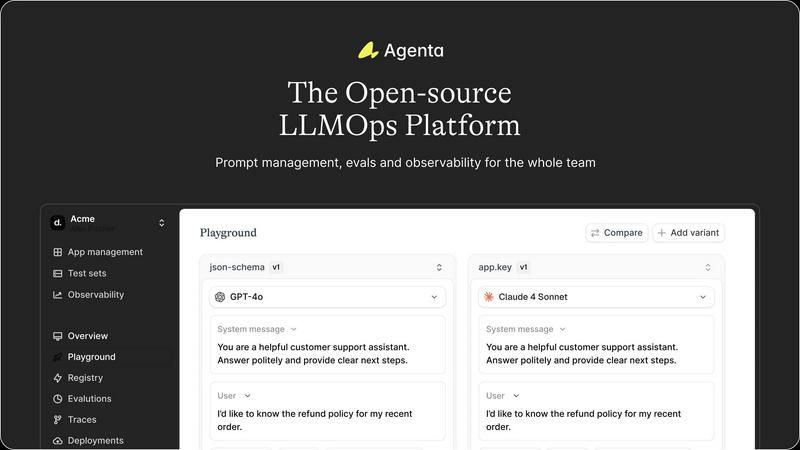
Agenta
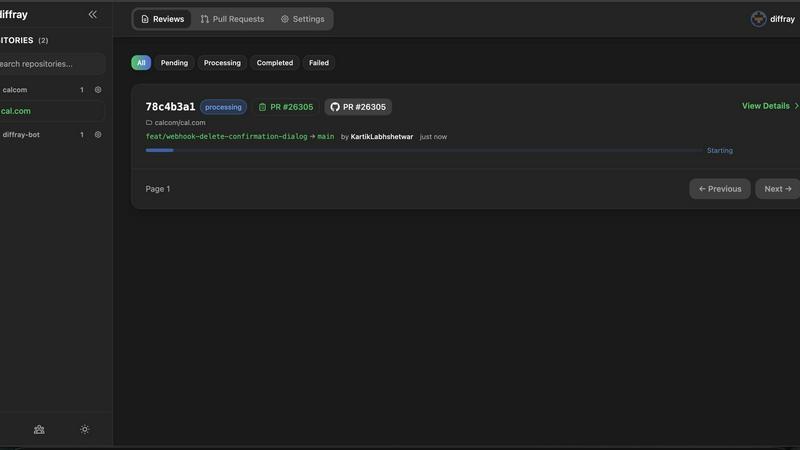
diffray
Feature Comparison
Agenta
Unified Experimentation Playground
Agenta offers a unified playground that allows teams to iterate on prompts collaboratively. Users can compare different prompts and models side-by-side, ensuring that all team members are aligned in their experimentation efforts. This feature eliminates the chaos of scattered experiments, providing a structured environment for innovation.
Systematic Automated Evaluation
With Agenta, teams can replace guesswork with a systematic evaluation process. Automated evaluations enable users to run experiments, track results, and validate changes in an organized manner. This feature also allows integration with various evaluators, including LLM-as-a-judge, ensuring flexibility in evaluating LLM performance.
Comprehensive Production Observability
Agenta provides real-time observability for production systems, allowing teams to monitor performance and detect regressions. By tracing every request, users can pinpoint failure points with precision. This feature enhances debugging capabilities, enabling teams to swiftly identify and resolve issues.
Collaborative Workflow Integration
The platform fosters collaboration among product managers, developers, and domain experts by providing a user-friendly interface for prompt editing and experimentation. This feature empowers all team members to contribute to the evaluation process and compare experiments without needing extensive technical skills, promoting a more integrated workflow.
diffray
Multi-Agent Architecture
diffray's unique multi-agent architecture features over 30 specialized agents, each focusing on distinct areas such as security, performance, and best practices. This allows for more nuanced and accurate code assessments, leading to a significant reduction in irrelevant feedback.
High Accuracy Feedback
With an impressive 87% reduction in false positives, diffray ensures that development teams receive high-quality, actionable feedback. This focus on accuracy means that developers can trust the insights provided, leading to more effective code improvements.
Accelerated Review Process
By reducing the average PR review time from 45 minutes to just 12 minutes per week, diffray allows development teams to review more code in less time. This efficiency supports faster deployment cycles and enhances overall productivity within software development.
Seamless Integration
diffray integrates effortlessly with popular version control systems like GitHub, GitLab, and Bitbucket. This seamless integration ensures that teams can adopt diffray without disrupting their existing workflows, making it easy to implement across various projects.
Use Cases
Agenta
Collaborative LLM Development
Agenta is ideal for teams engaged in collaborative LLM development. By centralizing prompt management and evaluation, it allows developers, product managers, and domain experts to work together seamlessly, enhancing productivity and reducing bottlenecks.
Automated Testing and Validation
Teams can leverage Agenta to automate the testing and validation of their LLM applications. By systematically evaluating changes and tracking results, organizations can ensure that their models perform as expected, leading to higher reliability in production environments.
Debugging and Trace Analysis
Agenta's comprehensive observability features enable teams to conduct in-depth debugging and trace analysis. By following each request and annotating traces, users can gather valuable insights into system performance and user feedback, facilitating continuous improvement.
Rapid Iteration for Product Launches
The platform supports rapid iteration cycles, making it suitable for organizations looking to fast-track their LLM applications to production. By utilizing Agenta's unified experimentation playground, teams can validate their models more quickly, ensuring timely launches without sacrificing quality.
diffray
Open-Source Projects
For open-source projects, diffray provides a powerful tool for maintaining code quality while managing contributions from multiple developers. Its specialized agents ensure that the code meets community standards without overwhelming maintainers with irrelevant feedback.
Enterprise Development Teams
Enterprise teams benefit from diffray's targeted feedback and reduced false positives, allowing them to focus on critical code issues that impact security and performance. This leads to better risk management and compliance within large-scale software systems.
Continuous Integration/Continuous Deployment (CI/CD)
In CI/CD environments, diffray enhances the automated review process by integrating with CI pipelines. This ensures that code is continuously assessed for quality, allowing for quicker identification of issues before they reach production.
Educational Institutions
Educational institutions teaching software engineering can utilize diffray to assist students in understanding best practices in coding. The tool provides targeted feedback, helping students learn how to improve their coding skills effectively.
Overview
About Agenta
Agenta is an open-source LLMOps platform specifically designed to address the challenges faced by AI development teams in building reliable Large Language Model (LLM) applications. It provides the necessary infrastructure to facilitate the entire lifecycle of LLM development, from inception to deployment. By centralizing key processes such as prompt management, evaluation, and observability into a single, collaborative environment, Agenta helps teams mitigate the unpredictability and fragmented workflows that often plague LLM projects. It is tailored for cross-functional teams, including developers, product managers, and subject matter experts, enabling them to transition from ad-hoc prompt management and "vibe testing" to a structured, evidence-driven approach. The platform's primary value proposition lies in its integration of three critical pillars of LLMOps: a unified experimentation playground, systematic automated evaluation, and comprehensive production observability. Agenta serves as the single source of truth for prompts, tests, and traces, allowing teams to version control experiments, validate changes, and debug issues efficiently using real production data. This significantly reduces time-to-production, empowering teams to deliver robust AI agents swiftly.
About diffray
diffray is an innovative AI-powered code review tool designed to optimize the pull request (PR) process for development teams. Unlike traditional AI code review solutions that typically deploy a single generic model, diffray employs a sophisticated multi-agent architecture consisting of over 30 specialized agents. Each of these agents is dedicated to specific areas such as security, performance, best practices, and SEO, allowing for targeted feedback that substantially minimizes noise during code reviews. This targeted approach has been shown to reduce false positives by an impressive 87%, while also enabling teams to uncover three times more real issues compared to conventional tools. The efficiency gains from using diffray allow teams to shorten PR review times from an average of 45 minutes to just 12 minutes per week, freeing developers to concentrate on more critical tasks. With seamless integration into popular version control systems like GitHub, GitLab, and Bitbucket, diffray offers a user-friendly setup that can be completed in minutes, making it an ideal solution for both open-source projects and private repositories. Its main value proposition lies in enhancing development workflows, mitigating risks associated with code vulnerabilities, and ultimately improving software quality.
Frequently Asked Questions
Agenta FAQ
What is LLMOps?
LLMOps refers to a set of best practices and methodologies designed to manage the lifecycle of Large Language Models. It encompasses processes such as prompt management, evaluation, deployment, and monitoring to ensure the reliability and effectiveness of LLM applications.
How does Agenta support collaboration among teams?
Agenta enhances collaboration by providing a unified platform where developers, product managers, and domain experts can work together on prompt management, evaluations, and debugging. This integration fosters communication and aligns efforts across different roles.
Can Agenta integrate with existing AI frameworks?
Yes, Agenta is designed to seamlessly integrate with popular AI frameworks and models, including LangChain, LlamaIndex, and OpenAI. This flexibility allows teams to utilize their preferred tools without being locked into a specific vendor.
Is Agenta suitable for both small and large teams?
Absolutely. Agenta is designed to accommodate teams of various sizes, from small startups to large enterprises. Its collaborative features and structured processes make it adaptable to different workflows and team dynamics.
diffray FAQ
How does diffray reduce false positives?
diffray employs a multi-agent architecture with over 30 specialized agents that focus on specific aspects of code quality. This targeted approach significantly enhances the accuracy of the feedback, reducing the number of false positives to just 13%.
What types of projects can benefit from using diffray?
diffray is suitable for a wide range of projects, including open-source initiatives, enterprise software development, and CI/CD pipelines. Its flexible integration with popular version control systems makes it an ideal choice for various development environments.
Is diffray easy to set up?
Yes, diffray is designed for user-friendly setup and can be integrated with systems like GitHub, GitLab, and Bitbucket in just a few minutes. This allows teams to quickly start improving their code review processes without significant overhead.
Can diffray help with learning and development?
Absolutely. diffray is not only a tool for professionals but also an excellent resource for educational institutions. It helps students understand coding best practices by providing targeted feedback on their submissions, fostering a better learning environment.
Alternatives
Agenta Alternatives
Agenta is an open-source LLMOps platform designed for the development, evaluation, and debugging of reliable Large Language Model applications. It serves as a comprehensive solution for AI development teams, addressing the inherent challenges of unpredictability and fragmented workflows in LLM development by providing a unified collaborative environment. Users often seek alternatives to Agenta due to various reasons, including pricing structures, specific feature sets, or unique platform needs that may not be fully met by Agenta. When evaluating alternatives, it is essential to consider factors such as the ease of integration with existing workflows, the robustness of the evaluation framework, and the level of support for collaboration among cross-functional teams.
diffray Alternatives
Diffray is a cutting-edge AI-driven code review tool that falls within the development category. It leverages a unique multi-agent architecture to provide specialized feedback, significantly enhancing the code review process for development teams. As teams seek to optimize their workflows, users often look for alternatives due to various factors such as pricing, feature sets, and compatibility with their existing platforms. These considerations are crucial as they can impact the efficiency and effectiveness of the code review process. When evaluating alternatives, it's essential to look for features that align with your team's specific needs, such as the ability to minimize false positives, the comprehensiveness of feedback, and ease of integration with version control systems. Additionally, considering the user interface and support options can also influence the overall experience and adoption of the tool within the development workflow.