Agenta vs OGimagen
Side-by-side comparison to help you choose the right tool.

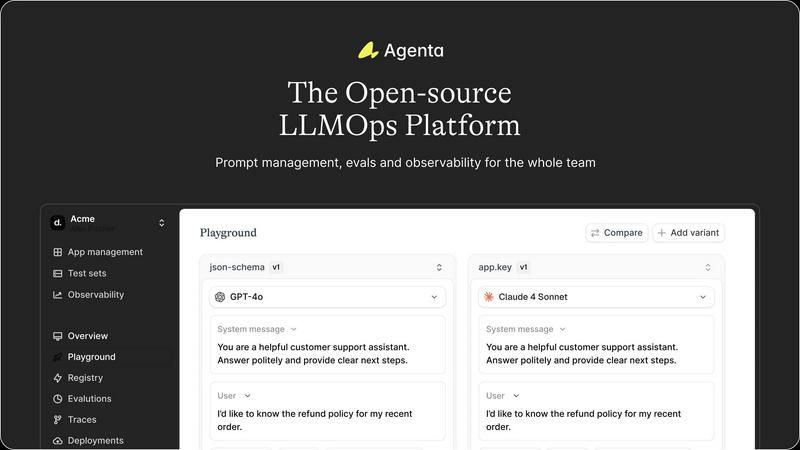
Agenta is an open-source LLMOps platform that centralizes prompt management, evaluation, and observability for reliable.
Last updated: March 1, 2026

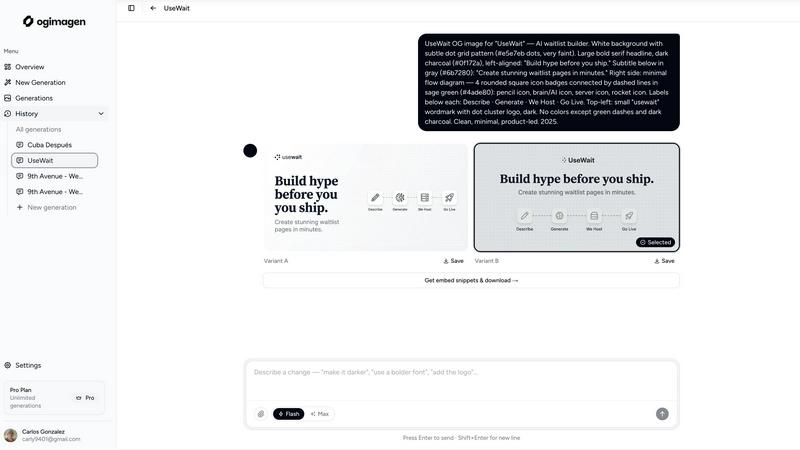
OGImagen is an AI-powered generator that creates and delivers optimized Open Graph, Twitter, and LinkedIn images with ready-to-use meta tags.
Last updated: March 11, 2026
Visual Comparison
Agenta
OGimagen
Feature Comparison
Agenta
Unified Experimentation Playground
Agenta offers a unified playground that allows teams to iterate on prompts collaboratively. Users can compare different prompts and models side-by-side, ensuring that all team members are aligned in their experimentation efforts. This feature eliminates the chaos of scattered experiments, providing a structured environment for innovation.
Systematic Automated Evaluation
With Agenta, teams can replace guesswork with a systematic evaluation process. Automated evaluations enable users to run experiments, track results, and validate changes in an organized manner. This feature also allows integration with various evaluators, including LLM-as-a-judge, ensuring flexibility in evaluating LLM performance.
Comprehensive Production Observability
Agenta provides real-time observability for production systems, allowing teams to monitor performance and detect regressions. By tracing every request, users can pinpoint failure points with precision. This feature enhances debugging capabilities, enabling teams to swiftly identify and resolve issues.
Collaborative Workflow Integration
The platform fosters collaboration among product managers, developers, and domain experts by providing a user-friendly interface for prompt editing and experimentation. This feature empowers all team members to contribute to the evaluation process and compare experiments without needing extensive technical skills, promoting a more integrated workflow.
OGimagen
AI-Powered Multi-Platform Generation
OGimagen's core engine uses artificial intelligence to generate two distinct visual variants (A & B) from user-provided titles, descriptions, and brand colors. The system is specifically tuned to create pixel-perfect images optimized for the precise specifications of each social platform. With a single generation action, it automatically produces three correctly sized assets: a standard Open Graph image, a Twitter Card, and a LinkedIn Card. This eliminates the need for manual resizing, reformatting, or maintaining multiple design templates.
Framework-Specific Meta Tag Snippets
Following image generation, OGimagen provides immediate access to copy-paste code snippets for embedding the generated images into a website's HTML <head> section. While free users receive a standard HTML snippet, Pro subscribers unlock framework-specific code for Next.js (App Router and Pages Router), Astro, SvelteKit, and Remix. These snippets include correctly formatted openGraph and twitter metadata objects, ensuring proper integration and immediate preview functionality upon deployment.
Model Context Protocol (MCP) Integration
For Pro users, OGimagen offers deep integration into the developer workflow via Model Context Protocol (MCP). This allows developers to generate, list, and manage OG images directly from within compatible code editors and AI agents like Claude Code, Cursor, and Windsurf. Users can attach brand logos as reference images and fetch meta tag snippets without leaving their coding environment, dramatically streamlining the content creation and deployment pipeline.
Global CDN Hosting & Management
All generated images are automatically uploaded and served from a global Cloudflare Content Delivery Network (CDN). This ensures high-performance image deliverability with low latency worldwide, which is critical for social platform crawlers that fetch preview images. Hosting duration varies by plan, from 45 days for Starter to permanent hosting for Pro. The platform manages the entire asset lifecycle, including storage, optimization, and global distribution.
Use Cases
Agenta
Collaborative LLM Development
Agenta is ideal for teams engaged in collaborative LLM development. By centralizing prompt management and evaluation, it allows developers, product managers, and domain experts to work together seamlessly, enhancing productivity and reducing bottlenecks.
Automated Testing and Validation
Teams can leverage Agenta to automate the testing and validation of their LLM applications. By systematically evaluating changes and tracking results, organizations can ensure that their models perform as expected, leading to higher reliability in production environments.
Debugging and Trace Analysis
Agenta's comprehensive observability features enable teams to conduct in-depth debugging and trace analysis. By following each request and annotating traces, users can gather valuable insights into system performance and user feedback, facilitating continuous improvement.
Rapid Iteration for Product Launches
The platform supports rapid iteration cycles, making it suitable for organizations looking to fast-track their LLM applications to production. By utilizing Agenta's unified experimentation playground, teams can validate their models more quickly, ensuring timely launches without sacrificing quality.
OGimagen
Technical Blog and Documentation Sites
Developers maintaining technical blogs or documentation can use OGimagen to automatically generate relevant social cards for every new article or API reference page. By simply inputting the post title and a brief description, they receive a professional, code-themed image and the exact meta tags needed for their static site generator (like Next.js or Astro), ensuring every shared link presents a polished, credible preview.
SaaS Product Launch and Feature Updates
SaaS companies can maintain a consistent brand image across social media when announcing new features or product launches. Marketing teams can quickly generate on-brand social cards using company colors and logos, creating engaging previews for shared announcement links on LinkedIn, Twitter, and community platforms like Discord or Slack, thereby increasing engagement and click-through rates.
E-commerce and Product Marketing
E-commerce stores can automate the creation of social preview images for individual product pages. By pulling in product titles and descriptions, OGimagen can generate attractive card images that showcase the product contextually. This improves the visual appeal when products are shared on social platforms or messaging apps like WhatsApp, directly influencing potential customer clicks.
Content Agencies and Freelancers
Agencies and freelancers managing multiple client websites can standardize and scale their OG image production. OGimagen allows them to swiftly create client-specific images by adjusting brand colors and styles, then provide clients with the correct embed code for their specific web framework. This saves significant design and development time while delivering a high-value, consistent service.
Overview
About Agenta
Agenta is an open-source LLMOps platform specifically designed to address the challenges faced by AI development teams in building reliable Large Language Model (LLM) applications. It provides the necessary infrastructure to facilitate the entire lifecycle of LLM development, from inception to deployment. By centralizing key processes such as prompt management, evaluation, and observability into a single, collaborative environment, Agenta helps teams mitigate the unpredictability and fragmented workflows that often plague LLM projects. It is tailored for cross-functional teams, including developers, product managers, and subject matter experts, enabling them to transition from ad-hoc prompt management and "vibe testing" to a structured, evidence-driven approach. The platform's primary value proposition lies in its integration of three critical pillars of LLMOps: a unified experimentation playground, systematic automated evaluation, and comprehensive production observability. Agenta serves as the single source of truth for prompts, tests, and traces, allowing teams to version control experiments, validate changes, and debug issues efficiently using real production data. This significantly reduces time-to-production, empowering teams to deliver robust AI agents swiftly.
About OGimagen
OGimagen is an AI-powered platform engineered to automate and optimize the creation of Open Graph (OG) images and social media cards. It addresses the technical and design challenges developers and content creators face when generating platform-specific preview images for shared links. The core value proposition lies in its ability to transform simple text inputs—like a title and description—into production-ready, visually compelling social cards within seconds. The tool is built for developers, marketers, and website owners who require professional-looking link previews for platforms like Facebook, X (Twitter), and LinkedIn without needing design software or manual image editing. OGimagen ensures technical compliance by generating images in the exact pixel dimensions required by each major platform (1200x630 for OG, 1200x600 for Twitter, 1200x627 for LinkedIn) and delivers them via a global Cloudflare CDN for fast, reliable delivery. Furthermore, it streamlines the implementation workflow by providing ready-to-paste meta tag snippets for all major web frameworks, including Next.js, Astro, and SvelteKit. This end-to-end solution significantly improves click-through rates by guaranteeing that shared links display engaging, on-brand preview imagery with minimal effort and zero design skills required.
Frequently Asked Questions
Agenta FAQ
What is LLMOps?
LLMOps refers to a set of best practices and methodologies designed to manage the lifecycle of Large Language Models. It encompasses processes such as prompt management, evaluation, deployment, and monitoring to ensure the reliability and effectiveness of LLM applications.
How does Agenta support collaboration among teams?
Agenta enhances collaboration by providing a unified platform where developers, product managers, and domain experts can work together on prompt management, evaluations, and debugging. This integration fosters communication and aligns efforts across different roles.
Can Agenta integrate with existing AI frameworks?
Yes, Agenta is designed to seamlessly integrate with popular AI frameworks and models, including LangChain, LlamaIndex, and OpenAI. This flexibility allows teams to utilize their preferred tools without being locked into a specific vendor.
Is Agenta suitable for both small and large teams?
Absolutely. Agenta is designed to accommodate teams of various sizes, from small startups to large enterprises. Its collaborative features and structured processes make it adaptable to different workflows and team dynamics.
OGimagen FAQ
What exactly is an OG image?
An OG (Open Graph) image is the preview picture that appears when a website link is shared on social media platforms, messaging apps, or other services that support the Open Graph protocol. It is defined by specific HTML meta tags (og:image, og:image:width, og:image:height) in your webpage's code. This image is crucial for engagement as it provides a visual context for your link, significantly impacting whether users decide to click.
How does AI generation work?
OGimagen's AI generation process analyzes the text inputs you provide—such as title, description, and selected style preset—to create a coherent visual representation. The AI is trained to combine typography, layout, color theory, and thematic elements to produce two unique, aesthetically balanced image variants optimized for readability and visual impact at social card dimensions. You do not need to provide image prompts; the system constructs the design based on your content.
What is MCP integration?
MCP (Model Context Protocol) integration allows OGimagen to connect directly with your code editor or AI-assisted development environment. For Pro users, this means you can invoke OGimagen's functionality—such as generating a new image or fetching an embed snippet—via commands within tools like Claude Code, Cursor, or Windsurf. This bridges the gap between content creation and development, enabling you to manage social images as part of your core coding workflow.
What happens when CDN hosting expires?
When the CDN hosting period for your generated image expires (e.g., after 45 days on the Starter plan), the image file is removed from the active CDN cache and will no longer be publicly accessible. If a social platform or user tries to load the preview after expiration, they will encounter a broken image link. To prevent this, you can extend hosting by purchasing additional generation packs, upgrading your plan, or downloading and self-hosting the image assets before the expiry date.
Alternatives
Agenta Alternatives
Agenta is an open-source LLMOps platform designed for the development, evaluation, and debugging of reliable Large Language Model applications. It serves as a comprehensive solution for AI development teams, addressing the inherent challenges of unpredictability and fragmented workflows in LLM development by providing a unified collaborative environment. Users often seek alternatives to Agenta due to various reasons, including pricing structures, specific feature sets, or unique platform needs that may not be fully met by Agenta. When evaluating alternatives, it is essential to consider factors such as the ease of integration with existing workflows, the robustness of the evaluation framework, and the level of support for collaboration among cross-functional teams.
OGimagen Alternatives
OGimagen is an AI-powered Open Graph image generator, categorized as a developer tool. It enables the rapid creation of production-ready social card images to enhance link previews across social platforms, aiming to improve engagement and click-through rates with minimal developer effort. Users may seek alternatives to OGimagen for various reasons. Common factors include specific budget constraints or pricing models, the need for different feature sets such as advanced branding controls or integration capabilities, and platform-specific requirements like compatibility with certain frameworks or content management systems beyond the tool's native support. When evaluating an alternative, key considerations should include the tool's core technology and output quality, its integration and automation potential within your existing development workflow, and the overall cost structure relative to the value provided. The ideal solution should balance ease of use with the technical flexibility required for scalable, maintainable social image generation.