aVenture vs Vendor Space
Side-by-side comparison to help you choose the right tool.

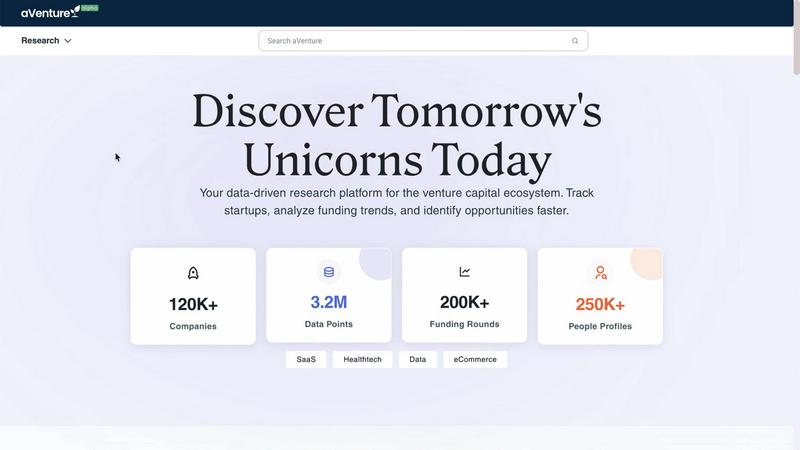
aVenture provides institutional-grade research on over 100,000 private companies and venture capital data.
Last updated: March 1, 2026

Vendor Space
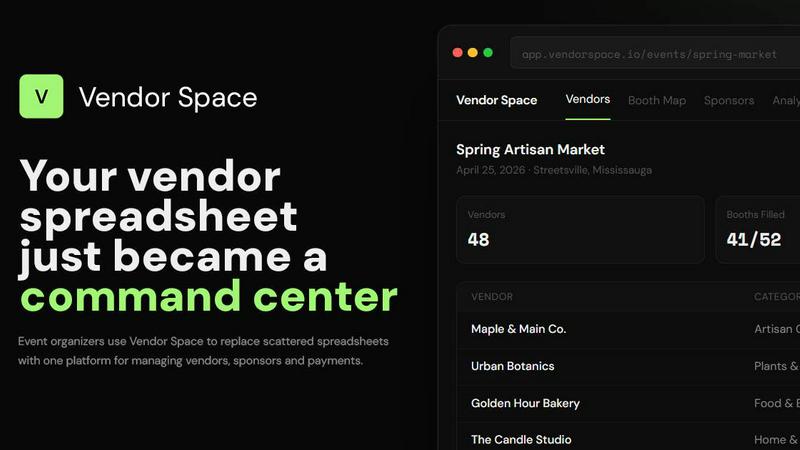
Vendor Space is a centralized platform that replaces spreadsheets to manage event vendors, sponsors, contracts, and payments.
Last updated: April 13, 2026
Visual Comparison
aVenture
Vendor Space
Feature Comparison
aVenture
Institutional-Grade Company Database
The platform maintains a dynamically updated database tracking over 107,109 active venture-backed companies, providing foundational data on funding rounds, valuation trends, and key personnel. Coverage spans 132 countries, ensuring a truly global perspective on private market activity. This database serves as the primary source for all analytical functions, with data integrity ensured through aggregation from more than 1,200 verified sources.
AI-Powered Analyst Engine
aVenture's proprietary AI engine automates the synthesis of complex venture data and news flow. It continuously scans and processes the latest coverage to generate intelligent summaries that highlight company traction, strategic shifts, and potential risks. This feature distills vast amounts of unstructured information into concise, actionable insights, explaining the material impact of new events on a company's position and prospects.
Deep Company Insights & Analytics
Beyond basic tracking, the platform provides granular analysis of ownership structures, cap table evolution, competitive positioning, and detailed funding histories. Users can surface insights into investor syndicates, follow-on investment patterns, and market share dynamics. This depth of analysis is calibrated to meet the due diligence standards of institutional investors and sophisticated corporate development teams.
Comprehensive Market & Trend Intelligence
aVenture aggregates data on 29,779 investors and 211,033 key people, facilitating advanced market mapping and trend analysis. Users can analyze sector-specific investment flows, identify the most active venture capital firms, and track emerging industry themes. The platform contextualizes individual company data within broader market movements, supporting strategic forecasting and opportunity identification.
Vendor Space
Centralized Vendor & Sponsor Dashboard
The platform provides a single, intuitive dashboard that serves as a command center for all event management activities. It displays real-time, at-a-glance metrics including total vendors, booths filled, and revenue collected. Organizers can manage vendor applications, statuses (Confirmed, Pending, Waitlist), categories, and booth assignments from one screen. Critically, sponsor management is fully integrated into this same dashboard, enabling the creation of tiered sponsorship packages and tracking of deliverables alongside standard vendor operations, eliminating the need to juggle separate systems.
Interactive Booth Mapping & Management
Vendor Space features a visual, interactive booth mapping tool that transforms floor plan management. Organizers can create digital layouts and assign vendors via drag-and-drop functionality. The map provides real-time visual indicators for booth status (Available, Reserved, Taken, Premium), automatically detects assignment conflicts, and shows overall fill rates. This feature replaces manual, error-prone methods like paper charts or static spreadsheets, ensuring accurate spatial planning and maximizing venue utilization.
Integrated Digital Contracts & Payments
This feature streamlines the legal and financial workflow by integrating digital agreements with Stripe-powered payment processing. Organizers can send custom contracts with built-in e-signature capabilities directly through the platform, tracking the status of each document (e.g., Signed, Pending). Payments can be collected instantly upon vendor registration or contract signing, with real-time tracking of all transactions. The system automatically calculates and applies the platform's 6% transaction fee, providing clear financial reporting.
Self-Service Vendor Portal & Analytics
Vendor Space includes a dedicated, branded portal where vendors can apply, submit information via custom forms, pay fees, sign contracts, and manage their participation details autonomously. This self-service model drastically reduces organizer administrative time. Complementing this, the platform offers a robust analytics module that provides real-time insights into key performance indicators such as revenue trends, vendor participation rates, booth fill percentages, and sponsor contribution metrics, enabling data-driven decision-making.
Use Cases
aVenture
Investment Due Diligence and Deal Sourcing
Investment professionals utilize aVenture to conduct thorough due diligence on target companies, examining complete funding histories, investor backgrounds, and competitive benchmarks. The platform's screening and alerting capabilities enable analysts to systematically source new deal flow by identifying high-growth companies in specific sectors, stages, or geographies that match their investment thesis.
Fundraising Preparation and Investor Targeting
Founders and startup executives leverage the platform to prepare for fundraising rounds. They can benchmark against similar companies, understand prevailing valuation metrics, and identify the most relevant and active investors for their sector and stage. This enables the construction of a targeted, data-backed outreach strategy to secure optimal financing.
Competitive and Market Landscape Analysis
Business development and corporate strategy teams use aVenture to monitor their competitive landscape, tracking rivals' funding events, partnership announcements, and strategic hires. The platform allows for comprehensive market mapping to identify potential partners, acquisition targets, or emerging disruptive threats within a defined market segment.
Limited Partner (LP) Portfolio Monitoring
Limited Partners and fund-of-funds managers employ aVenture to monitor the performance and activity of their venture capital fund investments. They can track the portfolios of their general partner (GP) relationships, analyze the health and progress of underlying portfolio companies, and gain visibility into follow-on funding rounds and exit events.
Vendor Space
Seasonal Craft Fairs and Artisan Markets
Organizers of recurring craft fairs utilize Vendor Space to manage high volumes of artisan applicants efficiently. The platform handles custom application forms for jurying, digital contract distribution for accepted vendors, and streamlined payment collection for booth fees. The visual booth map is essential for assigning spaces to different craft categories (e.g., pottery, textiles), while integrated sponsor management handles partnerships with local businesses, all from a single interface.
Large-Scale Food Festivals and Pop-Up Markets
For food-centric events with complex logistics, Vendor Space manages diverse vendor needs including health permit tracking, electrical requirements, and menu submissions through custom forms. The payment system handles varying booth pricing tiers, and the sponsor management module secures and tracks partnerships with beverage companies or equipment suppliers. The centralized dashboard provides a clear overview of vendor mix and financials critical for event success.
Professional Trade Shows and Job Fairs
Trade show organizers leverage the platform's professional tools to manage corporate exhibitors and sponsors. Features for tiered sponsorship packages (Gold, Silver, Bronze) with detailed deliverable tracking are crucial. Digital contracts formalize agreements, and the vendor portal allows exhibitors to upload logos, marketing materials, and manage representative passes. The analytics suite provides data on exhibitor ROI and attendee engagement metrics for post-event reporting.
Community Farmers Markets and Holiday Markets
Community event organizers benefit from the platform's simplicity and cost-effectiveness. The free-to-use model is ideal for non-profits or small organizations. They can quickly set up events, collect payments from local farmers and makers, and use the booth map to plan seasonal layouts. The system automates communication and reminders, saving volunteer hours, while the sponsor module helps manage partnerships with local banks or community groups supporting the event.
Overview
About aVenture
aVenture is an institutional-grade venture intelligence platform engineered to deliver comprehensive, data-driven insights into the global private market. It functions as a centralized data hub, aggregating and synthesizing information from over 1,200 distinct sources to track more than 107,109 active venture-backed companies across 132 countries. The platform's core architecture is built to process over 12.4 million distinct data points, encompassing funding histories, ownership structures, investor portfolios, and competitive landscapes. Its primary value proposition is the transformation of this vast, raw data into actionable intelligence through advanced analytics and a proprietary AI-driven synthesis engine. This AI analyst continuously processes real-time news and coverage to generate concise summaries of company traction, flag potential risks, and elucidate the material impact of new developments. aVenture is designed for a professional user base that includes investment analysts conducting due diligence and market mapping, founders preparing for fundraising rounds, business development teams scouting for partners or acquisition targets, and corporate strategists monitoring competitive threats and emerging opportunities. By providing deep, reliable visibility into the venture ecosystem, aVenture enables precision in deal sourcing, diligence, and strategic outreach.
About Vendor Space
Vendor Space is a comprehensive, all-in-one vendor and sponsor management platform engineered specifically for event organizers. It is designed to eliminate the operational chaos associated with managing vendors by replacing disparate tools like spreadsheets, email threads, and manual payment trackers with a single, unified command center. The platform digitizes and consolidates the entire vendor lifecycle, from initial application and custom form creation to booth mapping, digital contract execution, and integrated payment processing. A key differentiator is its inclusion of sponsor management within the same ecosystem, allowing for seamless coordination between paid partnerships and vendor operations. Built by an event organizer, the interface prioritizes intuitive usability without sacrificing powerful functionality. Vendor Space operates on a transparent, pay-as-you-go model: the platform itself is completely free to use, with revenue generated solely through a flat 6% transaction fee applied to processed payments. This approach removes barriers like monthly subscriptions, hidden costs, and binding contracts. The core value proposition is to professionalize event operations, drastically reduce administrative overhead by an estimated 80%, and enhance the experience for both organizers and vendors through centralized, automated workflows.
Frequently Asked Questions
aVenture FAQ
What is the source of aVenture's data?
aVenture aggregates its data from a comprehensive network of over 1,200 primary and secondary sources. This includes regulatory filings, news publications, company websites, direct submissions, and partner data feeds. The platform's proprietary data ingestion and normalization systems continuously update and cross-reference this information to ensure accuracy and comprehensiveness across its database of 107,109+ companies.
How does the AI Analyst engine work?
The AI Analyst engine employs natural language processing (NLP) and machine learning models to scan, read, and synthesize vast quantities of unstructured text from news articles, press releases, and financial reports. It identifies key events, extracts relevant metrics, and contextualizes information against the platform's existing company profiles to generate concise summaries on traction, risks, and strategic developments without requiring manual research.
What types of companies and investors are covered?
The platform focuses on venture-backed private companies globally, spanning from early-stage startups to late-stage pre-IPO unicorns. It tracks over 29,779 investors, including venture capital firms, corporate venture arms, angel investors, private equity firms involved in growth equity, and accelerators like Y Combinator. Coverage is strongest in major innovation hubs but extends across 132 countries.
Can I track specific sectors or industries with aVenture?
Yes, aVenture offers advanced filtering and tagging capabilities that allow users to track companies and investment activity within specific sectors such as SaaS, Healthtech, Fintech, Cleantech, and more. Users can create custom alerts, build watchlists, and generate reports based on these industry classifications to monitor trends and opportunities in their areas of interest.
Vendor Space FAQ
How quickly can I set up my first event?
Most organizers can have their first event fully configured and live within 15 minutes. The process involves creating the event, configuring booth options and pricing tiers, and then immediately sharing the generated vendor registration page. The platform is designed for immediate usability without extensive training or complex setup procedures, allowing you to begin managing vendors almost instantly.
What is the cost structure for using Vendor Space?
Vendor Space operates on a completely free-to-use model with no monthly subscriptions, setup fees, or binding contracts. The platform generates revenue solely through a flat 6% transaction fee applied only when you successfully collect a payment from a vendor or sponsor. You pay nothing to create events, manage vendors, use contracts, or access any other feature until you start collecting revenue.
How does the integrated payment processing work?
Payments are powered by Stripe, a leading global payment processor, which is built directly into the Vendor Space platform. This integration allows vendors to pay securely via credit or debit card during the application process. Organizers see real-time tracking of all transactions, and funds, minus the 6% platform fee, are deposited directly into their connected Stripe account according to Stripe's standard payout schedule.
Can Vendor Space integrate with other tools I use?
Yes, Vendor Space offers robust integration capabilities. Stripe is natively built-in for payments. Furthermore, through a Zapier integration, the platform can connect with over 7,000 other applications. This allows you to automate workflows, such as pushing new vendor data to a CRM like HubSpot, syncing payment records to accounting software like QuickBooks, or triggering notifications in communication tools like Slack or Gmail.
Alternatives
aVenture Alternatives
aVenture is an institutional-grade venture intelligence platform within the business intelligence category. It provides AI-powered research and analytics on over 100,000 private companies, synthesizing vast datasets into actionable insights for professional users. Users may explore alternatives for various reasons, including budget constraints, specific feature requirements not covered by the platform, or the need for a different user interface or data integration capability. The search often stems from a need to align tool capabilities with precise operational workflows or cost structures. When evaluating an alternative, key considerations should include the depth and accuracy of the private company database, the sophistication of analytical and AI synthesis tools, the frequency and sources of data updates, and the platform's ability to serve specific user roles such as investors, analysts, or corporate development teams.
Vendor Space Alternatives
Vendor Space is a specialized vendor and sponsor management platform within the business and finance software category. It is engineered to consolidate the entire vendor lifecycle for event organizers, replacing disparate tools like spreadsheets and email with a unified operational dashboard. Users may seek alternatives for several technical reasons. These include a requirement for different pricing structures beyond transaction-based models, a need for integration with existing enterprise resource planning or accounting systems, or a demand for feature sets that extend beyond event-specific vendor management into broader procurement or inventory control. When evaluating alternative solutions, key technical specifications to assess include the platform's core architecture for data centralization, its application programming interface for third-party software connectivity, the granularity of its user permission and role-based access controls, and the transparency of its total cost of ownership calculation, encompassing all subscription, transaction, and implementation fees.