BuiltByMe vs Patrivox
Side-by-side comparison to help you choose the right tool.

BuiltByMe
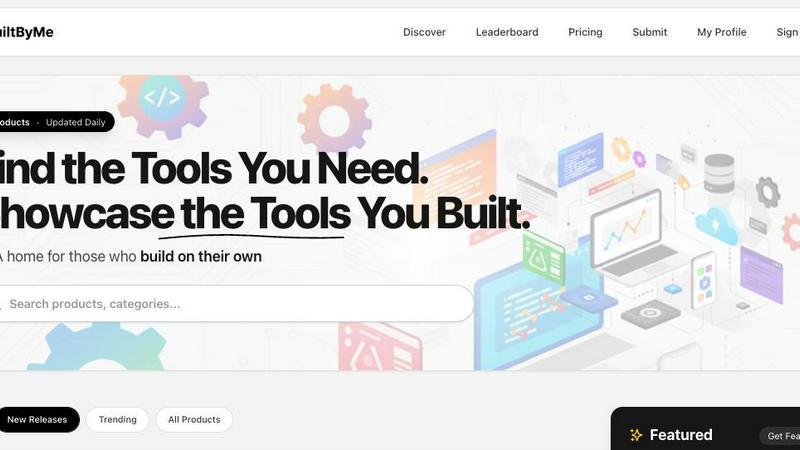
BuiltByMe is a curated directory for discovering niche SaaS, AI, and developer tools built by independent creators.
Last updated: February 28, 2026

Patrivox
Patrivox uses Mistral AI to digitize, classify, and make your document archives fully searchable in minutes.
Last updated: March 4, 2026
Visual Comparison
BuiltByMe
Patrivox
Feature Comparison
BuiltByMe
Curated AI Tools Directory
The platform hosts a meticulously organized and searchable directory specifically for AI tools, among other categories. Each listing includes detailed technical specifications, use cases, and direct links, allowing users to efficiently discover and compare solutions like SEObots, AI video generators, and OCR software based on their precise project requirements and technical needs.
Structured Product Submission Portal
Independent builders gain access to a dedicated portal for submitting their software products for listing. This structured process ensures that all entries contain consistent, comprehensive information—including descriptions, categories, and links—maintaining the directory's quality and making it a reliable resource for users seeking vetted, indie-built tools.
Community-Driven Ranking & Leaderboards
BuiltByMe incorporates a dynamic ranking system powered by community votes and engagement metrics. This algorithmic approach surfaces trending and high-quality tools, with a weekly leaderboard highlighting the most popular or noteworthy products. This feature provides continuous, merit-based visibility for creators and signals quality to users.
Categorized Discovery Engine
The platform's architecture supports deep categorization of tools by type and function, such as AI Tools, Developer Tools, and Marketing Tools. This technical categorization enables users to perform targeted, efficient discovery within niche verticals, moving beyond generic search to find specialized solutions that address specific technical or business problems.
Patrivox
Next-Generation OCR & Automated Entity Extraction
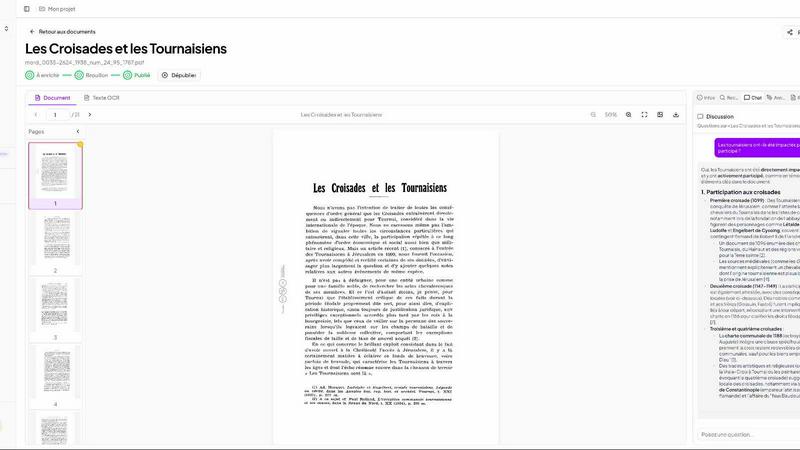
Patrivox utilizes Mistral AI's advanced optical character recognition technology to accurately convert scanned PDF documents into machine-readable text. Beyond simple text extraction, the system performs automatic Named Entity Recognition (NER), identifying and categorizing key entities such as individuals, locations, organizations, and dates from within the documents. This process occurs in batch mode, allowing for the upload of hundreds of files simultaneously, with metadata automatically enriched without any manual configuration or data entry required.
Intelligent Search & AI-Powered Chat Interface
The platform provides a multi-faceted search experience across the entire document collection. It features instant full-text search with typo tolerance and filtering capabilities by date, author, or document type. Furthermore, users can interact with their archives using a conversational AI chat interface, asking questions in plain language. The AI synthesizes answers based on the document content and provides direct citations to the source material, enabling efficient, evidence-based research and information retrieval.
Interactive Knowledge Graph (Constellation)
Patrivox automatically generates a visual knowledge graph, termed "Constellation," which maps the relationships between all identified entities. Users can navigate interactively from node to node, discovering non-obvious connections between people, places, and organizations across different documents. This feature allows for exploratory research, revealing hidden patterns and contextual relationships that would be exceedingly difficult to discern through manual review of the archival material.
Sovereign European Hosting & Collaboration Tools
The platform is built with data sovereignty as a core principle. All data is processed and stored on servers located within the European Union, ensuring full compliance with GDPR regulations. It includes comprehensive audit logs for accountability. Patrivox also supports seamless collaboration, offering unlimited reader accounts for public or team access alongside configurable administrator roles for managing content and user permissions securely.
Use Cases
BuiltByMe
Independent Developer Seeking Tool Exposure
A solo developer who has built a niche API integration tool can submit it to BuiltByMe to gain targeted exposure beyond their personal network. By being listed in the "Developer Tools" category and potentially featured on the leaderboard, they can attract early adopters, gather valuable feedback, and establish initial traction within a relevant community of peers and potential customers.
Startup Founder Sourcing Early-Stage Solutions
A technical founder building a new SaaS product needs to find affordable, specialized tools for tasks like SEO content generation or project management. They use BuiltByMe's curated AI and marketing tools directories to discover and evaluate indie-built alternatives that are often more agile, cost-effective, and tailored to specific needs than enterprise-grade software.
Product Manager Researching Competitive Landscape
A product manager tasked with analyzing the market for a new feature can utilize BuiltByMe to discover emerging tools and innovative approaches built by indie makers. This research provides insights into current trends, unmet user needs, and potential competitive threats or partnership opportunities within a specific software vertical.
Entrepreneur Discovering Automation Tools
An entrepreneur looking to automate business operations, such as social media content creation or document processing, can browse BuiltByMe's categorized listings. They can efficiently compare AI-powered tools like grid makers for Instagram or advanced OCR systems, selecting the best indie-built solution to enhance productivity without significant upfront investment.
Patrivox
Municipal and State Archives Digitization Projects
Municipal archives can utilize Patrivox to systematically digitize, process, and open access to vast collections of official records, including council deliberations, civil registers, and historical correspondence. The AI automates the indexing process, making decades or centuries of administrative documents fully searchable for historians, genealogists, and citizens, thereby enhancing transparency and preserving civic heritage.
Historical Society Bulletin and Collection Management
Historical societies and associations managing periodic bulletins, journals, and documentary collections can transform these resources into a searchable digital library. Patrivox enables members and the public to instantly find articles by topic, mentioned individuals, or locations, and to ask complex questions about the society's holdings, significantly increasing the utility and engagement with their published materials.
Ecclesiastical and Parish Register Preservation
Dioceses and parish archives can preserve fragile parish registers (baptisms, marriages, burials) by digitizing them with Patrivox. The AI automatically extracts names, dates, and places, linking them across records. This creates an invaluable resource for genealogical research and historical demography, allowing for complex queries about family lineages and local history that were previously labor-intensive to perform.
Special Collections Management for Heritage Libraries
Heritage libraries and institutions with special collections can use Patrivox to provide controlled, enhanced access to unique or rare documents. Researchers can perform deep textual analysis, discover connections between authors and subjects via the knowledge graph, and access sourced answers to specific inquiries, all while the institution maintains secure, role-based access and a complete audit trail of document interactions.
Overview
About BuiltByMe
BuiltByMe is a specialized digital platform and community hub engineered to serve as the definitive discovery engine and structured directory for software tools and products created by independent developers, solo founders, and small, bootstrapped teams. Its core technical architecture is designed to address a critical dual-market problem: providing systematic visibility for creators and efficient, curated discovery for users. For builders, the platform offers a dedicated, product-centric venue to submit, list, and showcase their innovations, moving beyond the noise and fragmentation of general social media. Key mechanisms for exposure include a categorized directory (e.g., AI Tools, Developer Tools, Marketing Tools), a weekly leaderboard driven by community engagement, and featured spotlights. For users—including developers, entrepreneurs, and professionals seeking niche or early-stage solutions—BuiltByMe functions as a trusted resource. It employs categorization, user voting systems, and trending algorithms to surface high-quality, relevant tools. The platform's fundamental value proposition lies in creating a symbiotic ecosystem that systematically organizes, promotes, and provides access to indie innovation, fostering a community where independent work can be found, evaluated, and celebrated.
About Patrivox
Patrivox is a sophisticated, AI-powered Software-as-a-Service (SaaS) platform engineered to transform static, scanned document archives into dynamic, intelligent knowledge bases. It is specifically designed for European heritage institutions, municipal archives, historical societies, dioceses, and enterprises managing large collections of documents such as parish registers, municipal deliberations, bulletins, and special collections. The platform leverages Mistral AI's advanced optical character recognition (OCR) and natural language processing (NLP) to automatically extract text, identify named entities (people, places, organizations, dates), and construct a semantic network of connections. Its core value proposition is the radical simplification of accessing archival knowledge, enabling full-text search with typo tolerance, natural language question-answering with source citations, and interactive exploration via a knowledge graph. As a sovereign solution, Patrivox is 100% hosted in Europe, GDPR-native by design, and provides a secure, scalable infrastructure to democratize access to historical and institutional knowledge for researchers, administrators, and the public.
Frequently Asked Questions
BuiltByMe FAQ
What types of tools can be submitted to BuiltByMe?
BuiltByMe accepts submissions for software tools and digital products built by independent developers, solo founders, or small, bootstrapped teams. This encompasses a wide range, including AI tools, developer utilities, marketing software, productivity apps, and more. The key criteria is that the product is built by an individual or a very small, independent team, not a large corporate entity.
How does the ranking and leaderboard system work?
The platform employs algorithms that factor in community engagement metrics, such as user votes, views, and external traffic. These data points contribute to a product's trending score. A weekly leaderboard is generated based on these scores, dynamically showcasing the most popular and actively engaged-with tools within the directory, providing ongoing visibility for high-quality submissions.
Is there a cost associated with submitting a tool to the directory?
Based on the provided context, BuiltByMe appears to operate a submission model for builders to list their tools. The available navigation includes a "Submit Tool" page, and the call-to-action encourages builders to "Get your AI tool featured." Detailed information on any potential listing fees, premium placement options, or subscription tiers for creators is not specified in the current content.
How can users ensure they are finding quality tools on the platform?
BuiltByMe implements several mechanisms to signal quality. First, all submissions are structured to provide consistent, detailed information for evaluation. Second, the community-driven voting system allows users to see peer endorsements. Third, the trending algorithms and leaderboards highlight tools with proven engagement. Users are encouraged to combine these signals with the detailed product descriptions to make informed decisions.
Patrivox FAQ
How does Patrivox ensure data privacy and compliance?
Patrivox is a fully sovereign European platform. All data processing and storage infrastructure is hosted exclusively within the European Union. The platform is designed from the ground up to be GDPR-native, implementing principles of data minimization, security, and accountability by default. Comprehensive audit logs are maintained for all system activities, providing full transparency over data access and processing.
What file formats and volumes can I upload?
The primary supported format for document ingestion is PDF. The platform is optimized for batch processing, allowing users to drag and drop hundreds of PDF files simultaneously. Individual file size limits vary by subscription plan, typically ranging from 250 MB to 1 GB per file. There are also tiered limits on the total number of pages and storage capacity, detailed in the pricing plans.
What is an "AI query" in the context of pricing plans?
An "AI query" refers to each individual interaction with the platform's conversational AI chat interface. Every question asked in natural language that requires the AI to analyze document content and generate a synthesized, sourced answer consumes one query from the monthly allowance. Standard full-text searches and knowledge graph navigation do not count as AI queries.
Can I provide public access to the archives I upload?
Yes. A core feature of Patrivox is the ability to share your processed knowledge base with unlimited readers. You can grant secure, role-based access to researchers, your team, or the general public without incurring additional per-user costs. Administrators retain full control over management permissions and can curate what is accessible to different user groups.
Alternatives
BuiltByMe Alternatives
BuiltByMe is a specialized directory and discovery platform within the niche SaaS and developer tool ecosystem. It functions as a curated, community-driven hub designed to increase visibility for independent software builders and provide a structured resource for users seeking specific, often early-stage, technical solutions. Users may seek alternatives to BuiltByMe for several operational reasons. These include differing budgetary constraints, such as the need for a free-tier submission model versus a paid promotional structure. Feature requirements also drive evaluation, with some users prioritizing advanced analytics, API access for integration, or different community engagement mechanics like review systems over simple voting. Platform scope is another factor, as some may require a broader marketplace or a more narrowly focused vertical directory. When evaluating an alternative platform, key technical and functional criteria should be assessed. These include the underlying directory architecture and categorization schema, the algorithms for surfacing and ranking products, and the specific mechanisms for community validation, such as voting, reviews, or ratings. The platform's audience reach, submission workflow, and data portability are also critical specifications to compare against project requirements.
Patrivox Alternatives
Patrivox is a specialized SaaS platform within the document intelligence and content automation category. It leverages advanced AI, specifically Mistral AI, to perform high-accuracy OCR, entity extraction, and knowledge graph generation, transforming static scanned PDFs into a dynamic, searchable digital archive. This process is designed for speed and depth, enabling complex semantic search and natural language queries. Users may explore alternatives to Patrivox for several technical and operational reasons. Common drivers include specific budget constraints or pricing model preferences, the need for integration with an existing enterprise software stack, or requirements for particular feature sets such as custom entity recognition models, different API capabilities, or support for niche document types not covered by a general platform. When evaluating an alternative solution, key technical criteria should be assessed. These include the core OCR engine's accuracy, especially with historical or poor-quality scans, the sophistication of its natural language processing for entity and relationship extraction, and the flexibility of its search functionality. Additionally, considerations around data sovereignty, compliance certifications, and the scalability of the platform's architecture are critical for enterprise deployment.