
claude-ide vs LLMWise
Side-by-side comparison to help you choose the right tool.

claude-ide
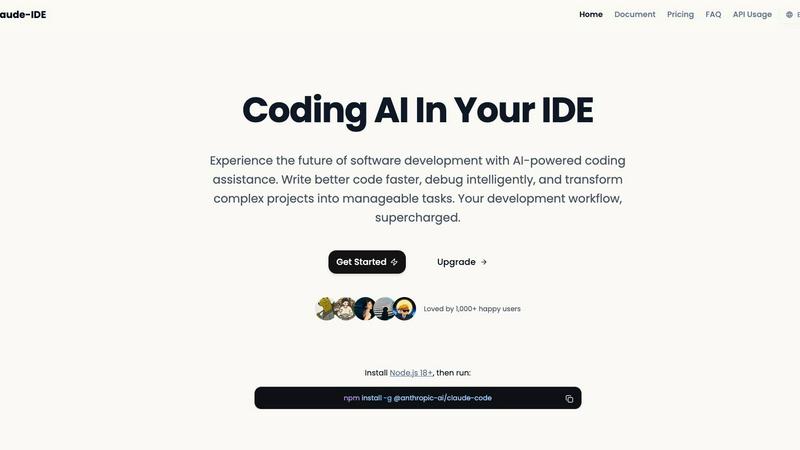
Claude IDE delivers intelligent AI coding assistance directly in your terminal and IDE, enhancing code quality and.
Last updated: March 1, 2026

LLMWise
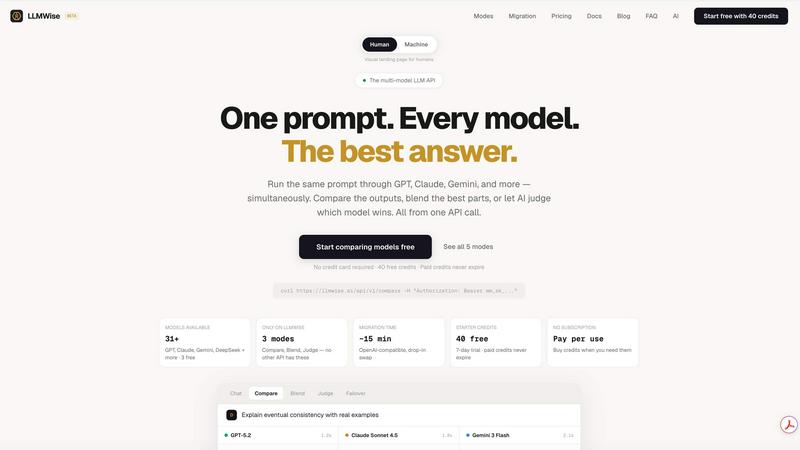
LLMWise offers a single API to access and compare 62 AI models, optimizing prompts with pay-per-use pricing.
Last updated: February 26, 2026
Visual Comparison
claude-ide
LLMWise
Feature Comparison
claude-ide
Intelligent Code Understanding
Claude IDE's intelligent code understanding capability allows it to analyze your entire codebase rather than just isolated snippets. This feature enables the assistant to make coordinated changes across multiple files and provide suggestions that are highly relevant and tailored to the specific context of your project.
Seamless Integration
Designed to reside within your terminal and IDE, Claude IDE ensures that developers do not experience context switching. Its seamless integration with popular tools like Visual Studio Code and JetBrains means that the coding experience remains uninterrupted, allowing developers to focus on writing code efficiently.
Quick Code Familiarization
With its ability to analyze and explain entire codebases in seconds, Claude IDE simplifies the onboarding process for new developers or those unfamiliar with a given project. It quickly grasps the architecture and dependencies of a project, allowing users to become productive without extensive manual exploration.
From Issues to Pull Requests
Claude IDE manages the entire development workflow by integrating deeply with platforms like GitHub and GitLab. Developers can read issues, write code, execute tests, and submit pull requests directly within the terminal, eliminating the need to switch between different applications and improving overall efficiency.
LLMWise
Smart Routing
Smart routing is a pivotal feature of LLMWise that intelligently directs each prompt to the most appropriate LLM. For instance, coding-related requests can be sent to GPT, while creative writing tasks may be better suited for Claude. This dynamic selection process optimizes performance and accuracy, allowing users to achieve the best results based on the nature of their inquiries.
Compare & Blend
The Compare & Blend feature enables users to run prompts across different models simultaneously. Users can analyze responses side-by-side to determine which model performs best for their specific needs. The blending capability further enhances output quality by synthesizing the most effective parts of each model's response into a single, cohesive answer, thus elevating the overall quality.
Circuit-Breaker Failover
LLMWise ensures resilience through its circuit-breaker failover mechanism. In the event that a primary model provider experiences downtime, LLMWise automatically reroutes requests to backup models. This feature guarantees that applications remain operational, preventing disruptions and maintaining service continuity even in unpredictable circumstances.
Test & Optimize
LLMWise offers comprehensive testing and optimization tools that allow developers to benchmark model performance, conduct batch tests, and implement optimization policies tailored for speed, cost, or reliability. Automated regression checks ensure that updates do not negatively impact existing functionalities, providing peace of mind to developers who rely on stable AI integrations.
Use Cases
claude-ide
Rapid Onboarding for New Developers
When onboarding new developers to a project, Claude IDE can provide comprehensive overviews of codebases, enabling them to understand project structures and components quickly. This feature significantly reduces the learning curve associated with new codebases.
Efficient Code Debugging
For developers facing bugs or issues within their code, Claude IDE offers intelligent debugging assistance that helps identify and resolve problems quickly. By understanding the context of the code, it can suggest fixes and optimizations, enhancing overall code quality.
Collaborative Development
In team environments, Claude IDE streamlines collaboration by integrating with version control systems. Developers can effectively manage tasks such as issue tracking, code reviews, and pull requests without leaving their development environment, thus promoting a more cohesive workflow.
Simplifying Complex Code Modifications
When a project requires significant changes across multiple files, Claude IDE's capability to perform powerful multi-file edits ensures that all modifications are accurate and functional. This feature reduces the risk of errors that can occur when managing changes manually.
LLMWise
Multi-Model AI Development
Developers can leverage LLMWise to streamline the process of developing AI applications that require different capabilities. For instance, a project might need sophisticated language understanding for chatbots, high-quality translation for internationalization, and creative writing for marketing content. LLMWise allows developers to access the best tool for each job without juggling multiple subscriptions.
Cost-Effective Prototyping
Businesses can utilize the 30 free models available through LLMWise to prototype and test various AI solutions without incurring initial costs. This enables teams to experiment with different models and determine the best fit for their applications before committing to premium services, significantly lowering the barrier to entry for AI adoption.
Enhanced AI Quality Assurance
Quality assurance teams can use the Compare mode to evaluate how different models respond to the same input. This process helps identify edge cases and ensures that the selected model performs reliably across a range of scenarios, ultimately leading to more robust and dependable AI applications.
Flexible Integration for Startups
Startups can benefit from LLMWise's BYOK (Bring Your Own Keys) feature, allowing them to integrate their existing API keys for various models. This flexibility not only reduces costs by eliminating the need for multiple subscriptions but also provides access to failover routing, ensuring that their applications remain resilient while managing expenses effectively.
Overview
About claude-ide
Claude IDE is an advanced integrated development environment that harnesses the power of Anthropic's Claude Sonnet 4.5 model to provide intelligent AI coding assistance directly within your existing development workflow. Unlike standalone applications, Claude IDE integrates seamlessly into your terminal and popular IDEs such as Visual Studio Code and JetBrains. It is designed for developers across all skill levels, including professionals, students, and hobbyists, who seek to increase productivity and simplify their coding processes. The main value proposition of Claude IDE lies in its ability to deliver context-aware AI capabilities that enable users to understand complex codebases rapidly and implement sophisticated modifications without the need to switch between multiple tools. By operating within the developer's environment, Claude IDE offers intelligent suggestions, debugging assistance, and project-wide comprehension, revolutionizing the coding experience and streamlining software development.
About LLMWise
LLMWise is an innovative API solution designed to simplify the integration and utilization of multiple large language models (LLMs) from leading AI providers. By consolidating access to models from OpenAI, Anthropic, Google, Meta, xAI, and DeepSeek, LLMWise provides a unified interface that eliminates the need for developers to manage numerous subscriptions and APIs. The core functionality of LLMWise revolves around intelligent routing, which automatically selects the most suitable model for each specific task, whether it is coding, creative writing, or translation. This seamless orchestration allows developers to focus on their applications without worrying about the intricacies of individual API implementations. LLMWise is particularly valuable for developers and businesses seeking to leverage the best AI capabilities available, with flexible payment options that adapt to usage, ensuring cost efficiency and scalability.
Frequently Asked Questions
claude-ide FAQ
What platforms does claude-ide support?
Claude IDE supports integration with popular development environments, specifically Visual Studio Code and JetBrains IDEs. It operates seamlessly within your terminal for an uninterrupted coding experience.
How does claude-ide enhance developer productivity?
By providing context-aware AI suggestions and tools directly within the developer's workflow, Claude IDE minimizes context switching and allows developers to focus more on coding, thus enhancing overall productivity.
Is claude-ide suitable for beginners?
Yes, Claude IDE is designed for developers of all levels, including beginners. Its intelligent code understanding and quick code familiarization features make it an excellent tool for those learning to code or working on unfamiliar projects.
Can claude-ide integrate with version control systems?
Claude IDE integrates deeply with version control platforms like GitHub and GitLab, enabling developers to manage their entire workflow—from reading issues to submitting pull requests—directly within their development environment.
LLMWise FAQ
How does LLMWise optimize model selection?
LLMWise employs an intelligent routing mechanism that analyzes the nature of each prompt and directs it to the most suitable LLM. This ensures that users receive the best possible response based on the specific capabilities of each model.
Can I use my existing API keys with LLMWise?
Yes, LLMWise supports the Bring Your Own Keys (BYOK) feature, allowing you to integrate your existing API keys from different providers. This flexibility enables you to take advantage of failover routing while managing costs effectively.
What happens if a model provider goes down?
LLMWise has a circuit-breaker failover mechanism that automatically reroutes requests to backup models when a primary provider is unavailable. This ensures that your applications continue to function without interruption.
Are there any subscription fees associated with LLMWise?
LLMWise operates on a pay-as-you-go model, which means you only pay for what you use with no monthly subscription fees. New users receive 20 trial credits that never expire, and there are 30 models available at zero charge for ongoing use.
Alternatives
claude-ide Alternatives
Claude IDE is an advanced integrated development environment that combines AI coding assistance with existing developer workflows. It falls under the category of AI Assistants, specifically designed to enhance productivity and streamline coding tasks by embedding itself within popular terminals and IDEs. Users often seek alternatives to Claude IDE due to various factors such as pricing, feature sets, and compatibility with specific platforms. When searching for an alternative, it is essential to consider the depth of AI integration, the range of supported programming languages, user interface intuitiveness, and overall effectiveness in improving coding efficiencies. When evaluating alternatives, developers should focus on the tool’s ability to understand complex codebases, the seamlessness of integration into their existing environments, and the quality of support and resources available. A comprehensive understanding of project architecture and intelligent suggestions can significantly impact a developer's productivity, so it is vital to assess how well any alternative meets these criteria.
LLMWise Alternatives
LLMWise is a cutting-edge API designed to streamline access to various large language models (LLMs) including GPT, Claude, and Gemini among others. It belongs to the AI Assistants category, catering to developers who seek to leverage the best AI capabilities without the hassle of managing multiple providers. Users often seek alternatives due to factors such as varying pricing structures, feature sets, and specific platform requirements that may better suit their unique applications. When searching for alternatives, it is crucial to consider several key attributes. Look for options that offer intelligent routing to optimize model usage, ensure reliability through features like failover mechanisms, and provide flexibility in pricing, such as pay-per-use models. Additionally, assess the ease of integration and the ability to benchmark and optimize performance, ensuring that the chosen solution aligns with your development goals.