Filator vs Playwriter
Side-by-side comparison to help you choose the right tool.

Filator
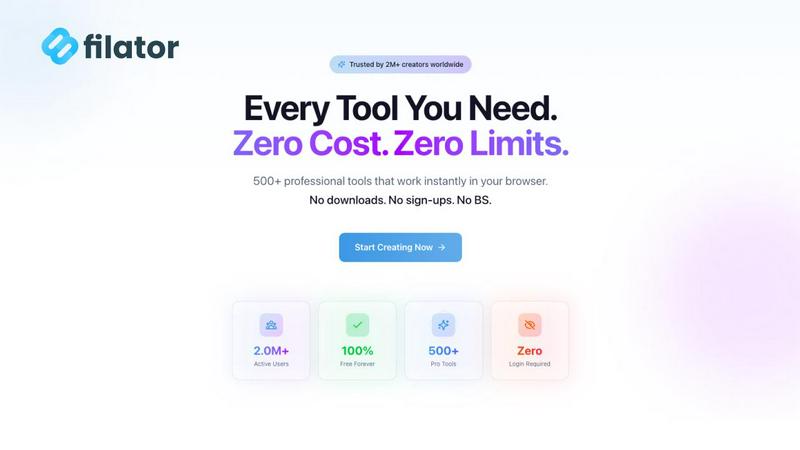
Filator is a free platform with over 500 AI, PDF, and image tools to create, convert, and automate tasks instantly.
Last updated: March 1, 2026

Playwriter
Playwriter lets AI agents control your existing Chrome browser with full Playwright API access via a simple CLI.
Last updated: March 18, 2026
Visual Comparison
Filator
Playwriter

Feature Comparison
Filator
Privacy-First, Client-Side Processing
All tool operations on Filator are engineered to execute within the user's web browser through client-side JavaScript. This architecture ensures that files, documents, and data inputs are processed locally on the user's machine. No data is uploaded to external servers for processing, eliminating risks associated with data breaches, unauthorized access, or third-party logging. This feature is fundamental to the platform's commitment to user privacy and is a key differentiator from cloud-based SaaS tools that require file uploads.
Consolidated Suite of 500+ Professional Tools
The platform aggregates a vast and continuously expanding library of over 500 specialized digital utilities into one accessible interface. This eliminates the need to navigate between multiple websites, manage numerous bookmarks, or learn disparate interfaces. The suite is professionally curated, covering critical domains including AI toolkits, PDF editing, image conversion and manipulation, developer-focused code utilities, text processing, social media content creation, and business operations, providing a one-stop solution for diverse professional needs.
Zero-Friction Instant Access
Filator is designed for immediate productivity. Users can access and utilize any tool without any mandatory account creation, email verification, or login process. There are no artificial delays, waiting queues, or mandatory tutorials. This frictionless model allows professionals to open the platform, select their required tool, and begin working instantly, significantly reducing the time-to-result for urgent tasks and streamlining daily workflows.
Progressive Web App (PWA) with Offline Capability
Filator is built as a Progressive Web App, providing a native application-like experience directly from the web browser. Users can install it on their desktop or mobile device home screen for quick access. Crucially, over 20 core tools are fully functional without an active internet connection once the app is installed. This offline capability ensures reliability and uninterrupted access to essential utilities like basic text tools, calculators, and certain converters in environments with limited or no connectivity.
Playwriter
Your Authenticated Browser Session
Playwriter's foundational feature is granting AI agents access to your actual Chrome browser tab, complete with all existing logins, cookies, local storage, and installed extensions. This eliminates the need for agents to navigate authentication flows manually, bypasses bot detection mechanisms triggered by fresh, headless instances, and ensures the browsing context is identical to a human user's. It also avoids the memory overhead of spawning a separate browser process, as the automation occurs within your already-running Chrome instance.
Full Playwright API via a Single Execute Tool
Unlike systems that define dozens of individual tools (e.g., click_element, extract_text), Playwriter provides agents with one powerful execute tool. This tool accepts any valid Playwright code, granting the agent unrestricted access to the entire Playwright API for browser control. This approach minimizes context window bloat from extensive tool schemas and offers maximum flexibility, allowing agents to perform complex sequences, use advanced selectors, handle frames, and manage dialogs without being constrained by a pre-defined wrapper.
Advanced Debugging and Inspection Suite
Playwriter includes a comprehensive suite of debugging and inspection utilities designed for AI-driven development. This includes a debugger with breakpoints to pause execution, live code editing to modify agent scripts on the fly, and network interception to monitor and mock HTTP requests. Furthermore, it generates highly efficient accessibility snapshots (5-20KB) instead of full screenshots, providing the AI with structured DOM and ARIA data in a compact format, and supports full screen recording of agent sessions for playback and analysis.
Local-First Architecture and Collaboration
The entire Playwriter system runs locally on your machine. The Chrome extension connects to a local WebSocket server (default localhost:19988), and all communication—including Chrome DevTools Protocol commands—stays on your computer. This enables real-time collaboration: you can watch the agent interact with websites live, intervene to solve CAPTCHAs or consent modals, manually correct issues, and then re-enable agent control. The session multiplexing allows multiple CLI instances or agents to interact with different browser tabs simultaneously.
Use Cases
Filator
Rapid Document Preparation for Freelancers
Freelancers and consultants frequently need to prepare client-ready documents under tight deadlines. Using Filator, they can seamlessly chain tools: compressing large PDF portfolios, merging multiple contract files into a single document, converting a client's image into a required format for a report, and generating a professional invoice—all within the same platform without uploading sensitive client data to various external services, ensuring both speed and confidentiality.
Developer Workflow Optimization
Software developers can streamline their debugging and data handling workflows. They can use the JSON formatter and validator to clean up API responses, encode or decode Base64 strings for data transmission tasks, generate secure passwords for testing environments, and use text diff tools to compare code snippets. Having these utilities consolidated saves time otherwise spent searching for reliable, standalone online tools.
Social Media Content Creation and Mockups
Digital marketers and social media managers can use Filator to create engaging visual content quickly. The platform allows them to generate realistic mockups for Instagram posts, Twitter (X) tweets, and other platforms to preview campaigns. They can also resize images to platform-specific dimensions, convert graphic formats, generate QR codes for marketing campaigns, and use AI tools to rewrite promotional copy, all within a unified workspace.
Academic and Research Paper Formatting
Students and researchers can efficiently manage their document workflows. They can merge multiple research PDFs, compress large files for email submission, convert images or documents into required formats (e.g., PDF to JPG for presentations), use the AI essay writer for structuring drafts, and employ the word counter for adhering to strict length guidelines. The privacy guarantee is particularly valuable when handling unpublished research data.
Playwriter
AI-Powered Web Research and Data Extraction
Agents can autonomously conduct in-depth research across multiple websites that require login, such as private forums, subscription news services, or web applications. Using your authenticated session, the agent can navigate complex site structures, handle pagination, consent pop-ups with your assistance, and extract structured data using the full Playwright API, all while operating within your real browser context to avoid blocks.
Automated Testing and QA with Real User Conditions
Developers and QA engineers can use Playwriter to instruct AI agents to perform end-to-end testing on web applications under genuine user conditions. Since the agent uses your browser with your specific extensions and cache, tests can cover scenarios like "user is logged in with specific preferences" or "with ad-blocker enabled," providing more accurate and realistic test results than isolated, clean browser environments.
Complex Workflow Automation and Web Task Delegation
Playwriter enables the delegation of tedious, multi-step web tasks to AI agents. This includes activities like filling and submitting complex forms across several pages, managing content in web admin panels (e.g., CMS updates), monitoring dashboards for changes, or orchestrating workflows that involve moving data between different web services that you are already logged into.
AI-Assisted Development and Debugging
Developers can use Playwriter as a pair-programming tool for web development. An AI agent can be instructed to interact with a web application you are building, profile performance, test specific user journeys, set breakpoints in the automation script, intercept network calls to debug API interactions, and generate visual labels or snapshots to help identify UI elements, all within your development browser.
Overview
About Filator
Filator is a comprehensive, privacy-centric online platform engineered to consolidate over 500 professional-grade digital tools into a single, unified workspace. It is designed for developers, designers, marketers, and professionals across all industries who require efficient, reliable utilities without encountering typical barriers such as mandatory signups, restrictive premium paywalls, or intrusive data collection practices. The platform's core architectural principle and primary value proposition is delivering maximum productivity through instant, client-side processing. This technical approach ensures that user data and files are processed directly within the user's web browser, guaranteeing that sensitive information never leaves their local device, thereby upholding a stringent standard for privacy and security. Tools are systematically organized into broad categories, encompassing essential functions like AI-powered generation (including content rewriting and image creation), comprehensive PDF manipulation (merging, compressing, converting), advanced image processing with conversion across 132 format combinations, developer utilities (JSON formatters, encoders/decoders), text tools, social media mockup generators, QR code creation, and business calculators. Supported by Progressive Web App (PWA) technology that enables offline functionality for 20+ core tools, Filator serves a global community exceeding 2 million users across 150+ countries, enabling seamless creation, conversion, and workflow automation directly from any modern web browser.
About Playwriter
Playwriter is a developer-centric tool that provides AI agents with direct, programmatic control over your existing, authenticated Chrome browser session. It solves the fundamental limitation of most browser automation tools for AI, which either spawn a fresh, "clean" browser instance (lacking logins, cookies, and extensions while triggering bot detection) or offer a limited, pre-defined set of actions. Playwriter bridges this gap by exposing the full power of the Playwright automation API to AI agents through a single, unified interface. It operates via a Chrome extension and a local CLI, establishing a WebSocket relay on your machine. This architecture allows agents to execute any Playwright code directly in your browser, leveraging your real sessions, installed extensions, and local settings. Its core value proposition is enabling robust, realistic, and collaborative web automation where the AI handles repetitive tasks within the exact same browser environment a human uses, facilitating seamless human-in-the-loop workflows. It is open-source under the MIT license and integrates with any MCP (Model Context Protocol) client like Cursor, Claude Desktop, and VS Code.
Frequently Asked Questions
Filator FAQ
Is Filator completely free to use?
Yes, Filator offers a robust free plan that provides access to over 60 core tools without any cost. This includes many PDF, image, text, and developer utilities. The free plan also includes a monthly allocation of AI credits (10 credits) to experiment with AI-powered features. For users requiring high-volume AI processing, unlimited tools, and advanced features like dynamic QR codes, paid subscription plans (Starter, Pro, Premium) are available.
How does Filator ensure my data privacy?
Filator ensures privacy through its client-side processing architecture. When you use a tool, your files and data are processed entirely within your own web browser using JavaScript. They are never uploaded to Filator's servers or any third-party servers for the core tool operations. This means your documents, images, and data never leave your computer, providing a level of privacy and security superior to traditional cloud-based processing tools.
What are AI credits and how are they consumed?
AI credits are the currency used for processing requests within Filator's AI-powered tools, such as the AI Content Rewriter, AI Image Generator, and AI Chat. Each operation consumes a certain number of credits. For example, generating an image or rewriting a paragraph of text may cost one credit. The free plan includes a monthly allotment, while paid plans offer substantially higher or unlimited credits. Credit consumption is clearly indicated before you run an AI tool.
Can I use Filator tools offline?
Yes, for a selection of over 20 essential tools. By installing Filator as a Progressive Web App (PWA) on your device (desktop or mobile), you can use tools like the Password Generator, Text Case Converter, Basic Calculators, and certain converters without an active internet connection. This is ideal for use while traveling or in areas with poor connectivity. Note that AI tools and tools requiring significant processing libraries typically still require an online connection.
Playwriter FAQ
How does Playwriter differ from other browser automation MCP servers?
Other MCP solutions typically either launch a new, isolated Chrome instance (lacking your logins and extensions) or provide a limited set of hard-coded tools. Playwriter is unique because it injects automation into your existing, live Chrome session and provides a single, unrestricted execute tool for the full Playwright API. This combines real-world browser context with maximum programming flexibility for the AI agent.
Is my browsing data secure with Playwriter?
Yes. Playwriter operates on a strict local-first principle. The Chrome extension communicates only with a WebSocket server running on localhost (port 19988 by default). All commands and data, including Chrome DevTools Protocol traffic, remain on your machine. No browsing data, cookies, or session information is transmitted to any remote server. The tool is also open-source, allowing for code audit.
What happens if the agent encounters a CAPTCHA or needs a human decision?
This is a key collaborative feature of Playwriter. Since you are sharing your browser, you see the agent's actions in real-time. If a CAPTCHA or a consent wall appears, you can simply solve or click it yourself. You can then temporarily disable the extension on that tab, perform any necessary manual steps, re-enable control, and the agent can continue its automated task from the new state.
Can I use Playwriter with multiple browser tabs or multiple AI agents simultaneously?
Yes. The local WebSocket relay multiplexes sessions. You can attach the Playwriter extension to multiple Chrome tabs, each representing a separate controllable session. Multiple CLI instances or AI agents (via MCP) can connect to the relay and control different tabs independently, allowing for parallel automation tasks within a single browser window.
Alternatives
Filator Alternatives
Filator is a comprehensive, privacy-first online platform in the tech tools category, offering over 500 AI, PDF, image, and developer utilities. It consolidates specialized functions into a single, no-signup workspace for professionals seeking efficient task automation and conversion. Users may explore alternatives for various reasons. Some require a different feature mix, such as advanced collaborative functions or platform-specific integrations not covered by a generalist suite. Others might prioritize a different deployment model, like downloadable desktop software over a web app, or seek tools with a different focus, such as deep video editing or complex data analysis. When evaluating alternatives, key considerations include the core toolset alignment with your workflow, the underlying data processing architecture for security, and the overall access model regarding cost and registration. The ideal solution should match your specific technical requirements while providing reliable performance and a user experience that minimizes friction in your daily tasks.
Playwriter Alternatives
Playwriter is an open-source automation tool that provides AI agents with direct, stateful control over a real Chrome browser session. It belongs to the browser automation and AI agent tooling category, enabling complex workflows via CLI or the Model Context Protocol (MCP). Users often seek alternatives for various reasons, including specific budget constraints, the need for different integration points like Selenium or Playwright frameworks, or requirements for non-Chrome browser support or cloud-based execution. When evaluating alternatives, key considerations include the depth of browser integration, whether the solution provides a fresh, isolated session or access to an authenticated one with extensions, and the method of data exchange with the AI. The efficiency of state capture, such as using lightweight accessibility snapshots versus full screenshots, significantly impacts performance and cost. Security model, licensing, and support for debugging features like network interception and breakpoints are also critical differentiators. --- FAQ_SEPARATOR--- [
{"question": "What is Playwriter?", "answer": "Playwriter is an open-source (MIT licensed) tool that allows AI agents to control a real, authenticated Chrome browser session via CLI or the Model Context Protocol (MCP), providing full automation capabilities."},
{"question": "Who is Playwriter for?", "answer": "It is for developers and teams building AI agents that require reliable, stateful web interaction using an existing browser session with logins and extensions, rather than a fresh, isolated instance."},
{"question": "Is Playwriter free?", "answer": "Yes, Playwriter is open source and released under the permissive MIT license, making it free to use and modify."},
{"question": "What are the main features of Playwriter?", "answer": "Key features include automation via a real Chrome session, compact accessibility snapshots, a debugger with breakpoints and live editing, network interception, video recording, and compatibility with any MCP client."}
]