
Image to 3D AI vs Kane AI
Side-by-side comparison to help you choose the right tool.

Image to 3D AI
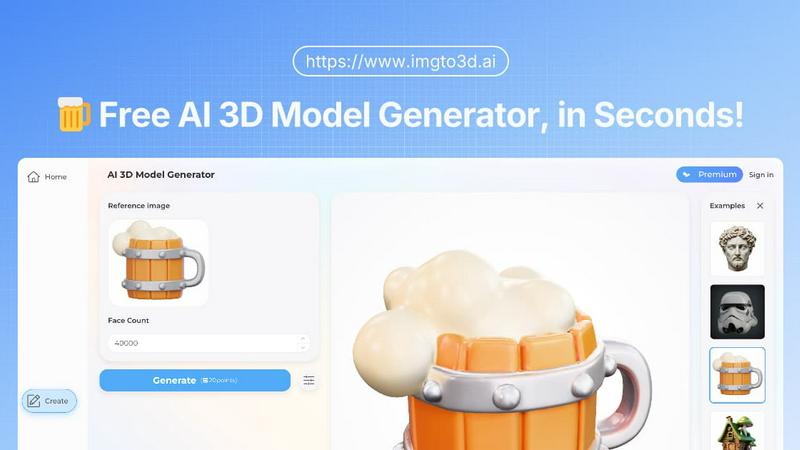
ImgTo3D.ai instantly converts 2D images into detailed, textured 3D models for gaming and design.
Last updated: February 28, 2026

Kane AI
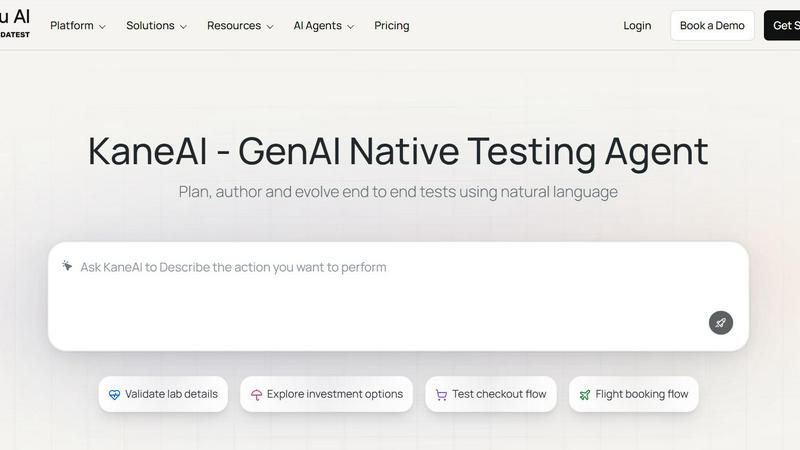
KaneAI empowers teams to effortlessly plan, create, and evolve tests using natural language for integrated quality.
Last updated: February 26, 2026
Visual Comparison
Image to 3D AI
Kane AI
Feature Comparison
Image to 3D AI
AI-Powered Textured Conversion
This core feature leverages cutting-edge deep learning algorithms to perform a comprehensive analysis of a 2D image. The AI interprets visual cues to reconstruct three-dimensional geometry while simultaneously generating corresponding texture maps that wrap accurately onto the model's surface. This process happens automatically, transforming a flat JPG, PNG, or WebP file into a complete, textured 3D asset without any manual intervention, significantly accelerating the initial modeling phase.
Adaptive Polygon Density Control
Users have precise control over the final mesh's complexity through a face count selector, typically ranging from 5,000 to 40,000 polygons. This allows for optimization based on the intended use case: lower-poly models for real-time applications like mobile games or VR, and higher-poly models for detailed renders or 3D printing. The algorithm intelligently distributes polygons to preserve critical details while maintaining an efficient topology, ensuring an optimal balance between visual fidelity and performance.
Multi-Format Export Capabilities
The platform supports exporting the generated 3D models in industry-standard file formats. This includes OBJ for universal software compatibility, GLB (binary glTF) for optimal web and real-time application use, and STL specifically formatted for 3D printing workflows. This flexibility ensures that assets can be seamlessly imported into game engines like Unity or Unreal, 3D editing suites, slicing software for printers, or AR/VR development platforms without requiring conversion.
Browser-Based, Zero-Installation Workflow
Image to 3D AI operates entirely within a modern web browser, requiring no software downloads, installations, or system-specific drivers. The process is initiated by simply dragging and dropping an image file onto the web interface. Furthermore, the free tier does not mandate user account creation or credit card details, providing immediate, barrier-free access to core AI generation functionality for instant experimentation and concept visualization.
Kane AI
Intelligent Test Generation
KaneAI leverages natural language processing to convert high-level instructions into structured test cases. Users can simply articulate their testing objectives, and the platform will automatically generate detailed test steps, minimizing the need for coding expertise.
Unified Testing Capabilities
This feature allows teams to plan, author, and evolve end-to-end tests across multiple layers such as databases, APIs, and UI. KaneAI ensures that all aspects of the application are thoroughly tested, providing comprehensive coverage without the need for multiple tools.
Real-Time Network Checks
KaneAI performs real-time checks on network responses, payloads, and statuses during test execution. This ensures that any disruptions or irregularities in the network do not compromise the integrity of the testing process, leading to more reliable outcomes.
Smart Integration with Development Tools
KaneAI seamlessly integrates with popular development and project management tools like JIRA and Azure DevOps. This allows teams to create, manage, and track test cases directly within their existing workflows, facilitating smooth collaboration and efficient test execution.
Use Cases
Image to 3D AI
Rapid Game Asset Prototyping
Game developers and indie studios can use the platform to rapidly generate prototype models for characters, props, weapons, and environmental assets directly from concept art or reference images. This allows for quick iteration on visual concepts within the game engine, enabling faster decision-making in pre-production and early development stages without committing extensive resources to manual modeling for test assets.
3D Printing Preparation
Enthusiasts and professionals can transform photographs of objects, sketches of custom designs, or digital artwork into 3D models ready for physical production. By exporting in the STL format, the generated mesh can be directly imported into slicing software to prepare for FDM or resin 3D printing. This is ideal for creating custom figurines, replacement parts, architectural models, or artistic sculptures from a 2D idea.
XR/VR/AR Content Development
Creating optimized assets for Extended Reality (XR) environments demands models that are visually acceptable but geometrically efficient to maintain high frame rates. This tool allows XR producers to quickly generate a library of low-to-mid poly 3D objects from reference images, with control over polygon count to ensure performance targets (e.g., 90fps in VR) are met without sacrificing the rapid pace of content creation needed for simulations or virtual worlds.
Creative Portfolio and Concept Development
Artists, graphic designers, and industrial designers can leverage the AI to quickly bring their 2D sketches and illustrations into the 3D space. This facilitates the creation of compelling, multi-dimensional portfolio pieces and allows for rapid visualization of product concepts, architectural ideas, or character designs in a 3D context, enhancing presentation and client communication without requiring mastery of complex 3D modeling software.
Kane AI
Automated API and UI Testing
KaneAI allows teams to validate APIs alongside UI flows in a unified manner. This integrated approach ensures that both frontend and backend components work harmoniously, leading to a more cohesive user experience.
Dynamic Test Case Generation from Various Inputs
Teams can input diverse formats such as text documents, images, or spreadsheets to create structured test cases. This flexibility enables organizations to streamline their testing processes, making it easier to adapt to changing requirements.
Continuous Testing in Agile Environments
With its ability to trigger automation directly from JIRA conversations, KaneAI supports continuous testing initiatives. This is crucial for Agile teams that require rapid feedback on their code changes to maintain a steady development pace.
Accessibility Testing
KaneAI includes built-in features for accessibility validation, ensuring that applications are usable by all individuals, including those with disabilities. This commitment to inclusivity does not slow down the release cycle, making it a valuable asset for quality assurance teams.
Overview
About Image to 3D AI
Image to 3D AI, also known as ImgTo3D.ai, is a sophisticated, AI-driven platform engineered to automate the complex process of converting standard 2D images into fully realized, textured 3D models. It directly addresses the significant time and skill bottleneck inherent in traditional 3D modeling pipelines, which often require extensive manual sculpting, retopology, and UV unwrapping. The platform utilizes advanced deep learning algorithms to analyze a single input image—be it a photograph, digital drawing, or hand-drawn sketch—and intelligently infer depth, geometry, and surface texture data. This allows for the generation of a usable 3D mesh in a matter of seconds, a task that would traditionally take hours or days. Its primary value proposition is delivering professional-grade 3D asset creation at unprecedented speed and accessibility, eliminating the need for expensive, specialized software like Blender, Maya, or ZBrush. The tool is designed for a wide technical audience, including game developers for rapid prototyping, 3D printing enthusiasts creating physical objects, e-commerce teams needing product models, and XR/VR/AR developers populating digital environments. It operates on a freemium model, offering a robust, permanently free tier for casual and testing use, alongside a Pro plan that provides commercial licensing, priority processing to bypass queues, and advanced export formats for integration into professional workflows.
About Kane AI
KaneAI by TestMu AI is a revolutionary GenAI-native testing agent crafted specifically for high-speed Quality Engineering teams. It utilizes the power of natural language processing to facilitate test authoring, management, debugging, and evolution, significantly shortening the time and expertise needed to kickstart and scale test automation processes. Unlike conventional low-code solutions, KaneAI is engineered to tackle intricate workflows across all leading programming languages and frameworks, ensuring robust performance without compromise. This makes it an invaluable tool for QA professionals who aim to enhance their testing capabilities while maintaining alignment with business goals. With features like intelligent test generation, seamless integrations, and comprehensive support for web and mobile testing, KaneAI propels teams towards achieving continuous testing and reliable software delivery.
Frequently Asked Questions
Image to 3D AI FAQ
What image formats are supported for upload?
The platform accepts common raster image formats including JPG, PNG, and WebP. For optimal results, it is recommended to use clear, well-lit images with good contrast that feature a single primary object against a relatively uncluttered background. The AI analyzes these visual cues to most accurately infer depth and form.
What is the difference between the Free and Pro tiers?
The Free tier offers full access to the core AI 3D model generation with polygon density control and OBJ format export, requiring no sign-up. However, free users may experience processing queues during peak traffic. The Pro tier provides commercial licensing, priority processing with no queues, access to additional export formats (GLB, STL), and is designed for high-volume, professional workflows where reliability and format compatibility are critical.
How accurate and detailed are the generated 3D models?
The accuracy is dependent on the quality and clarity of the source image. The AI excels at interpreting the overall shape, volume, and primary textures from a well-defined 2D input. While it produces remarkably detailed models suitable for prototyping, real-time applications, and many 3D prints, it may not capture extremely fine, sub-surface details or complex internal geometries that would require multi-angle input or manual refinement in dedicated 3D software.
Can I use the generated 3D models for commercial projects?
Usage rights depend on the subscription plan. Models generated using the permanently Free tier are typically for personal, non-commercial use. To use generated models in commercial products, games, or for client work, a Pro subscription is required, which grants the necessary commercial license. Users should review the platform's specific Terms of Service for definitive licensing details.
Kane AI FAQ
How does Kane AI simplify the test automation process?
KaneAI simplifies the test automation process by enabling users to author tests using natural language, eliminating the need for extensive coding knowledge. This allows teams to focus on testing rather than technical complexities.
Can Kane AI integrate with existing tools my team uses?
Yes, KaneAI is designed to integrate seamlessly with popular tools such as JIRA and Azure DevOps. This ensures that test case creation and management can occur within your team's existing workflows without disruption.
What types of testing can Kane AI perform?
KaneAI supports a wide range of testing types, including UI testing, API testing, database testing, and accessibility testing. Its unified approach allows teams to cover all aspects of their applications efficiently.
Is Kane AI suitable for enterprise-level applications?
Absolutely. KaneAI is built for enterprise use, featuring robust functionalities such as single sign-on (SSO), role-based access control (RBAC), and compliance controls to meet the stringent requirements of large organizations.
Alternatives
Image to 3D AI Alternatives
Image to 3D AI is a specialized AI assistant platform that automates the conversion of 2D images into detailed, textured 3D models. It addresses the significant time investment of traditional manual modeling by using deep learning to infer geometry and apply textures in seconds, serving users in gaming, design, 3D printing, and XR development. Users may seek alternatives for various technical or operational reasons. These include specific budgetary constraints, the need for different export formats or integration capabilities, requirements for higher polygon counts or more advanced mesh editing tools, or a preference for a different user interface or platform ecosystem. Evaluating the specific demands of a project is crucial. When assessing an alternative solution, key technical criteria should be examined. These include the underlying AI model's accuracy and consistency, the range of supported input and output file formats, the degree of user control over mesh topology and texture resolution, processing speed and any usage limits, and the overall cost structure relative to the required feature set and volume of work.
Kane AI Alternatives
Kane AI is a groundbreaking GenAI-native testing agent that revolutionizes quality engineering by allowing teams to plan, create, and evolve tests using natural language. As a tool primarily designed for high-speed testing environments, it simplifies the complexities associated with test automation, making it accessible to teams with varying levels of expertise. Users often search for alternatives due to factors such as pricing, specific feature sets, or the need for compatibility with different platforms and workflows. When considering an alternative, it's essential to evaluate capabilities like test generation efficiency, integration options, and support for multiple programming languages. When looking for alternatives, prioritize features that align with your team's specific testing requirements, such as ease of use, speed of test execution, and support for various programming frameworks. Additionally, consider the scalability of the tool and how well it integrates with your existing workflows, as these factors can significantly impact your team's productivity and testing outcomes.