Oleno vs Wire
Side-by-side comparison to help you choose the right tool.

Oleno
Oleno is an autonomous content engine that creates on-brand, SEO-optimized content at scale for every buyer's journey.
Last updated: March 1, 2026

Wire is a content operations CLI that uses AI and 91 quality checks to replace your entire SEO and publishing stack.
Last updated: April 4, 2026
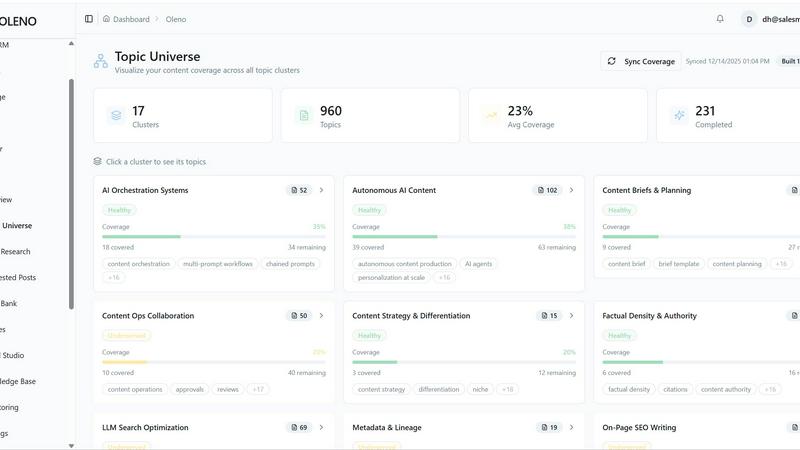
Visual Comparison
Oleno
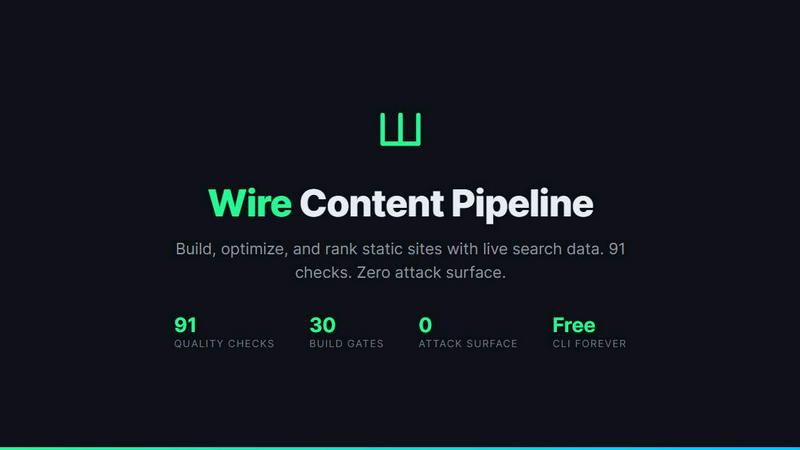
Wire
Feature Comparison
Oleno
Autonomous Workflow Automation
Oleno automates the entire content creation process, from initial topic discovery to final publication. This eliminates manual tasks, streamlining workflows and enabling marketing teams to focus on strategic initiatives rather than mundane coordination.
Dual-Surface Visibility
The platform is designed to produce search-optimized content that ranks well on search engines while also ensuring that the information is structured for citation by Large Language Models. This dual focus maximizes content visibility and utility across various platforms.
Comprehensive Content Operations
Oleno integrates all aspects of content operations into a single system. This includes scoring, drafting, quality assurance, and distribution, ensuring that there are no handoffs or gaps between different stages of content creation, which enhances efficiency and consistency.
Customizable Brand Studio
With Oleno's Brand Studio, users can define their brand's voice and positioning once, and the platform will enforce these elements across all content types. This ensures that all produced content is on-brand and aligns with the overall marketing strategy.
Wire
Integrated SEO & Content Pipeline
Wire consolidates the functions of keyword research tools, content optimizers, CMS platforms, and quality checkers into a single, automated command-line pipeline. It directly analyzes your Google Search Console data to find ranking opportunities, handles on-page optimization against a comprehensive rule set, generates the static site, and performs final verification—all in one sequential process. This eliminates the need for manual data transfer between platforms like Ahrefs, SurferSEO, and WordPress, ensuring actions are based on your actual performance data and executed consistently.
Autonomous AI Agent Protocol
The "Bot Protocol" allows you to configure an AI agent (using models like Claude) to operate your content site autonomously. Once set up with your styleguide and search data, the agent can continuously audit existing pages, rewrite underperforming content, integrate relevant news, manage internal linking, and deploy updates without manual intervention. This transforms AI from a one-off writing assistant into a fully operational, self-correcting content manager that works within the guardrails of Wire's strict quality enforcement system.
91-Point Pre-Publish Verification
Before any static site build is completed, Wire subjects every page to a battery of 91 automated checks. These rules cover critical areas including title tag length and alignment, content depth to prevent thin pages, internal link integrity, keyword cannibalization, AI writing pattern detection, and citation requirements. This system acts as a mandatory quality gate; if any check fails, the build is aborted. This ensures no warnings are ignored and only compliant, high-quality content is ever published.
Local-First Static Site Generation
All of Wire's processing occurs locally on your machine. Your search console data, content drafts, and final site never touch an external server, guaranteeing privacy and data ownership. The output is a static HTML site with no database or server-side runtime, drastically reducing the attack surface and complexity. This generated site can be deployed for free via services like GitHub Pages, or you can opt for Wire's managed service for hands-off hosting and operation.
Use Cases
Oleno
Scaling SEO Content Production
Oleno is ideal for B2B marketing teams needing to generate a high volume of search-optimized articles. The platform enables teams to efficiently produce content that not only ranks well but also drives organic traffic.
Thought Leadership Development
With its ability to incorporate a brand's point of view and industry insights, Oleno facilitates the creation of thought leadership content that distinguishes a brand in the marketplace and engages target audiences.
Customer Education Materials
Oleno allows teams to create comprehensive customer education resources, such as use case guides and case studies. This content builds trust with customers and enhances their understanding of the products and services offered.
Social Media Content Generation
The platform supports the creation of engaging social media content tailored for platforms like LinkedIn and X. Oleno ensures that the messaging aligns with the brand's voice and objectives, streamlining social media strategies.
Wire
Migrating from WordPress to a Static Stack
Teams burdened by WordPress hosting costs, plugin bloat, security vulnerabilities, and slow performance can use Wire to migrate their entire site. Wire can ingest existing content, reformat it, apply all SEO and quality checks, and output a clean, fast static version. This eliminates monthly hosting fees, reduces maintenance overhead, and improves site speed and security, all while automating ongoing SEO best practices that were previously managed manually via plugins like Yoast.
Scaling Content Production with AI Safely
Organizations using AI writers like ChatGPT or Claude to scale content creation face risks of inconsistent voice, SEO oversights, and quality decay. Wire provides the necessary governance: its styleguide enforces brand voice, its pipeline checks for SEO and cannibalization issues, and its verification layer blocks publication of low-quality or non-compliant output. This allows teams to safely scale AI-assisted writing while maintaining high editorial and technical standards.
Autonomous Site Maintenance and Recovery
For sites hit by Google algorithm updates or suffering from content decay, Wire enables automated recovery. An AI agent configured with the Bot Protocol can systematically audit the site against current search data, identify pages with title drifts, broken links, or stale content, and rewrite them to meet Wire's quality standards. This turns a typically manual, expensive recovery process into a continuous, automated maintenance operation.
Consolidating the SEO Tool Stack
Businesses spending hundreds to thousands monthly on separate tools for keyword research (Ahrefs/Semrush), content grading (Clearscope/Surfer), site crawling (Screaming Frog), and CMS hosting can replace them all with Wire. It provides integrated functionality for data analysis, optimization, and technical auditing in one tool, reducing costs and operational complexity while providing a single source of truth based on your actual search performance.
Overview
About Oleno
Oleno is an innovative autonomous content engine specifically designed to empower B2B marketing teams in achieving systematic organic growth. Unlike conventional AI writing tools, Oleno functions as a comprehensive, end-to-end system dedicated to demand generation. Its primary objective is to bridge the critical volume gap often encountered in content operations, allowing teams to address 100% of their strategic content backlog rather than just a fraction. Built with dual-surface visibility, Oleno generates content that is optimized for search engines like Google while also being structured for effective citation by advanced Large Language Models (LLMs) such as ChatGPT and Claude. The platform automates the entire content workflow, from topic discovery rooted in a brand’s own knowledge base and sitemap to drafting, quality assurance, and direct publication to Content Management Systems (CMS). This seamless process eliminates the need for manual coordination, prompt engineering, and template management, thus replacing a fragmented content operations stack with a unified, opinionated system that enhances both output quality and quantity.
About Wire
Wire is a comprehensive, local-first content operations CLI designed to replace and consolidate the entire modern SEO and publishing technology stack. It is engineered for technical marketers, content teams, and developers who manage content at scale and are frustrated by the cost, complexity, and data leakage of disparate SaaS tools. Wire's core value proposition is ownership, automation, and enforced quality. It operates by ingesting your proprietary Google Search Console data to identify genuine content gaps and underperforming pages, then uses AI (wrapped in strict governance layers) to rewrite and optimize content directly in your brand's voice. Crucially, it functions as a rigorous build system: every piece of content must pass 91 automated checks for SEO health, writing quality, and structural integrity before the static site is generated. If violations like thin content, title misalignment, or broken links are detected, the build fails outright, preventing substandard content from being published. This pipeline enables autonomous AI agents to safely manage a site—from audit and rewrite to deployment—while you retain full ownership of your data and output, which is compiled into secure, fast static HTML.
Frequently Asked Questions
Oleno FAQ
How does Oleno ensure content quality?
Oleno incorporates over 80 automated quality assurance checks to maintain high content standards throughout the production process. This rigorous QA system ensures that all published content is of superior quality.
Can Oleno adapt to different brand voices?
Yes, Oleno's Brand Studio allows users to define their brand's voice and positioning. Once set, these elements are consistently applied across all content types, ensuring alignment with brand identity.
Is Oleno suitable for small marketing teams?
Absolutely. Oleno is designed to help small marketing teams scale their content production efficiently. By automating many aspects of the workflow, it allows teams to produce high-quality content without the need for extensive resources.
How does Oleno handle topic discovery?
Oleno utilizes a brand's existing knowledge base and sitemap to discover relevant topics. This ensures that the content generated is aligned with the brand's expertise and market needs, maximizing relevance and impact.
Wire FAQ
How does Wire handle my Google Search Console data?
Wire requires read-only access to your Google Search Console data via an API key. This data is downloaded and processed entirely on your local machine; it is never sent to Wire's servers or any third party. The analysis identifies your pages that rank but have low click-through rates, pages that are losing traffic, and keywords you already rank for but lack dedicated content, providing a factual foundation for content updates grounded in your actual site performance.
What happens if my content fails one of the 91 checks?
The build process is designed to fail fast. If any page violates a rule—such as having a title outside the optimal character range, containing broken internal links, or being flagged for thin content—Wire will abort the static site generation entirely. It will provide a detailed error report specifying the file and the exact rule violated. You must fix the issue in the source content before Wire will proceed to publish, ensuring no substandard content is ever deployed.
Can I use Wire with any AI model?
Wire is designed to work with AI models via their API, with specific integration and prompting optimized for Anthropic's Claude model. The system's architecture—including the styleguide pre-prompt, deterministic auto-fix layers, and rule-based verification—is built around structured prompting. While it may be adaptable to other models with similar capabilities, its documented workflows and the Bot Protocol are specifically tailored for Claude to ensure reliable, high-quality output that aligns with its enforcement layers.
How does the "Bot Protocol" differ from just using ChatGPT?
Using ChatGPT or Claude interactively is a manual, session-based process with no memory of your site's full structure, existing content, or historical performance. The Bot Protocol configures an AI agent as an autonomous system operator. It has persistent access to your site's entire page graph, your search console data, and your styleguide. It can make planned, site-wide decisions—like updating internal links after a rewrite or identifying cannibalization—and execute them through Wire's pipeline, which is impossible with a standard chat interface.
Alternatives
Oleno Alternatives
Oleno is an autonomous content engine designed specifically for B2B marketing teams aiming for systematic organic growth. As a comprehensive solution within the SEO category, it excels in generating on-brand, programmatic content at scale, streamlining the content creation process from topic discovery to publication. Users often seek alternatives to Oleno due to various factors such as pricing, specific feature sets, or unique platform requirements that may not align with their operational needs. When evaluating alternatives, it's essential to consider the automation capabilities, quality assurance processes, and the ability to integrate with existing content management systems to ensure a seamless workflow and effective demand generation.
Wire Alternatives
Wire is a content operations CLI tool that consolidates the SEO and publishing stack into a single, locally-executed pipeline. It belongs to the technical SEO and content automation category, designed for users who prioritize data privacy, automation, and a unified workflow over disparate SaaS tools. Users may seek alternatives to Wire for various reasons. These include budget constraints requiring a different pricing model, the need for specific integrations not supported, or a preference for a cloud-based graphical interface over a command-line tool. Some organizations may also require less stringent publishing controls or a different deployment methodology. When evaluating alternatives, key considerations should include the core capabilities offered, such as automated SEO audits, content optimization, and static site generation. Other critical factors are data handling policies, the required technical expertise for setup and maintenance, the total cost of ownership, and the flexibility of the publishing and enforcement workflow to match team processes.