Playwriter vs qtrl.ai
Side-by-side comparison to help you choose the right tool.

Playwriter
Playwriter lets AI agents control your existing Chrome browser with full Playwright API access via a simple CLI.
Last updated: March 18, 2026

qtrl.ai
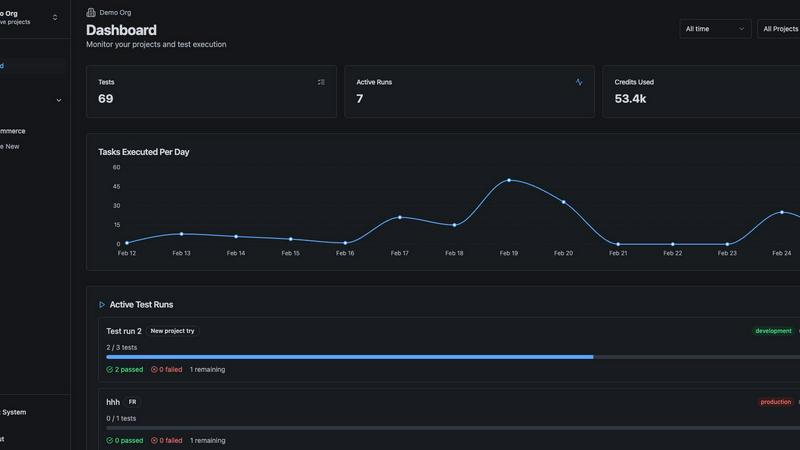
qtrl.ai empowers QA teams to scale testing with AI while maintaining control, governance, and seamless integration.
Last updated: March 4, 2026
Visual Comparison
Playwriter

qtrl.ai
Feature Comparison
Playwriter
Your Authenticated Browser Session
Playwriter's foundational feature is granting AI agents access to your actual Chrome browser tab, complete with all existing logins, cookies, local storage, and installed extensions. This eliminates the need for agents to navigate authentication flows manually, bypasses bot detection mechanisms triggered by fresh, headless instances, and ensures the browsing context is identical to a human user's. It also avoids the memory overhead of spawning a separate browser process, as the automation occurs within your already-running Chrome instance.
Full Playwright API via a Single Execute Tool
Unlike systems that define dozens of individual tools (e.g., click_element, extract_text), Playwriter provides agents with one powerful execute tool. This tool accepts any valid Playwright code, granting the agent unrestricted access to the entire Playwright API for browser control. This approach minimizes context window bloat from extensive tool schemas and offers maximum flexibility, allowing agents to perform complex sequences, use advanced selectors, handle frames, and manage dialogs without being constrained by a pre-defined wrapper.
Advanced Debugging and Inspection Suite
Playwriter includes a comprehensive suite of debugging and inspection utilities designed for AI-driven development. This includes a debugger with breakpoints to pause execution, live code editing to modify agent scripts on the fly, and network interception to monitor and mock HTTP requests. Furthermore, it generates highly efficient accessibility snapshots (5-20KB) instead of full screenshots, providing the AI with structured DOM and ARIA data in a compact format, and supports full screen recording of agent sessions for playback and analysis.
Local-First Architecture and Collaboration
The entire Playwriter system runs locally on your machine. The Chrome extension connects to a local WebSocket server (default localhost:19988), and all communication—including Chrome DevTools Protocol commands—stays on your computer. This enables real-time collaboration: you can watch the agent interact with websites live, intervene to solve CAPTCHAs or consent modals, manually correct issues, and then re-enable agent control. The session multiplexing allows multiple CLI instances or agents to interact with different browser tabs simultaneously.
qtrl.ai
Autonomous QA Agents
qtrl.ai's autonomous QA agents are designed to execute instructions on demand or continuously, enabling teams to run tests across multiple environments at scale. These agents operate within predefined rules to ensure compliance and quality, conducting real browser executions instead of relying on simulations. This feature allows teams to maintain a high degree of control while benefiting from automation.
Enterprise-Grade Test Management
The platform provides a centralized system for managing test cases, plans, and execution runs. With full traceability and audit trails, teams can easily track their testing efforts, ensuring transparency and accountability. This feature supports both manual and automated workflows, making it ideal for organizations that prioritize compliance and auditability in their QA processes.
Progressive Automation
qtrl.ai implements a progressive automation approach that allows teams to start with human-written instructions and gradually transition to AI-generated tests. This feature includes intelligent suggestions for new tests based on existing coverage, ensuring that teams can continuously improve their testing processes. Review, approval, and refinement are integral to every step, providing teams with the flexibility to control their automation journey.
Adaptive Memory
The adaptive memory feature builds a living knowledge base of the application by learning from exploration, test execution, and identified issues. This capability powers smarter, context-aware test generation, making the testing process more effective with every interaction. As teams engage with the platform, it becomes increasingly adept at understanding application behavior, resulting in more accurate and efficient testing.
Use Cases
Playwriter
AI-Powered Web Research and Data Extraction
Agents can autonomously conduct in-depth research across multiple websites that require login, such as private forums, subscription news services, or web applications. Using your authenticated session, the agent can navigate complex site structures, handle pagination, consent pop-ups with your assistance, and extract structured data using the full Playwright API, all while operating within your real browser context to avoid blocks.
Automated Testing and QA with Real User Conditions
Developers and QA engineers can use Playwriter to instruct AI agents to perform end-to-end testing on web applications under genuine user conditions. Since the agent uses your browser with your specific extensions and cache, tests can cover scenarios like "user is logged in with specific preferences" or "with ad-blocker enabled," providing more accurate and realistic test results than isolated, clean browser environments.
Complex Workflow Automation and Web Task Delegation
Playwriter enables the delegation of tedious, multi-step web tasks to AI agents. This includes activities like filling and submitting complex forms across several pages, managing content in web admin panels (e.g., CMS updates), monitoring dashboards for changes, or orchestrating workflows that involve moving data between different web services that you are already logged into.
AI-Assisted Development and Debugging
Developers can use Playwriter as a pair-programming tool for web development. An AI agent can be instructed to interact with a web application you are building, profile performance, test specific user journeys, set breakpoints in the automation script, intercept network calls to debug API interactions, and generate visual labels or snapshots to help identify UI elements, all within your development browser.
qtrl.ai
Product-Led Engineering Teams
For product-led engineering teams, qtrl.ai offers a robust framework to manage and scale quality assurance practices without losing oversight. With its AI-driven automation, these teams can accelerate their development cycles while maintaining high-quality standards, ensuring that new features are rigorously tested before release.
QA Teams Scaling Beyond Manual Testing
QA departments transitioning from manual testing to automated solutions find qtrl.ai particularly valuable. The platform supports a gradual shift to automation, allowing teams to begin with manual test management before incorporating AI-generated tests. This empowers QA teams to enhance their productivity and coverage without compromising control.
Companies Modernizing Legacy QA Workflows
Organizations looking to modernize outdated QA workflows can leverage qtrl.ai to integrate advanced test management and automation capabilities. The platform's flexibility allows companies to adopt new testing methodologies while ensuring compliance and traceability, ultimately improving the efficiency of their QA processes.
Enterprises Requiring Governance and Traceability
For enterprises that necessitate strict governance and audit trails in their QA processes, qtrl.ai provides the necessary tools to maintain visibility and control. The platform's comprehensive test management features and adaptive memory capabilities ensure that all testing activities are documented and traceable, meeting the demands of regulatory compliance.
Overview
About Playwriter
Playwriter is a developer-centric tool that provides AI agents with direct, programmatic control over your existing, authenticated Chrome browser session. It solves the fundamental limitation of most browser automation tools for AI, which either spawn a fresh, "clean" browser instance (lacking logins, cookies, and extensions while triggering bot detection) or offer a limited, pre-defined set of actions. Playwriter bridges this gap by exposing the full power of the Playwright automation API to AI agents through a single, unified interface. It operates via a Chrome extension and a local CLI, establishing a WebSocket relay on your machine. This architecture allows agents to execute any Playwright code directly in your browser, leveraging your real sessions, installed extensions, and local settings. Its core value proposition is enabling robust, realistic, and collaborative web automation where the AI handles repetitive tasks within the exact same browser environment a human uses, facilitating seamless human-in-the-loop workflows. It is open-source under the MIT license and integrates with any MCP (Model Context Protocol) client like Cursor, Claude Desktop, and VS Code.
About qtrl.ai
qtrl.ai is an advanced quality assurance (QA) platform designed to streamline and enhance software testing processes for teams of all sizes. By integrating enterprise-grade test management with sophisticated AI-driven automation, qtrl.ai provides a comprehensive solution that empowers software teams to scale their QA efforts effectively without sacrificing control or governance. This platform serves a diverse range of users, including product-led engineering teams, QA departments transitioning from manual testing, organizations modernizing outdated workflows, and enterprises that require strict compliance and traceability. At its core, qtrl.ai offers a centralized hub for organizing test cases, planning test runs, tracing requirements to coverage, and tracking quality metrics through real-time dashboards. Its intelligent automation features enable teams to incrementally adopt AI-driven testing solutions, ensuring that they maintain oversight and control while enhancing their testing capabilities. Ultimately, qtrl.ai's mission is to bridge the gap between the traditional slow pace of manual testing and the complex nature of conventional automation, delivering a reliable pathway to faster and more intelligent quality assurance.
Frequently Asked Questions
Playwriter FAQ
How does Playwriter differ from other browser automation MCP servers?
Other MCP solutions typically either launch a new, isolated Chrome instance (lacking your logins and extensions) or provide a limited set of hard-coded tools. Playwriter is unique because it injects automation into your existing, live Chrome session and provides a single, unrestricted execute tool for the full Playwright API. This combines real-world browser context with maximum programming flexibility for the AI agent.
Is my browsing data secure with Playwriter?
Yes. Playwriter operates on a strict local-first principle. The Chrome extension communicates only with a WebSocket server running on localhost (port 19988 by default). All commands and data, including Chrome DevTools Protocol traffic, remain on your machine. No browsing data, cookies, or session information is transmitted to any remote server. The tool is also open-source, allowing for code audit.
What happens if the agent encounters a CAPTCHA or needs a human decision?
This is a key collaborative feature of Playwriter. Since you are sharing your browser, you see the agent's actions in real-time. If a CAPTCHA or a consent wall appears, you can simply solve or click it yourself. You can then temporarily disable the extension on that tab, perform any necessary manual steps, re-enable control, and the agent can continue its automated task from the new state.
Can I use Playwriter with multiple browser tabs or multiple AI agents simultaneously?
Yes. The local WebSocket relay multiplexes sessions. You can attach the Playwriter extension to multiple Chrome tabs, each representing a separate controllable session. Multiple CLI instances or AI agents (via MCP) can connect to the relay and control different tabs independently, allowing for parallel automation tasks within a single browser window.
qtrl.ai FAQ
How does qtrl.ai ensure the quality of AI-generated tests?
qtrl.ai ensures the quality of AI-generated tests by implementing a review and approval process. Teams can assess suggested tests based on coverage and context, allowing for refinement before execution. This oversight minimizes the risks associated with automated testing.
Can qtrl.ai integrate with existing CI/CD pipelines?
Yes, qtrl.ai supports integration with existing CI/CD pipelines. This capability allows teams to seamlessly incorporate quality assurance into their development workflows, facilitating continuous quality feedback loops and improving overall efficiency.
What types of environments can qtrl.ai run tests in?
qtrl.ai can execute tests across various environments, including development, testing, staging, and production. The platform allows for per-environment variables and encrypted secrets, ensuring secure and consistent test execution across all stages of the application lifecycle.
Is there support available for new users of qtrl.ai?
Yes, qtrl.ai provides comprehensive support for new users, including documentation, tutorials, and customer assistance. This ensures that teams can effectively utilize the platform's features and maximize their quality assurance efforts from the outset.
Alternatives
Playwriter Alternatives
Playwriter is an open-source automation tool that provides AI agents with direct, stateful control over a real Chrome browser session. It belongs to the browser automation and AI agent tooling category, enabling complex workflows via CLI or the Model Context Protocol (MCP). Users often seek alternatives for various reasons, including specific budget constraints, the need for different integration points like Selenium or Playwright frameworks, or requirements for non-Chrome browser support or cloud-based execution. When evaluating alternatives, key considerations include the depth of browser integration, whether the solution provides a fresh, isolated session or access to an authenticated one with extensions, and the method of data exchange with the AI. The efficiency of state capture, such as using lightweight accessibility snapshots versus full screenshots, significantly impacts performance and cost. Security model, licensing, and support for debugging features like network interception and breakpoints are also critical differentiators. --- FAQ_SEPARATOR--- [
{"question": "What is Playwriter?", "answer": "Playwriter is an open-source (MIT licensed) tool that allows AI agents to control a real, authenticated Chrome browser session via CLI or the Model Context Protocol (MCP), providing full automation capabilities."},
{"question": "Who is Playwriter for?", "answer": "It is for developers and teams building AI agents that require reliable, stateful web interaction using an existing browser session with logins and extensions, rather than a fresh, isolated instance."},
{"question": "Is Playwriter free?", "answer": "Yes, Playwriter is open source and released under the permissive MIT license, making it free to use and modify."},
{"question": "What are the main features of Playwriter?", "answer": "Key features include automation via a real Chrome session, compact accessibility snapshots, a debugger with breakpoints and live editing, network interception, video recording, and compatibility with any MCP client."}
]
qtrl.ai Alternatives
qtrl.ai is a modern quality assurance (QA) platform that enables software teams to enhance their testing processes through AI-driven automation while maintaining full control and governance. By combining enterprise-grade test management with intelligent automation, qtrl.ai provides a centralized hub for organizing test cases, planning runs, and tracking quality metrics, making it particularly appealing to product-led engineering teams and companies seeking to modernize their QA workflows. Users often search for alternatives to qtrl.ai due to various reasons, including pricing, specific feature requirements, or compatibility with existing platforms. When selecting an alternative, it's essential to consider factors such as the level of automation offered, ease of integration with current systems, user experience, and the ability to maintain compliance and governance standards. Finding a solution that aligns with your team's needs is crucial for effective quality assurance.