RocketShare vs Website-Blocker
Side-by-side comparison to help you choose the right tool.

RocketShare
RocketShare provides secure, zero-knowledge encrypted file sharing where only you control access.
Last updated: March 4, 2026

Website-Blocker
Website-Blocker is a cloud-synced parental control extension that blocks harmful sites and manages screen time.
Last updated: March 1, 2026
Visual Comparison
RocketShare
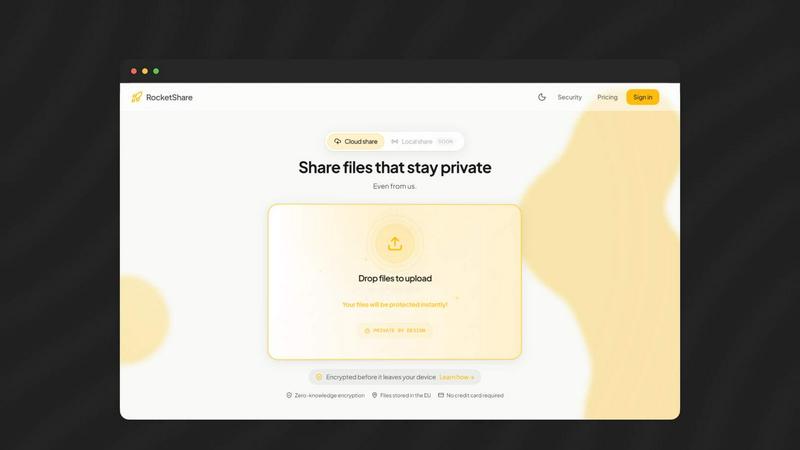
Website-Blocker

Feature Comparison
RocketShare
Zero-Knowledge, End-to-End Encryption
RocketShare implements a true zero-knowledge encryption model where files are encrypted locally on the sender's device using strong cryptographic standards before upload. The platform's servers never receive or have access to the unencrypted data or the decryption keys. This means that even in the event of a server breach, the encrypted data remains computationally infeasible to decipher. The decryption key is typically part of the shareable URL, granting access only to intended recipients with the complete link.
Dual Sharing Modes: Cloud and Local (P2P)
The platform provides two technical methodologies for file transfer. The Cloud Share mode uploads encrypted files to secure, EU-based data centers for persistent, time-limited access. The Local Share (peer-to-peer) mode establishes a direct, encrypted connection between the sender's and recipient's devices for the transfer, with files never stored on RocketShare's servers. This P2P option is ideal for transient data exchange where cloud persistence is not required.
EU-Based Data Sovereignty
For cloud-based transfers, all encrypted file data is stored exclusively on servers located within the European Union. This provides users with the legal and regulatory assurances associated with EU data protection jurisdiction, including adherence to the General Data Protection Regulation (GDPR) framework for data handling and storage practices.
No-Account Required File Sharing
RocketShare operates on a frictionless, self-serve model that does not mandate account creation for basic file sending. Users can initiate secure transfers immediately without providing personal information or payment details. This reduces barriers to adoption while maintaining full security, as the encryption process is device-based and independent of user authentication on the platform's servers.
Website-Blocker
Cloud-Powered Synchronization & Management
The platform's foundation is its secure cloud backend. All blocking rules, schedules, and settings are stored centrally and synchronized in real-time across every installed browser extension. Management is performed through an intuitive cloud portal or the companion PWA mobile application, allowing administrators to remotely update policies, monitor status, and gain usage insights from any location. This architecture guarantees that a rule created on one device is instantly propagated to all others, ensuring unwavering policy enforcement without manual device-by-device configuration.
Granular Blocking with Category & URL Filters
Website-Blocker provides multi-layered filtering for precise control. Users can block individual websites by entering specific URLs or domain names. For broader, more efficient control, the solution includes category-based blocking, enabling the instant restriction of entire groups of websites (e.g., social media, gaming, adult content) with a single action. This dual approach allows for both targeted restriction of known problematic sites and proactive filtering against entire classes of distracting or inappropriate content.
Advanced Scheduling & Timer-Based Access
Beyond simple blocking, the tool enables sophisticated time management. Users can implement recurring daily or weekly schedules to define permitted browsing hours for specific sites or categories. Complementing this is a precise timer-based browsing feature, which allows access to a selected website only for a pre-set duration. Once the timer expires, access is automatically revoked. These features are essential for enforcing structured screen time limits and promoting disciplined, focused work or study sessions.
Password Protection & Custom Redirects
To ensure the integrity of the configured controls, all administrative settings are protected by a secure master password. This prevents unauthorized users from altering block lists, schedules, or disabling the extension. Furthermore, when a website is blocked, administrators can utilize the custom redirect feature. Instead of displaying a standard error page, blocked attempts can be redirected to a user-defined page, such as a productivity reminder, an educational alternative, or a family-friendly search portal, turning a restriction into a positive reinforcement opportunity.
Use Cases
RocketShare
Legal Document Exchange
Law firms and legal professionals can securely share sensitive case files, contracts, deposition transcripts, and client communications. The zero-knowledge architecture ensures attorney-client privilege and work-product doctrine protections are technically enforced, as no third party can intercept or access the confidential materials during transfer or storage.
Healthcare Data Transmission
Medical practices, therapists, and healthcare administrators can use RocketShare to exchange protected health information (PHI), patient records, lab results, and imaging files in compliance with stringent regulations like HIPAA. The platform's encryption and EU data storage provide a robust technical safeguard for patient privacy.
Creative Asset Delivery
Photographers, videographers, and design agencies can deliver high-resolution client galleries, raw footage, and creative proofs. The ability to send files of any size, coupled with guaranteed privacy, protects intellectual property and ensures only paying clients access the final deliverables via the unique, key-embedded link.
Confidential Corporate Collaboration
Teams working on proprietary projects, financial reports, merger & acquisition documents, or source code can collaborate securely. The local P2P sharing option is particularly valuable for transferring draft documents or sensitive data between team members without creating a cloud-based copy, minimizing the digital footprint.
Website-Blocker
Parental Control & Child Digital Safety
Parents can deploy Website-Blocker to create a safe online environment for their children. By blocking access to inappropriate content categories and specific risky websites, they can shield children from harmful material. Simultaneously, parents can set enforceable screen time schedules for gaming or social media and use timer-based limits for educational sites to prevent overuse. The cloud sync ensures these protections are active on the child's laptop, desktop, and any other device where the extension is installed.
Individual Productivity & Focus Enhancement
Professionals, freelancers, and students utilize the tool to eliminate self-inflicted digital distractions. By blocking social media, news, and entertainment sites during work or study hours using recurring schedules, users can maintain deep focus. The timer-based feature is particularly useful for allowing short, controlled breaks on specific sites without the risk of losing track of time, thereby combating procrastination and improving overall time management and output quality.
Managed Device Access in Educational Settings
Educators and administrators in schools or libraries can use the cloud management portal to configure standardized browsing policies across multiple devices. They can block distracting websites and games on classroom computers while allowing access to educational resources. The scheduling feature can ensure these restrictions are only active during school hours, and the password protection prevents students from circumventing the rules, maintaining a conducive learning environment.
Family-Wide Digital Wellbeing & Routine Enforcement
Families can adopt Website-Blocker to establish and enforce healthy digital habits for all members. Parents can set household rules, such as "no social media after 9 PM" or "one hour of gaming per day," applied consistently across everyone's devices. The custom redirect can point to a family activity board or reading list. This centralized management fosters shared accountability and helps the entire family disconnect and engage in offline activities according to a agreed-upon routine.
Pricing Comparison
RocketShare
The provided context indicates that specific pricing plans, tiers, or costs are not detailed in the available material. The website highlights a "No credit card required" approach for initial use, suggesting a possible freemium model or free tier for basic services. For detailed, current pricing information regarding premium features, storage limits, or team plans, users are directed to visit the official RocketShare website and navigate to its dedicated "Pricing" section.
Website-Blocker
Website-Blocker operates on a freemium model. Users can start with a free account that provides essential website blocking and scheduling functions. For advanced protection and parental controls, the Gold Plan is available starting at $7.50 per month. This premium tier includes access to all advanced features: category-based blocking, custom redirects, password protection for settings, comprehensive cloud portal and PWA management, and usage insights. Users can install the extension and begin with the free tier, upgrading to the Gold Plan at any time directly from within the extension or client area.
Overview
About RocketShare
RocketShare is a secure file-sharing platform engineered to provide absolute data privacy through a zero-knowledge encryption architecture. The core operational principle is that user privacy is non-negotiable; the platform is designed so that no entity, including RocketShare's own administrators, can access the content of shared files. This is achieved by performing client-side encryption on the user's device before any data is transmitted. The encryption keys remain solely with the user, often embedded directly within the shareable link, ensuring servers only process cryptographically secure, unreadable data. The platform supports the transfer of files of any size and offers two distinct sharing modalities: cloud-based storage with data housed in EU-based facilities, and a local, peer-to-peer transfer option that minimizes data persistence. Targeted at professionals and organizations handling sensitive information, RocketShare delivers enterprise-grade security within a self-serve, user-friendly interface. Its value proposition is providing top-tier cryptographic security without compromising on simplicity, making robust privacy accessible for legal, creative, healthcare, and corporate sectors.
About Website-Blocker
Website-Blocker is a comprehensive, cloud-synchronized digital management platform engineered as a browser extension for Chrome, Edge, and Firefox. It functions as a dual-purpose tool for both advanced parental control and individual productivity enhancement. The core architecture integrates a browser extension with a secure cloud portal and a Progressive Web App (PWA), creating a multi-device ecosystem. This system provides granular control over internet access, enabling users to block specific URLs, implement category-based filtering, and enforce custom browsing schedules with timer-based or recurring time windows. The primary value proposition is its real-time synchronization; all configuration settings, block lists, and schedules are stored and managed centrally in the cloud. This ensures consistent policy enforcement and remote management capabilities across all supervised devices, whether at home or on the go. Designed for parents seeking to safeguard children from harmful content and manage screen time, as well as for professionals and students aiming to eliminate digital distractions, Website-Blocker delivers a robust, scalable solution for digital safety and focused habit formation.
Frequently Asked Questions
RocketShare FAQ
How does zero-knowledge encryption work on RocketShare?
Zero-knowledge encryption means the encryption and decryption processes occur exclusively on user devices. When you upload a file, the RocketShare client application on your computer or browser encrypts it using a strong, randomly generated key before it leaves your system. This key is not sent to RocketShare. The encrypted data is then transmitted to our servers. The decryption key is typically appended to the shareable link. Only someone with the full link possesses the key needed to decrypt the file, and this decryption happens locally on the recipient's device.
Where are my files stored?
For files sent via the Cloud Share option, the encrypted data is stored on secure servers located within the European Union. We do not utilize or replicate data to servers outside the EU. For files sent via the Local Share (peer-to-peer) option, the files are never stored on our servers; they are transferred directly between the devices of the sender and recipient over an encrypted channel.
Can RocketShare access or view my files?
No. Under no circumstances can RocketShare or its personnel access the content of your files. The cryptographic design ensures we only handle encrypted data blobs. We do not possess the encryption keys required to decrypt them. This architecture is fundamental to our service and is technically enforced.
Is there a file size limit for transfers?
RocketShare is designed to send files of any size. The platform does not impose artificial caps on file dimensions for its core transfer functionality. Performance will be subject to the sender's and recipient's respective network bandwidth and connectivity, especially for very large files or when using the Local Share mode.
Website-Blocker FAQ
On which browsers and devices does Website-Blocker work?
Website-Blocker is engineered as a browser extension compatible with Google Chrome, Microsoft Edge, and Mozilla Firefox. Its cloud-synchronized architecture means settings configured via the online portal or PWA app are enforced on any device where the extension is installed and logged into the same account. This provides cross-platform control across Windows, macOS, and ChromeOS desktops/laptops.
How does the cloud synchronization work?
The extension communicates with Website-Blocker's secure cloud servers. When you create or modify a blocking rule, schedule, or setting in the web portal or mobile PWA, that change is immediately pushed to our cloud database. Each installed extension periodically checks in with the cloud server and downloads the latest configuration, applying it locally within seconds. This ensures real-time policy updates and consistent management across all endpoints.
Can the blocked settings be bypassed or uninstalled by a child?
The extension incorporates several security measures to prevent circumvention. Administrative functions, including disabling the extension, modifying settings, or uninstalling it, are protected by a master password set by the parent or administrator. Furthermore, the extension is designed to resist simple removal attempts by non-admin users on managed devices, providing a robust layer of enforcement for parental controls.
What is the difference between the free and Gold Plan?
The free tier offers core website blocking and basic scheduling capabilities. Upgrading to the Gold Plan (starting at $7.50/month) unlocks advanced features including category-based blocking for efficient filtering of entire website types, custom redirects to guide users to alternative pages, password protection for settings, full access to the cloud management portal and PWA for remote control, and detailed usage insights to monitor browsing activity across protected devices.
Alternatives
RocketShare Alternatives
RocketShare is a secure file-sharing and collaboration platform within the productivity and management software category. It distinguishes itself through a strict zero-knowledge encryption model, ensuring that all file data is encrypted client-side before upload, making it inaccessible to the service provider itself. Users may seek alternatives to RocketShare for various reasons, including specific budget constraints, the need for integrated collaboration features like real-time document editing, or requirements for different deployment models such as on-premises solutions. Platform compatibility, storage limits, and administrative control levels are also common decision factors. When evaluating an alternative, key technical criteria include the encryption standard employed (e.g., AES-256), the jurisdiction of data storage, the availability of client-side encryption, and the granularity of user permission controls. The chosen solution should align with both the operational workflow and the specific compliance or security mandates of the user or organization.
Website-Blocker Alternatives
Website-Blocker is a cloud-synchronized parental control and productivity management solution, operating as a browser extension for Chrome and Edge. It provides granular website blocking and scheduling to safeguard children and enhance focus. Users may seek alternatives for various reasons, including budget constraints, the need for different feature sets like application-level control, compatibility with other operating systems or browsers, or a preference for different management interfaces such as standalone desktop applications. When evaluating alternatives, key considerations should include the scope of blocking capabilities, the sophistication of scheduling and timer functions, cross-platform and multi-browser support, the security of the management console, and the reliability of synchronization across devices. The chosen solution must align with the specific technical requirements for digital safety or productivity enforcement.